Japanese Futon and the Art of Sleeping on the Floor
· 11 min read
A Japanese futon is a foldable mattress set that turns one small room into a bedroom at night and a living room by day. Here is how it works, where it came from, and why it still makes sense.
Every evening in millions of Japanese homes, a bedroom appears out of nowhere. A folded mattress comes out of a closet, a duvet is shaken open, a small pillow is set at one end, and a room that served as a living space all day becomes a place to sleep. In the morning the whole thing disappears again. That is the daily life of a Japanese futon, and it has worked this way for centuries.
A Japanese futon is not a sofa bed, and it is not a thin camping mat. It is a proper bedding set, designed to be laid on the floor each night and put away each morning. The system is simple, it saves space, and once you have slept on one in a quiet inn, a raised bed can start to feel like an unnecessary piece of furniture.
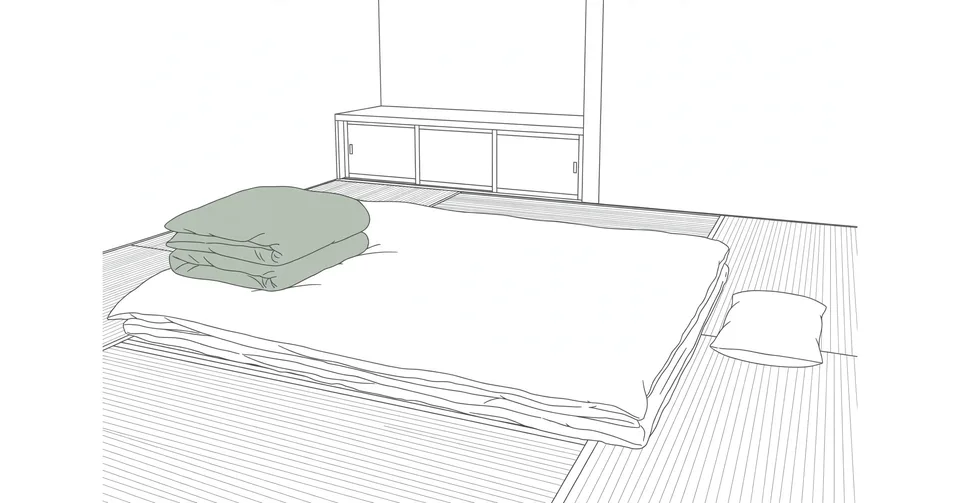
The first surprise for most visitors is how comfortable the setup is. The mattress is firm, the floor feels warm under tatami, and the room feels larger without a bed frame taking up the middle of it. The second surprise is how much care the system asks of you. A Japanese futon needs air, sun, and a short daily routine, and that routine is part of the point rather than a flaw in the design.
What a Japanese futon actually is
A complete Japanese futon set has three parts, and each one has its own name and job. The mattress is the shikibuton, the duvet is the kakebuton, and the pillow is the makura. Together they form a bed that can be folded, carried, and stored in a closet, which is exactly what a small Japanese home needs.
| Part | Japanese name | What it does |
|---|---|---|
| Mattress | shikibuton | The firm padded base, laid directly on the floor |
| Duvet | kakebuton | The quilted cover that keeps you warm at night |
| Pillow | makura | Traditionally filled with buckwheat hulls |
The shikibuton is usually 5 to 8 centimetres thick, filled with cotton or a modern synthetic filling, and firm enough that you feel supported rather than sunk. The kakebuton is lighter and looser, more like a duvet than a blanket, and it changes with the seasons. A heavy winter kakebuton and a thin summer one are two different pieces of bedding, and many households own both. The traditional pillow is filled with buckwheat hulls, which shift under your head and rustle softly when you move. It feels strange on the first night and oddly right by the third.
Underneath it all sits tatami, the woven rush grass mat that covers the floor of a traditional Japanese room. Tatami gives a slight softness under the mattress, and it helps regulate humidity in a way a bare wooden floor does not. Each mat can absorb and release up to half a litre of moisture, which matters in a country where summer humidity is a daily fact of life. A Japanese futon on tatami is a small system, and every part of it is doing quiet work.
Where the Japanese futon came from
Sleeping on padded bedding laid on the floor has roots that stretch back centuries in Japan, but the Japanese futon as most people know it today became common during the Edo period, from 1603 to 1868. Before cotton became widely available, commoners slept on straw mats with a simple blanket, or on kami busuma, stitched paper bedding stuffed with fibres from beaten straw, cattails, or silk waste. The wealthy used padded bedding much earlier, from the Heian period onward, but it was a luxury, not a household standard.
Cotton changed that. As domestic cotton production expanded during the Edo period, padded bedding became affordable for ordinary households, and the futon spread through the country. The format fitted homes that were already built around flexible rooms. A traditional Japanese room was never meant to serve one purpose all day. It was a living room, a dining room, and a bedroom in turn, and the bedding had to disappear in the morning so the room could change its job. The Japanese futon was the answer, and it stayed the dominant sleeping arrangement in Japan well into the twentieth century. Western style beds only became a mainstream alternative in the postwar decades, and even today many households keep a futon set for guests, for the tatami room, or for the sheer habit of it.
There is a practical logic here that goes beyond tradition. Japan's homes have always been small by Western standards, and a bed that folds into a closet is a bed that gives you your room back every morning. The Japanese futon is not a compromise made for lack of space. It is a design that treats space as something to be used twice.
The morning routine that keeps a Japanese futon fresh
A Japanese futon asks for a little work every day, and the work is simple. In the morning, the bedding is folded and stored in a large closet called an oshiire, and the room returns to being a living space. On a sunny day, the mattress goes out to air. Across Japan, futons can be seen hanging over balcony railings in the morning sun, and the sight is so common that nobody thinks twice about it.
Airing is not a quaint custom. It is maintenance. A mattress that lies directly on the floor collects moisture from the body overnight, and without sun and airflow it will grow damp, heavy, and eventually mouldy. Sunlight and fresh air keep the filling dry and discourage dust mites, which is why airing is treated as an essential chore rather than an optional one. Traditional households also beat the mattress with a bamboo stick called a futon tataki to keep the filling fluffy, and modern homes often use a futon dryer, a small machine that blows warm air through the bedding when the weather is too wet to hang it outside.
The routine takes only a few minutes, and it builds a small rhythm into the day. You lay the bed out at night and put it away in the morning, and the act itself marks the change between rest and activity. I have come to like that about the Japanese futon. A bed that stays made all day never asks you to notice it. A futon asks you to handle it twice a day, and that handling keeps the bedding fresh in a way a stationary mattress never quite manages.
Why tatami matters
It is hard to talk about a Japanese futon without talking about the floor underneath it. Tatami mats are made of woven rush grass over a rice straw core, and each mat measures about one by two metres, roughly the size of a Western twin bed. Rooms in Japan are still measured in tatami mats, which is why you will hear a room described as six mats or eight mats rather than in square metres.
Tatami does three things for a Japanese futon. It cushions the mattress slightly, it absorbs moisture and releases it slowly, and it gives the room its smell, a faint grassy scent that is one of the first things you notice when you step into a traditional room. Sleeping on a Japanese futon laid on a hard wooden floor is possible, and some people do it, but the tatami underneath is part of the experience. It is also why the futon system and the tatami room grew up together. One without the other is only half the idea. If you want the full picture, the story of how tatami still sets the measure of a Japanese room is worth reading alongside this one.
The Western futon is a different thing
Visitors from outside Japan often arrive with the wrong picture in mind, because the word futon means something else in the West. In the late 1960s, an American furniture designer named William Brouwer pioneered the Western futon, a folding sofa bed built on a wooden or metal frame. It became popular in student flats and small apartments, and the name stuck.
A Japanese futon has no frame at all. It rests directly on tatami or a wooden floor, and it is designed to be folded and stored away, not to convert into a sofa. The two share a name and a spirit, both are about making a small space do more, but they are different objects. If you buy a futon frame abroad and expect the Japanese experience, you will be disappointed. The real thing is simpler, flatter, and firmer, and it comes with a closet rather than a frame. The history of the futon on Wikipedia draws the line between the two clearly, and it is worth a read before you go shopping.
Sleeping on a Japanese futon as a visitor
The easiest way to try a Japanese futon is to stay in a ryokan, one of Japan's traditional inns. In most ryokan, the futon is laid out while you are eating dinner, so you return to your room to find the bed already made, the duvet folded back, and a small sweet waiting on the tray. It is one of the quiet pleasures of staying in a traditional inn, and it is usually followed by a long soak in the bath, since most ryokan are built around hot springs that are a way of life in Japan.
A few practical notes help on the first night. The mattress is firmer than most Western beds, so give it a night before deciding you hate it. Most people adjust by the second night, and some never want to go back. Getting up from the floor takes a little more effort than rolling out of a raised bed, which is worth remembering if your knees complain in the morning. In winter, ask for an extra kakebuton rather than turning the heating up. The extra layer is warmer, quieter, and cheaper, and it is what the inn expects you to ask for. A good guide to why many Japanese still sleep on the floor covers the same ground from a resident's point of view, including the folding routine and the daily airing.
If you are thinking of buying a Japanese futon for your own home, start with a proper shikibuton, not a cheap imitation. A real one is thick enough to protect your hips and shoulders from the floor, and it should come with a washable cover. You will also need somewhere to store it during the day, or at least a place to air it. A futon left unfolded on the floor all day will grow damp, and a damp futon is a short lived one. The system only works if you work with it.
A small room, used twice
The Japanese futon survives because it solves a real problem with grace. It gives a small room two lives, one by day and one by night, and it asks only a few minutes of care in return. It is old without being outdated, simple without being crude, and comfortable without needing a frame, a headboard, or a box spring.
I think that is why it still appeals to people far from Japan. The futon is not really about sleeping on the floor. It is about a house that changes shape with the day, and a bed that knows when to disappear. A room that can be a living room in the morning and a bedroom at night is a room that is used properly, and a Japanese futon is the small, foldable machine that makes it possible.
More in Life & Style
- A Tanzen Is the Full Length Robe Japan Wears Indoors in Deep Winter
- A Hanten Is the Winter Jacket Japan Wears to Work
- A Hibachi Carries the Hearth Anywhere in the House
- A Kotatsu Turns a Cold Winter Evening Into the Warmest Room in the House
- The Jizaikagi Hangs Above the Fire and Sets the Pace of Dinner
- An Irori Hearth Warms the Room and the People Around It
Latest posts
- A Hohin Is the Handleless Teapot Gyokuro Was Waiting For
- Shigaraki Ware Turns an Ancient Lake Bed Into Japan's Warmest Pottery
- Boro Turns Rags Into the Cloth Japan Refused to Throw Away
- Iga Ware Fires the Clay Pot That Holds Heat the Longest
- Mount Takao and the Day Trip Tokyo Takes When It Needs Air
- A Donabe Turns a Clay Pot Into Japan's Slowest and Warmest Way to Cook
- Sashiko Turns Mending Into the Most Beautiful Part of a Garment
- Warosoku Burns Brighter Because Its Wick Is Hollow
- A Shichirin Turns a Handful of Charcoal Into a Full Meal
- Japanese Chopsticks and the Quiet Rules Behind Every Meal
- The Haze Tree Grows the Wax Behind Japan's Oldest Candles
- Haze Wax Keeps Japan's Oldest Candles Burning
- Furoshiki, the Japanese Cloth That Wraps Almost Anything
- Japanese Candles Are Still Rolled by Hand in Japan
- Ubame Oak Is the Tree That Turns Into White Charcoal