Tokyo Tower and the Orange Giant That Refused to Be Replaced
· 10 min read
Tokyo Tower has stood over the city since 1958, taller than the Eiffel Tower that inspired it. It lost its height crown to Tokyo Skytree, but it never lost its job, or its place in the city's heart.
If you have ever seen a postcard of Tokyo, you have seen Tokyo Tower. The orange and white lattice rises above the low roofs of Minato ward, and on a clear winter day you can spot it from trains, from office windows, and from the top of its taller rival across the city. It is not the tallest thing in Tokyo anymore. It has not been for years. Yet it is still the tower people mean when they say the tower.
Tokyo Tower opened on 23 December 1958, thirteen years after the war had flattened much of the city around it. Japan needed a single tall antenna to carry the new television broadcasts to a country that was rebuilding fast, and the engineer Tachu Naito was given the job. He looked to Paris, to the Eiffel Tower, and he built his own version taller than the original, in about eighteen months, with roughly 4,000 tons of steel. When the work finished, Tokyo had the tallest freestanding tower on earth, and a symbol of its recovery that anyone could see from almost anywhere in the city.
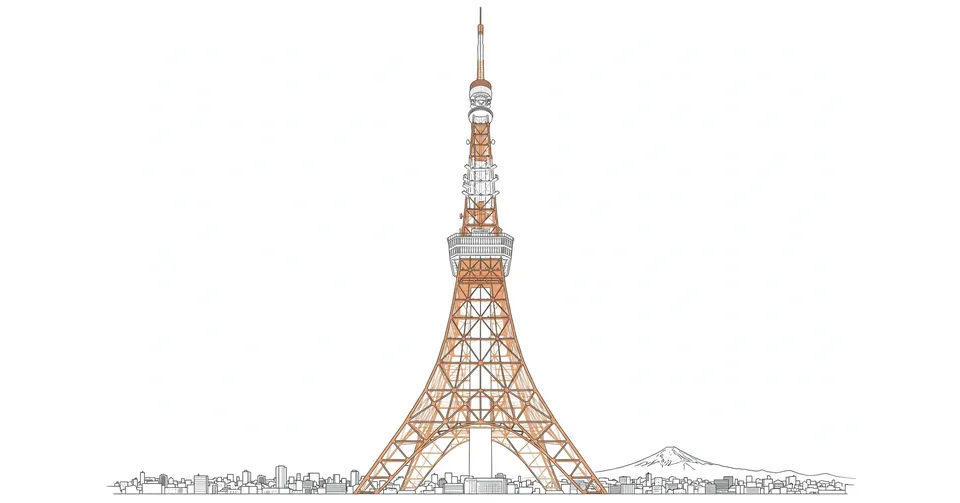
The first thing most visitors notice is the colour. Tokyo Tower is orange and white, and the orange is not a design choice. Aviation rules require tall structures to be visible to aircraft, so the tower wears international orange in bands, repainted by hand every five years with about 28,000 litres of paint. The colour was meant to be practical. It became the reason Tokyo Tower is loved. Against a grey winter sky or a blue summer one, the orange lattice looks warm, almost friendly, and it photographs well from every angle, which is part of why Tokyo Tower still appears on so many postcards.
A Tower Built for Television
Tokyo Tower was never meant to be a tourist attraction first. It was built because Japan's television stations each needed their own tall antenna, and the government decided one shared tower would do the job better than a forest of masts. The site chosen was Shiba Park, close to the centre of the city, and construction began in June 1957. About 400 workers built around the clock, and the tower was finished in October 1958, opening to the public two months later.
The numbers still impress. Tokyo Tower stands 333 metres tall, which made it the tallest freestanding tower in the world when it opened. It held that title until 1967, when the Ostankino Tower in Moscow passed it. It remained Japan's tallest structure until Tokyo Skytree opened in 2012, more than half a century later. The steel in its frame weighs about 4,000 tons, against about 7,300 tons for the Eiffel Tower, because seventy years of progress in metallurgy had happened between the two. About a third of the steel came from American tanks damaged in the Korean War, melted down and reforged, which gives the tower a quiet link to the war that had ended only a few years before it rose.
Naito, the designer, had spent his career on earthquake resistant structures, and his tower was built to sway with the ground rather than fight it. That engineering has been tested more than once, including in the great earthquake of 2011, when the antenna at the very top bent slightly and was later repaired. Tokyo Tower stood. It was designed by a man who understood that in Japan, a tall building must be ready to move. Trip to Japan gives a full account of how the tower became a symbol of postwar recovery, from the first steel to the opening day crowds.
Why Tokyo Tower Is Orange
The orange paint has its own story. The colour is officially called international orange, and it is the same shade used on airport control towers and tall masts around the world, chosen because it stands out against both sky and cloud. Tokyo Tower is painted in alternating bands of orange and white, seven sections in all, and the whole job takes a team of painters months to complete. The painters work from ropes and platforms, high above the city, and the tower is repainted roughly every five years.
At night the tower changes character completely. For most of the year it glows in a warm orange light known as the Landmark Light, which makes the lattice look as if it were lit from inside. On special occasions the lighting changes, sometimes to cool white, sometimes to colours chosen for a season or an event, and the tower becomes a calendar you can read from across the city. Seasonal illuminations come and go, but the orange glow is the one people picture when they think of the tower after dark. I have always thought the night view is the better one. In daylight the tower is a landmark. At night it is a lantern.
Two Decks, Two Different Cities
Tokyo Tower has two observation decks, and they give you two different views of the same city. The Main Deck sits 150 metres up and spreads across two floors, with a full circle of windows and a glass floor panel, the Skywalk Window, for anyone brave enough to look straight down. A small Shinto shrine sits on the Main Deck too, said to be the highest shrine in Tokyo, where visitors leave wishes for good grades and safe travel. The Top Deck sits 250 metres up and is reached only on a guided tour, through a glass panelled elevator with mirrors and LED lighting that feels like a short trip into the future before the doors open on the view.
From the Main Deck, Tokyo looks close and busy, a city of rooftops, parks, and trains. From the Top Deck of Tokyo Tower, it looks vast and flat, stretching to the horizon in every direction, and on a clear winter day you can see Mount Fuji to the west and the white shape of Tokyo Skytree to the east. That is the strange pleasure of the higher deck. It does not just show you more of the city. It shows you the tower's own rival, standing across the water, and the mountain that both towers were built in the shadow of.
The practical details are simple. The Main Deck is open from 9:00 to 23:00, with last admission at 22:30, which makes it the latest closing observation deck in the city. Current hours and ticket prices are listed on the Japan National Tourism Organization page for Tokyo Tower. Main Deck tickets cost 1,200 yen at the counter, or 1,500 yen online for a timed slot. The Top Deck Tour costs 3,300 yen online, or 3,500 yen at the counter, and covers both decks. If your legs are willing, you can also climb the stairway to the Main Deck, about 600 steps, which is open on Saturdays, Sundays, and holidays. The climb is a small adventure in itself, and the view at the top feels earned in a way the elevator never quite manages.
The Tower That Lost Its Height and Kept Its Job
Every city has a building that was once the tallest and is now only the most loved, and Tokyo Tower is Tokyo's version. When Tokyo Skytree opened in 2012 at 634 metres, nearly twice the height, the obvious question was what would happen to Tokyo Tower. The answer turned out to be very little. Tokyo Tower still broadcasts television and radio signals, it still draws millions of visitors a year, and it still appears in films, anime, and photographs more often than its taller rival. Skytree is the taller tower. Tokyo Tower is the one people draw when they sketch the city from memory.
Part of the reason is location. Tokyo Tower stands in the middle of the old city, near Roppongi, Shiba Park, and the temples of the area, while Skytree stands across the river in Sumida ward. A visitor can walk to Tokyo Tower from a subway station in minutes, eat in the FootTown complex at its base, and be back on the street in time for dinner. The tower fits into a day in Tokyo in a way a special trip across the river does not always manage. It is also, simply, prettier. The Eiffel Tower shape, the orange paint, the lattice that lets the sky through, all of it adds up to a building that looks like it was designed to be looked at, not only to be looked from.
There is a lesson in that, and it is one I keep coming back to. Cities do not keep their landmarks because they are the biggest or the newest. They keep them because people have attached memories to them, first dates and school trips and evenings when the lights came on. Tokyo Tower has had almost seventy years to collect those memories, and no amount of extra height can buy that. When I stand under it and look up, I do not think about antennas or steel tonnage. I think about how a practical object, a television mast painted orange so that aeroplanes could see it, became the thing a whole city points to when it wants to say home.
How to Visit Tokyo Tower
Tokyo Tower is easy to reach, which is part of its charm. The nearest stations are Akabanebashi on the Oedo line, about five minutes on foot, and Onarimon on the Mita line, about six minutes. Kamiyacho on the Hibiya line is about seven minutes away, and Hamamatsucho on the JR Yamanote line is about fifteen minutes on foot through Shiba Park, a pleasant walk on a fine day. The same Yamanote line also carries crowds to Shibuya Crossing, so the two landmarks pair well in a single afternoon.
Go late in the afternoon if you can. Arrive while it is still light, watch the city change colour from the Main Deck, and stay for the lights coming on. The Top Deck Tour is worth booking ahead, since places are limited and it sells out on weekends and holidays. If the weather turns bad, the Top Deck can close without warning, so check the forecast before you pay for the higher ticket. And if you are in Tokyo in winter, pick a clear, cold day. The air is sharpest then, the view reaches furthest, and on the best days Mount Fuji stands on the horizon like a second, quieter tower, one that no engineer ever had to build.
Tokyo Tower will probably never be the tallest thing in Tokyo again, and it does not need to be. It was built to carry television signals, it became a symbol of a country rebuilding itself, and it stayed because people loved the way it looked against the sky. The orange giant refused to be replaced, not by being taller, but by being the tower that Tokyo still reaches for first. That is a better kind of height, and it is the reason the tower is still there, glowing orange over the city, every night.
More in Food & Travel
- Tokyo Skytree and How Japan Built the World's Tallest Tower
- Hakone and the Hot Spring Town Below Mount Fuji
- The Japanese Alps and the Mountains at the Heart of Honshu
- Japanese Wagashi and the Sweets That Mark the Seasons
- A Hohin Is the Handleless Teapot Gyokuro Was Waiting For
- Mount Takao and the Day Trip Tokyo Takes When It Needs Air
Latest posts
- Matsumoto Temari Turns Mountain Cocoons Into Wishes You Can Hold
- Nambu Tekki Is the Iron That Outlasted the Lords Who Ordered It
- Forest Bathing in Japan, the Quiet Science of Shinrin-Yoku
- Emoji, the Tiny Pictures Japan Gave the World
- Temari Is the Embroidered Ball Japan Gives for Good Luck
- A Tetsubin Turns Iron and Fire Into Japan's Slowest Kettle
- Ninja, the Shadow Warriors of Feudal Japan
- A Kamado Turned the Japanese Kitchen Into a Slow Oven
- Bizen Ware Lets the Fire Do the Painting
- Japanese Haiku and the Seventeen Syllables That Hold a Season
- Japanese Futon and the Art of Sleeping on the Floor
- Shigaraki Ware Turns an Ancient Lake Bed Into Japan's Warmest Pottery
- Boro Turns Rags Into the Cloth Japan Refused to Throw Away
- Iga Ware Fires the Clay Pot That Holds Heat the Longest
- A Donabe Turns a Clay Pot Into Japan's Slowest and Warmest Way to Cook