Kemari Is the Ball Game Japan Played Without Trying to Win
· 14 min read
Kemari is Japan's ancient court kickball game, played in a circle with no score and no losers, where eight players work together to keep a deerskin ball in the air.
Imagine a ball game with no scoreboard, no referee blowing a whistle, and no one keeping count of who is ahead. Eight people stand in a circle on a quiet court, and their only shared job is to keep a small leather ball in the air for as long as they can. When someone makes a good kick, nobody cheers for a point, because there are no points to cheer for. That game is kemari, and Japan has been playing it for more than 1,300 years.
Kemari is the oldest ball game in Japan, and it is also one of the strangest by modern standards. It arrived from China during the Asuka period, it became the favorite pastime of Heian court nobles, and it survived centuries of war, fashion, and political change without ever becoming a competition. The players are not opponents. They are partners in a small act of balance, and the ball is the only thing that matters.
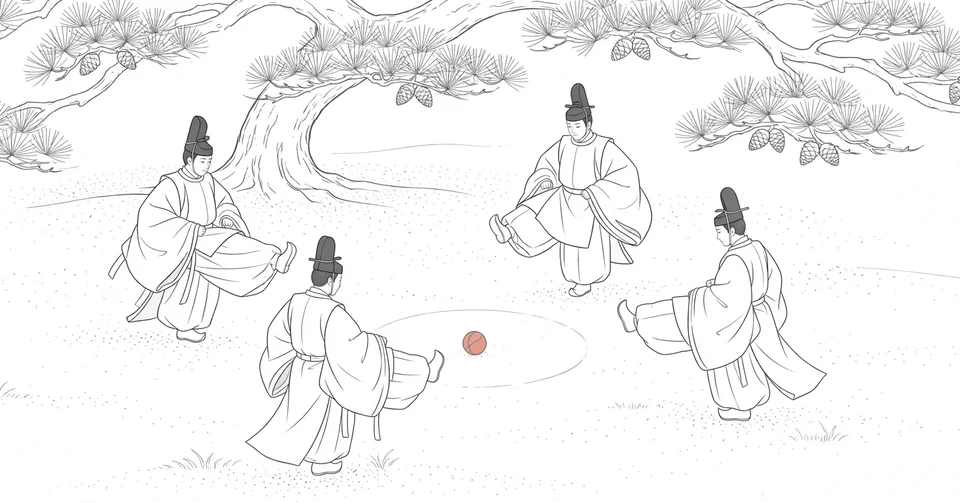
What makes kemari worth knowing is not just its age. It is the idea behind it. In a world where almost every game is built around beating someone else, kemari asks a different question: what happens when the whole point is to keep something beautiful going together? The answer, played out over thirteen centuries, is a game that looks like a sport, sounds like a chant, and feels more like a ceremony.
A shoe, a prince, and a revolution
The earliest written record of kemari comes from the Nihon Shoki, the ancient chronicle of Japan, in an entry dated to the year 644. The scene is set at Hokyoji, a temple in Asuka in what is now Nara Prefecture. Two young men are playing kemari on the same team when one of them loses a shoe mid-kick. The other picks it up, carries it over, and presents it to him with the courtesy of a friend. That small act of kindness became the start of one of the most famous friendships in Japanese history.
The two players were Nakatomi no Kamatari, later known as Fujiwara no Kamatari, and Prince Naka no Oe, who would later become Emperor Tenji. The story says the game brought them close, and together they went on to bring down the powerful Soga clan and launch the Taika reforms of 645, a sweeping reorganization of the Japanese state. It is a remarkable claim, and historians treat the details with care, but the connection itself is real enough to be remembered for nearly fourteen centuries: a kickball game, a lost shoe, and a friendship that changed a country.
This is the first lesson kemari teaches. The game was never only about the ball. From its very first mention, it was about the people standing in the circle together, and about what happens between them while the ball is in the air.
From China to the Heian court
Kemari came to Japan from China, where a similar kicking game called cuju had been played since at least the Warring States period. The two games share the same written characters, and the Japanese name is believed to come from that Chinese ancestor. Where cuju was competitive, with teams trying to kick a ball through posts, the Japanese version took a different path. It dropped the goal, dropped the score, and kept only the pleasure of the kick itself.
The game probably reached Japan in the sixth or seventh century, carried along the same routes that brought Buddhism and other continental learning. By the Heian period, which ran from 794 to the late twelfth century, kemari had become one of the defining pastimes of the imperial court. Nobles built private practice grounds in their own gardens, and skill at kemari was considered a mark of refinement, alongside poetry and calligraphy. A courtier who could keep the ball aloft with grace was admired in much the same way as a poet who could compose a fine verse.
The link between kemari and the ball itself runs deeper than most people realize. The name of the embroidered temari ball, the colorful stitched sphere now given as a gift for good luck, is believed to come from kemari, a kickball game that arrived from China more than 1,300 years ago. The two balls are different objects, one kicked and one treasured, but they share a root, and the story of one helps explain the other. You can read about the embroidered cousin of kemari in Temari Is the Embroidered Ball Japan Gives for Good Luck, where the same ball becomes a gift rather than a game.
During the Kamakura period, the rules of kemari were written down and formalized, and the game spread from the court to the warrior class. Samurai played it too, and records describe young warriors practicing kemari, drinking tea, and reading poetry after their training. The game reached its peak of popularity between the tenth and sixteenth centuries, and for a long time it seemed as permanent a part of Japanese life as the cherry blossom season. Only in the Edo period did its fortunes fade, as sumo and other entertainments drew the crowds, and by the start of the modern era it had nearly vanished altogether.
The court with four trees
A kemari court is not marked with painted lines or chalk. It is marked with trees. Four trees stand at the corners of a square, and the players arrange themselves inside it. The ground has several names, including mariniwa, mariba, kakari, and kikutsubo, but the idea is the same in every version: a flat, open space defined by living things rather than by lines on the ground.
Each tree has a fixed place and a fixed species. The arrangement is part of the tradition, and serious players in the old days would plant the four trees in their own yards so they could play whenever they wished. Others kept saplings in large planters and moved them into place for a game. Today the court is commonly set at about 15 meters on each side, though portable trees make the size easy to adjust.
| Corner | Tree |
|---|---|
| Southeast | Willow |
| Northeast | Cherry |
| Northwest | Pine |
| Southwest | Maple |
There are exceptions, and the exceptions are part of the charm. At the imperial palace, the court is marked with pines only, and at some modern shrine festivals the four points are marked with bamboo instead. The trees are not decoration. They are the boundary, the frame, and the reminder that this game is played outdoors, in a garden, under the sky, as it always was.
I find something quietly radical in that design. A modern sports field is a machine for measuring: lines, zones, goals, all drawn to make winning and losing unambiguous. A kemari court is the opposite. It is a garden with four trees, and the only rule it enforces is that the players stand together inside it.
How a game without winners is actually played
A formal game of kemari has six to eight players. Four of them are the main players, called mariashi, and each stands in front of one of the corner trees. Up to four assistants, called nobuse, stand outside the square, ready to help keep the ball alive. A referee of sorts, called the kensho, watches over the game, though there is nothing to score and no one to penalize.
Before the game begins, each player gets a chance to kick the ball a few times, testing its bounce and getting a feel for it. Then the real play starts. A player may kick the ball up as many times as he likes to gain control, then loft it gently toward the next player, who must keep it from touching the ground. Only the foot may move the ball, though the body can be used to slow it down or guide it toward the foot. The right foot does most of the work, kicked with the toe while the leg stays straight and the upper body stays still, moving slowly, right, left, right, before the kick.
The sounds of the game are as distinctive as the movements. The player kicking the ball calls out "ariyaaa" each time he juggles it, and "ari" when he passes it to someone else. The player about to receive it calls "o" when the ball reaches the top of its arc. If several players call at once, the one who holds the call longest takes the ball. The result is a slow rhythm of voices, something like "ariyaaa, ariyaaa, ariyaaa, ari", rising and falling with the ball. The calls are said to come from the names of ball spirits that people long ago believed in, and they give kemari a sound unlike any other game. The Imperial Household Agency describes the game in exactly these terms, noting that kemari is not about winning or losing, and everyone works together to keep the ball in the air.
The aim is simple to state and hard to achieve: keep the ball in the air as long as possible, and let it touch the ground as rarely as possible. When the ball does fall, the game pauses, the ball is picked up, and play resumes. There is no punishment for dropping it, only the shared wish to do better next time. It is, in the best sense, a game that forgives.
The ball that became a viscount
The ball itself is a small work of craft. It is made of deerskin, stitched into a hollow sphere, and it measures about 20 centimeters across and weighs around 120 grams, according to the Imperial Household Agency. Older accounts describe it as stuffed with sawdust or barley grains while the hide was shaped, then emptied and sewn shut. There are several traditional types, including a white ball, a plain material ball, a smoked ball, and a Chinese-style ball, each with its own character.
The most famous story about a kemari ball concerns an emperor whose team once kept a ball in the air for more than 1,000 kicks. Poets who saw the feat wrote that the ball seemed suspended, hanging in the sky. The emperor was so pleased that he retired the ball on the spot and granted it a high court rank, effectively making it a viscount. It is a funny story, and it may well be embellished, but it captures something true about how the court saw the game. In kemari, the ball is not a tool to be used up and thrown away. It is the honored guest at the center of the circle, and when it performs beautifully, even a ball can be rewarded.
That attitude is worth pausing over. Modern sport treats the ball as disposable, one of many, replaced without a thought. Kemari treats the ball as a companion, checked carefully before play begins, handled with manners, and sometimes, in legend at least, given a title. The game asks its players to pay attention to a small leather sphere, and attention, practiced long enough, starts to look a lot like respect.
The clothes players wear
Originally, there was no special uniform for kemari. Players simply played in whatever they were wearing, usually court robes such as kariginu, suikan, or hitatare. By the thirteenth or fourteenth century, a distinctive outfit had emerged, based on the suikan but cut for the game. It is called the mari-suikan, and it has very large sleeves, an open front, chest cords, and decorative knots instead of the usual ornaments. It is worn with an eboshi hat and wide pleated trousers called kuzu-bakama, and today players wear special leather shoes called kamogutsu, with ties to keep them on the feet. The ties are a sensible invention. Prince Naka no Oe lost his shoe during that famous game in 644, and no modern player wants to repeat the story.
The clothes are colorful, with different patterns, and long ago the colors and patterns showed the social status of the wearer. Watching a game of kemari today is therefore also watching a small fashion show from the Heian court, with bright robes swaying as the players move. The formality of the dress contrasts beautifully with the simplicity of the game, and that contrast is part of the pleasure of watching it.
Where kemari still lives today
Kemari nearly died at the beginning of the modern era, but it was saved by an imperial intervention. Emperor Meiji, who was himself said to be fond of the game, ordered the creation of the Kemari Preservation Society, known in Japanese as the Kemari Hozokai, and according to the Kokugakuin University account of the tradition, the society was established with an imperial donation in 1903. Because of that rescue, kemari persists today as a living tradition rather than a museum piece.
The best place to see it is at a shrine. Every year on January 4, Shimogamo Shrine in Kyoto, formally known as Kamo-mioya Jinja, holds the Kemari Hajime, the first kemari game of the year, performed by members of the preservation society as an offering to the shrine. Eight players in Heian-period costume form a circle on the shrine grounds and keep a white deerskin ball aloft, mostly with the right foot and without bending the knee, while crowds watch. The society also performs kemari at Shiramine Shrine in Kyoto on April 14 and July 7 each year. In spring and autumn, special exhibitions are held at the Kyoto Imperial Palace, where visitors can watch the game in the place where court nobles once played it. A detailed history of the game, from its first mention in the Nihon Shoki to the shoes and robes of its players, is told at Sengoku Daimyo, which draws on the research of a member of the preservation society.
These performances are popular, and they draw crowds, but they are not shows in the modern sense. They are ceremonies, performed at the start of the year as a prayer for harmony and good fortune. The players are not performing for applause. They are keeping a promise made more than a thousand years ago, that the ball will stay in the air.
Japan has other traditional games that still reward quick hands and sharp memory, and the most famous of them turns poetry into a race. If kemari is the slow game of the court, karuta turns a hundred poems into a contest of speed, and the contrast between the two says a lot about how wide Japanese play can be.
Why a game nobody wins still matters
It is easy to dismiss kemari as a curiosity, a pretty relic from a court that vanished centuries ago. But I think that misses the point. The game survived because it offers something that competitive sport cannot, and that something is the experience of working together without a prize at the end. Every player in the circle depends on the others. A bad pass is not a mistake to be punished, it is a problem the whole group solves together, and a long rally belongs to everyone, not to the person who kicked last.
There is a lesson in that for a world that turns almost everything into a contest. We rank restaurants, we count followers, we turn hobbies into side hustles and friendships into networks. Kemari refuses all of that. It has no leaderboard, no champion, and no final score, and after more than a thousand years it is still played, still watched, and still loved. Perhaps that is because the game understands something we keep forgetting: that doing something well together can be enough, and that a ball kept in the air by eight people is a small image of what a community is supposed to be.
If you ever find yourself in Kyoto on January 4, go to Shimogamo Shrine and watch. Stand at the edge of the court, listen for the calls of "ariyaaa" and "ari", and watch the ball rise and fall without ever quite landing. You will be watching a game that has no winners, and you may find, as I did while learning about it, that you do not miss them at all.
More in Culture & Society
- Chagama Is the Kettle That Never Leaves the Tea Room
- Judo, the Gentle Way Japan Gave the World
- Matsumoto Temari Turns Mountain Cocoons Into Wishes You Can Hold
- Nambu Tekki Is the Iron That Outlasted the Lords Who Ordered It
- Temari Is the Embroidered Ball Japan Gives for Good Luck
- A Tetsubin Turns Iron and Fire Into Japan's Slowest Kettle
Latest posts
- Lake Toba and the Supervolcano That Made the World's Largest Volcanic Lake
- Raja Ampat and the Coral Kingdom at the Edge of Indonesia
- Tokyo Skytree and How Japan Built the World's Tallest Tower
- Forest Bathing in Japan, the Quiet Science of Shinrin-Yoku
- Tokyo Tower and the Orange Giant That Refused to Be Replaced
- Emoji, the Tiny Pictures Japan Gave the World
- Hakone and the Hot Spring Town Below Mount Fuji
- Ninja, the Shadow Warriors of Feudal Japan
- A Kamado Turned the Japanese Kitchen Into a Slow Oven
- Bizen Ware Lets the Fire Do the Painting
- The Japanese Alps and the Mountains at the Heart of Honshu
- Japanese Haiku and the Seventeen Syllables That Hold a Season
- Japanese Wagashi and the Sweets That Mark the Seasons
- Japanese Futon and the Art of Sleeping on the Floor
- A Hohin Is the Handleless Teapot Gyokuro Was Waiting For