Batik, Indonesia's Wearable Art
· 9 min read
Batik Indonesia went from royal cloth to UNESCO heritage and everyday wear. This is how wax, dye, and patience turn plain cotton into a story you can wear.
Batik Indonesia is the rare kind of art you can wear to the office. It is cloth first and decoration second, a length of cotton or silk patterned with hot wax and dye, made slowly by hand in workshops across Java. On 2 October 2009, UNESCO inscribed Indonesian Batik on the Representative List of the Intangible Cultural Heritage of Humanity, and Indonesia has celebrated National Batik Day every 2 October since.
The remarkable thing is not the award. It is that batik never became a museum piece. Presidents wear it to state events, office workers wear it on Fridays, and schoolchildren wear it as uniform. A craft that once marked royalty now belongs to everyone, and that may be the best thing that ever happened to batik Indonesia.
Look closely at a piece of real batik and you can read it like a map. The curling parang pattern once belonged to warriors and kings. Kawung, a pattern of four intersecting ellipses, recalls the aren palm fruit and the idea of purity. Mega mendung, the cloud pattern of Cirebon, speaks of patience and the sky after rain. None of this is decoration for its own sake. In batik Indonesia, every motif carries a meaning, and for centuries the pattern you wore said something about who you were.
How batik Indonesia is made
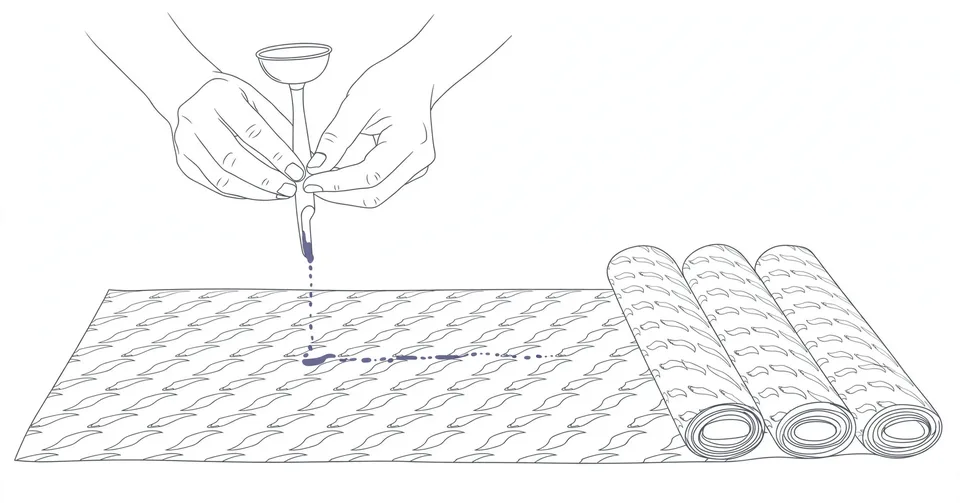
Batik is a wax-resist dyeing technique, and the idea behind it is simple enough to explain in one sentence. The maker draws a pattern on cloth with hot wax, then dips the cloth in dye. The waxed areas resist the dye and stay pale, while the rest takes the colour. The wax is then removed, often with boiling water, and the process repeats for every colour in the design.
The tool that makes this possible is the canting, a small copper pen with a spout and a wooden handle. The maker scoops hot wax into the canting and draws with it the way you would draw with a pen, letting a thin line of wax fall onto the cloth. Cloth made this way is called batik tulis, hand-drawn batik, and a single piece can take weeks of steady work.
There is also a faster method. Batik cap uses a copper stamp, carved with a pattern, which is dipped in hot wax and pressed onto the cloth. It is still handmade, but one stamp can repeat a motif across metres of fabric in a fraction of the time. Both methods produce real batik Indonesia, and both demand a steady hand and a good eye. The difference is time, not honesty.
The colours of traditional batik Indonesia came from nature. Indigo gave blue, the soga tree gave brown, and the tinggi tree gave beige and black. Modern makers of batik Indonesia often use synthetic dyes as well, which offer brighter colours and a wider range, but the old palette of deep blue, warm brown, and soft cream is still the one most people picture when they hear the word batik.
A cloth with a thousand years behind it
Nobody knows exactly when batik began. The technique may have been introduced in the 6th or 7th century from India or Sri Lanka, and the art of batik is most highly developed on the island of Java, although its age is hard to pin down because cloth rarely survives long in a tropical climate. One early clue in the long story of batik Indonesia is the Cker inscription of 1185, which mentions villagers being allowed to wear cloth painted with colours, a description that sounds very much like batik.
Batik flourished under Majapahit and the Central Javanese kingdoms that followed. It was first described for Europeans in Thomas Stamford Raffles' book "The History of Java", published in 1817, which is how the wider world first learned that Javanese cloth carried patterns with names, rules, and meanings.
What strikes me about this history is how ordinary it is at its core. Batik was not invented as luxury for its own sake. It was cloth for daily life, made by families, worn at births and funerals, and passed down the generations. The royal courts refined it and gave it rules, but the hands that made it were ordinary hands, and they still are. That is why batik Indonesia feels different from other heritage crafts. It was never only for the palace. It was always for the people who made it too.
Patterns that used to say who you were
In 17th-century Central Java, certain motifs were larangan, forbidden to commoners and reserved for royalty. To wear a forbidden pattern was to claim a rank you did not hold, and the rules were taken seriously. Patterns were symbols of class and identity, as legible to people of the time as a uniform or a title is today.
Those rules have faded, and nobody is punished for wearing parang anymore. But the meanings of batik Indonesia linger, and they are part of why people still care about motifs. A kawung sarong at a wedding, a mega mendung shirt at a formal dinner, a parang jacket at a state ceremony, each choice still says something, even if the message is now closer to respect for tradition than to a claim of rank.
This is also what connects batik to other Indonesian arts that carry memory in their form. The keroncong singer Waldjinah, the subject of an earlier article on this site, spent her life keeping a Javanese musical tradition alive in the same way batik makers keep their patterns alive, by practising them in public, year after year, until the tradition becomes part of daily life rather than a performance of the past.
Batik tulis, batik cap, and the printed pretenders
Not everything sold as batik is batik. Mass-printed cloth copies batik patterns with ink and a machine, and it is cheap, fast, and widely sold. There is nothing wrong with a printed shirt if you like the pattern, but it is worth knowing what you are buying, because the difference matters to the people who make the real thing.
| Type | How it is made | How to recognise it |
|---|---|---|
| Batik tulis | Drawn by hand with a canting | Pattern visible on both sides, tiny irregularities in the lines |
| Batik cap | Stamped by hand with a copper stamp | Pattern visible on both sides, motifs repeat exactly |
| Printed batik | Pattern printed by machine | Pattern usually sharp on one side only, back of the cloth looks pale or blank |
The simplest test is to turn the cloth over. In real batik Indonesia, the wax and dye soak through, so the pattern shows on both sides. In printed cloth, the back is usually faded or blank. It is a small test, and it tells you immediately whether someone sat with a canting for days or a machine did the work in seconds.
I think this distinction is worth caring about, and not out of snobbery. A handmade cloth costs more because it contains days of someone's time, and paying that price is the most direct way to keep the craft alive. Buying a print is fine, but buying a print while believing it is handmade helps no one, least of all the maker whose work is being copied.
Where to see batik Indonesia being made
The main centres of batik Indonesia are Pekalongan, Yogyakarta, and Surakarta, known as Solo. Each has its own character. Pekalongan, on the north coast of Java, is famous for bright colours and Chinese and Dutch influences. Yogyakarta and Solo, the old court cities of Central Java, keep the deep indigo and brown palette and the classical motifs.
Visitors to these cities can watch the making process in small workshops and buy directly from the makers. Watching someone draw with a canting is the fastest way to understand why the cloth costs what it does. The hand moves slowly, the wax must stay at the right temperature, and one wrong line cannot be undone. It is quiet, patient work, and it looks nothing like a factory.
Solo is also the home of keroncong, and the connection is not a coincidence. The same Central Javanese court culture that shaped batik shaped its music, its dance, and its food. A trip to Solo can take in all of them at once, and the batik you buy there will carry a little of that history with it.
Why batik Indonesia still matters
Batik Indonesia matters because it proves that tradition does not have to be frozen to survive. It changed hands, from courts to workshops to factories to fashion runways, and it kept changing without losing its meaning. UNESCO's inscription in 2009 recognised this, describing how the techniques and symbolism of batik permeate the lives of Indonesians from beginning to end. Babies are carried in batik slings decorated with symbols meant to bring the child luck, and the dead are shrouded in funerary batik.
That image, a life wrapped in the same cloth at its start and its end, is the best argument for batik I know. It is not a costume and not a souvenir. It is a thread that runs through a whole life, and it is still being woven today.
Like rendang, which this site covered when it was named the world's best food, batik shows how something deeply local can be recognised around the world without giving up what made it local. Rendang did it with taste, batik does it with cloth, and in both cases the world came to Indonesia rather than the other way around.
The honest answer to why batik Indonesia endures is simple. It is useful, it is beautiful, and it belongs to the people who make it and wear it. As long as Indonesians keep reaching for batik for weddings, for work, and for ordinary Fridays, the wax will keep flowing and the canting will keep drawing. A craft that is worn every day does not need to be saved. It only needs to be worn.
More in Culture & Society
- Numazu Imperial Villa and Japan's Seaside Imperial Retreat
- Wabi-Sabi and the Japanese Beauty of Imperfect Things
- Women Only Train Cars in Japan and the Problem They Answer
- Maneki Neko and Japan's Beckoning Lucky Cat
- The Baduy People and Life Without Modern Technology
- The Obon Festival, Japan's Week for Honouring Ancestors
Latest posts
- Love Live Sunshine and How Anime Changed Numazu
- Numazu Deep Sea Aquarium and the Creatures of Suruga Bay
- Numazu Himono and the Art of Dried Fish
- Numazu Port and the Freshest Seafood in Shizuoka
- Disaster Vending Machines in Japan That Give Their Drinks Away
- The E33G Remote Worker Visa and How to Legally Work from Bali
- Bullet Climbing Mount Fuji, the Overnight Ascent Japan Is Trying to Stop
- Climbing Mount Semeru, Java's Highest Volcano
- Tamago Sando and Japan's Konbini Egg Sandwich
- The Salaryman and Japan's Loyal Office Culture
- Onsen Tattoo Rules in Japan and How They Are Slowly Changing
- Key Money in Japan and Why Renting Costs Four Months Up Front
- Sento, Japan's Everyday Public Bathhouse
- The Fuji Five Lakes and the Best Views of Mount Fuji
- Visiting the Ghibli Museum and Ghibli Park in Japan