Kongobuji Still Governs the Mountain Kukai Left Behind
· 13 min read
Kongobuji is the head temple of Koyasan Shingon Buddhism, and it still runs the mountain from its great hall, its painted sliding doors, and the largest rock garden in Japan.
Koyasan looks like a small town, but it is governed like a temple. The streets, the inns, the cedar forest, and the cemetery all answer to one address, and that address is Kongobuji. It is the head temple of Koyasan Shingon Buddhism, the sect Kukai founded on this mountain, and it still runs the mountain today.
The first thing a visitor notices is not power but scale. Kongobuji has a great hall floored in tatami, a kitchen that can feed 2,000 people at once, and behind the hall the largest rock garden in Japan. It feels less like a single temple and more like a town hall, a museum, and a monastery sharing one roof.
What makes it worth a slow visit is the way it compresses twelve centuries into one building. The ground was chosen by Kukai in 816, the hall was rebuilt by a warlord in 1593 as a memorial to his mother, and the name Kongobuji only arrived in 1869, when two temples merged into one. To walk through it is to walk through the whole history of the mountain.
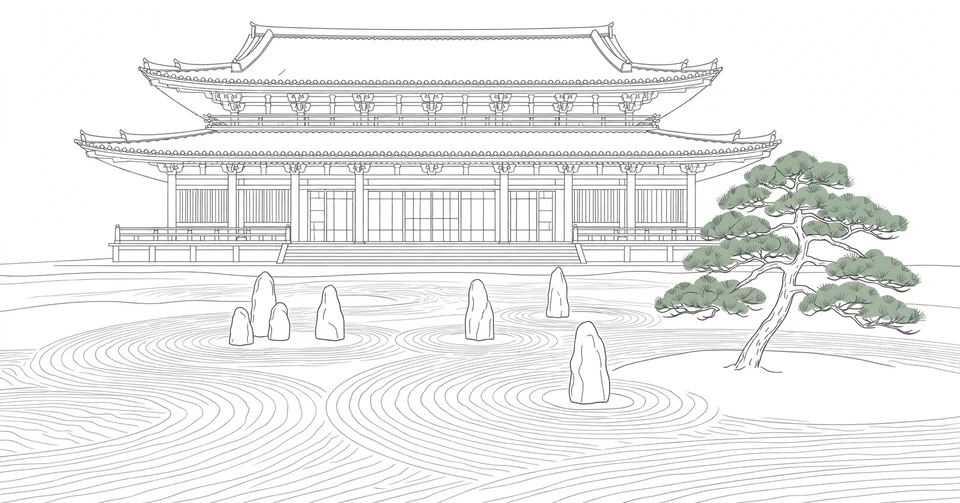
Most head temples in Japan feel like monuments, places where history is kept behind glass. Kongobuji feels different because it is still at work. The abbot lives here, the sect is administered from here, and the rooms a visitor walks through are the same rooms where the business of the mountain gets done. That working character is the reason to come, and it is the reason the temple has survived every fire and rebuilding in its long life.
What kongobuji actually governs
Kongobuji is the headquarters of the Koyasan sect of Shingon Buddhism. The Japan Tourism Agency puts the scale plainly: the temple oversees around 3,600 branch temples across the country. That number is worth pausing over. It means the decisions made in a quiet hall on a mountain in Wakayama reach temples in every part of Japan, from city centers to remote valleys.
The temple is also the residence of the abbot of Koyasan, which gives it a double role. It is a place of worship and a place of administration at the same time. Pilgrims come to pray, monks come to study, and the sect comes to be governed. Few temples in Japan carry both duties so openly, and fewer still do it from a building that a visitor can walk through for the price of a cup of coffee.
I find that combination more interesting than any single treasure inside. A temple that only preserves the past is a museum. A temple that still governs is a living institution, and living institutions have a different smell to them: incense mixed with paper, tea, and the faint sound of someone working in the next room. Kongobuji has that smell, and it is the first thing that tells you the place is real.
The grounds are free to enter, and the main hall costs 500 yen. That small fee is the price of stepping from the public mountain into the working heart of it, and it is money well spent. The hall is where the paintings are, where the garden is viewed from, and where the scale of the place finally becomes clear.
A temple with three birthdays
Kongobuji has not one founding date but three, and each one tells a different story about the mountain. The first belongs to Kukai, the monk later known as Kobo Daishi. According to the Japan Tourism Agency, the head temple was first established on this spot in 816 by Kukai, the founder of Koyasan. He was 42 years old, he had returned from China with a new form of Buddhism, and he had chosen this high valley as the place to build it. Everything on the mountain traces back to that choice.
The second birthday belongs to Toyotomi Hideyoshi, the warlord who unified Japan in the late sixteenth century. In 1593 Hideyoshi rebuilt the temple in the style visitors see today. He converted it into a mausoleum to honor his mother and renamed it Seiganji. The main gate from that rebuilding is still the oldest structure on the grounds, and the Toyotomi family crest, a paulownia flower, is still emblazoned on the large lantern to the left of the gate. Stand under that gate and you are standing in the one part of the temple that Hideyoshi himself would recognize.
The third birthday came in 1869, after the temple had been rebuilt once more in 1863. That year Kongobuji merged with a neighboring temple, and the combined complex took the name Kongobuji, which means Diamond Peak Temple. The name is a statement of intent. A diamond is hard, clear, and unbreakable, and the sect was claiming those qualities for itself at a moment when Japan was changing fast. The Meiji Restoration was underway, Buddhism was under pressure from the new government, and the mountain needed a single strong institution to speak for it. The merger gave it one.
It is worth being honest about what this layered history means for a visitor. You cannot point to a single wall and say Kukai touched it. The buildings are mostly nineteenth century, the garden is from 1984, and the paintings are from the seventeenth. What is old is the institution, the ground, and the continuity. Kongobuji has been governed from this spot for more than twelve hundred years, even though almost nothing standing here is that old. That is not a disappointment. It is the point. Temples in Japan are rebuilt the way a family keeps a house: the roof is replaced, the walls are repainted, and the home stays the same.
The Banryutei, Japan's largest rock garden
Behind the main hall lies the reason many people come to Kongobuji at all. The Banryutei is the largest rock garden in Japan, a field of white gravel covering about 2,340 square meters, scattered with 140 large granite stones. The stones were brought from Shikoku, the island where Kukai was born, and the white gravel came from Kyoto. Together they are arranged to suggest a pair of dragons rising from a sea of clouds to protect the temple.
The garden was built in 1984, which surprises people who expect everything on Koyasan to be ancient. It is not old, and it does not pretend to be. What it is, is large enough to change the feeling of the whole temple. From the veranda of the main hall, the gravel stretches away like water, and the stones rise out of it like the backs of animals surfacing. The effect is calm and slightly strange at the same time, and it works best if you sit and look at it for longer than feels necessary.
I sat there longer than I planned to, and I think that is the garden doing its job. A rock garden is not a picture to be glanced at. It is a place to practice looking slowly, and the Banryutei gives you a great deal to look at slowly. The two dragons are easy to find once someone points them out, a male and a female, one on each side of the garden, but the pleasure is in the smaller details: the way the gravel is raked into waves around each stone, the way the stones lean, the way the whole field seems to move when a cloud passes overhead.
The garden is also a reminder that Kongobuji is not frozen in time. A temple that could commission the largest rock garden in Japan in 1984 is a temple that is still making decisions, still spending money, and still confident that people will come to look. That confidence has been rewarded. The Banryutei is now one of the most photographed places on the mountain, and it is the image most visitors carry home.
The paintings inside the hall
The main hall is worth entering for the fusuma, the opaque paper sliding doors painted with landscapes. Lonely Planet notes that the doors carry work by famed seventeenth century artists, including those of the Kano school, the family of painters who defined the look of official Japan for generations. The paintings are not crowded together like a gallery. They are spread through the rooms the way paintings were meant to be lived with, one scene per room, glimpsed as you slide a door open and step through.
Many of the temple's statues and ritual implements are displayed at the Reiho kan, the treasure hall, rather than in the main hall itself. That division is worth understanding. The main hall is for the paintings and the garden view. The treasure hall is for the objects. A visitor who only enters the hall has seen the art of the temple, but a visitor who also finds the Reiho kan has seen its tools, the things monks actually used in ritual, and that is a different kind of intimacy.
The newer annexes, the Betsuden and the Shin-Betsuden, hold contemporary paintings of the seasons and images inspired by Kobo Daishi's time in China. I like that the temple keeps adding to its collection. It would be easy for a place this old to stop acquiring art and simply guard what it has. Kongobuji has not stopped, and the new paintings sit comfortably beside the old ones, proof that the temple still thinks of itself as a patron and not only a custodian.
The hall itself dates from the nineteenth century, and its scale is part of the experience. The rooms run one into another, the tatami stretches away underfoot, and the light from the garden comes in low and soft. It is a building designed for slow movement, and the right way to see it is slowly, room by room, without hurrying toward the garden at the back.
The kitchen that can feed 2,000 people
One detail from the Japan Tourism Agency stays with me more than the grander facts: the temple precinct houses a kitchen that can feed 2,000 people at once. It is an odd thing to boast about, until you think about what a mountain temple actually does.
Koyasan is a place people come to in groups. Pilgrims arrive by the busload, monks gather for ceremonies, and the great hall fills for memorial services. All of those people need to eat, and for centuries the temple has fed them. The kitchen is not a curiosity. It is infrastructure, as essential to the mountain as the gate or the hall, and its size tells you how many people the temple has always expected.
That expectation shapes the whole town. Around fifty of the temples on the mountain run shukubo, lodgings where travelers sleep on futons and eat with the community, and the mountain as a whole is built around feeding and housing strangers. If you want to understand that side of Koyasan, start with the town itself, where Kukai is said to be still meditating and where the lodgings, the meals, and the morning prayers are part of a single daily rhythm. Kongobuji is the administrative heart of that system, and the kitchen is the proof that administration here has always meant hospitality.
The food itself is shojin ryori, the vegetarian cuisine of Buddhist temples, and it is served in the lodgings rather than at Kongobuji. But the scale of the temple kitchen explains why the lodgings exist at all. A mountain that feeds two thousand people at a sitting has made a decision about what it is for, and that decision is written into every building on it.
How to visit kongobuji
Kongobuji stands at the center of Koyasan, at 132 Koyasan, a short walk from the Danjo Garan precinct and from the town's main intersection. It is easy to find and hard to miss, and it makes a natural first stop for anyone arriving on the mountain, because it explains the place you are standing in.
The grounds are free, and the main hall costs 500 yen. Go in the morning if you can, when the tour groups are still at Okunoin and the hall is quiet. Sit on the veranda and look at the Banryutei for a while. Then walk through the painted rooms slowly, and finish at the gate, where the paulownia crest on the lantern is the one detail Hideyoshi left behind.
Pair the visit with the two places that complete the picture. Okunoin, the great cemetery at the edge of town, is where the founder is believed to rest, and the Danjo Garan is where the teaching began. Kongobuji sits between them, geographically and institutionally, and seeing all three in one day gives you the shape of the whole mountain: teaching at one end, rest at the other, and government in the middle.
If the mountain's rituals interest you, the fire ceremony is the living counterpart to the administration. The goma rite has been performed here for more than a thousand years, and the sect that Kongobuji governs is the sect that keeps it burning, a story told in the fire ritual that has burned for 1,200 years. A temple that governs is also a temple that prays, and on Koyasan the two have never been separate.
Practical details change, so check before you go, but the shape of a visit has been stable for years: a free walk through the grounds, a small fee for the hall, and as much time as you want with the garden. The temple's official site is koyasan.or.jp, and the phone number listed for the temple is +81 736 56 2011.
Why the mountain still needs its head temple
Twelve centuries after Kukai chose this valley, the mountain still has a head temple, and the head temple still has work to do. It administers thousands of branch temples, it houses the abbot, it keeps the paintings, it feeds the pilgrims, and it tends the largest rock garden in Japan. None of that happens by itself. It happens because an institution on this spot has kept doing it, through warlords and restorations and mergers, without ever closing its gate.
That continuity is the real treasure of Kongobuji, more than the stones or the paintings. Buildings burn and are rebuilt. Gardens are made and remade. What survives is the decision, repeated by every generation of monks on this mountain, to keep governing from this spot. Stand in the hall, look out at the dragons in the gravel, and you are looking at the latest version of a decision made in 816. It has held for more than twelve hundred years, and from the veranda of Kongobuji, it does not look like it is ending soon.
More in Culture & Society
- Desa Pakraman Is the Name the Law Gave the Old Village
- A Primbon Reads Your Life From the Day You Were Born
- Pasaran Is the Five-Day Week Java Never Gave Up
- A Ceper Folds a Coconut Leaf Into a Crescent Moon
- Your Neptu Is the Number Hidden Inside Your Birthday
- Tilem Is the Dark Moon Bali Counts Its Year By
Latest posts
- The Saka Calendar Sets Nyepi on a Different Date Every Year
- On Tumpek Kuningan Bali Feeds Its Ancestors
- Garuda Carried a Mountain to the Middle of the Ocean
- Vasuki Was the Rope That Churned the Ocean of Milk
- En No Gyoja, the Mystic Shugendo Calls Its Patriarch
- A Saito Goma Burns Its Prayers Outdoors
- A Shukubo Lets You Sleep Inside a Working Temple
- Okunoin Is Japan's Largest Cemetery and Its Quietest Forest
- Suka Duka Means the Banjar Shows Up for Joy and Grief Alike
- Tabuh Rah Spills Blood So the Ground Stays Calm
- The Bendesa Adat Speaks for a Village That Has Two Governments
- Catur Brata Is Four Silences Kept at the Same Time
- On Koyasan the Founder Is Said to Be Still Meditating
- Your Weton Is the Day You Were Born, Counted Two Ways
- Rahu and Ketu Still Chase the Sun and Moon Across the Sky