Okunoin Is Japan's Largest Cemetery and Its Quietest Forest
· 12 min read
Okunoin is Japan's largest cemetery, where more than 200,000 tombstones line a two kilometre cedar path to the mausoleum of Kukai, the monk believed to be still meditating after more than a thousand years.
Okunoin is the largest cemetery in Japan, and it does not look like any cemetery you have seen before. More than 200,000 tombstones stand under a forest of tall cedars on Mount Koya, along a stone path almost two kilometres long. The path ends at the mausoleum of Kukai, known as Kobo Daishi, the monk who founded Shingon Buddhism and who, by belief, never died at all.
That belief is the reason Okunoin exists. Kukai is said to rest in eternal meditation, waiting for Miroku, the Buddha of the future, while monks bring him meals twice a day. People have wanted to be buried near him for more than a thousand years, and the forest has been filling with their stones ever since.
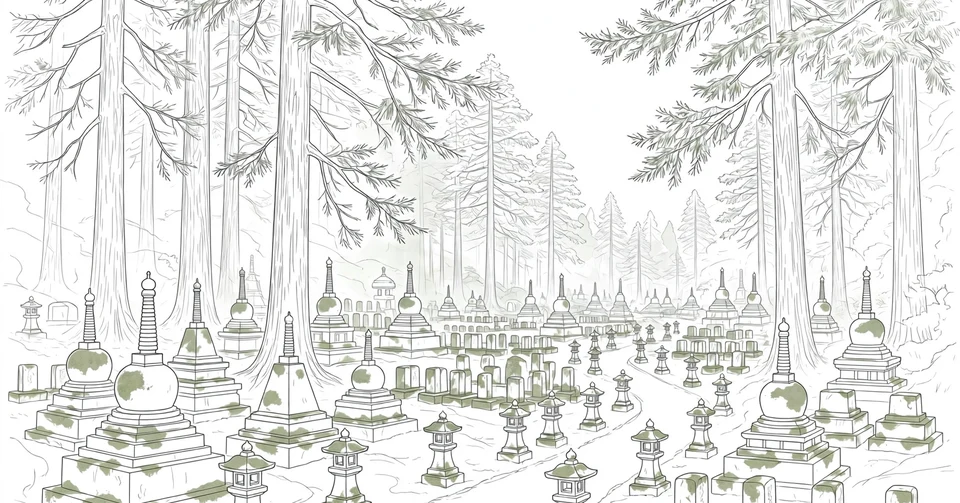
I think the first thing to understand about Okunoin is that it is not a place for looking at graves. It is a place for walking slowly, and for letting the quiet do its work. The cedars block the sky, the moss softens every stone, and the noise of the ordinary world simply stops reaching you. By the time the mausoleum appears, the walk has already changed the way you think about death, and that is the point.
The bridge where the living world ends
The traditional entrance to Okunoin is the Ichinohashi Bridge, the first bridge. Visitors are expected to bow to Kobo Daishi before crossing it, because the bridge marks the line between the world of the living and the world of the dead. It is a small wooden bridge, easy to miss, but everything about the visit changes once you cross it.
The bridge sits about a 10 to 15 minute walk from the Senjuinbashi intersection in the centre of Koyasan, or a short bus ride that costs 160 yen. From the bridge, the walk to the mausoleum is about two kilometres along the old approach through the graveyard. Most visitors today take the shorter route instead, starting at the Okunoin-mae bus stop, which cuts the walk to slightly under a kilometre. The bus from the cable car station takes 20 minutes and costs 610 yen, or 10 minutes and 270 yen from the town centre, with two or three buses per hour.
Which route you choose matters less than you might think. The shorter route passes through a newer part of the cemetery, and the old route passes through the forest of cedars. Both end at the same place. But if you have the time, the old route is the one to take, because the walk itself is the experience. Okunoin rewards the people who arrive on foot.
Two kilometres of stone and cedar
The cemetery at Okunoin holds more than 200,000 graves and memorial monuments, and the earliest records of the cedar plantings go back to 1012, according to Wikipedia's Okunoin entry. The trees belong mostly to the genera Cryptomeria and Chamaecyparis, the tall conifers that give the whole place its dark green roof. A large part of the forest was cut during the Meiji era in the late nineteenth century, so only a small area of natural forest remains, but the replanted cedars have grown tall enough to make the path feel like a tunnel of green.
The stones along the path belong to people from every walk of life. Many are monks and feudal lords who wanted to rest close to Kukai in death so they could receive salvation. The memorials of warlords such as Oda Nobunaga and Takeda Shingen stand among the stones of ordinary families, and the founders of other Buddhist sects rest here too, including Honen and Shinran. Enemies in life lie a few steps apart in Okunoin, and nobody seems to mind.
That is one of the things that makes Okunoin unusual. Koyasan was built by Kukai for Shingon Buddhism, which he introduced to Japan in 805, but the cemetery welcomes everyone. The idea is simple: if Kukai is waiting here for the Buddha of the future, then this is where you want to be when that future arrives, whatever sect you belonged to in life.
About halfway along the old approach, both paths meet at the Gokusho Offering Hall, near a row of statues of Jizo, the bodhisattva who looks after children, travellers, and the souls of the deceased. The statues are known as Mizumuke Jizo, the water covered Jizo, because visitors pour water over them and make offerings to pray for departed family members. It is a small, practical ritual, and watching people perform it quietly is one of the most moving sights in Okunoin.
The man okunoin is built around
Kukai was born in 774 and died, or entered eternal meditation, in 835. The site of Okunoin was opened in that same year, 835, and his mausoleum has stood at the end of the path ever since. According to popular belief, after being laid in his mausoleum, Kukai entered an eternal samadhi, a meditative trance, and is still alive on Mount Koya, waiting for Maitreya, the Buddha of the future.
I find this belief easier to understand once you have walked the path. The mausoleum is not presented as a tomb. It is presented as a room where a living teacher sits in meditation, and the monks who serve him treat it that way. They bring him ritual offerings and meals twice a day, every day, as they have done for centuries. The belief is not a story told to tourists. It is a daily practice, carried out whether anyone is watching or not.
Kukai founded the mountain community of Koyasan in the early ninth century, and the town that grew around it is still a working religious centre today. The article about Koyasan tells the story of the town itself, and how the founder is said to be still meditating there. Okunoin is the quiet eastern edge of that town, the place where the story becomes a walk you can take.
His school, Shingon, is the esoteric Buddhism he brought from China, built around ritual, mantra, and fire. The article about Shingon explains how its fire ritual has burned for 1,200 years. Okunoin is the other half of that story: the same faith, expressed not in flame but in silence, stone, and trees.
The hall of ten thousand lanterns
Past the Gokusho, the path reaches the Gobyobashi Bridge, which crosses a stream behind the Mizumuke Jizo and separates the innermost grounds from the rest of Okunoin. Visitors should bow again before crossing, and photography, food, and drink are forbidden beyond this point. To the left of the bridge stand wooden markers placed in the stream as a memorial to unborn children.
A few metres past the bridge, on the left side of the path, lies the Miroku Stone, housed in a small cage. Visitors are challenged to lift the stone from the cage's lower platform to an upper platform with only one hand. It is believed that the stone feels lighter to good people and heavier to bad people, and that it can provide a connection to the Miroku Bodhisattva. Whether you believe that or not, watching someone try is a reminder that Okunoin asks something of every visitor, not just attention.
The path ends at Torodo Hall, the Hall of Lamps, the main hall of worship, built directly in front of Kobo Daishi's mausoleum. Inside the hall are more than 10,000 lanterns, donated by worshippers and kept eternally lit. Two of them are said to have been burning without pause for more than 900 years. In the hall's basement are 50,000 tiny statues, donated to Okunoin in 1984 on the occasion of the 1150th anniversary of Kobo Daishi's entrance into eternal meditation.
Behind Torodo Hall stands the mausoleum itself, the Gobyo, the site of his eternal meditation. It is a sacred place with no access to the public, and visitors come from all over to pray to Kobo Daishi there. It is not uncommon to see pilgrims chanting sutras in front of the hall. The hall is open from 6:00 to 17:00 and admission is free, which feels almost wrong for a place this old and this revered, and also exactly right.
Some guidebooks suggest visiting the graveyard at night, and a night visit does give the place a very different atmosphere. The lanterns along the path glow, the cedars turn black against the sky, and the stones seem to lean closer. But some parts of the path are poorly lit, and neither Torodo Hall nor the other offering halls are open at night. If you go, go quietly, and remember that photography, food, and drink are still prohibited beyond the Gobyobashi Bridge, even in the dark.
The newer okunoin
The shorter approach from the Okunoin-mae bus stop leads through a more recent addition to the cemetery, and it is stranger than the old path in its own way. Here you will find modern tombstones bought by individuals, associations, and companies, including some surprising ones.
The first corporate tomb was built by Konosuke Matsushita, the founder of Panasonic, in 1938. Since then, Japanese companies have bought tombs here for their employees and their families. A pest control company built a memorial to all the termites its products have exterminated. Another monument, from ShinMaywa Industries, features a large scale model of the Saturn V rocket that carried Apollo 11 to the Moon, although the company had no connection to the mission.
I think these monuments are worth seeing, because they show that Okunoin is not a museum. It is still growing, still accepting new stones, and still making room for new kinds of grief. A company that wants its employees remembered next to a ninth century monk is saying something about what it values, and a rocket standing among the cedars is a reminder that the desire to be close to something sacred does not belong to one era.
The modern section also makes the old section easier to understand. The warlords and the monks chose this forest for the same reason the companies do now: because being near Kukai felt like the safest place to wait for whatever comes next. The stones change, but the reason stays the same.
Visiting okunoin without breaking its silence
Okunoin is one of the most sacred places in Japan and a popular pilgrimage spot, and visitors are expected to behave respectfully and dress appropriately. That sounds obvious, but the rules here are stricter than at most temples, and they are worth knowing before you go.
Bow at the Ichinohashi Bridge and again at the Gobyobashi Bridge. Do not eat, drink, or take photographs beyond the Gobyobashi Bridge. Do not step off the path onto the graves. Speak quietly, or not at all, along the approach. These are not suggestions for a good photograph. They are the terms on which a living religious community lets strangers walk through its cemetery.
The practical details are simple. Torodo Hall is open from 6:00 to 17:00 with no closing days and no admission fee, and Japan Guide's Okunoin page lists the current bus fares and walking times from the town centre. The walk from the Ichinohashi Bridge to the mausoleum takes about 40 minutes at a slow pace, and the shorter route from the Okunoin-mae bus stop takes about half that. Wear shoes you can walk in, because the cobbled sandō is uneven in places, and bring water in summer, since there is nowhere to buy a drink once you are past the entrance.
The best time to visit is early in the morning, when the mist is still in the cedars and the tour groups have not arrived, or late in the afternoon, when the light slants through the trees. Midday in summer can be hot and crowded, and the path loses some of its quiet. Winter is cold but beautiful, with snow on the lanterns and almost nobody on the path. There is no bad season for Okunoin, only a bad hour, and the bad hour is the one when you are in a hurry.
If you are staying in Koyasan, it is worth visiting Okunoin twice: once in the day, to see the stones and the hall, and once at night, to hear the forest. The night visit will not show you more, but it will show you differently, and for a place built around waiting, that feels appropriate.
What stays with you after okunoin
Most cemeteries ask you to remember the dead. Okunoin asks you to think about waiting. Kukai is waiting for the Buddha of the future. The warlords are waiting beside him. The companies are waiting too, in their own way, with rockets and termite memorials. Everyone in this forest is waiting for something, and the forest itself seems to be waiting with them.
That is why the quiet of Okunoin feels different from the quiet of other sacred places. It is not empty quiet. It is patient quiet, the kind that comes from a thousand years of people deciding that this particular forest is where they want to spend eternity. The cedars grow, the moss spreads, the lanterns burn, and the monks bring meals twice a day to a teacher who has not eaten in public for more than a thousand years. Nothing here is in a hurry, and nothing here is finished.
I left Okunoin thinking less about death than about attention. The people who built this place paid attention to one man for more than a thousand years, and the forest they built around him still rewards anyone who pays attention to it for a single afternoon. You do not need to share the belief to feel it. You only need to walk slowly, bow at the bridges, and let the quiet do its work.
More in Culture & Society
- Desa Pakraman Is the Name the Law Gave the Old Village
- A Primbon Reads Your Life From the Day You Were Born
- Pasaran Is the Five-Day Week Java Never Gave Up
- A Ceper Folds a Coconut Leaf Into a Crescent Moon
- Your Neptu Is the Number Hidden Inside Your Birthday
- Tilem Is the Dark Moon Bali Counts Its Year By
Latest posts
- The Saka Calendar Sets Nyepi on a Different Date Every Year
- On Tumpek Kuningan Bali Feeds Its Ancestors
- Garuda Carried a Mountain to the Middle of the Ocean
- Vasuki Was the Rope That Churned the Ocean of Milk
- En No Gyoja, the Mystic Shugendo Calls Its Patriarch
- A Saito Goma Burns Its Prayers Outdoors
- Kongobuji Still Governs the Mountain Kukai Left Behind
- A Shukubo Lets You Sleep Inside a Working Temple
- Suka Duka Means the Banjar Shows Up for Joy and Grief Alike
- Tabuh Rah Spills Blood So the Ground Stays Calm
- The Bendesa Adat Speaks for a Village That Has Two Governments
- Catur Brata Is Four Silences Kept at the Same Time
- On Koyasan the Founder Is Said to Be Still Meditating
- Your Weton Is the Day You Were Born, Counted Two Ways
- Rahu and Ketu Still Chase the Sun and Moon Across the Sky