Datemaki Rolls Sweet Eggs Into a Spiral of Good Luck
· 19 min read
Datemaki is Japan's sweet rolled omelette, a golden spiral of egg and fish cake that sits in the New Year osechi box as a wish for learning. Here is where it came from, what it means, and how to make it at home.
Cut a slice of datemaki and you get a small golden spiral, neat as a rolled letter. It is sweet, soft, and faintly of the sea, and it looks too pretty to be an omelette. In Japan it is one of the first dishes people reach for in the New Year osechi box, and it is also one of the most misunderstood dishes on the table, because it looks simple and it is not.
Datemaki is a sweet rolled omelette made from eggs blended with white fish cake, baked in a flat sheet, and rolled into a log while it is still hot. Slice it and the cross section shows a spiral, the same shape as a paper scroll. That shape is the whole point. In the language of osechi, where every dish is a wish, the scroll stands for learning, and the eggs stand for children, so one small slice carries two hopes at once.
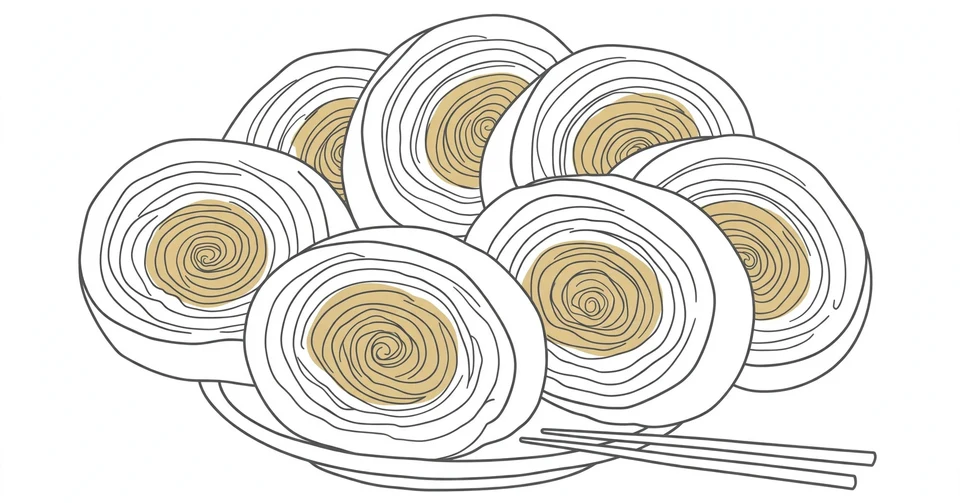
I first tried datemaki at a New Year gathering in Shizuoka, where it sat in the top tier of the box beside the black beans and the herring roe. I expected something like the rolled omelette I knew from breakfast, only sweeter. What I got was closer to a soft sponge cake that had been to sea: light, springy, sweet at the front and savoury underneath, with a golden brown top that tasted faintly of caramel. I took one slice to be polite and went back for three more, which is how I learned that the quietest dish in the box is often the one people finish first.
What datemaki is, and what it is not
Datemaki, written 伊達巻 in Japanese, is an omelette that behaves like a cake. The eggs are blended with hanpen, a white fish cake, plus sugar, mirin, and a pinch of salt, then poured into a square pan and baked in the oven in a single flat sheet. While the sheet is still hot it is rolled up in a bamboo mat, tied, and left to cool into a firm log. When the log is sliced, each round shows the spiral where the sheet curled in on itself, and the outside carries the ribbed pattern of the bamboo.
That is what sets datemaki apart from the rolled omelette most people know. Tamagoyaki, the everyday Japanese omelette, is cooked on the stove in a rectangular pan, one thin layer at a time, rolled as it cooks. Datemaki is baked in the oven in one layer and rolled once, at the end. Tamagoyaki is usually savoury or only mildly sweet, and it is eaten all year round. Datemaki is frankly sweet, it contains fish cake rather than just fish flavoured dashi, and it belongs to New Year. The two dishes are cousins, but they are not the same dish, and confusing them is the fastest way to misunderstand both.
The texture is the giveaway. A good datemaki is soft and springy, almost spongy, with a fine, even crumb and a golden brown top. It should yield under a chopstick and spring back, not crumble and not squash flat. The sweetness arrives first, then the egg, then a quiet savoury note from the fish cake that keeps the whole thing from tasting like dessert. I think that balance is the reason datemaki survives in a box full of much louder dishes. It does not shout. It waits, and by the third day of picking at the box, it is usually the slice people miss.
A roll that came from Nagasaki
Datemaki began in Nagasaki, the port city that was Japan's window to the outside world during the Edo period, when the country was largely closed to foreign trade. Sugar reached Japan through Nagasaki earlier than through most of the country, and sweet food became part of the city's celebration cooking. The dish was once called castella kamaboko, a name that ties it to castella, the sponge cake Portuguese traders brought to Nagasaki, and to kamaboko, the fish cake it resembles. It was a port city dish from the start: foreign sugar, local fish, Japanese technique.
How it got its present name is a matter of competing stories, and the honest thing is to tell both. One story says the roll looked like the obi sash of a kimono worn by fashionable young people of the Edo period, people called date mono, and since date meant fashionable or eye catching and maki meant rolled, the dish became datemaki. Another story credits the warlord Date Masamune, who was said to enjoy eggs grilled with flounder meat, and claims the dish took his name. The full history, with both theories laid out, is told in the Food in Japan guide to date maki, which traces the dish to Edo period Nagasaki and explains the fashionable sash theory in detail.
Either way, the name stuck, and the dish travelled. From Nagasaki it spread through the country as part of osechi, the New Year feast, and it settled into the top tier of the box, where the celebratory dishes live. I like that a dish with an uncertain name ended up carrying such a certain job. Nobody agrees on who named it, but everybody agrees on what it is for, and that is rarer than it sounds.
Why a scroll stands for learning
The meaning of datemaki lives in its shape. Rolled up, it looks like a scroll, and in the days when important documents were rolled into scrolls, a scroll was the picture of knowledge itself. Eat the scroll, the logic goes, and you take in learning, wisdom, and success in studies. It is the kind of wordless pun that runs through all of osechi: a shape that means a thing, eaten in the hope of gaining the thing. For families with children at school, the slice is a small, edible piece of encouragement, and I have seen parents serve it to a child with exactly that look, half joke and half genuine hope.
The eggs carry a second wish. Eggs mean children, so datemaki also stands for descendants as treasures, for a family that continues and prospers. The golden yellow of the egg helps too. It is close to the colour of gold, which gives the dish a feeling of luxury and good fortune on a table that is already full of golds, reds, and blacks. Three meanings in one slice: learning, children, and plenty. Most dishes in the box carry one wish. Datemaki carries three, and it does it without looking busy.
There is also a third reading, and it is worth mentioning because it shows how local these meanings can be. The agriculture ministry ties datemaki to a kimono pattern instead of a scroll, and reads it as a wish never to lack clothing. I enjoy the disagreement. A dish with two explanations has been loved by two different kinds of people, and both of them were probably right about their own family. When a symbol is argued over, it usually means the symbol is still alive.
The fish cake that makes it float
If there is one ingredient that makes datemaki what it is, it is hanpen. Hanpen is a white, square fish cake made from fish paste mixed with grated mountain yam and whipped egg, and it has a light, airy texture that is closer to meringue than to the firm fish cakes most people know. Blended with eggs, it gives datemaki its flavour and its lift, the lightness that makes the roll spongy instead of dense. Without hanpen, you are making a sweet omelette. With it, you are making datemaki.
Traditionally the fish was ground into a paste by hand, with a mortar and pestle, then mixed with whole eggs, whipped egg whites, sugar, and seasonings into a kind of batter. It was slow, laborious work, which is why most modern recipes use hanpen in place of the hand ground paste. The shortcut is an honest one. Hanpen does the same job, and it does it reliably, which matters when you are cooking for a holiday and the roll has to come out right the first time.
Finding hanpen outside Japan takes a little effort. Japanese grocery stores usually stock it in the refrigerated or frozen section, and if you cannot find it, pureed white fish, scallops, or shrimp can stand in, as they did before hanpen became the standard. That substitution is not a modern cheat. It is the older method, the one the dish started with, and it is a useful reminder that datemaki was a cook's dish before it was a shop's dish. The fish is not a garnish or a flavouring. It is half the recipe, and the roll would not be itself without it.
How datemaki is made at home
Making datemaki at home is easier than its reputation suggests, and the method is forgiving in a way that surprises first timers. The ingredients are few: eggs, hanpen, sugar, mirin, and salt, with a little honey in some recipes. A typical batch uses four or five eggs and about 90 to 100 grams of hanpen, with two tablespoons of sugar and one or two tablespoons of mirin. The exact amounts vary from recipe to recipe, and that variation is normal. The dish has always been adjusted to the household, and a cook who likes it less sweet simply uses less sugar.
The method has four stages, and each one is simple on its own. First, everything goes into a blender or food processor and is blended until smooth, until the mixture looks like a loose cake batter. Second, the batter is poured into a square baking pan lined with parchment paper and baked in a fairly hot oven, around 190 to 200 degrees Celsius, until the top turns golden brown and a toothpick pushed into the centre comes out clean. That takes about ten to twenty minutes depending on the oven, and the wise cook checks early, because an overcooked datemaki turns dry and no amount of rolling will save it. Getting the egg cooked right matters more than getting the colour perfect. A pale datemaki is still delicious. A dry one is not.
Third comes the roll, and this is the part that needs timing rather than skill. The baked sheet must be rolled while it is still hot, on a damp bamboo mat, with the browned side facing down, or it will crack instead of curling. A minute or two of cooling is enough to make it safe to handle, but no more. Roll it slowly, tie the mat with rubber bands to hold the round shape and press the ribbed pattern of the bamboo into the surface, then wrap the whole thing in plastic so it does not dry out. Fourth, it rests in the fridge for at least two hours, or overnight, until the shape sets. Then it is unwrapped and sliced into ten or twelve rounds. The clearest step by step version of this method, with photographs of each stage, is the norecipes datemaki recipe, which bakes the roll at 190 degrees Celsius and rests it in the fridge before slicing.
The most common mistakes are all about patience. Rolling too late, when the sheet has cooled, is the first. Overbaking is the second. Slicing too soon, before the roll has set, is the third. None of them ruins the flavour, which is a comforting thought for a first attempt. Even a cracked or slightly lopsided datemaki tastes like datemaki, and a cook who has made it once will make it better the second time, because the dish teaches by doing. I think that is true of most New Year cooking. The first year you follow the recipe. The second year you understand it.
Datemaki against tamagoyaki
Put datemaki beside tamagoyaki and the family resemblance is obvious, but so are the differences. Both are rolled egg dishes. Both use eggs, sugar, and a bamboo mat. But they are cooked differently, seasoned differently, and eaten on different occasions, and a table that serves one is not serving the other.
| Datemaki | Tamagoyaki | |
|---|---|---|
| Cooked | Baked in the oven in one flat sheet | Cooked on the stove in thin layers |
| Fish | Hanpen or fish paste blended in | Usually no fish, sometimes dashi only |
| Sweetness | Clearly sweet | Savoury to mildly sweet |
| When eaten | New Year, in osechi | All year, breakfast and bento |
| Texture | Soft, spongy, light | Firm, layered, springy |
The comparison matters because the two dishes are often confused by visitors, and the confusion is understandable. If you order tamagoyaki in a restaurant in July, you will get a neat yellow roll with visible layers, served warm. If you eat datemaki in January, you will get a cold slice from a box, sweeter, softer, and ribbed on the outside from the mat. They share a shape and a technique, but they do not share a season, and in Japanese food the season is often the point. Datemaki without New Year is like a Christmas cracker in June: the same object, but the meaning has gone quiet.
The sweetness argument
Ask a room of Japanese cooks about datemaki and the first argument will be about sugar. The dish is meant to be sweet. The question is how sweet. Recipes vary widely, and households vary more, because sweetness is the most personal part of the dish and the part people remember from childhood. A cook who grew up with a very sweet datemaki will find a restrained one thin and disappointing. A cook who grew up with a restrained one will find a sweet one cloying.
There is also a regional split. Datemaki is sweeter in Kanto, around Tokyo, than in Kansai, around Kyoto and Osaka, and a traveller who tries both will notice the difference at once. Shop bought datemaki tends toward the sweet end of the scale, which is one reason home cooks often make their own: they can pull the sugar back to the level their family likes. Sugar does more than sweeten, too. It helps the top brown in the oven, so a cook who cuts the sugar hard may get a paler roll, and that is a fair trade for most people. Flavour first, colour second, is a good rule for this dish.
My own view is that the sweetness is the point, not a flaw. Datemaki is a celebration dish, and celebration food is allowed to be sweet. The problem is never the sugar itself. It is the sugar without anything behind it, sweetness with no egg and no fish to answer it. A well made datemaki earns its sugar, because the savoury note from the hanpen and the caramel note from the mirin give the sweetness something to stand on. Eat a slice slowly and you can taste the order of it: sweet first, then egg, then the sea, quiet at the back. That sequence is the recipe working as it should.
Where datemaki sits in the osechi box
In the osechi box, datemaki sits in the top tier, the first box, where the celebratory dishes and sweets are kept. It shares that tier with kuromame, the black beans for health, kazunoko, the herring roe for children, tazukuri, the little glazed sardines for a good harvest, kamaboko, the red and white fish cake, and kuri kinton, the golden chestnut mash for wealth. That is crowded company, and it tells you how the dish is valued. The top tier is not a random shelf. It is the first thing the family sees when the box is opened, and it holds the dishes that matter most.
Our guide to the whole feast, Osechi Packs a Whole Year of Luck Into Stacked Boxes, lays out every dish in the box and the wish each one carries, and datemaki is there among them as the sweet rolled omelette that looks like a scroll. The box itself matters too. The dishes are packed into jubako, the stacked lacquered boxes that give the meal its shape, and the tiers stack good fortune on good fortune, layer upon layer. Our article on Jubako Layers a Familys Luck One Box at a Time follows those boxes from the workshop to the table and explains why the stacking is itself the first wish.
At the table, the tower comes apart and the tiers are laid side by side, so everyone can reach every dish. Datemaki is eaten cold or at room temperature, straight from the box, usually with chopsticks and usually in small slices, because a little of it goes a long way in a meal that already has a dozen other flavours competing for attention. It keeps well, too. Like most osechi dishes it is made to last, seasoned to keep for two or three days chilled, which is exactly the length of the New Year holiday. That is why the roll is made in advance, on the last days of the old year, and eaten slowly across the first days of the new one. The cooking is done before the year begins, and the eating is unhurried.
Ready made or homemade
Most families in Japan today do not make every dish in the osechi box by hand. Many buy ready made sets from department stores, supermarkets, and specialist shops, and mix them with a few homemade dishes, and datemaki is one of the easiest dishes to buy. At New Year it is sold in every supermarket in the country, in slices and in whole rolls, and specialist kamaboko shops have sold their own versions for generations. Suzuhiro in Asakusa has specialised in traditional Japanese foods since 1865, and its datemaki is made with fish paste, eggs, and sake by hand. Marutashiro in Odawara has been making kamaboko and datemaki for about 140 years, since the first year of the Meiji era. Azuma, a restaurant in Choshi founded in 1966, is known for a datemaki that looks like a pudding, golden brown and carefully made from selected eggs.
Buying it ready made is a sensible choice, and there is no shame in it. The roll is fiddly, the timing matters, and a shop that makes hundreds of rolls a day will usually make a better one than a cook making their first. But making it at home has a value that has nothing to do with quality. The New Year dishes are, in the end, a household's own record of the year, and a dish you rolled yourself carries a different weight on the table than one you bought, even if the bought one tastes better. I think the honest answer is to do both: buy the dishes you cannot make well, and make the ones you can, and let datemaki be one of the ones you try, because it is the most forgiving dish in the box to learn on.
Eating datemaki after New Year
Datemaki does not have to wait for January. The roll is good sliced cold into a bento box, where its sweetness sits well beside rice and pickles, and it works on a buffet table, where the golden spirals are the first thing people notice. It is also served with drinks, and its sweetness makes it a natural partner for sake or tea, the same way a sweet bean paste pairs with bitter green tea. Cut thin, it can top a small cracker or a piece of bread. Cut thick, it is a snack on its own, eaten with chopsticks standing at the kitchen counter, which is how most of it disappears in my experience.
That afterlife matters, because it keeps the dish from becoming a museum piece. A food that is only eaten on one day of the year is a ritual. A food that is eaten on that day and also on ordinary days is a living dish, and datemaki is both. The New Year gives it meaning. The rest of the year gives it a use. I like that balance, and I think it is why the dish has survived when other New Year foods have faded. It is not only symbolic. It is also, plainly, good to eat, and a dish that is good to eat does not need a holiday to justify itself.
If you make a roll and have half of it left after New Year, wrap it well and keep it in the fridge, and eat it within a few days. It dries out if it is left uncovered, so plastic wrap is not optional, it is part of the recipe. Sliced thin and eaten cold, it will still be soft and sweet on the third day, and by then the box will be nearly empty, the holiday will be nearly over, and the last slice will taste like the year settling in.
A small roll with a large job
Datemaki is a small dish with a large job. It has to be sweet without being cloying, light without being empty, and symbolic without being solemn, and it has to do all of that in a slice no thicker than a finger. That it manages the job at all is a quiet achievement, and that it has managed it for centuries, from a port city in Nagasaki to a box on a table in Shizuoka, is a larger one.
What I take from it is simpler than the symbolism. A dish does not need to be grand to matter. It needs to be made with care, served with meaning, and eaten slowly, with people you like, on a day that is set aside for exactly that. Datemaki is an egg and a fish cake rolled into a scroll, and the scroll says to learn, and the eggs say to grow, and the gold says to prosper. Eat the slice, take the wishes with a pinch of salt, and keep the part that is true: that a year that begins with food made slowly and shared freely has already begun well.
More in Food & Travel
- Kamaboko Paints the New Year Red and White
- Japanese Bento and the Lunch Box That Became an Art Form
- Tazukuri Turns Tiny Sardines Into a Wish for a Good Harvest
- Kazunoko Is the Herring Roe That Promises Children and Plenty
- Kuromame Turns Black Beans Into a Wish for Health
- Jubako Layers a Family's Luck One Box at a Time
Latest posts
- Gyoji Are Sumo's Referees in Silk and Calligraphy
- Japanese Baseball and the Game Japan Made Its Own
- The Banzuke Remembers Every Basho in Calligraphy
- Osechi Packs a Whole Year of Luck Into Stacked Boxes
- Fifteen Days of Basho Decide Who Sumo Remembers
- Kojiri Is the End Cap That Takes Every Knock for a Katana
- Kurikata Is the Chestnut Knob That Holds a Katana at the Hip
- Koshirae Is the Formal Mounting That Turns a Blade Into a Katana
- Shirasaya Is the Plain White Scabbard Where a Katana Rests
- The Togishi Polishes a Katana for Weeks Before It Ever Cuts
- Kozuka Is the Small Knife Hiding in a Katana's Saya
- Wakizashi Was the Short Sword a Samurai Never Took Off
- Tsuba Is the Small Guard That Stops a Katana From Cutting Its Owner
- Yokote Is the Small Line That Tells a Katana's Age
- Seppa Are the Thin Washers That Keep a Katana From Rattling