Kamaboko Paints the New Year Red and White
· 23 min read
Kamaboko is the mild, springy fish cake that turns a New Year table red and white, and its story runs from a Heian feast in 1115 to the ramen bowls and oden pots of today.
The first thing you notice about kamaboko is how little it asks of you. It sits quietly in the New Year box, a pale half moon edged in pink, mild and springy, easy to overlook beside the glossy black beans and the bright herring roe. Yet the Japanese New Year table would feel wrong without it, and once you know what it carries, a thousand years of history, a wish for purity, a small red shield against bad luck, you start to see why this humble fish cake has lasted so long.
Kamaboko is steamed fish cake made from surimi, a smooth paste of white fish, shaped into a half cylinder and steamed on a small wooden board. The red kind is white inside with a pink skin, the white kind is pale all the way through, and both are sliced thin and eaten cold or dropped into hot soup. It tastes mild and faintly sweet, nothing like the fishy punch people expect, and its springy bite, called ashi in Japanese, is the mark of good craft.
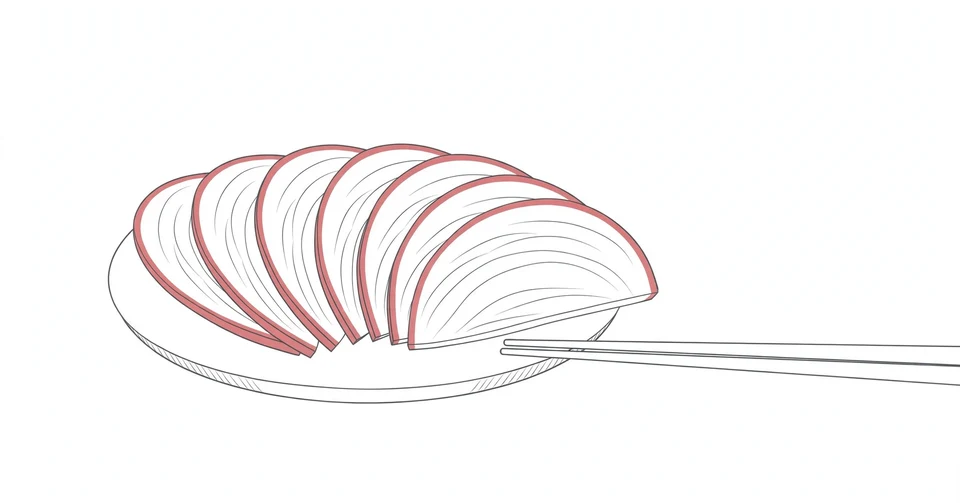
I first paid proper attention to kamaboko at a New Year gathering in Shizuoka, where a neighbour laid out a small plate of it beside the stacked osechi boxes. I had eaten it a dozen times before in ramen and never really tasted it. That day, sliced thin with a dab of wasabi and soy sauce, it finally made sense: a food that does not shout, a food that trusts you to slow down. This article is an attempt to give that quiet food the attention it deserves, from its first written record in 1115 to the grilled bamboo leaf cakes of Sendai and the spiral topped ramen bowls of today.
What kamaboko actually is
At its simplest, kamaboko is a processed seafood product made from surimi, and surimi is nothing more exotic than minced white fish that has been washed, deboned, and ground into a smooth paste. The fish most often used are cod, Alaska pollock, threadfin bream, lizardfish, gnomefish, gruntfish, and Japanese bluefish, usually a blend rather than a single species. The paste is seasoned with salt, a little sugar and starch, and sometimes sake and egg white, then shaped and cooked by steaming, grilling, or frying until it turns firm.
The classic form, the one most people picture when they hear the name, is a semi cylindrical loaf steamed on a small wooden board. The board is not decoration. It holds the shape while the paste sets, and the finished loaf is sold still sitting on it, ready to be lifted off and sliced. Red kamaboko is white on the inside with a striking pink outer layer, while white kamaboko keeps its natural pale colour all the way through. Both share the same mild flavour and the same bouncy texture, and the difference is mostly visual, a choice about what the occasion calls for.
That texture is the whole point of the fish cake. It is not flaky like a grilled fillet and not soft like a dumpling. It is firm yet yielding, springy in a way that pushes back gently against the teeth. Japanese craftsmen call this quality ashi, and it is the first thing a good maker is judged on. A loaf with poor ashi feels mushy or rubbery, while a good one feels clean and alive. If you have ever eaten imitation crab meat, known as kanikama, you already know the family resemblance, because kanikama is also made from surimi, pressed into shreds that mimic crab leg meat.
It is also a practical food. It is high in protein and low in fat, and a typical serving contains all nine essential amino acids, which makes it a complete protein source. The trade off is salt. Surimi needs salt to bind, and commercial kamaboko can be quite high in sodium, so people watching their salt intake should check the label. Traditional producers use only fish and a short list of seasonings, while some mass produced versions add MSG and preservatives. The ingredient list tells the story plainly, and it is worth the extra moment to read it.
What I like most about this fish cake is that it refuses to be the star of the show. It is a supporting player by design, a food that makes the bowl or the box around it better without demanding attention for itself. There is something honest about that. In a food culture full of loud flavours and dramatic presentations, kamaboko earns its place by being steady, mild, and useful, and I think that modesty is exactly why it has survived for nine centuries.
Kamaboko's long road from skewers to celebration
The history of kamaboko goes back to the Heian period, and its first written record is unusually precise. A document called the Ruiju-zoyosho describes a celebratory feast held on 21 July 1115 by Fujiwara no Tadazane, a high ranking minister of the court, and kamaboko was among the dishes served. That single record is why 15 November became Kamaboko Day in Japan, a date the Japan Kamaboko Association formally designated in 1983 to mark the anniversary of the feast. Few foods can point to their debut with that kind of exactness, and this fish cake wears its age lightly.
The name itself tells a story about how the food used to look. In its earliest form, ground fish meat was wrapped around a bamboo stick and chargrilled over a flame. The shape reminded people of two things at once: the head of a cattail plant, called gama no ho, and a long spear, called hoko. Put together, kabahoko, the name later softened into kamaboko. That skewered ancestor never disappeared. It evolved into chikuwa, the hollow grilled tube that still sits in oden pots and convenience store shelves today, while the steamed loaf on a wooden board became the standard form we know today.
For centuries it stayed close to celebration. It was a banquet food, something for feasts and formal meals rather than an everyday purchase. During the Edo period, craft techniques matured and apprenticeship systems kept the knowledge of good kamaboko tightly guarded within producing families. Then the Meiji era brought mechanical grinders, and large scale production became possible for the first time. After the Second World War, kamaboko spread into daily life as an affordable, protein rich food for ordinary households, and a technical breakthrough in 1954 made that spread permanent: a technician at the Hokkaido Fisheries Experiment Station developed a method for producing frozen surimi from Alaska pollock, which meant the paste could be made in bulk, shipped, and stored.
The long history is well told in the Just One Cookbook guide to kamaboko, which traces the same path from the Heian feast to the modern loaf and explains why the red and white pair belongs on celebratory tables. Read the full history and varieties on Just One Cookbook
Reading that history changed how I think about a food I used to treat as a garnish. It did not become a New Year symbol by accident or by marketing. It earned the role over centuries, starting as a clever way to preserve fish, becoming a feast dish for nobles, and finally settling into the homes of ordinary people. A food that survives that journey is not a trend. It is a habit, and habits that last nine hundred years usually carry a reason worth respecting.
How kamaboko is made, from white fish to white loaf
Making it starts with white fish, and the first real work is washing. The filleted fish is rinsed again and again in cold water, a step called mizu sarashi, or water bleaching, which removes fat, blood, and enzymes that would otherwise dull the colour and leave a fishy smell. The result is a clean white paste with a glossy surface, and it is this washing, more than any other step, that gives good kamaboko its natural whiteness and its springy bite. In Odawara, one of the most famous kamaboko cities in Japan, craftsmen use local groundwater from the Hakone area, known as Hakone Hyakunenmizu, or Hakone hundred year water, to wash and purify the paste, and they credit that water for the particularly clean and elastic character of Odawara kamaboko.
Once the paste is washed, salt is worked in to draw out the sticky protein that binds everything together, then sugar, starch, and seasonings are mixed through. The paste is shaped by hand or machine into a half cylinder and pressed onto a small wooden board, and then it is steamed until firm. Some varieties are grilled instead, which gives a toasty surface and a faint smokiness, and others are fried. The steamed board loaf is the classic, but the method is a family of techniques rather than a single recipe, and each region has its own way of handling the paste.
Quality varies widely, and the difference is easy to taste once you know what to look for. A good loaf has a glossy cut surface, a clean white interior, and a bounce that returns gently when pressed. A poor one looks dull, feels either mushy or rubbery, and tastes faintly of nothing at all. Traditional producers use only high quality fish with no additives, while cheaper factory loaves may rely on fillers and flavourings to make up for thin fish content. The price gap on a supermarket shelf is not random. It usually reflects how much real fish went into the paste and how carefully it was washed.
There is a quiet discipline in the way kamaboko is made that I admire. Nothing about the process is showy. The craftsman washes, grinds, seasons, shapes, and steams, and the reward for doing each small step properly is a food that looks almost plain. That is the nature of craft at its best: the effort disappears into the result, and only the eating reveals it. When I buy kamaboko now, I look for the shorter ingredient list and the firmer loaf, and I am willing to pay a little more for a maker who still washes the fish properly.
Red and white kamaboko and the meaning of the colours
The most famous pairing in the kamaboko world is kohaku kamaboko, the red and white pair that appears in osechi, the traditional New Year feast served in stacked lacquered boxes called jubako. The two loaves sit side by side, one blushing pink and one plain white, and together they carry more meaning than any other single item in the box. In Japanese culture, red and white are the colours of celebration and good fortune, and kamaboko wears both at once.
The symbolism runs in two directions. Red kamaboko is said to ward off evil and protect the household from bad luck in the year ahead, while white kamaboko stands for purity and a fresh start. The half moon shape of a sliced piece adds a third layer of meaning: the arch is said to recall the first sunrise of the year, the dawn breaking over the first morning of January. Eat the slice, the tradition suggests, and you take a small piece of that sunrise with you into the new year.
It helps to know that the red of red kamaboko is really a soft pink, dyed onto the outside of the loaf while the inside stays white. The colour is a skin, not a flavour, and the pink layer is thin enough that a slice shows a white face framed by a rosy edge. That contrast is what makes the slices so decorative in the osechi box, where they sit beside other foods that each carry their own wish. The black beans in the box, kuromame, are eaten as a wish for health, and the pairing of dark beans with bright kamaboko shows how the whole feast works: every dish is a small hope you can eat. Read about the black beans that share the box with kamaboko
The osechi box itself is worth understanding if you want to understand why kamaboko matters so much at New Year. Each dish in the stacked boxes is chosen for what it symbolises, and the boxes are eaten over the first days of January while families rest and visit. Kamaboko holds a prominent place in that arrangement, not because it is the richest or rarest food in the box, but because its colours and its shape say the new year plainly: red against evil, white for purity, and the rising sun in every slice. Read how osechi packs a whole year of luck into stacked boxes
I find this symbolism moving rather than superstitious. Nobody I know in Japan believes a slice of fish cake will literally keep evil away, but everyone understands what the colours are saying. The red and white pair is a way of starting the year deliberately, of putting hope on the table in a form you can share and eat together. That is a better use of symbolism than decoration for its own sake, and it explains why kamaboko has kept its place in the box while other New Year customs have faded.
The kamaboko family goes far beyond the red and white loaf
Kamaboko is not a single product. It is a broad family of surimi based fish cakes that vary by shape, cooking method, and regional origin, and the red and white board loaf is only the most familiar member. The Food in Japan guide to kamaboko gives a clear map of the main types, and it is worth reading before a trip to a Japanese supermarket, because the chilled fish cake aisle is far more varied than a first time visitor expects. See the full guide to kamaboko types on Food in Japan
| Type | Appearance | Cooking method | Best known for |
|---|---|---|---|
| Red and white kamaboko | Pink red or white, board mounted | Steamed | New Year osechi, everyday meals |
| Narutomaki | Pink and white spiral | Steamed | Ramen topping, decorative garnish |
| Chikuwa | Hollow tube, browned exterior | Grilled | Oden, stir fries |
| Sasa kamaboko | Bamboo leaf shape, pale white | Lightly grilled | Sendai specialty, smoky aroma |
| Hanpen | White square or triangle, fluffy | Boiled | Oden, datemaki |
| Satsuma-age | Various shapes, golden brown | Deep fried | Kagoshima specialty, hot pot ingredient |
| Kobu maki | Kelp wrapped swirl | Steamed | New Year osechi, premium occasions |
Narutomaki is the member of the family most people outside Japan have already met without knowing its name. It is the white disc with a pink spiral that floats in a bowl of ramen, adding a flash of colour and a mild seafood note to the soup. The spiral is made by rolling the paste with a coloured layer inside, then slicing the loaf into thin rounds, and the result is so recognisable that it has become a visual shorthand for ramen itself. A bowl without it looks slightly undressed to a Japanese eye.
Chikuwa is the oldest shape in the family, the direct descendant of the skewered fish paste from the Heian period. The paste is wrapped around a bamboo or metal stick, grilled until the outside browns, and then slipped off to leave a hollow tube. It is a favourite in oden, the winter stew of fish cakes and vegetables simmered in dashi, and it is also sold in convenience stores as a quick snack. Toyohashi in Aichi Prefecture is recognised as the origin of modern commercial chikuwa production, and the city still takes pride in the craft.
Sasa kamaboko deserves a paragraph of its own, because it shows how one region can make kamaboko entirely its own. In Sendai, in Miyagi Prefecture, craftsmen mould white fish paste into a shape that mimics a bamboo leaf, then grill it lightly before serving. The surface develops a pale golden char, and the gentle smokiness sets it apart from the steamed varieties. Eaten fresh from the grill, it is warmer and slightly looser than the packaged version, with a faint woodsy aroma, and specialist shops at Sendai Station and downtown grill it on the spot while visitors line up. Sasa kamaboko is one of the three major Sendai specialties, alongside gyutan, grilled beef tongue, and zunda mochi, and it is one of the most popular souvenir foods to take home from Miyagi.
The rest of the family fills out the picture. Hanpen is a soft, fluffy white square or triangle that is boiled rather than steamed, and it soaks up dashi in oden like a sponge. Satsuma-age, from Kagoshima, is deep fried until golden brown and turns up in hot pots and stir fries. Kobu maki wraps the fish paste around kelp and rolls it into a swirl, a premium piece reserved for formal occasions and the New Year box. Decorated kamaboko takes the craft further still: steamed cylindrical loaves that reveal a picture when cut open, a tree, a flower, or a kanji character hidden inside the slice.
What strikes me about this family is how much variety comes from a single idea. One paste, white fish washed and ground, becomes a dozen different foods simply by changing the shape and the heat. Steamed, grilled, fried, or boiled, the same starting point turns into a ramen topping, a New Year symbol, a station snack, and a festival souvenir. That is the mark of a food that a culture has truly adopted: it stops being one dish and becomes a vocabulary.
How to eat kamaboko at home
The simplest way to eat kamaboko is also the best introduction. Slice it thin, straight from the board, and serve it cold with wasabi and soy sauce. This presentation is called itawasa, and it is a classic izakaya snack, the kind of small plate that arrives with a cold beer or a cup of sake and disappears quietly while people talk. The fish umami pairs naturally with the heat of wasabi, and the whole thing takes less than a minute to prepare. If you have never eaten kamaboko before, start here, because itawasa shows you the food with nothing hiding it.
From that starting point, kamaboko fits into almost any Japanese meal. Sliced narutomaki goes on top of ramen, soba, and udon, where it adds colour and a gentle seafood flavour to the broth. Whole pieces go into oden, absorbing the dashi slowly during a long simmer. Red and white kamaboko appears in zouni, the New Year soup eaten in many regions, and it tops toshikoshi soba, the noodle soup eaten on New Year Eve. The mild flavour is the reason it works in so many places: it never fights the broth or the sauce, it simply adds body and a springy contrast.
There are more playful ways to serve it too. Thin slices can be stuffed with a little cream cheese or cucumber and eaten cold as a finger food. Frying thin slices in sesame oil brings out a crispy outer layer with a soft, chewy interior. Some people enjoy it as tempura, wrapped in nori for an extra layer of ocean flavour. And for a special occasion, the slices can be cut into decorative patterns, a fan, a flower, a pine sprig, which turns a simple loaf into a small piece of table art. The guides that teach these cuts make the work look easy, and even a beginner can manage a simple fan cut with a steady knife.
Making kamaboko at home is possible, and the Food in Japan guide lays out a straightforward version that takes patience rather than skill. White fish fillets are ground in a food processor until smooth, then blended with one egg, a little ginger juice, cornstarch, and salt until the paste holds together. The paste is divided, shaped into logs about four and a half inches long and two inches wide, rolled in oiled foil, and steamed over high heat for thirty minutes. A skewer pushed into the centre tells you when it is done: if it comes out clean, with no sticky paste, the kamaboko is ready. Let it cool before slicing, and slice it thin.
I have not made kamaboko at home yet, and I am honest about that, but the recipe is on my list for the next quiet weekend. The appeal is not just the result. It is the process, the grinding and shaping and waiting, which forces you to pay attention to a food that is usually bought ready made. Even if my first loaf turns out lopsided, it will teach me more about the craft than a dozen supermarket purchases, and that is a fair trade for thirty minutes of steaming.
Kamaboko in everyday Japanese life
Outside the New Year box, kamaboko is an ordinary food, and that ordinariness is part of its charm. You will find it in the chilled section of every supermarket in Japan, in the refrigerator or freezer aisle of Japanese grocery stores abroad, and in forms that suit every budget. The board loaves sit beside tubes of chikuwa and packs of narutomaki, and the price range is wide: a basic factory loaf costs very little, while an artisan loaf from a famous maker can cost several times as much. Both are kamaboko, and both have their place.
The food shows up in places you might not expect. Convenience stores sell chikuwa as a snack, department store food floors carry high quality chikuwa and gift sets of assorted kamaboko, and ramen shops keep narutomaki on hand as a standard topping. In winter, oden pots simmer in convenience stores and at home, filled with kamaboko of several kinds soaking up dashi. At New Year, the red and white pair returns to the table as it has for centuries, and the rest of the year it quietly fills lunchboxes, noodle bowls, and drinking snacks without ceremony.
Odawara remains the spiritual home of kamaboko, and a visit there shows how seriously the craft is taken. Suzuhiro, a kamaboko specialty producer originally from Odawara, is known for using high quality white fish and Hakone groundwater, and its museum in the city explains the history and the making of the fish cake with hands on exhibits. Within the same Gamo no Sato complex sits Chouwarou, a restaurant in a renovated traditional building with lacquered walls and old farmhouse architecture, where kamaboko features on the menu alongside craft beer and regional artisan foods. Eating there connects the dining experience directly to the production heritage of the city.
There is a lesson in the way kamaboko moves between celebration and everyday life without changing its nature. The same loaf that sits in the New Year box also goes into a Tuesday bowl of noodles, and nobody finds that strange. Most foods choose one role or the other: festive or daily, special or ordinary. Kamaboko refuses the choice, and I think that refusal is the reason it has lasted. A food that can be both a wish for the new year and a quick snack after work has earned a permanent place in the kitchen.
Where to try the best kamaboko
If you want to taste kamaboko at its best, go to the source. Odawara, in Kanagawa Prefecture, is the first stop, and it is an easy day trip from Tokyo. The Suzuhiro Kamaboko Museum in the city walks visitors through the history and the craft, and the shops nearby sell loaves made that day with the local groundwater. The Gamo no Sato complex, home to the Chouwarou restaurant at 245 Kazamatsuri in Odawara, is the place to sit down and eat kamaboko as a meal rather than a topping, with the old farmhouse setting doing half the work of the occasion.
Sendai is the second stop, and the reason is sasa kamaboko. Several specialty shops inside and near Sendai Station grill the bamboo leaf cakes fresh while you watch, and the difference between a just grilled piece and a packaged one is large enough to justify the trip on its own. Buy a few to eat on the spot, warm from the grill, and take a box home as a souvenir, because sasa kamaboko keeps well and travels better than most fresh foods.
Tokyo offers a shorter version of the same experience. The Suzuhiro shop in Asakusa, at 1-38-1 Asakusa in Taito Ward, sells chewy kamaboko, roasted chikuwa, and oden ingredients from ten in the morning until six in the evening, every day. It is a small shop, easy to miss among the temple crowds, and that is part of its appeal: a quiet counter selling a quiet food in one of the busiest corners of the city. Osaka has its own answer in the Yao Kamaboko Store, a three minute walk from Temma Station, where the gyoza maki, a dumpling wrapped in fish paste, draws curious first time visitors with a texture that is firm outside and savoury all the way through.
My own plan is simple, and I offer it as a suggestion rather than a rule. If you are in Tokyo for a few days, start with the Asakusa shop, buy one red and one white loaf, and eat them as itawasa that evening with wasabi and soy sauce. If the taste hooks you, as I expect it will, put Odawara on the list for the next trip and eat the fish cake where the water that makes it comes from. Food tastes better when you know where it comes from, and kamaboko, of all foods, rewards that kind of attention.
Why a quiet fish cake still matters
Kamaboko will never be the most exciting food on a Japanese table, and that is precisely the point. It does not need to be exciting. It needs to be there, red and white at New Year, spiralled in the ramen bowl, simmering in the winter oden, waiting in the fridge for a quick plate with wasabi. It has done that job for more than nine hundred years, through feasts and famines, through craft guilds and factory lines, and it has done it without changing its nature.
What stays with me after writing about kamaboko is the modesty of it. A food made from ordinary white fish, washed in ordinary water, shaped by hand and steamed on a board, ends up carrying the colours of celebration and the shape of the first sunrise. That transformation does not come from luxury ingredients or clever technique. It comes from time, from a culture deciding, century after century, that this small thing is worth keeping. The red keeps evil away, the white promises a fresh start, and the slice on the plate is a reminder that hope can be an everyday object, not only a grand gesture.
The next time you see kamaboko, in a New Year box or floating in a bowl of noodles, give it a moment of real attention. Slice it thin, taste it slowly, and notice the spring in it. A food that has lasted since 1115 is not asking for applause. It is asking to be noticed, and that is a small enough request for nine centuries of quiet service.
More in Food & Travel
- Datemaki Rolls Sweet Eggs Into a Spiral of Good Luck
- Japanese Bento and the Lunch Box That Became an Art Form
- Tazukuri Turns Tiny Sardines Into a Wish for a Good Harvest
- Kazunoko Is the Herring Roe That Promises Children and Plenty
- Kuromame Turns Black Beans Into a Wish for Health
- Jubako Layers a Family's Luck One Box at a Time
Latest posts
- Gyoji Are Sumo's Referees in Silk and Calligraphy
- Japanese Baseball and the Game Japan Made Its Own
- The Banzuke Remembers Every Basho in Calligraphy
- Osechi Packs a Whole Year of Luck Into Stacked Boxes
- Fifteen Days of Basho Decide Who Sumo Remembers
- Kojiri Is the End Cap That Takes Every Knock for a Katana
- Kurikata Is the Chestnut Knob That Holds a Katana at the Hip
- Koshirae Is the Formal Mounting That Turns a Blade Into a Katana
- Shirasaya Is the Plain White Scabbard Where a Katana Rests
- The Togishi Polishes a Katana for Weeks Before It Ever Cuts
- Kozuka Is the Small Knife Hiding in a Katana's Saya
- Wakizashi Was the Short Sword a Samurai Never Took Off
- Tsuba Is the Small Guard That Stops a Katana From Cutting Its Owner
- Yokote Is the Small Line That Tells a Katana's Age
- Seppa Are the Thin Washers That Keep a Katana From Rattling