Kazunoko Is the Herring Roe That Promises Children and Plenty
· 20 min read
Kazunoko is salted herring roe, a crunchy golden dish in the osechi New Year feast, and its thousands of tiny eggs carry a wish for many children and a flourishing family.
Open the top box of osechi on the morning of January 1 and you will find a small golden sheet that looks like nothing else on the table. That is kazunoko, salted herring roe, and it is one of the most meaningful dishes in the whole New Year feast. It is not there for its size. A piece of kazunoko is barely larger than a finger, and it is gone in two bites. It is there because a single piece holds thousands of tiny eggs, and each one carries the same wish: may the family grow, and may it flourish.
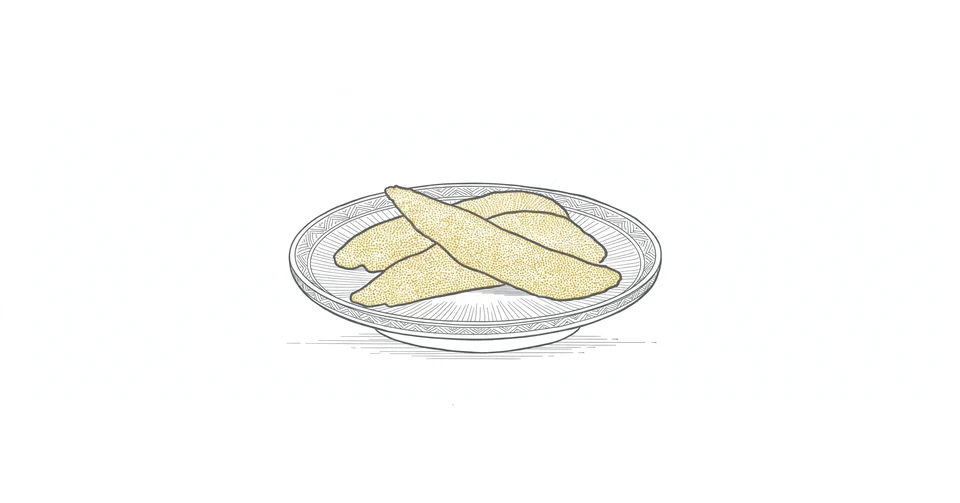
Kazunoko tastes of the sea in its crispest form. It is briny and savory, lightly sweet after its dashi marinade, and it snaps when you bite it, the tiny eggs separating with a clean crunch. People who try it for the first time often expect something soft and rich, like other kinds of roe, and are surprised by how firm it is. That surprise is part of the dish. Our article on osechi, the New Year feast packed into stacked boxes calls kazunoko the dish that surprises first timers most, and after one bite you understand why. It is a wish you can hear as well as taste.
This article looks at kazunoko on its own: what it is, why it means children and plenty, how it is prepared over several patient days, where it sits in the osechi box, how it changes from region to region, and how its history runs through the herring towns of Hokkaido. It is a small dish, but it carries a long story, and the story is worth knowing before the next New Year arrives.
What kazunoko actually is
Kazunoko, written as 数の子, is herring roe preserved with salt or seasoning. It is not baby herring. It is a cluster of many herring eggs held together in their natural roe sac, a firm, pale yellow to golden sheet that a cook cuts into bite size pieces before serving. The eggs are so tightly packed that the sheet holds together when handled gently, then breaks apart into a crisp, grainy crunch when you bite it. The Just One Cookbook guide to kazunoko describes it as a lump of tiny and crunchy eggs, an expensive delicacy with an acquired taste, and that is an honest summary. It is not a dish that tries to please everyone at once.
The flavor of kazunoko comes less from the eggs themselves than from what the cook does with them. Salted kazunoko straight from the package is strongly briny, too salty to enjoy on its own. After soaking and marinating, the taste turns savory and lightly sweet, with the clean umami of dashi, the depth of soy sauce, and the gentle warmth of sake and mirin. Just One Cookbook compares the texture to densely packed tobiko, the small flying fish roe used on sushi, and the comparison is useful: think of a sheet of tobiko that has been pressed into a single firm piece, golden instead of orange, with a snap instead of a pop.
Kazunoko is sold in a few forms, and the form decides how much work the cook must do. Salted kazunoko is the most common choice for home preparation, cured heavily with salt so it keeps, and it needs the full soaking and marinating process described below. Seasoned kazunoko is ready to eat or nearly ready, already flavored with soy sauce, dashi, mirin, or bonito, and it suits a busy New Year kitchen. Dried kazunoko, called hoshi kazunoko, is a specialty product with a concentrated flavor that needs rehydration before serving. Whole, evenly shaped golden pieces cost the most, while broken pieces often taste just as good for less money, which makes them a sensible choice for a family that cooks at home. I think the broken pieces are the honest buy. You are paying for flavor and crunch, not for a photograph, and the broken pieces deliver both.
Why kazunoko means many children
The meaning of kazunoko is written into its name. The word kazu can suggest number or abundance, and the word ko means child, so kazunoko reads, near enough, as a number of children. The name is the wish. A family that serves kazunoko at New Year is wishing for many children, healthy grandchildren, and a family line that continues and prospers into the next generation.
The biology behind the wish is easy to see. On average, a female Pacific herring lays about 20,000 eggs each year, according to the Alaska Department of Fish and Game, and the number varies with the size and age of the fish. One study of a herring stock in Alaska found an average of about 11,800 eggs per female at age three and about 53,600 at age eleven, so the exact figure moves around a great deal, but the scale is always the same: thousands upon thousands of eggs from a single fish. Hold a piece of kazunoko up to the light and you are holding a small part of that abundance in your hand. The symbolism needs no explanation after that. It is a wish made visible.
Japanese food writers sometimes call kazunoko the yellow diamond, a nickname that points to both its golden color and its price. It is a luxury food now, and it has been for a long time, which adds a second layer to the wish. Serving kazunoko says that the family can afford to hope out loud. That is worth pausing over, because wishes in osechi are never only about luck. They are also about what a household values enough to spend money and time on, and a dish of tiny eggs at the center of the New Year table says the household values its future more than its present comfort.
There is a gentler way to read the wish, and I think it is the better one. Not every family that eats kazunoko is hoping for a large number of children in the literal sense, and the dish should not be treated as a demand placed on anyone at the table. A wish for many children is, at its root, a wish for continuity: that the people we love will still be here next year, that the table will still be full, that something of this household will carry on. Read that way, kazunoko belongs to everyone at the table, including the people who have no children and the people who have already raised theirs. The eggs are many, and the hope is broad, and that is enough.
How kazunoko is prepared, step by step
Kazunoko is a dish that rewards patience and punishes hurry. The work takes days, not minutes, and most of it is waiting. That is why it belongs to osechi, a feast that is cooked before the year turns so that nobody has to cook while the year begins. A household that makes kazunoko at home usually starts about four days before serving it, and the slow pace is part of the point. The cook is not only preparing food. She is preparing the household for a holiday.
The method below follows the Food in Japan guide to kazunoko, which sets out the full process with quantities for four servings. Salt levels vary by brand, thickness, and curing method, so the times are a guide rather than a rule, and tasting a small piece along the way is the only reliable test.
The first stage is desalting. Dissolve one teaspoon of salt in 500 milliliters of cold water, cover the roe with this weak saltwater, and refrigerate it for two hours. Then change the liquid and repeat, again for two hours, and once more after that, for about six hours in total. Plain water would pull the salt out too fast and spoil the texture, so the weak saltwater removes the excess salt gradually. After about six hours, taste a very small edge. If it is still harshly salty, keep soaking and keep changing the water every hour or two until the salt level feels right.
The second stage is removing the membrane. Rinse the roe, pat it dry, and loosen the thin white membrane with your fingers, pulling slowly so the egg cluster does not break apart. This is the fiddliest part of the whole dish, and it cannot be rushed. A torn membrane means a crumbling piece, and a crumbling piece still tastes fine but loses the clean shape that makes kazunoko look like kazunoko on the plate. Take your time here. The dish has already waited for days. It can wait for a careful pair of hands.
The third stage is the marinade. Heat one tablespoon of sake and one tablespoon of mirin in a small pan for about a minute to drive off the alcohol, then add 240 milliliters of dashi and two tablespoons of soy sauce, bring it briefly to a simmer, and let it cool fully. Some cooks add a spoonful of katsuobushi, dried bonito flakes, and let it steep for a minute before straining. Never pour hot marinade over the roe, or it will turn watery and soft. Cover the desalted roe with the cold marinade and refrigerate it overnight, or for up to two days. Cut it into bite size pieces and serve it chilled, often topped with a little more katsuobushi.
| Ingredient | Amount for four servings |
|---|---|
| Salted kazunoko | 4 to 5 pieces, about 200 to 250 grams |
| Cold water for soaking | 1.5 liters |
| Salt for weak saltwater | 3 teaspoons |
| Dashi | 240 milliliters |
| Soy sauce | 2 tablespoons |
| Sake | 1 tablespoon |
| Mirin | 1 tablespoon |
| Katsuobushi | 10 grams, optional |
If the finished kazunoko is still too salty, soak it longer in fresh weak saltwater. If it tastes bitter, check for leftover membrane and use a fresh, fully cooled marinade. If it lacks flavor, give it another night in the marinade before serving. These are small fixes, but they show something true about the dish: kazunoko is not cooked so much as coaxed. The cook does not apply heat and force. She applies salt water, time, and a cold seasoned bath, and the roe answers slowly. I find that restraint appealing. Most festive cooking is loud work, all fire and noise. Kazunoko is quiet work, and the quiet suits the first days of the year.
Kazunoko in the osechi top box
In the stacked boxes of osechi, kazunoko sits in the top tier, the ichi no ju, alongside kuromame and tazukuri. These three are the classic celebration dishes, the iwai zakana, and together they open the meal. The black soybeans wish the family health and diligent work. The glazed sardines wish for a bountiful harvest. The herring roe wishes for many children and a flourishing family. Health, harvest, and children: the three things a household most wants from a new year, set out in three small dishes before anything else is eaten.
The contrast between the three dishes is part of their charm. Kuromame is soft, sweet, and glossy. Tazukuri is tiny, crisp, and glazed with soy and sugar. Kazunoko is firm, golden, and briny, the only one of the three that snaps when you bite it. Eaten side by side, they cover sweet, salty, and savory in three mouthfuls, and they set the tone for the rest of the box: small portions, strong flavors, and a meaning attached to every bite. The top box also holds other celebratory dishes, including datemaki, kamaboko, and kuri kinton, but the trio of beans, sardines, and roe is the heart of it, and a box without kazunoko feels, to many families, like a wish left unsaid.
The boxes themselves add to the meaning. A jubako is a set of square lacquered boxes that stack into a tower, and the stacking is said to represent happiness piling up on happiness. Our article on jubako, the boxes that layer a family's luck follows the tiers from the celebratory dishes at the top to the simmered vegetables at the bottom, and it shows how the arrangement turns a meal into a small piece of architecture. When the tower is unstacked on New Year morning and the tiers are laid side by side, kazunoko is easy to reach, easy to share, and easy to finish in a few bites. That is as it should be. A wish does not need a large portion. It needs to be tasted by everyone at the table.
Osechi is eaten over the first three days of January, a period called sanganichi, and the dishes are made to keep. Sugar, salt, and vinegar preserve the food so the household can eat well for three days without lighting the stove. Kazunoko fits that pattern perfectly. It is salted, then marinated, then kept cold, and it holds its crunch for days. It is food designed for a holiday of rest, and its preparation days earlier is what makes the rest possible.
Regional and family variations
There is no single correct kazunoko, and the regions of Japan make sure of that. The clearest difference is the one that shows up in the top box itself. In Kanto, around Tokyo, the celebratory trio is usually kazunoko, kuromame, and tazukuri. In Kansai, around Kyoto and Osaka, pounded burdock root called tataki gobo often takes the place of the little sardines, carrying a wish for a long life and a stable household through its deep roots. Kazunoko stays in both versions. The roe is the constant, and the company around it changes.
Within Hokkaido, the home of the herring trade, kazunoko appears in dishes that rarely reach the osechi boxes of the south. Matsumae zuke is the best known of these: chopped kazunoko mixed with squid and kombu in a sweet and savory marinade of soy sauce, sake, mirin, and sugar, where the roe adds crunch against chewy squid and slippery kelp. It is a preserved dish built for a cold climate, and it shows how a luxury ingredient can also be a practical one, stretched and shared in a jar rather than served as a single precious piece. Another Hokkaido form is kazunoko kombu, herring roe laid on kelp, which pairs the crunch of the eggs with the deep savory flavor of the seaweed itself.
Family recipes vary in the marinade as much as the regions do. Some households use a light colored soy sauce to keep the golden color bright, since a dark dashi made only with bonito can darken the roe. Some add a strip of kombu to the marinade for extra umami. Some serve the roe plain, with only a pinch of katsuobushi and a few drops of soy sauce, so the clean crunch speaks for itself. Others add a small dab of wasabi for heat. None of these is the correct version. They are all the same dish, adjusted to the taste of one household, and that is how a tradition stays alive: not by being repeated exactly, but by being cooked slightly differently in every kitchen that loves it. The families that argue about the right marinade are the families that care most about the dish, and the argument itself is a kind of affection.
A short history of herring in Hokkaido
The story of kazunoko is also the story of herring in Hokkaido, and that story is one of abundance, collapse, and stubborn survival. For centuries, herring came to the Sea of Japan coast of Hokkaido in enormous numbers to spawn in the early spring, in February and March. The fish arrived in such great numbers that the sea turned white with milt, and the Japanese name for the event, kuki, means coming in swarms. Herring were called the harbingers of spring, and their arrival set the rhythm of the coastal year.
Rumoi, a small city on the northwestern coast of Hokkaido, was built on herring. Japanese fishers worked the area from the Edo period onward, and the city was founded in 1877 with only about 600 inhabitants. In the late 19th century, migrant workers called yanshu doubled the population during the fishing season, catching and processing the fish. Most of the catch was turned into fertilizer for the cotton and mulberry fields of Honshu, and shipped south on kitamaebune cargo vessels, but dried herring and herring roe were produced alongside it. The catch reached its peak in 1897, at roughly 970,000 tons for all of Hokkaido, a figure so large that the fishing grounds were called sengokubasho, a place where you can catch a thousand koku of herring. The wealth built grand houses known as herring palaces, and fishing families like the Saga family of Rumoi, whose grounds were established in 1844, operated fleets of boats and lodged hundreds of workers in great wooden banya halls.
Then the herring vanished. The large scale catching came to an end in 1954, when the shoals suddenly disappeared, and the collapse is still described in Hokkaido as a sudden and shocking event. Overfishing and changes in the marine environment are the usual explanations, and both probably played a part. The city did not die with the fish. Rumoi turned to processing imported herring and roe from Russia, Canada, and the United States, and it specialized in salted herring roe, putting years of effort into improving the quality of the finished product through traditional methods. Today Rumoi produces the highest volumes of salted herring roe in Japan, and the city counts a 160 year history of herring processing among its proudest claims. Its mascot is even shaped like a piece of roe.
Most kazunoko sold in Japan today still depends on imported roe, mainly from the Pacific coasts of Canada and Alaska, and Japanese companies cure, grade, season, and package it at home. The catching area and the processing place are not always the same. There are hopeful signs for the local fish: recent reports describe herring returning to the coasts of Hokkaido in larger numbers, with spawning events seen again after decades of absence, but the recovery is young and the old abundance is gone. I think that history should be part of how we eat kazunoko. It is easy to treat a small golden piece on a New Year plate as an ordinary luxury, but it comes from a fishery that once fed whole towns and then collapsed within living memory. A dish with that past deserves to be eaten slowly, and with some gratitude for the people who kept the craft alive after the fish were gone.
How to buy and serve kazunoko today
For most people, kazunoko is a dish to buy rather than to make, and the buying itself is part of the New Year ritual. In Japan, supermarkets stock more kazunoko as New Year approaches, department store food halls carry premium brands and gift ready packages, and fish markets offer several grades, including broken pieces for home use. Outside Japan, Japanese grocery stores are the most reliable option, and some online seafood retailers sell salted or seasoned packs, though cold shipping conditions and delivery dates need checking before ordering. Just One Cookbook notes that in the United States the roe appears at Japanese grocers like Nijiya Market or Uwajimaya at the end of December, sold frozen or seasoned in packages.
Prices vary widely with origin, size, shape, firmness, curing, and season, and they often rise before New Year, so it pays to compare net weight and labels rather than package price alone. Whole golden pieces with an even shape cost the most, and broken pieces cost less while tasting much the same. Seasoned kazunoko is the simplest choice for a first timer: it is ready to eat, its flavor is balanced, and it needs no days of soaking. Salted kazunoko is the better choice for a cook who enjoys the process and wants the firmest crunch. Either way, read the label. Seasoned products may contain soy, wheat, or bonito, and anyone with a fish or seafood allergy should avoid the dish entirely.
Serving kazunoko is simple, and simplicity suits it. Cut the marinated roe into bite size pieces, arrange them in a small dish, and top with katsuobushi and a few drops of soy sauce. A small amount of wasabi adds heat for those who like it. Serve it chilled, in small portions, beside the other dishes of the top box, and let people take a piece or two rather than a pile. It pairs well with dry sake, especially a crisp junmai or ginjo style, and it also works as a sushi topping, laid over rice with a narrow strip of nori. Keep prepared kazunoko sealed in the refrigerator and use it within the period stated on the package, and discard any piece with an unpleasant smell, excessive leakage, or an unexpected change of color. These are ordinary rules of food safety, but they matter more for a dish that is served cold and eaten over several days.
My advice for a first tasting is to eat kazunoko on its own before you eat it as part of osechi. Take one small piece, with nothing else on the chopsticks, and pay attention to the crunch before you pay attention to the flavor. The crunch is the dish. Once you know what it feels like, the rest of the box makes more sense, because every other dish in the top tier is soft or sweet beside it. Kazunoko is the one that wakes the mouth up, and a New Year meal needs at least one dish that does that.
A small dish with a large wish
Kazunoko is a small dish, a few golden pieces in the top box of a feast that lasts three days, but it carries more meaning per bite than almost anything else on the table. It is a cluster of thousands of eggs, prepared over days of soaking and marinating, laid beside black beans and small sardines as one of the three wishes a household makes at the start of the year. It is also a piece of Hokkaido history, a reminder of herring towns that rose and fell with the fish, and of the craftspeople who kept making the roe after the shoals were gone. A dish can hold all of that and still be, in the end, something simple: a crisp, briny bite shared on a cold January morning.
The wish inside kazunoko does not need to be believed literally to be worth making. Whether or not you want many children, whether or not you believe a dish can shape a year, there is something good about beginning a year by naming what you hope for and putting it on the table where everyone can see it. Health, harvest, and children are old hopes, but they are not outdated ones. They are the hopes of any household that wants to be well, to have enough, and to continue. Kazunoko says all three in a single bite, quietly, without a speech, and then it is gone, leaving only the crunch behind and the year ahead still unwritten.
More in Food & Travel
- Kamaboko Paints the New Year Red and White
- Datemaki Rolls Sweet Eggs Into a Spiral of Good Luck
- Japanese Bento and the Lunch Box That Became an Art Form
- Tazukuri Turns Tiny Sardines Into a Wish for a Good Harvest
- Kuromame Turns Black Beans Into a Wish for Health
- Jubako Layers a Family's Luck One Box at a Time
Latest posts
- Gyoji Are Sumo's Referees in Silk and Calligraphy
- Japanese Baseball and the Game Japan Made Its Own
- The Banzuke Remembers Every Basho in Calligraphy
- Osechi Packs a Whole Year of Luck Into Stacked Boxes
- Fifteen Days of Basho Decide Who Sumo Remembers
- Kojiri Is the End Cap That Takes Every Knock for a Katana
- Kurikata Is the Chestnut Knob That Holds a Katana at the Hip
- Koshirae Is the Formal Mounting That Turns a Blade Into a Katana
- Shirasaya Is the Plain White Scabbard Where a Katana Rests
- The Togishi Polishes a Katana for Weeks Before It Ever Cuts
- Kozuka Is the Small Knife Hiding in a Katana's Saya
- Wakizashi Was the Short Sword a Samurai Never Took Off
- Tsuba Is the Small Guard That Stops a Katana From Cutting Its Owner
- Yokote Is the Small Line That Tells a Katana's Age
- Seppa Are the Thin Washers That Keep a Katana From Rattling