Japanese Bento and the Lunch Box That Became an Art Form
· 11 min read
The Japanese bento packs a whole meal into one small box, and a thousand years of habit into the way Japan eats lunch. Here is how it grew from dried rice for travellers into an everyday art form.
Open a Japanese bento and you open a small argument about what lunch is for. It is not a sandwich eaten at a desk, and it is not a feast. It is a complete meal, rice and protein and pickles, fitted into a box small enough to carry in one hand, and arranged with a care that makes an ordinary Tuesday feel considered. The Japanese bento has been packed, sold, and argued over for centuries, and it still shows up everywhere in Japan, in schoolbags, office desks, train seats, and park benches under the cherry trees.
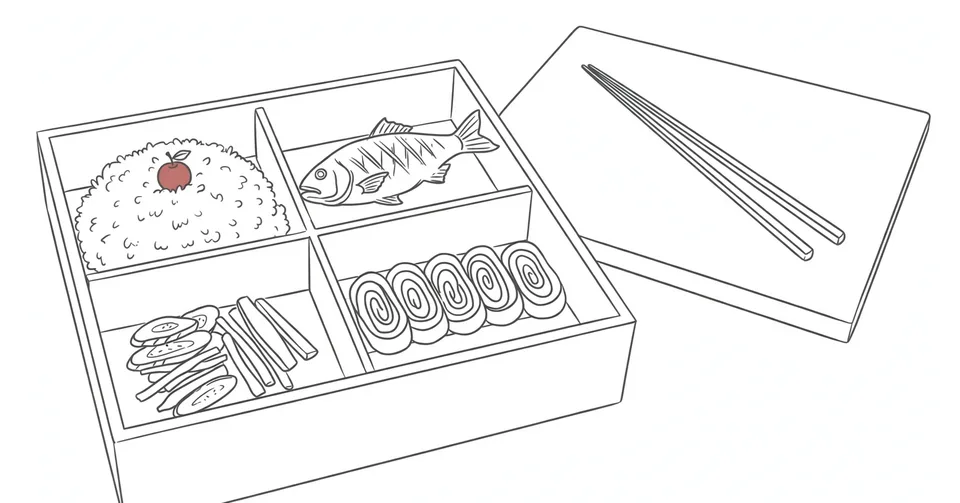
A Japanese bento is, at its simplest, a single-portion meal in a box. Rice takes the largest space, a piece of grilled fish or fried chicken takes the next, and two or three small vegetable dishes fill the gaps, often with a pickled plum on top of the rice. Nothing touches that should not touch. Each compartment has a job, and the whole box is meant to be eaten at room temperature, which is part of the point. A Japanese bento is food designed to travel, to wait, and still to taste like someone thought about it.
That is the part worth sitting with. Most packed lunches in the world are an afterthought, something assembled in a hurry and eaten without looking. The Japanese bento went the other way. Over a thousand years it turned the problem of carrying food into a craft, and the craft into a habit so deep that millions of people still practice it every day without calling it art. The history explains why the box looks the way it does, and why it refuses to disappear.
What a Japanese bento actually is
The word itself gives away the idea. Bento, written 弁当, comes from a Chinese Song dynasty slang term, biandang, meaning convenient, and its history is documented back to the 16th century. That is still the definition that matters. A Japanese bento is a meal made ahead of time, meant to be eaten later, somewhere else, without a kitchen nearby.
The classic shape is easy to recognise. A rectangular box, often lacquered wood in the old days and plastic or bamboo today, divided into compartments. Rice fills about half of it. The main dish, usually grilled fish such as salmon or mackerel, or fried chicken, sits beside the rice. Then come the small sides, simmered vegetables, rolled omelette, and pickles, each in its own corner. A single pickled plum, umeboshi, often sits in the middle of the rice like a red flag on a white field, and it is not only decoration. The plum is sour and salty, and it was traditionally believed to keep the rice fresh a little longer.
What makes a Japanese bento different from a lunchbox anywhere else is the attention to balance. Colour matters, and so does variety. A good box has something white, something green, something red or orange, something brown. The colours are not painted on. They come from the food itself, and the cook who packs the box is expected to think about them. That sounds fussy until you eat one. A box that looks cared for simply tastes better, and that is a small, honest lesson about how much presentation shapes appetite.
Dried rice and the first portable meals
The Japanese bento did not begin as a box. It began as a bag of dried rice. During the Kamakura period, from 1185 to 1333, farmers, hunters, and travellers carried hoshi-ii, rice that had been cooked and then dried so it would keep without spoiling. It could be eaten dry on the road or softened with water. The practice of carrying food and eating it outside the home is older still, appearing in the Kojiki and the Nihon Shoki, texts completed in the 8th century. But the portable meal as a habit took shape with hoshi-ii, a food built for distance.
Over the following centuries the idea grew richer. By the Edo period, from 1603 to 1868, lacquered wooden boxes had appeared, and packed meals had become part of urban life rather than only a traveller's ration. People carried them to cherry blossom viewings, to tea gatherings, and to the theatre. The box stopped being survival equipment and became something closer to a small occasion. That shift, from ration to pleasure, is the moment the Japanese bento became itself.
The Edo period and the theatre box
The most famous box of the Edo period was the makunouchi bento, named for the intermission, makunouchi, between acts of a kabuki play. Theatregoers in Edo would eat during the break, and vendors sold them a compact lacquered box of rice, grilled fish, pickles, and tamagoyaki, the rolled omelette that still appears in boxes today. The makunouchi bento was designed for a specific situation, eaten on a lap, in the dark, between acts, without a mess. It had to be neat, balanced, and ready. The format it set, rice plus protein plus pickles in a divided box, is still the template for a traditional Japanese bento.
The Edo period also gave the Japanese bento its fancier cousin, the shokado bento. Named after a partitioned paint box used by the monk Shokado Shojo, it is a square lacquered box divided into four compartments, used for refined meals at restaurants and formal occasions. Where the makunouchi box was food for the crowd, the shokado box was food for ceremony. Both are still made and sold today, which says something about how little the idea has needed to change.
The train era and the ekiben
The railway changed the Japanese bento again. In 1885, the first ekiben, the station bento, reportedly went on sale at Utsunomiya Station in Tochigi Prefecture, two onigiri wrapped in bamboo leaf for one sen each. As trains spread across Japan in the Meiji era, every station began selling its own version, filled with the local speciality. A station in a fishing town sold a fish bento. A mountain station sold one with mushrooms and wild vegetables. The ekiben turned the box into a souvenir of a place, and eating one on a train became part of the journey itself.
That story deserves its own telling, and it has one. The ekiben grew from that two-onigiri stall into a national habit, with hundreds of regional varieties still sold at stations today. If you want the full version, the station bento is worth reading about on its own, because it shows how a practical meal became a way of tasting a region in one sitting. The everyday Japanese bento and the ekiben are the same idea at different scales, one packed at home, one bought at a platform, both built to be eaten on the move.
The modern Japanese bento, from konbini shelves to kyaraben
The Japanese bento nearly faded once, then came back stronger. After the war, home cooking changed, and the packed lunch looked old fashioned. Then two things happened in the 1980s. The microwave oven arrived, and convenience stores began selling ready-made boxes by the millions. A Japanese bento bought at a konbini is cheap, hot in two minutes, and good enough that office workers and students treat it as a normal lunch rather than a compromise. The convenience store did not kill the homemade box. It gave the whole idea a second life, and it made the Japanese bento the default lunch of a working country.
At the same time, a different kind of box was appearing in schoolbags. The kyaraben, short for character bento, is a lunch arranged and sculpted to look like an anime character, an animal, or a landscape. Parents, usually mothers, began competing in the 1980s and 1990s to make the most elaborate boxes for their children, and the habit went global through social media in the 2010s. A kyaraben can be a panda made of rice, a cartoon face built from seaweed and egg, or a tiny scene from a film. It is playful, and it is also a lot of work before 8 in the morning. I find the kyaraben touching rather than silly, because it turns the most routine chore of parenting into a small daily message. A child who opens that box knows someone spent an hour thinking about their lunch.
The modern Japanese bento also lives in the boxes people buy for themselves. Department stores sell lacquered boxes that cost more than the food inside them. Craftsmen in Kyoto and Wajima still make wooden and lacquered boxes by hand. A good box is a small piece of furniture, and people keep them for decades. The container matters because the meal is also a container, a frame for the food, and a frame that lasts changes how you feel about what is inside it.
What goes inside a Japanese bento
There is no single recipe, but there is a shape that most boxes follow. Rice is the base, and it usually takes up about half the box. The main dish is a protein, grilled salmon, fried chicken karaage, a piece of tamagoyaki, or simmered meat. Then come two or three small sides, simmered vegetables, pickled cucumber, boiled greens with sesame, or a small salad. A pickled plum on the rice is the classic finish. The rule of thumb that home cooks repeat is balance, a little of everything, nothing too wet, nothing that will go soggy by noon.
The details are where the care shows. Food that will sit for hours should not be too oily, and it should be packed tightly enough that it does not slide around. Dividers, small cups, and lettuce leaves keep flavours apart. The box is eaten at room temperature, so dishes are chosen that taste good cold or lukewarm. A Japanese bento is not a hot meal that went cold by accident. It is a cold meal by design, and the cooking is adjusted for that, with stronger seasoning than a fresh hot dish would need.
For a first taste, the easiest way in is a shop-bought box. Guides to bento types describe the same shape most boxes follow, and the rule is simple. Pick one with grilled fish rather than fried food, because it holds up better over hours, and look for a box with five or six different things inside rather than three. The variety is the point. A Japanese bento with only rice and chicken is a lunch. A Japanese bento with rice, fish, egg, greens, and pickles is a small tour of a kitchen.
How to try one for yourself
You do not need a trip to Japan to understand the Japanese bento, but a trip helps. In Japan, start at a convenience store. The shelves hold dozens of boxes, from a simple salmon and rice set to a full makunouchi style box, and most cost between 500 and 900 yen. Heat it if there is a microwave, or eat it as it is. Then try a department store basement, the depachika, where the boxes are fancier and the fish is grilled that morning. If you are travelling by train, buy an ekiben at the station before you board, and eat it while the countryside passes. That is the box in its natural setting.
At home, the way in is simpler than it looks. Cook rice, grill a piece of fish or fry some chicken, roll a small omelette, simmer some vegetables, and pack them tightly in a divided box. The first box will look messy, and that is fine. The second will look better. The lesson of the Japanese bento is not that lunch must be beautiful. It is that a little care, applied to the most ordinary meal of the day, adds up. A thousand years of people packing rice for the road all reached the same conclusion, and it fits in one small box.
The Japanese bento endures because it solves a real problem with grace. It feeds a person well, far from a kitchen, without fuss and without waste, and it does so with an attention that makes the eater feel considered. That is a modest ambition, and it is why the box is still on desks and train seats across Japan today. Lunch will never be the most important meal of the day. The Japanese bento is the argument that it still deserves to be made properly.
More in Food & Travel
- Kamaboko Paints the New Year Red and White
- Datemaki Rolls Sweet Eggs Into a Spiral of Good Luck
- Tazukuri Turns Tiny Sardines Into a Wish for a Good Harvest
- Kazunoko Is the Herring Roe That Promises Children and Plenty
- Kuromame Turns Black Beans Into a Wish for Health
- Jubako Layers a Family's Luck One Box at a Time
Latest posts
- Gyoji Are Sumo's Referees in Silk and Calligraphy
- Japanese Baseball and the Game Japan Made Its Own
- The Banzuke Remembers Every Basho in Calligraphy
- Osechi Packs a Whole Year of Luck Into Stacked Boxes
- Fifteen Days of Basho Decide Who Sumo Remembers
- Kojiri Is the End Cap That Takes Every Knock for a Katana
- Kurikata Is the Chestnut Knob That Holds a Katana at the Hip
- Koshirae Is the Formal Mounting That Turns a Blade Into a Katana
- Shirasaya Is the Plain White Scabbard Where a Katana Rests
- The Togishi Polishes a Katana for Weeks Before It Ever Cuts
- Kozuka Is the Small Knife Hiding in a Katana's Saya
- Wakizashi Was the Short Sword a Samurai Never Took Off
- Tsuba Is the Small Guard That Stops a Katana From Cutting Its Owner
- Yokote Is the Small Line That Tells a Katana's Age
- Seppa Are the Thin Washers That Keep a Katana From Rattling