Tazukuri Turns Tiny Sardines Into a Wish for a Good Harvest
· 15 min read
Tazukuri is a classic osechi dish of tiny dried sardines glazed sweet and shiny, eaten at New Year as a wish for a good harvest.
A handful of tiny fish, no longer than your little finger, can carry a whole harvest on its back. That is the promise of tazukuri, the glossy candied sardines that sit in the top tier of the osechi boxes every New Year in Japan. The fish are small, the dish is simple, and the wish behind it is as old as rice farming itself.
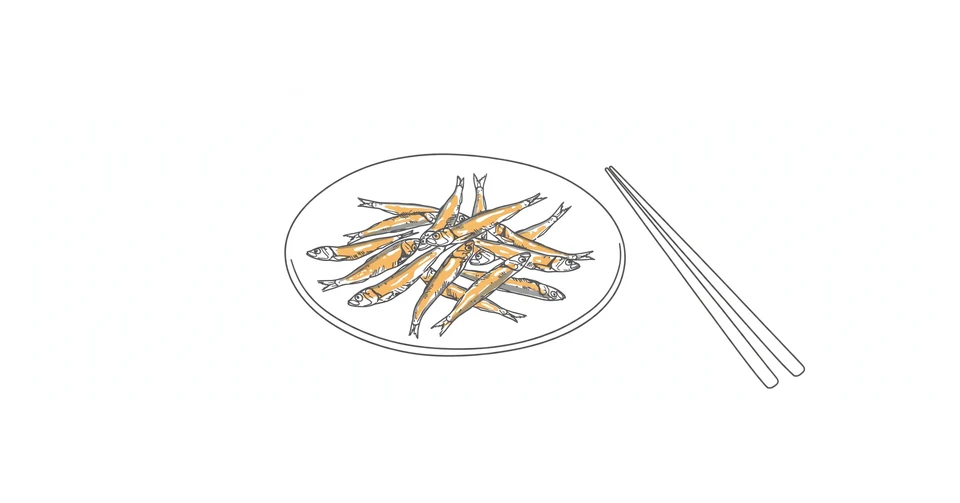
Tazukuri is made from dried young Japanese anchovies, roasted until crisp and then coated in a sweet soy glaze until they shine like lacquer. It is eaten in a single bite, or by the chopstickful, and it tastes of salt, sugar, and the sea all at once. Most people meet it once a year, on the morning of January 1, when the stacked boxes are opened and the year begins.
The name tells you the whole story. Tazukuri means making rice fields, and the dish exists because farmers once spread small sardines over their paddies as fertiliser. A good catch meant a rich harvest, so the little fish became a wish you could eat. This article follows that wish from the rice field to the New Year table, explains how tazukuri is made, and shows how to cook it at home without turning a crisp bite into a sticky lump.
What tazukuri is
Tazukuri is a dish of dried baby sardines, roasted and glazed, that belongs to osechi ryori, the traditional New Year feast of Japan. The fish are whole, head, bones, tail and all, and they are so small that a single serving holds dozens of them. The glaze is made from soy sauce, sugar, sake, and honey or mirin, cooked down until it coats each fish in a thin, shining shell. A scattering of toasted white sesame seeds finishes the dish, adding a nutty smell and a little extra crunch.
The fish themselves are young Japanese anchovies, known as katakuchi iwashi, and they are about 5 centimetres long. The anchovies sold for this dish carry the same name as the dish, tazukuri, and they are simply rinsed in water and dried, without being boiled in salt water first. That matters, because the more common dried anchovy, called iriko in the Osaka region and niboshi in the Tokyo region, is boiled in salt water before drying and tastes noticeably saltier. The tazukuri fish are flatter, straighter, and milder, which is what you want when the glaze is doing the seasoning. If you cannot find them, iriko or niboshi will work, but the result will be saltier, so it is worth easing back on the soy sauce.
The dish is also called gomame, and the two names are used side by side in Japan, though not everywhere in the same way. The Food in Japan guide to tadukuri reports that most people across the country say tazukuri, while gomame is the more common word in the Kansai region around Kyoto and Osaka. The two names carry different stories, which is fitting for a dish that has been loved in more than one place.
You will not find tazukuri on most everyday menus. It is a New Year dish first and a snack second, and the fish appear in Japanese grocery stores mainly in December, when families start preparing for the feast. That seasonality is part of its charm. A dish you eat once a year tastes of the occasion, and the occasion tastes better for having a dish of its own.
Why a little fish became a wish for a good harvest
The name tazukuri is written with the characters for rice field and making, and it translates simply as making rice fields. The link between the fish and the field is not wordplay. It is farming. Long ago, farmers spread dried sardines over their rice paddies as fertiliser, and the practice was so valued that sardine fertiliser was, according to Food in Japan, the most expensive fertiliser used in rice fields. Fields fed with it often gave a good harvest, and a good harvest meant a fed family and a secure year. Eating the little fish at New Year became a way of asking for that harvest again.
There is a second story in the other name. Gomame is commonly explained as meaning 50,000 grains of rice, a number that stands for wealth and plenty, and Food in Japan gives that reading in its guide to the dish. The same source offers a different account of the word's origin, tracing it to komamure, meaning a small group, which became komame and then, with the polite prefix go, gomame. The two explanations do not quite agree, and neither can be proven from the kitchen. I take the honest view: the 50,000 grains reading is the one people use when they explain the dish at the table, and the komamure account is the one scholars argue about. Both point the same way, toward plenty, and for a New Year wish that is enough.
The fish carry still more meanings, because in osechi almost nothing means only one thing. The word mame, inside gomame, also suggests being in good health and working diligently, so the dish carries a wish for a healthy year as well as a full harvest. And because a single serving contains so many tiny fish, some families read the dish as a wish for many children and a flourishing household, the same kind of thinking that makes herring roe a symbol of descendants. One small dish, then, can wish for food, health, and family all at once, and it does so without a single word being spoken at the table.
That layered meaning is what I admire most about tazukuri. Modern life tends to separate food from hope, as if a meal should only feed the body and the wishing should happen somewhere else. The old New Year table did not make that split. It put the wish on the plate, where everyone could see it, taste it, and share it. A farmer who had spread sardines on a field knew exactly what the dish meant, and so did the child reaching for it. The meaning was not decoration. It was the reason the dish existed.
Tazukuri in the osechi trio, and the Kansai difference
Inside the stacked boxes of osechi, tazukuri holds a place of honour. It is one of the three essential celebratory dishes, called iwai-zakana, alongside kuromame, the sweet black beans, and kazunoko, the salted herring roe. The three sit together in the top tier of the box, the tier reserved for celebration, and together they wish the household health, children, and a good harvest. Our guide to the whole feast, Osechi Packs a Whole Year of Luck Into Stacked Boxes, lays out the tiers and every dish in them, and the black beans beside the sardines deserve their own story, which our article on Kuromame Turns Black Beans Into a Wish for Health tells in full.
The trio is not identical everywhere in Japan, and the difference is a small lesson in how local the New Year is. In Kanto, around Tokyo, the three dishes are kazunoko, kuromame, and tazukuri, exactly as described above. In Kansai, around Kyoto and Osaka, pounded burdock root called tataki gobo often appears in the trio instead. Burdock puts down strong, deep roots, so it carries a wish for a long life and a stable household.
Here the sources disagree, and it is worth saying so plainly. Our osechi article reports that tataki gobo takes the place of tazukuri in the Kansai trio, while Japan Today says it sometimes replaces kuromame instead. Both agree that the burdock appears and the trio changes; they differ only on which dish steps aside. Regional food writing is full of these small disagreements, because households, not rule books, decide what goes in the box. The safest way to put it is that in Kansai the trio may swap one of its members for tataki gobo, and that whichever dish is swapped, the wish stays the same: a household that holds firm and lasts.
Tazukuri also earns its place for a practical reason. Like the other osechi dishes, it is made to keep. The sugar, salt, and soy in the glaze preserve the fish, so a batch cooked days before New Year is still good on the morning of January 1, and through the first three days of January, the period called sanganichi. The old rule was that the kitchen should rest over those days, with no cooking and no fire, so food that kept without attention was not a convenience. It was the whole point.
What it tastes like, and how families eat it today
Take a piece of tazukuri between your chopsticks and the first thing you notice is the crunch. The fish are roasted until they snap, so they break cleanly between the teeth, and the glaze adds a thin, sticky sweetness over the top. The flavour is salty and sweet at once, with a faint bitterness from the tiny bones and a nutty note from the sesame seeds. Food in Japan describes the taste as sweet, savoury, and nutty, like a crunchy teriyaki candy, and that is a fair description, though it misses the sea in it. The fish still taste of the fish, and that is why the dish works. Without the sea, it would be only candy.
Children often like tazukuri more than adults expect, because the sweetness and the cracker-like crunch are familiar even when the whole fish is not. Adults tend to eat it slowly, a few pieces at a time, often with a drink. The salty sweet flavour pairs well with cold beer or sake, and Just One Cookbook notes that the dish is a fine snack to enjoy with a cold beer or sake on New Year Day. It is also the kind of food that invites reaching back for one more piece, which is probably why a small dish of it disappears faster than anyone plans.
Most families today do not make tazukuri from scratch. Supermarkets and department stores sell it ready made in December, packed in small trays beside the other osechi dishes, and many households buy a little of everything and cook only the dishes they care about most. There is no shame in that. Osechi was always a practical meal as much as a symbolic one, and a family that buys its tazukuri still eats the wish. The home cooked version survives because it is genuinely easy, and because a cook who makes it once tends to make it every year after.
Outside New Year, the dish has a second life as a snack. The same crisp, glazed fish go well with rice, with noodles, or on their own as an otsumami, a small bite with a drink. The fish are also a good source of calcium, because you eat the bones whole, and Just One Cookbook points out that this is why her mother always made sure she ate tazukuri at New Year, for strong bones. An online nutrition calculator estimates one serving at about 92 calories with about 272 milligrams of calcium, though that is an estimate from a calculator, not a laboratory result, and it will change with the recipe. The real point is simpler: a dish made of whole small fish gives you more of the fish than a fillet ever could.
How to make tazukuri at home
Making tazukuri at home takes about 20 minutes, and the recipe below follows the method in the Just One Cookbook guide to tazukuri, which I read in full before writing this article. The quantities serve four people as a small New Year dish.
| Ingredient | Amount |
|---|---|
| Dried tazukuri anchovies | 1 cup |
| Toasted white sesame seeds | 1 tablespoon |
| Sake | 2 tablespoons |
| Soy sauce | 1 tablespoon |
| Sugar | 1 tablespoon |
| Honey | 1 tablespoon |
| Neutral oil | 1 eighth of a teaspoon, optional |
| Red chili pepper | 1 whole, optional |
Start by preparing a baking sheet lined with parchment paper, because the glazed fish must be spread out to cool and they will stick to anything else. Put the dried anchovies in a dry frying pan, with no oil, and toast them over medium low heat for 5 to 10 minutes, until they are crisp. Add the sesame seeds and toast them for 2 minutes more, shaking the pan constantly so the seeds do not burn. You will know the fish are ready when you can break one into two pieces with your fingers. Move the fish and seeds to the lined baking sheet and set them aside.
Put the sake, soy sauce, and sugar in the same pan and give them a quick stir. Add the honey and the small measure of oil, and the whole chili pepper if you are using one. Bring the mixture to a simmer over medium low heat and reduce it until it thickens enough that you can draw a line through the sauce on the surface of the pan with a spatula. Then return the fish and sesame seeds to the pan and toss them until every fish is coated. Transfer the tazukuri back to the baking sheet, spread the pieces out so they do not clump, and let them cool. Serve at room temperature.
The dish keeps well, which is why cooks often make it first when preparing osechi. Just One Cookbook recommends cooking it up to 4 days before serving and storing the leftovers in an airtight container in the refrigerator for 7 to 10 days. Food in Japan suggests it can keep for about 2 weeks in a cool, dark place, but that is a longer claim than the recipe source supports, so the refrigerator and the shorter window are the safer choice. Either way, a batch made in the last days of December will still be crisp and good when the boxes are opened.
The mistakes that spoil a batch
Tazukuri is a simple dish, and its mistakes are simple too, which is why they are worth naming. The first is wet fish. If the anchovies are not toasted until they snap, they will turn soft under the glaze and the dish will be chewy instead of crisp. Be patient with the dry pan, and test a fish with your fingers before you move on. The second mistake is a glaze cooked too far. If the sauce goes past the point where you can draw a line through it, it will harden as it cools and glue the fish into a single slab. Take the pan off the heat a little earlier than you think, because the sauce keeps thickening as it cools.
The third mistake is the opposite one: a glaze that is too thin. If you add the fish while the sauce is still watery, the coating will slide off and pool at the bottom of the pan, and the fish will dry out instead of shining. Wait for the large bubbles and the syrupy thickness, and only then bring the fish back. The fourth mistake is crowding the cooling sheet. Glazed fish left in a pile will stick to each other as they cool, and pulling them apart breaks the coating. Spread them in a single layer, with space between the pieces, and leave them alone until they are cool.
The last mistake is not a cooking mistake but a shopping one. Buying the wrong fish is the easiest way to spoil the dish before it starts. The anchovies for tazukuri are the flat, straight, unsalted kind, and they are sold in December at Japanese grocery stores. The saltier iriko and niboshi, which are boiled in salt water before drying, are meant for dashi stock, not for glazing. They will work in a pinch, but the dish will be saltier, and a first time cook may blame the recipe for what the fish did. Read the packet, ask the shopkeeper if you are unsure, and buy the fish with the dish's own name on the bag.
A small dish with a long memory
Tazukuri asks very little of the cook: a dry pan, a few spoonfuls of seasoning, twenty minutes, and a little patience while the glaze thickens. It asks even less of the eater: a pair of chopsticks and a willingness to eat a whole fish, bones and all. And yet it carries a wish that once fed whole villages, the wish that the fields would be full and the year would be kind.
I think the dish survives because it is honest about what a wish is. A wish is not a spell. It is a reminder, kept in the form of food, of what matters and what the work is for. The farmer who spread sardines on a field was not performing magic. He was feeding the soil so the soil would feed his family, and the New Year table remembers that plain exchange every time a small glazed fish is lifted from the box. The harvest did not come from the fish. It came from the work the fish stood for, and the dish keeps that work in view.
So eat the tazukuri first, or last, or somewhere in between. Eat it because it is crisp and sweet and good with a drink, and then remember, if you like, that it once stood for a whole rice field. A tradition that can hold both of those things at once, pleasure and meaning, in a fish no longer than your little finger, is a tradition that knows what it is doing. It has lasted this long because it never asked anyone to choose between enjoying the food and understanding it, and it will last longer still as long as someone keeps a dry pan, a little sugar, and a handful of tiny fish ready for the first morning of the year.
More in Food & Travel
- Kamaboko Paints the New Year Red and White
- Datemaki Rolls Sweet Eggs Into a Spiral of Good Luck
- Japanese Bento and the Lunch Box That Became an Art Form
- Kazunoko Is the Herring Roe That Promises Children and Plenty
- Kuromame Turns Black Beans Into a Wish for Health
- Jubako Layers a Family's Luck One Box at a Time
Latest posts
- Gyoji Are Sumo's Referees in Silk and Calligraphy
- Japanese Baseball and the Game Japan Made Its Own
- The Banzuke Remembers Every Basho in Calligraphy
- Osechi Packs a Whole Year of Luck Into Stacked Boxes
- Fifteen Days of Basho Decide Who Sumo Remembers
- Kojiri Is the End Cap That Takes Every Knock for a Katana
- Kurikata Is the Chestnut Knob That Holds a Katana at the Hip
- Koshirae Is the Formal Mounting That Turns a Blade Into a Katana
- Shirasaya Is the Plain White Scabbard Where a Katana Rests
- The Togishi Polishes a Katana for Weeks Before It Ever Cuts
- Kozuka Is the Small Knife Hiding in a Katana's Saya
- Wakizashi Was the Short Sword a Samurai Never Took Off
- Tsuba Is the Small Guard That Stops a Katana From Cutting Its Owner
- Yokote Is the Small Line That Tells a Katana's Age
- Seppa Are the Thin Washers That Keep a Katana From Rattling