Kaiseki, Japan's Multi-Course Art of Dining
· 10 min read
Kaiseki is Japan's multi-course meal of small, seasonal dishes, where every plate follows the season and the meal itself is the event.
A kaiseki dinner is not a meal you order. It is a meal you are given, one small dish at a time, in an order the chef has already decided. Kaiseki is Japan's most formal way of eating: a sequence of seven to fourteen small courses, each one built around the season, each one served only when the last plate is empty.
The word kaiseki carries a long history, and the meal carries an even longer one. It began as the light food served with the tea ceremony and grew, over centuries, into a style of dining that treats a single evening as a small work of art. Nothing on the table is an accident, from the first bite to the final bowl of rice.
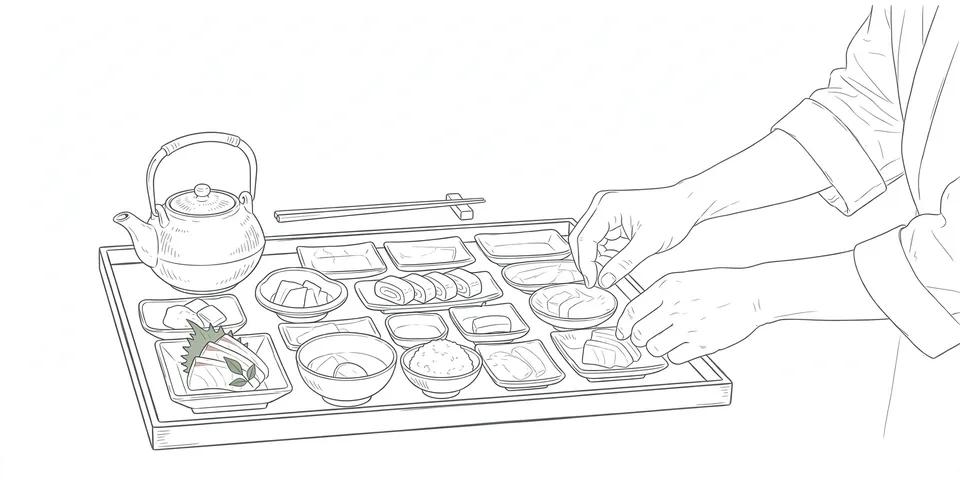
If you have ever eaten dinner at a ryokan, you have probably eaten kaiseki already, even if no one used the word. It is the dinner that arrives in your room on a lacquered tray, course after course, while the evening slows down around you. But kaiseki is also served in specialist restaurants, most famously in Kyoto, where the best rooms must be booked weeks or even months ahead.
Where kaiseki comes from
Kaiseki began with the tea ceremony. In the sixteenth century, the tea master Sen no Rikyu shaped the ceremony into the quiet, careful ritual it remains today, and a light meal was part of it. The meal was simple by design: one soup and three small dishes with rice, called ichiju-sansai, served before the tea so guests would not drink matcha on an empty stomach. The food was there to support the tea, not to steal attention from it.
In the Edo period, restaurants took that structure and turned it into the main event. This banquet version, written with different characters, kept the tea meal's order and its respect for the season, but replaced the matcha with sake and stretched the meal into a dozen courses. One detail still shows the split: in tea kaiseki the rice comes first, because the host feeds hungry guests before the tea, while in banquet kaiseki the rice comes last, because filling up on rice early would spoil the sake and everything that comes before it.
That history matters because it explains the mood of a kaiseki dinner. It is not a feast. It is a ceremony that learned to feed people well, and it still behaves like one: quiet, unhurried, and deliberate about every detail.
Shun, or why the season decides the menu
The guiding idea of kaiseki is shun, seasonality. Ingredients are chosen at their peak moment, and the presentation follows the season too. In spring the first course might be a sliver of bamboo shoot with a kinome leaf. In autumn it might be persimmon with white miso. A maple leaf beside a grilled fish in October, a pine sprig at New Year: the plate tells you the month before anyone speaks.
This is why no two kaiseki menus are the same. A restaurant changes its menu with the season, and often with the week, depending on what the market brings in. The chef is not showing off a fixed repertoire. He is answering the question of what is best right now, and the answer changes every few weeks.
The same thinking reaches the dishes themselves. Bowls, plates and cups are chosen to match the season and the food they hold, so the tableware is part of the meal rather than a frame around it. A summer dish might arrive in a cool glass bowl, while a winter soup comes in a lidded lacquered bowl that keeps the steam in until you lift the lid yourself.
The courses, in order
A full kaiseki dinner runs through its courses in a fixed order. Each course has a name and a job, and there is a reason it comes where it does. The meal moves from light to filling, from cold to warm, and from complex to simple, and it finishes with rice, the most basic food in Japanese cooking. The order shifts a little between restaurants, but the arc does not change.
| Course | What it is |
|---|---|
| Sakizuke | The first bite, one small seasonal dish that sets the tone |
| Hassun | The seasonal platter, food from the sea and the mountains side by side |
| Mukozuke | Sashimi, sliced seasonal fish arranged on the far side of the tray |
| Takiawase | Simmered vegetables with fish or meat, cooked separately in dashi |
| Yakimono | Grilled fish, usually over charcoal, with a seasonal garnish |
| Agemono | A light fried dish, often tempura or vegetable fritters |
| Mushimono | A steamed dish, often chawanmushi, savoury egg custard |
| Sunomono | A vinegared dish that clears the palate near the end |
| Shokuji | Rice with soup and pickles, served together as the last savoury course |
| Mizumono | Seasonal fruit or a simple sweet to close the meal |
Two courses carry most of the meaning. Hassun, named for the cedar tray exactly eight sun across, is where you see the chef's eye most clearly: a small arrangement of sea and mountain ingredients that sums up the season in one view. Shokuji, the rice course, is where the kitchen shows its foundation. The rice is cooked for this exact moment and eaten right away, with a clear soup and pickles, and once it arrives, the sake stops. The meal is ending.
Not every restaurant serves every course. Some skip the steamed dish, some swap it for the simmered one, and a lighter meal might run seven courses instead of twelve. The names matter less than the shape: a slow build toward rice, with each course smaller than you expect and better than the last one made you hope.
Kaiseki at a ryokan
For many visitors, the first kaiseki meal happens at a ryokan, and it is hard to imagine a better introduction. The dinner is served in your room or in a private dining room, usually in the early evening, and the courses arrive one at a time while you sit on the tatami in a yukata. There is nowhere to go and nothing to decide, which is exactly the point.
Many ryokan are also hot spring inns, so the rhythm of the evening is bath, then dinner, then sleep. The bath loosens you up, the meal slows you down, and the futon is already laid out by the time you finish. It is a small, complete system for rest, and the food is the warm centre of it.
The price of the dinner is usually included in the room rate at a ryokan, which makes it the easiest way to try kaiseki without booking a restaurant separately. A mid-range ryokan stay with dinner commonly runs from around 15,000 to 30,000 yen per person per night, and the dinner is a large part of what you are paying for. Read more about the inns themselves in the article on ryokan, Japan's traditional inns.
How much it costs, and how to book
At a specialist restaurant, a kaiseki dinner is one of the most expensive meals in Japan, and the price is part of the honest answer. A dinner typically costs from around 10,000 to 30,000 yen per person, and the most famous rooms in Kyoto charge 30,000 yen and above, sometimes as much as 66,000 yen for an exclusive course. Lunch is the cheaper way in: many of the same restaurants serve lunch from around 9,900 to 15,000 yen. A service charge of 10 to 15 percent and the 10 percent consumption tax are usually added on top of the menu price.
The price reflects what goes into the meal. The ingredients are seasonal and often rare, the courses are prepared one guest at a time, and the room itself, a private tatami room with a garden view, is part of the service. It is not a meal you stumble into. It is a meal you plan for, the way you would plan for a concert.
Booking is the practical hurdle. Many of the best kaiseki restaurants in Kyoto operate on a strict reservation-only basis, and the strongest ones ask for a booking two to three months ahead, often through a hotel concierge rather than a direct online reservation. Some do not take walk-ins at all, and some do not accept reservations in English online, which is another reason a hotel concierge is useful. If a restaurant's dinner is out of reach, its lunch is the sensible compromise: the same kitchen, the same order of courses, at roughly half the price. A current guide to Kyoto's restaurants and prices is useful before you book, for example the Kyoto kaiseki dining guide.
How to eat it
The etiquette of kaiseki is simpler than it looks, and it follows from the shape of the meal. Eat each course in the order it arrives, take time with it, and do not rush. The meal is the event, not the fuel before one. A full dinner can take two hours or more, and that is normal. Nobody will hurry you, and hurrying would waste the money you spent to be there.
Sake is the usual companion, poured in small cups alongside the courses, and a good restaurant will suggest a sake for the season just as it chooses the food for the season. If you drink, the one rule worth remembering is that the sake stops when the rice arrives: the shokuji course marks the end of drinking, and the meal closes quietly after it. The site's guide to Japanese sake explains what to order if the menu leaves the choice to you.
A few small things help. Pick up the lidded soup bowl with both hands and lift the lid toward you, so the steam rises away from the table. Eat the sashimi before the simmered dish cools. Do not ask for substitutions: the menu is fixed, the courses are set, and a restaurant that changes its menu for one guest is not doing kaiseki. If you have an allergy or a dietary restriction, say so when you book, not when the first course arrives, and be ready for the answer to be that the restaurant cannot serve you. That is not rudeness. It is the kitchen being honest about a menu it cannot bend.
There is a quieter opinion underneath all of this, and it is the reason kaiseki has survived for centuries while faster, louder styles of dining come and go. A kaiseki dinner insists that a meal can be worth two hours of your attention, that small portions can be more satisfying than large ones, and that the season is a good enough reason to change everything on the table. In a country where a train is never late and a convenience store never closes, the most formal meal in Japan is the one that asks you to stop and wait for the next small plate. That slowness is not a flaw in the design. It is the design.
If you go to Japan once, the honest advice is to try kaiseki once, at lunch if the dinner price is too much, at a ryokan if a restaurant booking is too hard. Order nothing, decide nothing, and let the courses arrive in their own order. The full course sequence, from sakizuke to mizumono, is described course by course in a guide to eating kaiseki in Tokyo. By the time the rice comes, you will understand why the meal ends there: everything before it was a long, careful way of arriving at the simplest food in Japan, cooked at exactly the right moment.
More in Food & Travel
- Dashi, the Quiet Stock Under Almost Everything Japan Cooks
- Ayu, the Sweetfish That Rules Japan's Clear Rivers
- Sake Kasu, the Sake Lees Japan Cooks With Instead of Throwing Away
- Kopi Tubruk and the Indonesian Way to Drink Coffee
- Subak and the Rice Terraces of Bali
- Nara Deer and the Sacred Animals of the Old Capital
Latest posts
- Fuji Ko, the Pilgrim Societies That Climbed Mount Fuji Together
- Gensen Kakenagashi, the Onsen Water That Never Circles Back
- Shiko, the Leg Stamp That Starts Every Sumo Day
- Semar, the God Who Chose to Work as a Servant
- Kyushoku and the Japanese School Lunch
- Sumadori, Japan's Smart Drinking for People Who Do Not Drink
- Bureiko, the Drinking Party Where Rank Is Left at the Door
- Kagami Biraki, Japan's Ceremony of Breaking Things Open
- Capsule Hotels and Sleeping in a Pod in Japan
- Hiroshima and the City That Chose Peace
- Shinnenkai, Japan's New Year Parties That Start the Year Over
- Punakawan, the Clown Servants Who Steal Every Wayang Show
- Kashikiri, the Private Onsen Bath You Book by the Hour
- Nomi-Hara, When After-Work Drinks in Japan Turn Into Harassment
- Shio Koji, Japan's Salted Ferment That Seasons Everything