Rahu and Ketu Still Chase the Sun and Moon Across the Sky
· 10 min read
Rahu and Ketu began as a single demon who stole one sip of immortality at the churning of the ocean, and the old story says they still chase the sun and moon across the sky, catching them only briefly at every eclipse.
Every eclipse has two explanations. The astronomer's version involves shadows, orbits, and geometry. The older version is a chase. In that telling, Rahu and Ketu, a severed head and a headless body, hunt the sun and the moon across the sky to settle a grudge that has never cooled.
When the chase succeeds, the light goes out. A total eclipse is the moment one of them finally catches its prey and swallows it whole. The catch never lasts, and the reason it never lasts is built into Rahu and Ketu themselves. They are immortal, furious, and physically incapable of holding on to anything they eat.
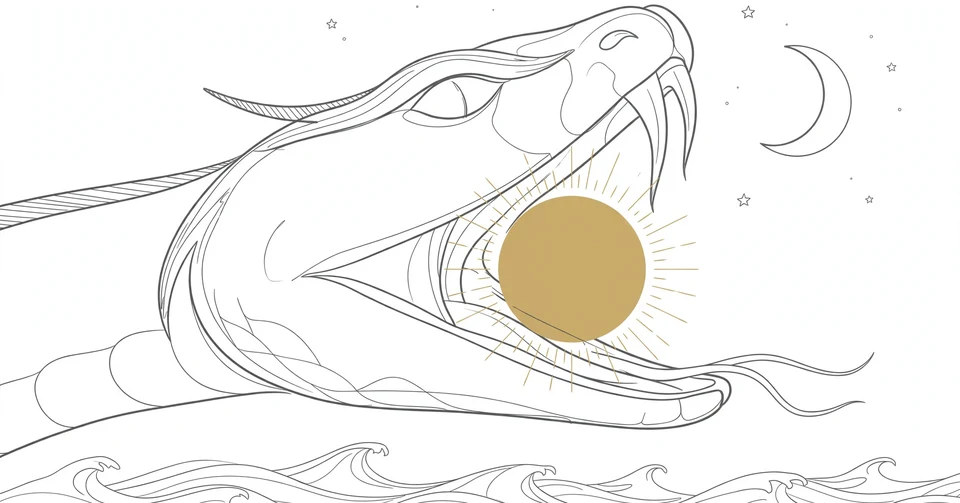
It is a Hindu myth, but it travelled far beyond India. In Bali and Java, Rahu and Ketu changed their names, moved into temple carvings and shadow puppet stories, and for many centuries decided what entire villages did on the day the sky went dark. This is the story of where Rahu and Ketu came from, why their revenge keeps failing, and how it still echoes across Indonesia every time the moon goes missing.
The theft at the churning of the ocean
The story of Rahu and Ketu begins with the Samudra Manthana, the great churning of the ocean of milk, when the devas and the asuras, gods and demons, agreed to work together to recover amrita, the nectar of immortality. It was an uneasy alliance. The devas had lost their strength and their fortune, and they needed the demons' muscle. The demons, for their part, wanted their share of the prize.
When the nectar finally surfaced, Vishnu took the form of Mohini, an enchantress of impossible beauty, and began pouring it out for the devas alone. The demons were too dazzled to notice they were being cheated. One of them, however, saw through the trick. His name was Svarbhanu, son of the asura Viprachitti and the lion goddess Simhika, and he disguised himself as a god, slipped into the line of devas, and took a seat in the worst possible place for a fraud: between Surya, the sun, and Chandra, the moon.
Mohini poured, and Svarbhanu drank. But the sun and the moon knew their own company, and they recognised the stranger sitting between them. They called out to Vishnu, and Vishnu answered with the Sudarshana Chakra, his spinning discus, which flew across the gathering and cut Svarbhanu's head from his body before the nectar had finished travelling down his throat.
A beheading should have ended the matter. Instead, it started the long career of Rahu and Ketu.
Why Rahu and Ketu can never keep what they catch
The amrita had already passed Svarbhanu's lips, and whatever it touched could not die. So the demon did not die. His severed head lived on as Rahu, still carrying all of Svarbhanu's cunning and resentment, and his abandoned body lived on as Ketu. Raised into the sky, Rahu and Ketu took their places among the nine navagraha, the great celestial powers of Hindu tradition, as a matched and opposite pair.
Neither of them forgot who had exposed the fraud. Hindu myth says that Rahu and Ketu kept one purpose from their old life: revenge on the sun and the moon. They pursue Surya and Chandra along their paths, patient as only the immortal can be, and now and then one of them catches up and swallows its enemy whole. That swallowing is an eclipse, grahana in Sanskrit, a brief act of vengeance staged in front of the whole earth.
But look carefully at what Rahu is. He is a head with no stomach, an appetite with nowhere to put a meal. Whatever he swallows slides straight out through his severed neck, and within minutes the sun or the moon slips free, unharmed, and carries on as if nothing happened. Ketu, a body with no head to aim it, is no better at keeping a grip. I find something quietly honest in this design. Most revenge stories pretend that vengeance satisfies. This one builds the disappointment into the monster. Rahu and Ketu can grab, but they can never hold, and so their punishment for the theft is to repeat it forever and fail forever.
Shadow planets with real coordinates
Modern astronomy will tell you that Rahu and Ketu do not exist, and in a certain sense the tradition agrees. Rahu and Ketu are called shadow planets, graha that wield influence without owning a body. There is no disc to see through a telescope, no surface for a probe to land on, nothing up there but a pair of names.
Yet the names point at something perfectly real. Astronomically, Rahu and Ketu are the two lunar nodes, the points where the moon's tilted orbit crosses the ecliptic, the apparent path of the sun. Rahu is the north node, where the moon crosses upward, and Ketu is the south node, fixed exactly opposite, always 180 degrees away. This is why eclipses are so picky about timing. An eclipse can only occur when the sun and the moon meet near one of the nodes, which is a precise, geometrical way of saying what the myth says in poetry: the darkness falls when the chase reaches the crossing.
The pair even keep time. The nodes drift slowly backwards around the ecliptic and complete a full circuit in about 18 years, a rhythm that sits close to the saros cycle ancient sky watchers used to forecast eclipses. In Vedic astrology, Rahu and Ketu remain among the most feared influences in a birth chart, tied to obsession, illusion, sudden fame and strange hungers, and the inauspicious daily window called Rahu kala is still printed in calendars and quietly avoided for weddings and journeys. Those are claims about meaning rather than physics, and the two registers, story and measurement, have shared the same sky for a very long time without much quarrelling.
How Rahu and Ketu reached Java and Bali
The chase did not stay in India. Hindu stories crossed the sea with traders, priests and poets, and the tale of Rahu and Ketu was among the cargo. The Amertamanthana, the churning story drawn from the Adiparwa, the first book of the Mahabharata, was being copied into Old Javanese during the reign of Dharmawangsa Teguh, around the turn of the eleventh century. The prize at the centre of that story never lost its importance on the islands. Balinese ritual still sets out to fetch tirta amerta, the water of life, in processions that walk down to the sea.
Centuries later, the fifteenth century Javanese text Tantu Panggelaran tells the episode again with local colouring. Here the giant Rahu sneaks into a feast and drinks the amerta in disguise, but Raditya Wulan, the sun and moon together, see through him, and Vishnu's discus takes his head clean off. The amerta had only splashed the head, so the head alone survived, and out of grudging hunger it has watched the sky ever since for a chance to swallow its betrayers.
These were not idle tales for the old kingdoms. Scribes in Java and Bali recorded actual eclipses in stone inscriptions, sometimes with rules attached. An inscription from Sucen, dated to 843 CE, speaks of the fifteenth day at a lunar eclipse, and a Balinese inscription from Batwan records a partial lunar eclipse in the year 1055. One Balinese inscription from 1181 even sets out what should happen during a grahana, including the waiver of purchase fees for buffalo and pigs while the sun was eclipsed. The myth and the calendar were the same document.
On the islands, Rahu and Ketu also merged with local giants of the dark. In Bali the swallower is Kala Rau, the bodiless head who lunges at Ratih, the moon goddess, whenever her light crosses his path. In Java he is Kala Rahu, far better known by his other name, Batara Kala, a towering figure of wayang stories bound up with time and death. The details changed in the crossing, but the silhouette never did: a head in the sky, hunting the two lights that once betrayed it.
Beating the mortar until the moon came back
A story this vivid does not stay inside books. In the Balinese reading of an eclipse, Kala Rau has caught Ratih and the darkness is an attack in progress, so the village answers with noise. People beat the kentongan, the wooden slit gongs that normally carry alarms from house to house, hoping to break the giant's concentration and persuade him to abandon the moon. Women take turns pounding the lesung, the long wooden rice mortar, in a rhythmic tradition called ngoncang, drumming the moon's rescue into the night.
Java replies with the same instruments. Around Yogyakarta the eclipse custom is gejog lesung, in which five or six people strike a lesung with pestles until the pounding turns into something close to music. One explanation holds that the lesung stands for Kala's lost body, so beating the mortar is beating him, and a well beaten Kala soon vomits up the sun. Another version says the drumming tickles Batara Kala until he feels sick, and out comes the moon. Both readings stay loyal to the logic of Rahu and Ketu: the swallower above has no proper body, so the body he left behind can be attacked from below.
Not every response was loud. Pregnant women were treated as especially vulnerable during an eclipse and were kept indoors and sheltered, in some villages beneath the bed, while households cooked rice and side dishes for sego rogoh, a shared protective meal eaten together once the danger passed. Fear runs through all of these customs, but so does organisation. An eclipse was one of the few events that could bring a whole village out of its houses at the same moment, acting on one signal, making one coordinated sound.
I suspect the noise did a second job that nobody needed to name. It turned a frightening sky into a group activity, and it is much harder to be privately terrified of the dark when your neighbours are beside you turning it into a rhythm. Whatever Rahu and Ketu were doing up there, down below the drumming made sure nobody faced the darkness alone or in silence.
A grudge that always ends in daylight
Today the predictions arrive from observatories, calculated to the minute years in advance, and nobody needs Rahu and Ketu to know when a shadow will cross the moon. On the question of when, the astronomy is simply better than the myth, and to be fair, the myth never really tried to compete on that ground.
What Rahu and Ketu still explain is how an eclipse feels. For a few strange minutes, appetite wins over light, an old grudge interrupts the order of the sky, and everyone watching understands in their body why their ancestors reached for the mortar and the gong. Then the design of the story reasserts itself. The head has no stomach. The body has no eyes. The catch cannot be kept.
So Rahu and Ketu remain where the story put them, chasing the sun and moon across the sky as they have chased them through a thousand years of Javanese manuscripts, Balinese temple nights, and one memorable sip of stolen immortality. Every eclipse still ends the same forgiving way. They catch the light, and they have to let it go.
More in Culture & Society
- Suka Duka Means the Banjar Shows Up for Joy and Grief Alike
- Tabuh Rah Spills Blood So the Ground Stays Calm
- The Bendesa Adat Speaks for a Village That Has Two Governments
- Catur Brata Is Four Silences Kept at the Same Time
- Your Weton Is the Day You Were Born, Counted Two Ways
- Hiwatari Asks You to Walk Across the Fire
Latest posts
- On Koyasan the Founder Is Said to Be Still Meditating
- Ngembak Geni Is the Morning Bali Starts Talking Again
- Karang Ayahan Is the Plot of Land a Village Trusts You With
- On Tumpek Landep Bali Blesses Everything Made of Metal
- Sudachi Is the Sharpest of Japan's Sour Citrus
- Shugendo Turns a Mountain Into a Place of Testing
- A Canang Sari Is Made Fresh Every Morning and Gone by Night
- The Aling-Aling Wall Exists Because Spirits Walk in Straight Lines
- Oi-Nishin Sent Tohoku Farmers Chasing Herring Every Spring
- The Nishin Goten Were Palaces Paid for by Fish
- The Tobi Were Edo's Daredevils Before They Were Its Firemen
- Kabosu Is Oita's Gentle Answer to Yuzu
- A Yamabushi Trains Where the Mountain Is the Temple
- Tri Hita Karana Holds a Village in Three Balances
- Shingon Has Kept Its Fire Ritual Burning for 1,200 Years