The Bendesa Adat Speaks for a Village That Has Two Governments
· 9 min read
In Bali a bendesa adat leads the customary village, chairs its assemblies and guards its awig-awig, while a second village head runs the state administration on the same streets.
Ask a Balinese villager who governs the village and you may get a polite question back: which government do you mean? On the same streets, often inside the same boundaries, two administrations run side by side. One belongs to the Indonesian state. The other is usually older, belongs to the customary community, and at its head stands the bendesa adat.
The bendesa adat is the person who speaks for the village in matters of temples, ceremonies, customary land and neighbourhood disputes. He does not issue identity cards or sign state paperwork. That is the job of the other village head, and the division of labour between the two explains a great deal about how Bali actually works.
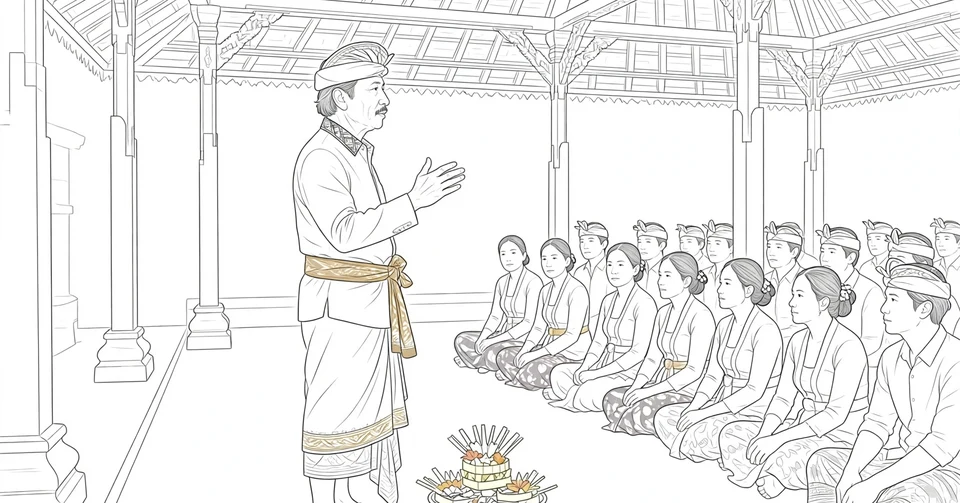
It is a position with no exact equivalent elsewhere in Indonesia. A bendesa adat draws no authority from a ministry and cannot be transferred by a regent or replaced by a governor's decree. His mandate comes from below, from the krama, the member households of the customary village, and it can be taken away by them as well.
What a bendesa adat actually does
The working week of a bendesa adat begins with meetings. He leads the prajuru, the customary board of the village, but the decisions themselves are not his to make alone. They belong to the paruman, the village assembly that talks until everyone agrees, which the bendesa adat convenes and chairs, and whose word binds every krama in the village.
Around him sits a small cabinet with old names. There is a deputy, the patajuh, a secretary called the panyarikan who keeps the village's letters and records, and a patengen who guards the treasury. Below them, each banjar, the neighbourhood hamlet that forms the building block of Balinese life, has its own board answering to the village one. The provincial regulation describes the prajuru as working collectively and collegially, and that phrase matters: a bendesa adat is first among his board, not a chief executive floating above it.
His most visible duty is guarding the awig-awig, the written customary code that each village composes for itself. The paruman adopts and amends the code, and the bendesa adat carries it out: announcing its rules, reminding households of their obligations, and applying the sanctions the assembly has decided when someone breaks them. Bali's Regional Regulation No. 4 of 2019 on customary villages defines the bendesa adat in one dry line, as the pucuk pengurus, the head of the customary board, and then spends many pages listing what that board may and may not do.
When neighbours quarrel, over a boundary stone, an inheritance, or a ceremony that went wrong, the dispute usually comes to the village first. The bendesa adat chairs the Kerta Desa Adat, the customary tribunal attached to every customary village, and the regulation instructs that tribunal to seek peace before it reaches for judgement. A large share of Bali's conflicts are settled in that room, with the bendesa adat mediating, long before any state court hears a word of them.
The role faces outward, too. A bendesa adat represents his village in legal acts, inside and outside the courts, once the paruman has approved: signing agreements over customary assets, receiving officials, and dealing with investors or developers who want something the village owns. And behind everything runs the ceremonial calendar. Priests conduct the rites at the village temples, but the dates, the budgets, the work rosters and the thousand small logistics of a temple anniversary are customary government business. A bendesa adat is, among other things, the operations manager of his village's sacred year.
Chosen by consensus, not by campaign
There are no posters, no party colours and no campaign promises in the election of a bendesa adat. Under the 2019 regulation he is chosen by the krama through musyawarah mufakat, deliberation that aims at consensus. Villages work the details out in their own rules: sometimes the room converges on one name by acclamation, sometimes a show of hands or a vote settles what talk could not. The paruman then formally ratifies the choice, and the new bendesa adat is installed in an inauguration ceremony that is part legal act and part blessing.
What the krama look for says much about the office. Studies of Balinese customary institutions note that villages weigh character before anything else: a bendesa adat should be someone others can imitate, steady in social life, knowledgeable in ceremony and in customary law, the elder neighbours already visit when they need advice. The material reward is modest. Where the awig-awig provides anything, it is a token allowance, not a salary, and many bendesa adat keep ordinary jobs or farms alongside the office.
The provincial regulation deliberately refuses to fix the length of a term, leaving the question to each village's own rules. In practice those rules converge. The election regulation of Desa Adat Keranjangan, one of hundreds of village rulebooks now published under the 2019 framework, gives its bendesa adat and board a term of five Saka years counted from their inauguration, and allows re-election for a further term. Other villages write nearly the same sentence. A bendesa adat who serves well may be asked to stay on; one who breaks the awig-awig can be dismissed by the same assembly that chose him. Scholars of the system put it plainly: the bendesa adat is not the holder of sovereignty in his village. Sovereignty sits with the assembled krama, and he is its executor.
One village, two governments
The second government is the desa dinas, the administrative village, led by a perbekel, the state village head. The perbekel is chosen in a formal village election under the national Village Law and runs the machinery of the republic at street level: civil registration, identity documents, letters of domicile, permits, and the development budgets and village funds that flow from Jakarta. Where the bendesa adat governs belonging, the perbekel governs paperwork.
The two villages are different creatures. The customary one is a desa adat, a village that governs itself: a community bound by shared temples, shared territory and shared duties, whose full members, the krama, are registered households carrying obligations of labour, money and presence. The administrative village, by contrast, serves everyone who lives within its lines, member or not. A person in Bali therefore holds two civic identities at once, and owes something to both governments.
The pattern is Balinese before it is Hindu. In Pegayaman, a centuries old Muslim village in Buleleng, researchers found the same dual structure running under different titles: a perbekel for state affairs and a penghulu as customary head, with almost every part of village life arranged by customary law except formal state business such as civil registration. The titles change with the faith of the village. The two storeys of government remain.
In daily practice the two heads need each other. A hotel project needs state permits, but it also needs the customary village's consent if it touches customary land or a temple's quiet. A great ceremony needs the bendesa adat to set its course, and often the perbekel's letters and budget lines to make it possible. Friction is real, especially over land and tourism money, and each office has its own pride. From a distance the arrangement looks like duplication. Up close it looks more like a separation of powers arrived at by history rather than design: the state registers life, while the customary village, through the bendesa adat and his board, gives that life its rhythm and meaning.
A title that refuses to sit still
Even the name explains the job. Customary law scholars trace bendesa to banda, a binding rope, joined with desa: the bendesa adat is the one who binds the village together. His older synonym, kelihan, comes from kelih, an elder, the person looked up to. Both words describe the office as a relationship before they describe it as a rank.
Travel into the old mountain villages, the Bali Aga, and the shape of leadership changes again. There the top of the village may be a pair of elders called kubayan, or a whole council, as in Tenganan Pegringsingan, where the village is run collectively by its married household heads. The 2019 regulation accepts all of it without blinking, defining its subject as the Bandesa Adat, or Kubayan, or another name still. The bendesa adat of the lowland plains is simply the most common form of a much older and more varied idea.
For much of the late twentieth century, the administrative village was the only village the Indonesian state fully recognised and funded, and the customary village carried on largely on its own resources. Bali gradually answered with laws of its own: a 2001 provincial regulation on the desa pakraman, and then, on 28 May 2019, Regional Regulation No. 4 of 2019, which declared the desa adat a legal subject in its own right. It was launched at Pura Samuan Tiga, the temple of an ancient royal meeting, before customary heads representing 1,493 villages across the island. Above the villages now stands the Majelis Desa Adat, a federation that advises, coordinates and interprets custom. It does not appoint the bendesa adat. His mandate still comes from his own krama, in his own pavilion.
Stand in that pavilion on meeting night and the whole system explains itself without a single organisation chart. Rows of household heads sit on the floor. At the front sits the bendesa adat, the written awig-awig open beside him, talking the village through a temple budget, a land question or a neighbour's dispute until the room slowly converges. It is slow government, deliberately so. In a century that keeps asking who speaks for a place, Bali's answer is unusually concrete: the person the village chose, in the room where the village can answer back.
More in Culture & Society
- Suka Duka Means the Banjar Shows Up for Joy and Grief Alike
- Tabuh Rah Spills Blood So the Ground Stays Calm
- Catur Brata Is Four Silences Kept at the Same Time
- Your Weton Is the Day You Were Born, Counted Two Ways
- Rahu and Ketu Still Chase the Sun and Moon Across the Sky
- Hiwatari Asks You to Walk Across the Fire
Latest posts
- On Koyasan the Founder Is Said to Be Still Meditating
- Ngembak Geni Is the Morning Bali Starts Talking Again
- Karang Ayahan Is the Plot of Land a Village Trusts You With
- On Tumpek Landep Bali Blesses Everything Made of Metal
- Sudachi Is the Sharpest of Japan's Sour Citrus
- Shugendo Turns a Mountain Into a Place of Testing
- A Canang Sari Is Made Fresh Every Morning and Gone by Night
- The Aling-Aling Wall Exists Because Spirits Walk in Straight Lines
- Oi-Nishin Sent Tohoku Farmers Chasing Herring Every Spring
- The Nishin Goten Were Palaces Paid for by Fish
- The Tobi Were Edo's Daredevils Before They Were Its Firemen
- Kabosu Is Oita's Gentle Answer to Yuzu
- A Yamabushi Trains Where the Mountain Is the Temple
- Tri Hita Karana Holds a Village in Three Balances
- Shingon Has Kept Its Fire Ritual Burning for 1,200 Years