Tabuh Rah Spills Blood So the Ground Stays Calm
· 9 min read
In tabuh rah, Bali pays the bhuta kala in blood: a short, priest led rite inside a bhuta yadnya ceremony that ends the moment the ground has received what it was owed.
On certain temple days in Bali, two roosters are set against each other in a courtyard while a priest watches, and the whole thing is over almost as soon as it begins. This is tabuh rah, the island's rite of paying the unseen world in blood. There is no trophy and no champion. The rite ends the moment blood reaches the ground, because the blood was the point all along.
It is easy to mistake tabuh rah for a cockfight, and many visitors do. But tabuh rah is not a spectacle and it is not staged for a crowd. It belongs to the bhuta yadnya, the family of ceremonies Bali addresses to the bhuta kala, the coarse and hungry forces believed to stir up sickness, quarrels and misfortune. Within that frame, the brief fight is not a game at all. It is a settlement, made in the oldest currency the island knows.
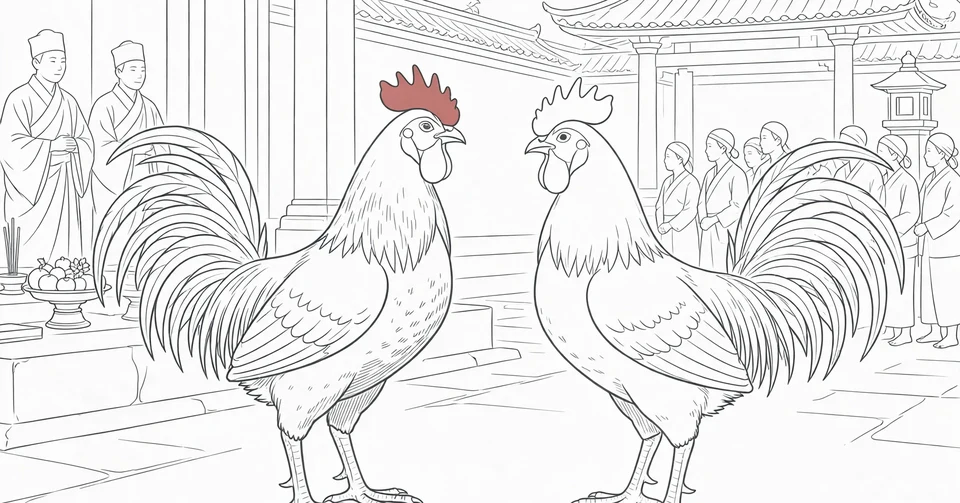
The name says as much. Balinese scholars read tabuh as a word for paying, close to tawur, the great calming offering, and rah simply means blood. Tabuh rah is a payment in blood, a small and deliberate debt settled with the powers of the lower world so that they stay calm and the village above them stays undisturbed.
What tabuh rah is paying for
To understand the payment, it helps to understand the creditors. The bhuta kala are not demons in the Western sense, and Bali does not declare war on them. They are imbalance itself: appetite, temper, greed, the restlessness in nature and in people. Since they cannot be banished, they are managed, fed at ground level and kept in their place, the way a household manages fire by giving it a hearth.
Researchers of Balinese religion describe the blood of tabuh rah as the medium that holds two worlds in balance: the bhuana agung, the great world of temples, mountains and gods, and the bhuana alit, the small world of the village and the human body. A few drops on the earth speak to both at once. The blood that reaches the ground is also a plea, an appeal to Ida Sang Hyang Widhi Wasa, God in the Balinese Hindu understanding, to keep danger away from the community. It is precisely because the stakes are read this way that the literature on tabuh rah insists it must never be performed carelessly.
Blood is not chosen at random, either. In the manuscript tradition of Kesiman in Denpasar, the calming offerings work through five liquids: palm wine, fermented rice wine, arak, water and blood, and blood is the weightiest of the five. Water can wash and wine can gladden, but only blood says that something living has been given. That is why tabuh rah takes the shape it does. When the creditors are the bhuta kala, the island pays in the one liquid that cannot be faked.
There is an inward reading too. The scholar I Ketut Mertha, whose work on the rite is widely cited in Bali, describes the dripping blood as a condition for cleansing people of greed and attachment to worldly things. The payment, in other words, is not only made to spirits outside the gate. Tabuh rah also asks the humans watching to notice the hunger in themselves, and to settle it before it settles them.
Tabuh rah runs on strict limits
A study of the rite at Pura Penataran Agung Batur Rening, a temple in the customary village of Batur Rening in Abiansemal, Badung, shows how tightly tabuh rah is fenced in. There it is held in the utama mandala, the innermost courtyard of the temple, as one step inside a larger caru offering. Nothing about it is improvised, and the cockfight is not even the first contest of the day.
Before any rooster appears, the pamangku, the temple priest, leads the smaller contests that open tabuh rah, setting the offerings against each other: eggs first, then candlenuts, pangi fruit and coconuts, each round accompanied by mantras. An elder interviewed by researchers in Kesiman gave these older contests a name from the manuscripts, ajejuden, and a meaning to go with it: human beings are always placing a wager on something, and the real stake is the care of their own soul. Only then are two roosters brought in for the perang satha, the cock war, and they are kept at it only until blood comes out. The old rule, the pakem, caps the whole thing at telung seet, three sets. Once the ground has received its payment, the rite is finished, and the defeated bird is not wasted or paraded. It becomes part of the banten sodan, an offering in its own right.
The word priests use for the goal of all this is somya, the state in which a rough force has been soothed into something calm and almost friendly. Tabuh rah is a panyomya, a calming down. The bhuta kala are not insulted, tricked or driven off. They are given their portion, in the place where portions for them belong, and the ceremony above them can proceed in peace.
I find that restraint the most honest part of tabuh rah. A rite that wanted violence would not be in such a hurry to stop. The blood here is a signature on an agreement rather than a show, and the smallness of the amount is the message: this much, no more, and everyone goes home.
The same logic as caru
Tabuh rah makes most sense next to its larger sibling. A caru is the ground level feast Bali lays out for the bhuta kala, rice, meat and strong flavours arranged on the earth so the rough forces eat and quieten. Tabuh rah follows the same logic with the volume turned down and the meaning concentrated: instead of a meal, a few drops of blood, delivered at the exact moment a ceremony needs the lower world calm. Studies of Balinese communities describe tabuh rah as a standard completion of mecaru ceremonies, the smaller cousins of caru performed whenever balance needs restoring.
That moment is often the eve of something big. Old palm leaf texts connect the rite with Tawur Kesanga, the great mecaru held across Bali on the day before Nyepi, when the island pays its rough guests in full before a day of total silence. The pattern never changes. First the ground is settled, then the real ceremony can begin, and tabuh rah is one of the oldest tools for settling it. The written trail is older than most of the temples that now host it. One legal study of tajen traces the provision for the rite back to a Balinese inscription of 933 Saka, roughly a thousand years ago, and palm leaf texts such as the Ciwa Tattwa Purana place the perang satha of tabuh rah inside the tawur of the ninth month, immediately before the silence. The scholar Ida Bagus Putu Purwita argued that the rite, as the customary form of bhuta yadnya in Bali, still carries the shape of a much older style of sacrifice.
The setting changes from temple to temple. At Pura Pangrebongan in Kesiman, Denpasar, tabuh rah appears inside Ngerebong, a gathering ceremony classed as bhuta yadnya, and it is held on a single day of the temple festival, in the temple hall. The ceremony as a whole is a lesson in the three harmonies Bali calls tri hita karana: harmony with God, with other people, and with the natural world. Within it, tabuh rah does the ground level work. Legal scholars who studied the Kesiman tradition describe its purpose in the language of balance: to stir the fiery quality in people and then harmonise it, so that restlessness is turned toward steadiness before it can do harm.
Where tabuh rah ends and tajen begins
None of this should be confused with tajen, the cockfighting arena where money does the talking. In tajen the roosters are a vehicle for stakes that, as the Batur Rening study notes, can run from tens of thousands to tens of millions of rupiah, and the loudest function on display is entertainment. Whatever else tajen is, it is gambling, and Indonesian law treats it that way: articles 303 and 303 bis of the Criminal Code, reinforced by the gambling control law of 1974, class gambling offences as crimes. Even the arenas borrow the courtesies of the rite they imitate. Before a tajen session, canang and segehan offerings are set out to ask the bhuta kala for permission to use the ground, as if the gambling ring still needed the spirits' blessing. The grammar of tabuh rah runs that deep. The researchers who examined Ngerebong concluded that the fights held inside that ceremony were purely a complement of the ritual, with no gambling practice attached to them.
The uncomfortable part is that the two share a shape, and the sacred word sometimes gets borrowed as cover. The Batur Rening researchers recorded the drift plainly. Because every tabuh rah involves blood, some villagers came to assume that every bloody fight was tabuh rah, and under that label ordinary tajen could unfold in the temple's outer courtyard through the eleven days of a festival. Balinese scholars and customary leaders push back on exactly this blurring. Their line is consistent: tabuh rah is bounded by ceremony, led by a priest, limited in rounds and finished the moment the offering is made. A fight staged for stakes fails every one of those tests.
That distinction matters beyond Bali's temples. When a rite is reduced to its most visible objects, two birds and a patch of red earth, everything that makes it a rite disappears: the mantras, the calendar, the limits, the intention. What remains looks like cruelty or gambling, and outsiders judge the remainder. Tabuh rah deserves to be read whole, the way its practitioners read it.
In the end, tabuh rah is a small ceremony with an old fashioned idea inside it: that darkness is not defeated, it is dealt with. Bali pays a few drops of blood to the ground, asks for calm in return, and gets on with the festival. It is not a gentle image, but it is an honest one, and the island has trusted it for a very long time.
More in Culture & Society
- Suka Duka Means the Banjar Shows Up for Joy and Grief Alike
- The Bendesa Adat Speaks for a Village That Has Two Governments
- Catur Brata Is Four Silences Kept at the Same Time
- Your Weton Is the Day You Were Born, Counted Two Ways
- Rahu and Ketu Still Chase the Sun and Moon Across the Sky
- Hiwatari Asks You to Walk Across the Fire
Latest posts
- On Koyasan the Founder Is Said to Be Still Meditating
- Ngembak Geni Is the Morning Bali Starts Talking Again
- Karang Ayahan Is the Plot of Land a Village Trusts You With
- On Tumpek Landep Bali Blesses Everything Made of Metal
- Sudachi Is the Sharpest of Japan's Sour Citrus
- Shugendo Turns a Mountain Into a Place of Testing
- A Canang Sari Is Made Fresh Every Morning and Gone by Night
- The Aling-Aling Wall Exists Because Spirits Walk in Straight Lines
- Oi-Nishin Sent Tohoku Farmers Chasing Herring Every Spring
- The Nishin Goten Were Palaces Paid for by Fish
- The Tobi Were Edo's Daredevils Before They Were Its Firemen
- Kabosu Is Oita's Gentle Answer to Yuzu
- A Yamabushi Trains Where the Mountain Is the Temple
- Tri Hita Karana Holds a Village in Three Balances
- Shingon Has Kept Its Fire Ritual Burning for 1,200 Years