En No Gyoja, the Mystic Shugendo Calls Its Patriarch
· 15 min read
En no Gyoja, a seventh century ascetic of the Katsuragi mountains, is the figure Shugendo calls its founder, and his legends still shape the mountain faith of Yoshino and Omine today.
Walk through Yoshino in spring, when the cherry trees are in bloom, and sooner or later you will meet a statue that stops you. An old bearded hermit stands between two demons, one red and one blue, who carry water and firewood for him as calmly as servants. That is En no Gyoja, and the demons are not his enemies. They are his followers.
Almost nothing about En no Gyoja is certain. He was born in 634 in the Katsuragi mountains of what is now Nara Prefecture, he practised austerities in the mountains for decades, and he was banished by the imperial court in 699 before being cleared two years later. Everything else about him comes from legend, and the legends are magnificent.
What makes him worth knowing is not the magic. It is the fact that a man with almost no reliable biography became the patriarch of a living religion. Shugendo, the mountain faith of Japan, still calls En no Gyoja its founder, and its practitioners still climb the same peaks he is said to have walked. To understand him is to understand how Japan turns a mystery into a mountain.
A life half history, half legend
The only near contemporary record of En no Gyoja is a single entry in the Shoku Nihongi, the imperial chronicle completed in 797, about a century after his death. It says that En no Kimi Ozunu, as the chronicle calls him, was banished to Izu no Shima, the island of Izu Oshima, on June 26, 699. He had lived on Mount Katsuragi and was famed for his sorcery, and he had taught Karakuni no Muraji Hirotari, a court official. Hirotari envied his power and accused him of trickery with weird magic, and the court sent him far from the capital. The chronicle adds the rumour that everyone repeated: Ozunu could make demonic spirits draw water and gather firewood, and when they disobeyed he bound them with sorcery.
That one paragraph is almost the whole historical record. His birth year of 634 and his death around 700 to 707 come from later tradition rather than from documents of his own time, and even the death year is disputed. Some accounts say he died in 701, the year he was pardoned. Others give a range that stretches to 707. The honest thing to say is that En no Gyoja lived in the second half of the seventh century, and that the details of his life were already legend within a hundred years of his death. The folk tales collected in the Nihon Ryoiki, written around 800, already tell of his supernatural powers as established fact.
He is known by several names, and the names themselves tell the story. En no Ozunu is his family name, with Ozunu also written Ozuno or Otsuno. En no Ubasoku means En the Layman, a reminder that he was never an ordained priest. En no Kimi Ozunu adds Kimi, a court title. But the name that stuck is En no Gyoja, which means simply En the Ascetic. It is the name a mountain gives a man who lives on it.
I find something reassuring in how little we know. Most founders of religions arrive with volumes of scripture and biography, and the weight of all that paper can make them feel distant. En no Gyoja arrives with one chronicle entry and a mountain, and somehow that is enough. The faith he is credited with founding grew out of practice, not out of books, and its founder is remembered the same way, through what people did on the mountain rather than what they wrote about him.
En no Gyoja and the thousand days on Mount Omine
The central legend of En no Gyoja takes place on Mount Omine, the sacred peak in the Yoshino mountains. Aiming to bring peace to humanity, he prayed there for 1,000 days. According to the story, the Buddha appeared to him, together with the bodhisattvas Maitreya and Kannon. En no Gyoja thought their gentleness would not convince people to change their wicked ways, so he pleaded with the three to address the problem. They rose into the heavens, which erupted in lightning and fire, and in their place descended a new deity, Zao Gongen.
Zao Gongen was a fierce god with a stern face, made to scare people into righteousness, but his body was blue, the colour of compassion. En no Gyoja carved his likeness out of cherrywood, made him the principal deity of Shugendo, and founded the first Shugendo temple on Mount Omine. In Yoshino he later established Kinpusenji Temple, the head temple of the Kinpusen Shugendo sect. The story also explains one of the most famous sights in Japan. Because cherry trees played such a part in the founding of the faith, his followers planted them throughout Yoshino, and the 30,000 cherry trees that bloom there today are still regarded as sacred trees, the greatest cherry tree crop in Japan. The Japan Tourism Agency tells this story as the origin of Yoshino's blossom, and it is a good example of how a legend can shape a landscape for more than a thousand years.
Whether any of this happened as told is beside the point, and the tradition itself seems to know that. The story is not presented as a news report. It is a founding myth, the kind of story a community tells to explain why its mountain matters and why its trees are holy. What matters is what the story produced: a temple on the summit, a deity who is both frightening and kind, and a forest of cherry trees that draws millions of visitors every spring. A legend that plants 30,000 trees has done real work in the world.
The demons who carried his water
Look again at that statue in Yoshino, the hermit flanked by two demons, and you see the heart of the En no Gyoja legend. The demons are called Zenki and Goki, and tradition says En no Gyoja compelled them to become his followers. In the Muromachi period portrait of him, the two oni stand at his side providing water and wood, the same humble tasks the Shoku Nihongi attributes to the spirits he commanded. Zenki, the red one, is said to have been a demon who repented, while Goki, the blue one, was his companion. Together they became the model of the converted demon, the wild spirit brought into service.
The story has a sharp edge. En no Gyoja did not charm the demons with kindness alone. When they disobeyed, he bound them with sorcery, and the chronicle is blunt about it. There is something honest in that. The mountain faith he founded was never a gentle religion of meadows and sunlight. It was a religion of steep cliffs, cold water and endurance, and its founder dealt with the wild powers of the mountain the way a mountain ascetic would, by mastering them rather than by asking them politely.
En no Gyoja was also, by every account, a master of herbs. The Japan Tourism Agency notes that over thirty years in the Katsuragi area he accumulated a deep knowledge of medicinal plants, and this is the part of the legend that the court itself seems to have believed. After his death, his accuser Hirotari became head apothecary to the imperial family, and the chronicle records that in 732 Hirotari was elected to the highest post in the Agency for Apothecary. The court may have exiled the sorcerer, but it kept his herbal knowledge close. That detail feels more real than any of the flying and demon binding, and it may be the truest thing in the whole story. A man who knew which plants healed and which ones killed would have been both feared and valued in the seventh century, and the line between a healer and a sorcerer was thin.
Exile to Izu Oshima and the return
The banishment of 699 is the one event in the life of En no Gyoja that history confirms, and it is also the event that the legends embroidered most freely. The Shoku Nihongi gives the date, the accuser and the place. The folk tales give everything else. In one version, En no Gyoja observed his exile respectfully during the day, but at night he flew to Mount Fuji to pray for his release. In another, he walked on the surface of the sea as though it were dry land. In yet another, he travelled to the Korean kingdom of Silla and met the monk Dosho there. The tales cannot agree on where he went, which is exactly what you would expect of a man whose real movements nobody recorded.
What the chronicle does record is the ending. En no Gyoja was declared innocent in 701 and returned to the imperial court. His accuser, Hirotari, went on to a distinguished career, which suggests the whole affair was less a trial than a court intrigue that ran its course. Two years of exile is a short punishment for En no Gyoja, a man accused of black magic, and the speed of the pardon hints that the court never quite believed the charge. Perhaps they simply wanted the troublesome holy man out of the capital for a while, and then they wanted him back, because a man who could command demons and cure the sick was useful to have nearby.
Tradition says he died not long after his return, in the summer of 701, at Tenjogatake in what is now Osaka Prefecture, though other accounts stretch his death to 707 or have him ascending from a mountain and vanishing altogether. Some say he became immortal and flew away, or travelled to China with his mother. The uncertainty is fitting. A man whose life was already half legend was never going to get an ordinary death.
The chains and cliffs of Mount Omine today
The mountain where En no Gyoja prayed for a thousand days is still the centre of the faith he founded. Ominesanji Temple stands near the summit of Sanjogatake, the peak of Mount Omine, at 1,719.2 metres, and it remains the headquarters of the Shugendo sect. The whole mountain is a training ground for the yamabushi, the mountain ascetics who follow the path he is said to have opened, and climbing it is still an act of devotion as much as a hike. The tradition that credits En no Gyoja with founding the monastery there dates it loosely to the turn of the eighth century, which is as precise as the sources allow.
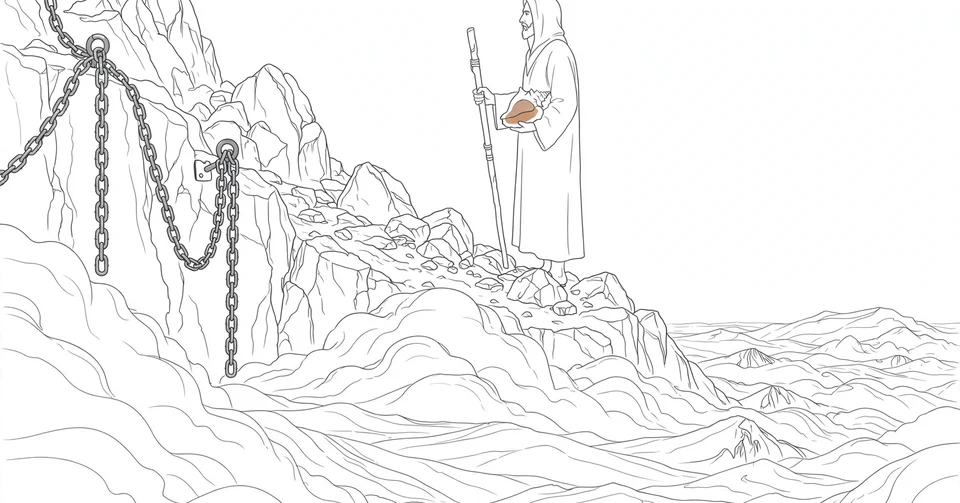
The most famous part of the climb is the three tests of courage, and they are not for the faint hearted. The first is Kanekake Iwa, the Hanging Stone, a cliff of about 30 feet where the final section requires climbers to swing out over an overhang using an embedded chain. The second is Nishi no Nozoki, the Insight from the West, where participants are held head first over a cliff some 60 metres high and made to confess their faults and promise to follow the sacred laws. The third, Byodo Iwa, the Rock of Equality, is available only by special request and involves traversing a rock tower above a deep drop. Every one of these tests has a safe detour for those who do not wish to take them, which seems wise. The point of the tests is to confront fear and ego, not to court disaster, and the mountain has been running them for more than a thousand years without needing to prove anything.
The climbing season runs from May 1 to September 30, and the most popular route starts in the town of Dorogawa Onsen. From there a six kilometre trail leads to the summit, a climb of about three hours through cedar forest and past tea houses. In 2004 the mountain became part of the UNESCO World Heritage listing of the Sacred Sites and Pilgrimage Routes in the Kii Mountain Range, which put its religious importance on the world stage. The Omine Okugake trail, a 170 kilometre route that runs from Yoshino through the Omine range to Kumano, is the longer pilgrimage that the mountain anchors, a walk of about five days through some of the most sacred ground in Japan.
One rule of Mount Omine still causes argument. Women have been barred from the sacred summit since the early Heian period, a ban of about 1,300 years, and a sign at the base of the mountain still says so. Defenders of the ban describe it as the preservation of a centuries old religious practice, while critics call it a violation of human rights that has no place in modern life. The neighbouring peak of Inamuragatake, at 1,726 metres, has been open to women as a training place since 1959, and is known as Nyonin Omine, the Women's Omine. I will not settle that argument here, because it is not mine to settle. But it is worth noting that the argument itself is a sign of the mountain's living importance. Nobody argues passionately about a place that no longer matters, and Mount Omine still matters enough to fight over.
Where you can still meet En no Gyoja
For a man who left almost no written record, En no Gyoja is remarkably easy to find. His statues stand in temples across Japan, and the finest of them are works of art in their own right. A Kamakura period statue of him, carved in polychromed wood around 1300 to 1375, is held by the Kimbell Art Museum, and the Muromachi period portrait that shows him with his two oni has been reproduced so often that it has become the standard image of the mountain ascetic. In Kyoto, one of the great floats of the Gion Festival, the En no Gyoja Yama, is dedicated to him, and yamabushi make an annual pilgrimage to it to perform rituals on site.
In 1799, at a ceremony marking what his followers counted as the thousandth year after his death, En no Gyoja was given the posthumous title Jinben Daibosatsu, the Great Bodhisattva Jinben, sometimes translated as the Miraculous Great Bodhisattva. Before that he had been venerated under the name Hoki Bosatsu, the Dharma Arising Bodhisattva. On Mount Ishizuchi in Shikoku, tradition says that after ascending from Tenjogatake in 701 he manifested as the great tengu Hokibo Daitengu, guardian of the mountain, and he is still enshrined in that form at the Hokibo hall of Gokuraku-ji Temple in Saijo. The same man is a bodhisattva in Nara, a tengu in Shikoku and a festival float in Kyoto, and none of these identities contradicts the others. That is how folk religion works. It does not ask a holy man to be one thing. It lets him be many.
The faith he founded did not have an easy history. In 1872, seventy three years after the ceremony that made him a bodhisattva, the Meiji government outlawed Shugendo for mixing multiple faiths, and the mountain temples were suppressed. The faith survived in secret and in memory, and it was revived after the war under the postwar constitution's guarantee of religious freedom. Today En no Gyoja is revered not only in Yoshino but in centres of Shugendo in Kyoto, Okayama and Yamagata, and his followers still undergo training in the mountains to seek peace, safety and security for the public. The Wikipedia entry on En no Gyoja gathers the scattered sources of his life in one place, and it is striking how short the historical section is compared with the long list of legends, artworks and festivals that follow it. The man is mostly myth, and the myth is mostly alive.
Why a man with no certain biography still matters
I keep coming back to the cherry trees. Thirty thousand of them bloom in Yoshino every spring because the followers of En no Gyoja believed the trees were sacred, and they planted them. That is a strange and wonderful thing for a legend to do. Most myths end in the telling. This one ended in a forest.
En no Gyoja matters because he shows how a religion can grow out of a place rather than out of a book. Shugendo did not begin with a scripture. It began with a man walking into the mountains, praying for a thousand days, and coming back with a god he had carved from cherrywood. The mountains of Yoshino and Omine were already sacred before him, in the old belief that mountains are the home of the dead and of the spirits of the harvest. He gave that belief a founder, a story and a discipline, and the discipline is still practised today by men and women who climb the same cliffs, hold the same conch shells and hang from the same chains.
If you climb Mount Omine in the climbing season, you will pass tea houses and cedar forest and finally the chains at Kanekake Iwa, and you will understand something that no biography could teach you. The mountain does not care whether En no Gyoja flew to Fuji or walked on water. It cares whether you can climb it, and it has been asking that question for thirteen centuries. The hermit with his staff and his conch, standing on a rocky summit above a sea of cloud, is still the best answer Japan has found to the question of what a holy man looks like. He looks like a man who went into the mountains and never really came back, because the mountains kept him, and because we keep going back to look for him there.
More in Culture & Society
- Desa Pakraman Is the Name the Law Gave the Old Village
- A Primbon Reads Your Life From the Day You Were Born
- Pasaran Is the Five-Day Week Java Never Gave Up
- A Ceper Folds a Coconut Leaf Into a Crescent Moon
- Your Neptu Is the Number Hidden Inside Your Birthday
- Tilem Is the Dark Moon Bali Counts Its Year By
Latest posts
- The Saka Calendar Sets Nyepi on a Different Date Every Year
- On Tumpek Kuningan Bali Feeds Its Ancestors
- Garuda Carried a Mountain to the Middle of the Ocean
- Vasuki Was the Rope That Churned the Ocean of Milk
- A Saito Goma Burns Its Prayers Outdoors
- Kongobuji Still Governs the Mountain Kukai Left Behind
- A Shukubo Lets You Sleep Inside a Working Temple
- Okunoin Is Japan's Largest Cemetery and Its Quietest Forest
- Suka Duka Means the Banjar Shows Up for Joy and Grief Alike
- Tabuh Rah Spills Blood So the Ground Stays Calm
- The Bendesa Adat Speaks for a Village That Has Two Governments
- Catur Brata Is Four Silences Kept at the Same Time
- On Koyasan the Founder Is Said to Be Still Meditating
- Your Weton Is the Day You Were Born, Counted Two Ways
- Rahu and Ketu Still Chase the Sun and Moon Across the Sky