Vasuki Was the Rope That Churned the Ocean of Milk
· 14 min read
Vasuki, the king of the nagas, let gods and demons tie him around a mountain and pull him until the ocean gave up both poison and the water of life.
No rope in any story ever did more work than Vasuki. He was not a rope at all. He was a king, a serpent with a jewel on his head, and he agreed to be tied around a mountain so that two armies of enemies could pull him from opposite ends. The mountain turned. The ocean frothed. Out of it came poison first, then treasures, then the water of life itself.
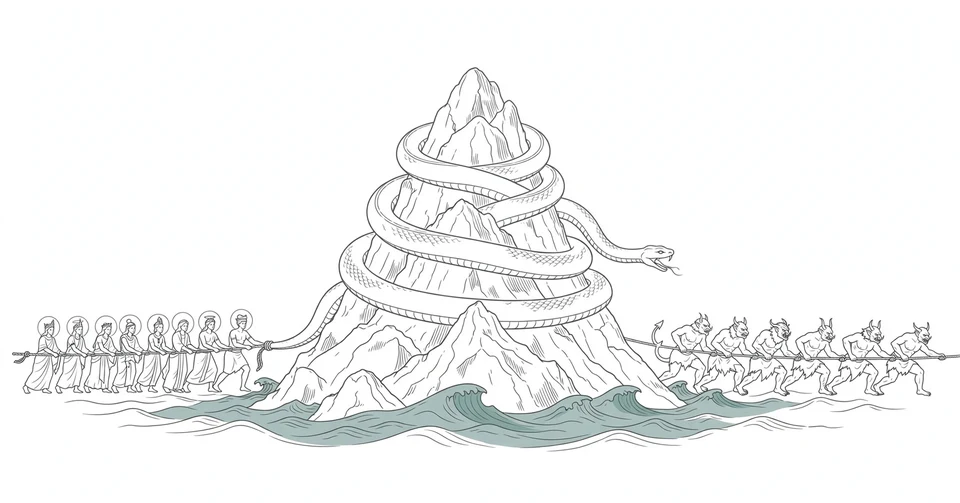
That is the strange heart of the story. The tool was alive, and the tool had a choice. Vasuki could have refused. The texts say he allowed it, and that permission is what makes him worth a whole article of his own, rather than a footnote in the churning of the ocean. He is the only character in the episode who belongs to nobody. He is not a god and not a demon. He is the rope, and the rope is the story.
Who Vasuki is, before the churning begins
Vasuki is the king of the nagas, the serpent beings of Hindu tradition. He is the son of the sage Kashyapa and Kadru, the mother of serpents. His elder brother is Shesha, the great serpent on whom Vishnu rests, and his sister is Manasa, another naga of wide fame. A gem called the Nagamani, the serpent jewel, is said to sit on his head. His consort, in the tradition, is Shatashirsha.
If you have seen a statue of Shiva, you have probably seen Vasuki without knowing it. In Hindu iconography Vasuki is generally shown coiled around the neck of Shiva, who is believed to have blessed him and to wear him as an ornament. It is a startling image once you notice it: the god of destruction wears a living snake as a necklace, and the snake is a king in his own right. The pairing is not an accident. Shiva is the ascetic who can hold poison in his throat, and Vasuki is the creature whose breath carries poison. They belong together, and the churning of the ocean is where that pairing is tested in public.
Vasuki is not only an Indian figure. In Chinese and Japanese tradition he is counted among the Eight Great Dragon Kings, the Hachidai Ryuo in Japanese. That is how far a serpent can travel: from a mountain in the Puranas to the temples of East Asia, still a king, still a dragon, still wearing his jewel. In Buddhism, Vasuki and the other naga kings appear in the audience for many of the Buddha's sermons, and their duties include leading the nagas in protecting and worshipping the Buddha.
How Vasuki became the rope
The churning, the samudra manthana, begins with a curse. The sage Durvasa offers the god Indra a garland, Indra's elephant throws it to the ground, and Durvasa curses Indra and all the devas to lose their strength, energy, and fortune. The devas lose their battles. The asuras, led by Bali, take control of the three worlds. The devas ask Vishnu for advice, and Vishnu tells them to make a temporary alliance with their enemies and churn the ocean of milk together for amrita, the nectar of immortality, promising the asuras an equal share. Vishnu quietly assures the devas that he will arrange for them alone to get it.
For the full story of that alliance, and the trick that ended it, our article on the samudra manthana tells it from the beginning. What matters here is the apparatus, because the apparatus is Vasuki. Mount Mandara is uprooted and carried to the middle of the ocean to serve as the churning rod. Vasuki, a naga who resides on Shiva's neck, becomes the churning rope after being promised his share. He coils himself around the mountain, and the two sides take their ends.
Here the texts disagree, and the disagreement is worth reporting honestly. In the version most often told, the asuras hold Vasuki's head and the devas hold his tail. The asuras demanded the head end, considering it more honourable, and were scorched by Vasuki's fiery breath throughout the work, while the devas at the tail were spared. Wikipedia's account of the legend adds a twist: Vishnu first counselled the devas to take the head and the asuras the tail, but the asuras saw the head as inauspicious and refused, so the devas relented and held the tail. Other versions, including the Bhagavata telling, reverse the ends entirely. The safe way to say it is that the two sides pulled from opposite ends of the same living rope, and that which end anyone held depended on which text you trust. The mountain turned either way.
Then the mountain began to sink. It was too enormous for the ocean floor, and the whole enterprise was about to drown. Vishnu took the form of Kurma, the tortoise, and supported the mountain on his shell. In the Mahabharata version, it is not Vishnu who takes the tortoise form but Akupara, the king of tortoises, who does it at the request of the devas and asuras. Either way, the picture is the same: a mountain, a serpent, and a tortoise holding the world up while gods and demons pull.
The poison in Vasuki's breath
The first thing the churning produced was not a treasure. It was poison. Halahala, also called kalakuta, rose from the ocean, so potent that it threatened to destroy all of creation. In some versions of the story, the poison escaped from the mouth of Vasuki himself as the two sides churned, and the asuras standing at his head were poisoned by his fumes. The devas and the asuras pulled back and forth on the snake's body anyway, and the mountain kept turning.
I keep coming back to this detail, because it changes what Vasuki is. He is not a passive rope. He is a rope that breathes fire and poison, and both sides know it. The asuras took the head end and paid for it with every breath. The devas took the tail and watched. Nobody in the story stops to ask whether the rope is suffering. The churning is an act of extraction, and Vasuki is the thing being extracted from, as much as the ocean is.
On Vishnu's advice, the gods approached Shiva for help. Out of compassion for living beings, Shiva drank the poison. It was so potent that it changed the colour of his throat to blue, which is why he is also called Neelakantha, the blue-throated one. The snake around his neck and the poison in his throat are the same story, told twice: the creature that can kill you is also the ornament you wear, and the god who can drink poison is the only one who can finish the work the rope started.
What came out of the ocean
Once the poison was dealt with, the ocean began to give up its treasures. All kinds of herbs were cast into the ocean, and fourteen ratnas, or gems, were produced, though the lists in the scriptures range from nine to fourteen and differ between the Puranas, the Ramayana, and the Mahabharata. Lakshmi, the goddess of prosperity, emerged and chose Vishnu as her consort. Kamadhenu, the wish-granting cow, appeared, along with Airavata the elephant, Uchhaishravas the seven-headed horse, the jewel Kaustubha, the wish-fulfilling tree Kalpavriksha, the crescent moon Chandra, and the apsaras, the divine dancers.
Finally Dhanvantari, the physician of the devas, emerged carrying a pot of amrita, the nectar of immortality. Fighting broke out at once. The asuras seized the pot and ran. Vishnu took the form of Mohini, a beautiful enchantress, and distributed the nectar to the devas while the asuras watched, charmed. One asura, Svarbhanu, disguised himself as a deva and drank some. The sun and the moon noticed, told Mohini, and Vishnu cut off his head with the discus Sudarshana Chakra. His head became Rahu and his body Ketu, the Hindu myth behind eclipses, which we tell in full in our article on Rahu and Ketu. Rejuvenated by the amrita, the devas defeated the asuras and regained their heaven.
Vasuki's share of all this is rarely stated plainly, and that is the point the story leaves hanging. He was promised a share. The texts do not record him drinking the nectar. He did the work, absorbed the pulling and the poison, and then the story moves on to the winners. A rope does not get a victory parade. I think that is why he lingers in the memory longer than the victors do. Everyone remembers the mountain and the tortoise and the poison. The rope is the one who said yes, and nobody thanked him in the text.
Vasuki beyond the churning
The churning is Vasuki's most famous hour, but the Mahabharata gives him a longer life, and it is not a comfortable one. His mother Kadru cursed him. He had refused to help her cheat in a wager against her sister Vinata, by hanging onto the tail of the divine horse Uchhaishravas to make it look black. For that refusal, Kadru condemned him to burn with his brothers in the snake sacrifice of King Janamejaya. Vasuki sought refuge with the devas, and his part in the churning was part of that search for safety. Wishing to save his brothers, he took the counsel of his siblings, and one of them, Elapatra, told him of a prophecy: the son of his sister Jaratkaru and a sage of the same name would save them. Vasuki arranged the marriage. The son born to them, Astika, put an end to Janamejaya's persecution of the nagas.
There is a pattern here that is easy to miss if you only know the churning. Vasuki keeps surviving by making himself useful to more powerful beings. He refuses his mother's cheat, and is cursed. He offers himself as a rope, and is pulled for an age. He marries off his sister on a prophecy, and is saved by his nephew. He is a king who never rules anything except his own body, and he lends that body out whenever the world needs a rope.
In another episode of the Mahabharata, the Kaurava brothers poison their cousin Bhima out of jealousy and throw him into the Ganges. Bhima sinks to the riverbed and reaches Nagaloka, the world of the nagas, where the nagas bite him and neutralise the poison. There he meets Vasuki, who presents him with wealth and costly gems, and then gives him a divine drink that gives him the strength of a thousand elephants. It is one of the few scenes in which Vasuki is generous on his own terms, with no mountain involved, and it is a reminder that the king of the nagas is also a host, not only a tool.
Vasuki is still worshipped. A temple of Vasuka stands near Haripad, at Mannarasala in Kerala, and another in the Visakhapatnam district of Andhra Pradesh. According to the regional legend of the Kukke Subramanya temple in Karnataka, the deity Kartikeya offered Vasuki protection from Garuda, the mount of Vishnu, who hunts serpents. Even in the stories, Vasuki needs a protector from the bird who carries mountains.
Vasuki in stone, from Angkor to Java
The churning is one of the most carved stories in Asia, and wherever it is carved, Vasuki is the long line that holds the composition together. At Angkor Wat, built in the first half of the twelfth century for King Suryavarman II and dedicated to Vishnu, the churning of the ocean of milk fills a great bas-relief panel in the east gallery. The gods pull the tail, the demons pull the head, and the serpent runs the whole length of the wall between them. It is the longest single story in the temple, and it works as a picture precisely because the rope gives the carver a horizontal line to organise a hundred figures around. Without Vasuki, the scene would be a crowd. With him, it is a tug of war.
The story travelled to Java as well. The Wikipedia page on the churning shows a miniature of the Samudra Manthana from the Majapahit era, kept in the museum at Trowulan, the old Majapahit capital in East Java. A small model, not a temple wall, but proof that the story was told in Java centuries ago, in the same form, with the same mountain and the same rope. Indonesia did not receive this myth as a foreign import. It was part of the world the Majapahit court lived in.
Bali keeps the story differently. The samudra manthana article on this site tells how the water of life, the amerta, is fetched every year at Melasti, carried home in bottles, and shared by whole villages, a public commons where the old myth kept the nectar for the winners alone. The nagas themselves are everywhere in Balinese carving, coiled around temple gates and stairways as guardians. Vasuki's name is rarely carved on a Balinese gate, but his shape is: the long serpent body that connects one side of a story to the other, that holds a building together the way a rope holds a mountain together. A visitor who has seen the Angkor panel and then walks through a Balinese temple will recognise the grammar at once.
What Vasuki means
The old commentaries give Vasuki a symbolic role, and it is a sharp one. In the traditional reading, Vasuki symbolises desire. The devas and the asuras held desire as a rope and churned the mind with concentration, represented by Mount Mandara, and withdrawal of the senses, represented by the tortoise. Desire, the reading warns, will overpower and destroy a person if it is not controlled. The poison that comes out first is the suffering of the early stages of practice, and Shiva, the ascetic principle, is the one who can drink it.
I find that reading honest, but incomplete, because it makes Vasuki the villain of his own story. Desire is not only a danger in this myth. It is also the engine. Without the desire for amrita, nobody churns anything, nobody cooperates, and the ocean keeps its treasures. The gods and the demons both want the same thing, and that shared wanting is the only reason they work together at all. Vasuki, as the rope, is desire made visible: a living thing stretched between two enemies, pulled from both ends, breathing fire, producing poison before it produces anything good.
The part I keep returning to is the order of things. The poison comes first. Not as a punishment, and not as a mistake, but as the first product of the work. Every serious effort I know follows the same order. You start churning, and the first thing that surfaces is something toxic: the resentment, the exhaustion, the knowledge that your allies are lying to you. The story does not pretend otherwise. It says the poison has to be drunk by someone willing to hold it in the throat, and only then do the treasures come. Vasuki does not drink the poison. He makes it, by being pulled. Shiva drinks it. That division of labour is the whole myth in miniature: one creature produces the poison by enduring, another absorbs it by choice.
Vasuki is still there, in the end, coiled around Shiva's neck. He did not get the nectar, as far as the texts say. He got a place on the god who drank the poison, close to the throat, where the blue mark is. That is a strange reward, and a fitting one. The rope that survived being pulled by gods and demons ends up as an ornament on the one being who could swallow what the pulling produced. He is not the hero of the churning. He is the reason the churning had a shape at all, and the reason we still remember it. A mountain can be a tool. A tortoise can be a foundation. Only a living rope can be pulled by enemies and still hold.
More in Culture & Society
- Desa Pakraman Is the Name the Law Gave the Old Village
- A Primbon Reads Your Life From the Day You Were Born
- Pasaran Is the Five-Day Week Java Never Gave Up
- A Ceper Folds a Coconut Leaf Into a Crescent Moon
- Your Neptu Is the Number Hidden Inside Your Birthday
- Tilem Is the Dark Moon Bali Counts Its Year By
Latest posts
- The Saka Calendar Sets Nyepi on a Different Date Every Year
- On Tumpek Kuningan Bali Feeds Its Ancestors
- Garuda Carried a Mountain to the Middle of the Ocean
- En No Gyoja, the Mystic Shugendo Calls Its Patriarch
- A Saito Goma Burns Its Prayers Outdoors
- Kongobuji Still Governs the Mountain Kukai Left Behind
- A Shukubo Lets You Sleep Inside a Working Temple
- Okunoin Is Japan's Largest Cemetery and Its Quietest Forest
- Suka Duka Means the Banjar Shows Up for Joy and Grief Alike
- Tabuh Rah Spills Blood So the Ground Stays Calm
- The Bendesa Adat Speaks for a Village That Has Two Governments
- Catur Brata Is Four Silences Kept at the Same Time
- On Koyasan the Founder Is Said to Be Still Meditating
- Your Weton Is the Day You Were Born, Counted Two Ways
- Rahu and Ketu Still Chase the Sun and Moon Across the Sky