Suka Duka Means the Banjar Shows Up for Joy and Grief Alike
· 10 min read
In Bali, suka duka is the banjar custom that sends the whole neighbourhood to help at weddings, baby ceremonies, funerals and cremations, so that joy and grief are never carried alone.
When a family in a Balinese village announces a wedding, they are not really announcing that they will host it. Within days the neighbours will have taken over the cooking, the decorating and the welcoming of the guests, and the family will mostly be told where to stand. When the same family loses a parent, the neighbours arrive before anyone thinks to ask them. Both reflexes come from the same custom, and its name is suka duka.
The two words are simple. Suka means joy, and duka means sorrow. Put together, suka duka is the promise that the community shows up for both, not only for the funeral when help is obviously needed, but also for the wedding when help is just as expensive. In most of Bali that promise is organised by the banjar, the neighbourhood association, and people speak of the arrangement simply as banjar suka duka.
Almost every banjar on the island still runs some form of suka duka, although no two banjar run it in exactly the same way. The rules are decided in the banjar's own meetings, adjusted as life changes, and treated as binding by the members who agreed to them. What follows is how the system works, what it covers, and why researchers who study it tend to reach for a surprising comparison: insurance.
What counts as suka, and what counts as duka
To understand suka duka you first have to understand the banjar itself, the neighbourhood council that runs daily life in Bali, because suka duka is one of its oldest and most personal jobs. The banjar divides the big events of a member's life into the two piles the name suggests.
On the suka side sit the happy ceremonies: engagements, weddings, thanksgiving ceremonies, and the three month ceremony for a new baby, when the child is formally welcomed into the world of the village. On the duka side sit death and everything that follows it, the funeral, the cremation known as ngaben for a Hindu family or the burial for a Christian one, and also plain misfortune such as an accident or a natural disaster.
The list matters because it defines the obligation. A member does not get to decide that weddings are worth helping with but funerals are not, or the other way around. Some banjar even specialise, with a small number organised as duka only groups, but the classic suka duka banjar covers the whole arc of a life, from the baby ceremony to the cremation ground. Joy and grief are one package, and membership means signing up for all of it.
The help arrives before it is asked for
The most striking thing about suka duka is that nobody has to organise it in the moment. For a wedding, members traditionally begin arriving about three days before the main day, once the family has asked the permission of the kelihan, the banjar head, and from then on the preparation simply becomes communal work. The work itself has a name, ngayah, labour offered without wages, and in a suka duka event ngayah is the main currency.
For a death, the reflex is even faster. When a member dies, the other households set about preparing everything the cremation or burial requires, and accounts of the system note that members already know what their tasks are without waiting for instructions. In the older pattern, each household hands over patus, a contribution in kind made of things a funeral actually consumes: firewood, rice, bamboo, a chicken, and some money. Several banjar have since converted patus into a cash payment of equal value, which is easier to collect and easier to spend where it is needed.
The division of labour inside a suka duka event is practical rather than ceremonial. In Banjar Umacandi in the village of Buduk, one of the best documented cases, the men take on the physical work at the host's house and stay with it until the event is finished. The women take charge of the food, cooking both for the army of helpers and for the invited guests, and for an engagement or a wedding reception they also contribute rice or cakes, in amounts settled together according to what the host family needs.
Nothing about this is spontaneous charity, and that is precisely why it works. The suka duka machinery runs on agreed turns. You cook at my daughter's wedding this year because the whole street cooked at yours, and everyone can keep the accounts in their head without ever writing them down.
The suka duka rules are agreed together, and they bind
A suka duka arrangement is not just a warm feeling. In Banjar Tuka in Dalung, researchers describe the suka duka bond as a traditional institution strengthened by the awig awig, the written customary rules that every member is obliged to obey. The dues, the turns of work and the contributions are all part of that written order, and a member who plans a wedding and has asked the kelihan's permission is entitled to the support of the whole group. Entitlement and obligation are the same coin.
Because the obligations are real, absence is not treated as a private matter. A member who repeatedly skips the work without a reason can face customary sanctions under the banjar's rules, usually light ones such as a small fine or an extra share of duty, but the disapproval behind them is the heavier penalty. In a village, being known as the household that never shows up is a debt that comes due at your own family's worst moment.
The amounts involved are modest and very concrete. In Banjar Umacandi, when a member dies, a contribution of 10,000 rupiah is collected from each household, while the women bring goods such as a kilo of rice, a kilo of sugar or packets of noodles, worth roughly 30,000 rupiah a person. A smaller contribution of 5,000 rupiah is gathered every six months as a thank you to the suka duka committee that keeps the records and does the organising.
Yet the system is not a trap. Rules in a suka duka banjar can be changed by agreement when members find them too heavy, and membership itself is not always absolute: in Umacandi, three of the ninety seven households chose not to join the banjar suka duka group, and the village carried on around them. The binding force is real, but it is the binding force of a promise the members wrote for themselves.
Insurance that predates the insurance company
It is hard to describe suka duka without reaching for the language of insurance, and Balinese scholars got there first. Studies of the banjar describe it as running a social security system for its members, long before formal insurance reached the village. The premiums are your labour, your rice and your small cash dues, paid steadily across the good years. The payout arrives on the worst week of your life, in the form of a hundred people who already know what to do.
A study of Banjar Umacandi, published in the Jurnal Ekonomi dan Bisnis, put prices on that payout. For a funeral, the researchers priced what a family would have spent alone at about 15.65 million rupiah, covering the plot, the coffin, tents and chairs, food, drinks, cakes and flowers. With the banjar and the church congregation both contributing labour, goods and cash, the family's own burden fell to roughly 7.86 million rupiah. For a wedding, the cakes, food and decoration that would have cost about 48 million rupiah were cut by some 22.5 million, because the catering company was replaced by the neighbours.
Those numbers only count money. They do not count the fact that a grieving family does not have to project manage a cremation, or that a bride's parents do not spend the wedding week in a panic over rice. The Balinese scholar Kastama, quoted in the same research tradition, puts the deeper point plainly: suka duka is the most important principle in the social bond of the banjar, because members feel safe knowing that in joy and in sorrow the burden is carried together. To my mind that feeling of safety, renewed at every wedding and every funeral, is the real product the system sells, and no insurance office has ever managed to deliver it with cooked rice included.
It works across religious lines too
Suka duka is often described as a Hindu Balinese custom, and its ceremonies certainly grow out of that world. But the system itself turns out to be portable. Almost all banjar in Bali still practise suka duka, including communities that are not Hindu, and in Buduk the Christian residents of Banjar Umacandi hold two suka duka memberships at once, one in the banjar and one in their church congregation, the Efrata congregation of the Balinese Protestant church. When one of them dies, the banjar's contributions arrive alongside the church's help, which covers money toward the coffin and lends out tents and two hundred chairs.
Research on Banjar Tuka in Dalung, published in Jurnal Pangkaja, tells the same story from the other side. There, Hindu and Catholic neighbours share one suka duka bond: Catholic members work actively to help when a Hindu neighbour's family holds a cremation, and Hindu members in turn support the preparations for Christmas and Easter. The shared work, the researchers argue, is exactly where the village's tolerance is built, long before anyone makes a speech about it.
Underneath all of this sits an older Balinese idea, menyama braya, the principle that everyone in the community is to be treated as a sibling. Suka duka is menyama braya with a schedule and a cash box. It takes the sentiment that we are all family and turns it into rosters, dues and rice, which is why it survives when sentiments alone fade.
A burden halved, a joy doubled
What I find most admirable about suka duka is its honesty about life. It does not pretend that weddings are pure happiness or that funerals are pure grief. A wedding is also an expense and a logistical siege; a funeral is also, quietly, a reunion of everyone who loved the person who died. The banjar simply organises itself around both truths at once.
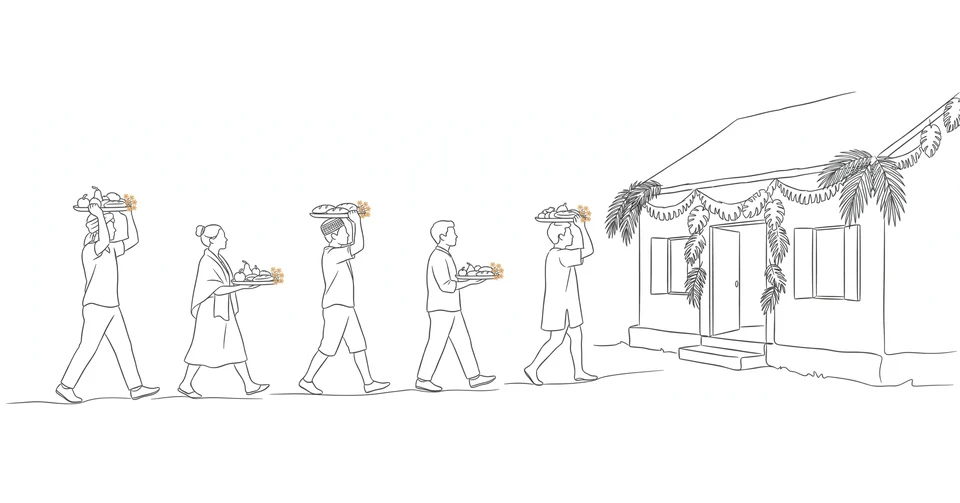
The system asks a lot: your weekends, your rice, your small dues, your presence at other people's milestones for decades. In return it makes a promise that modern life rarely makes so concretely. When your family's turn comes, in joy or in grief, you will not face it alone, because the whole street is already on its way to your gate, carrying the trays.
More in Culture & Society
- Tabuh Rah Spills Blood So the Ground Stays Calm
- The Bendesa Adat Speaks for a Village That Has Two Governments
- Catur Brata Is Four Silences Kept at the Same Time
- Your Weton Is the Day You Were Born, Counted Two Ways
- Rahu and Ketu Still Chase the Sun and Moon Across the Sky
- Hiwatari Asks You to Walk Across the Fire
Latest posts
- On Koyasan the Founder Is Said to Be Still Meditating
- Ngembak Geni Is the Morning Bali Starts Talking Again
- Karang Ayahan Is the Plot of Land a Village Trusts You With
- On Tumpek Landep Bali Blesses Everything Made of Metal
- Sudachi Is the Sharpest of Japan's Sour Citrus
- Shugendo Turns a Mountain Into a Place of Testing
- A Canang Sari Is Made Fresh Every Morning and Gone by Night
- The Aling-Aling Wall Exists Because Spirits Walk in Straight Lines
- Oi-Nishin Sent Tohoku Farmers Chasing Herring Every Spring
- The Nishin Goten Were Palaces Paid for by Fish
- The Tobi Were Edo's Daredevils Before They Were Its Firemen
- Kabosu Is Oita's Gentle Answer to Yuzu
- A Yamabushi Trains Where the Mountain Is the Temple
- Tri Hita Karana Holds a Village in Three Balances
- Shingon Has Kept Its Fire Ritual Burning for 1,200 Years