Catur Brata Is Four Silences Kept at the Same Time
· 9 min read
On Nyepi, Bali keeps catur brata, four vows held at the same time. There is no fire or light, no work, no travel and no entertainment from six in the morning until six the next morning, and this is what each silence means, who watches over it, and what is allowed to break it.
Most new years begin with noise. Bali begins its own with four kinds of quiet at once, and the name for that combined discipline is catur brata. For one full day, the island keeps four vows together: no fire or light, no work, no travel and no entertainment, with no exceptions made for convenience.
The full name is catur brata penyepian. Catur means four, brata is a vow or act of devotion, and penyepian reaches back to sepi, the Balinese word for silent that also gives Nyepi its name. The four rules belong to that single day, the day of silence that stops the entire island, and they bind everyone who happens to be on it, Balinese Hindu and passing tourist alike.
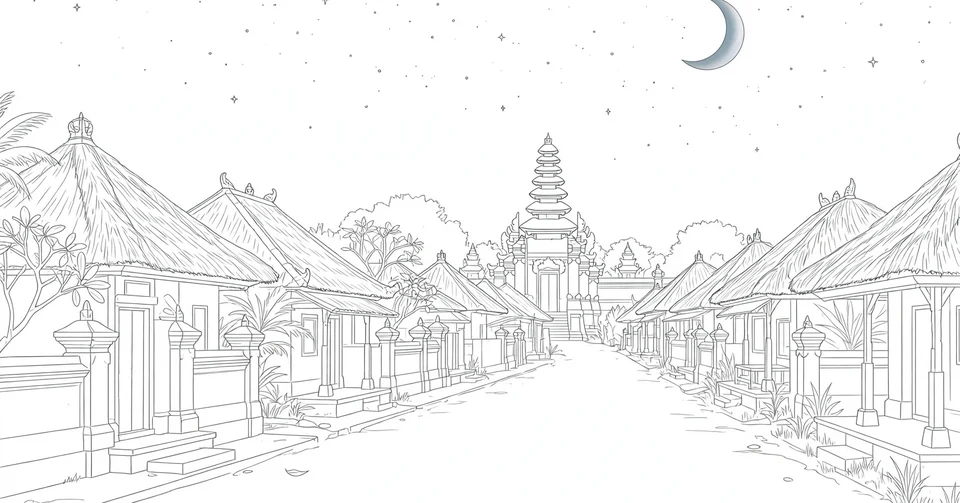
What makes catur brata remarkable is not any single rule. People in many places fast, rest on a holy day, or switch off their lights. It is the combination that is rare. Four restraints, kept by millions of people in the same 24 hours, turn a private discipline into something like public weather. The silence of Nyepi is what catur brata sounds like from the inside.
What catur brata asks of a whole island
The vow runs from six in the morning until six the following morning, and each of its four parts closes a different door. Wikipedia's summary of Nyepi lists them in their usual order: amati geni, no fire or light, including no electricity; amati karya, no working; amati lelunganan, no travel; and amati lelanguan, no revelry or self-entertainment. Together they form the core of the observance sometimes called tapa brata penyepian, the discipline of silence.
Notice what the list covers. Fire and light are the senses and the hearth. Work is the hands. Travel is the feet. Entertainment is the restless mind looking for something to consume. Whoever shaped catur brata was not banning activities at random. They were closing, one by one, every channel through which an ordinary noisy day normally flows.
The sequence is deliberate, too. The evening before Nyepi is pengerupukan, close to the loudest night of the Balinese year, when ogoh-ogoh monsters are paraded through the streets, pots and bamboo tubes are banged inside every house, and torches of dried coconut leaves are burned to drive out disorder. Catur brata is the answer to that noise. Having spent one evening making as much racket as possible, the island spends the next day proving it can also do the opposite, completely.
Amati geni, the rule of darkness
The first vow of catur brata is also the most visible. Under amati geni, no fire is lit and no light is shown. Cooking is finished the day before, because the kitchen stove stays cold. Lamps stay off after dark, and in houses and hotels the curtains are drawn so that not even a crack of light escapes into the street. The island does not merely dim. After sunset it goes properly dark, street by street, village by village.
There is a second meaning folded inside the first. Fire, in the teaching behind catur brata, also stands for anger, ego and appetite, the inner flames a person carries around all year. To sit in a dark house for one night is to practise keeping those flames down as well. The outer darkness is a picture of the inner one, and that is why amati geni is always explained as self control, not just as switching things off. Sejiva's guide to the four principles puts it simply: by minimising light, people are encouraged to quiet their impulses and return to inner calm.
Practically speaking, the electricity grid on the main island stays alive, because hospitals and other vital services cannot simply stop. What collapses is demand. In 2023 the state electricity company PLN estimated the island's load on Nyepi at around 615 megawatts, roughly 30 to 40 percent below the normal peak, as homes, shops and hotels voluntarily went dark around the clock. The reward arrives after sunset. With almost no light pollution, the night sky over Bali turns the deep black that city dwellers rarely see, and the stars and the Milky Way come out over silent rooftops. For many visitors, that sky ends up being the most memorable part of the day.
Amati karya, the rule of rest
The second vow, amati karya, is the simplest to state and, for many people, the hardest to keep: no work. Shops close, offices close, restaurants and cafes close, construction stops, and the warungs that feed the island's daily life stay shuttered from morning to morning. On the evening before, many cash machines are switched off as well, and they stay off until the day after Nyepi.
This is not a holiday in the ordinary sense, and the difference matters. A day off is usually spent doing something else, louder. Amati karya removes the something else too. What is left is the thing Nyepi is actually for: a day given to fasting, prayer, meditation and self reflection, in which the question is not how to fill the hours but what a person notices when the hours are left empty. Work, under catur brata, includes the small restless labour of errands and chores, so the rest is total.
Amati lelunganan, the rule of staying still
Under amati lelunganan, nobody travels. The roads of Bali, normally thick with scooters from dawn, stand completely empty. The beaches are out of bounds. Bali's only airport closes for the entire day, as it does every year, and no flights land or take off until the following morning.
Like the rest of catur brata, this rule applies to everyone on the island, whatever their religion. Tourists are free to move around inside their hotel, but nobody may step onto the street or the beach, and visitors who break the rule have faced deportation. Residents stay inside their own compounds. From the air, Bali on Nyepi must look like an island briefly returned to the animals: perfect roads, perfect beaches, and not a single human being on any of them.
Amati lelanguan, the rule of no fun
The fourth vow of catur brata, amati lelanguan, gives up revelry and self entertainment. Televisions and radios go quiet. Music stops. In recent years mobile data across the island has also been switched off for the same 24 hours, which closes the last loophole through which the outside world usually pours in. Many Balinese Hindus fast through the day as well, so the body keeps the same discipline as the house and the street.
Of the four, this may be the most modern feeling rule, and to me it is the most honest one. A person can sit in a dark, silent house and still spend the whole day entertained, scrolling and streaming the silence away. Amati lelanguan closes that door too. It treats pleasure not as a sin but as a noise, and asks what the mind does when the noise stops. What it usually does, people say, is slow down, reflect, and eventually rest.
Who watches the streets, and what may break the rules
A vow kept by millions needs gentle enforcement, and on Nyepi the guarding of catur brata belongs to the pecalang, the traditional village security men. They are the only people allowed outdoors, patrolling the empty streets in their checked sarongs to make sure the prohibitions are followed and no light or noise escapes. If a power fault needs fixing, even the electricity company's crew moves only with a pecalang escort.
The rules do bend for real emergencies, and only for those. The exceptions recognised on the day are emergency vehicles answering life threatening calls, and women on their way to give birth. Hospitals keep working through the silence, quietly, behind drawn curtains. Everything else waits. It says a great deal about how seriously catur brata is taken that an entire tourism island accepts this arrangement every year without serious argument: life and death may pass through the silence, but convenience may not.
Why keep four silences at the same time
It would be easier to keep one rule. A day without work, or a night without lights, would still be a fine tradition. The wisdom of catur brata, I think, is that it refuses to negotiate. Modern rest usually fails at the edges: we stop working but keep travelling, stop travelling but keep glowing and scrolling. A single unmoving day, in which every channel is closed at once, leaves the mind with nowhere to leak away to. What remains is the actual purpose of Nyepi, self reflection before the Saka new year begins, done properly because there is nothing else available to do.
There is something else, too. Because catur brata binds everyone equally, the silence is never lonely. A whole society agrees to be quiet together, and the agreement itself becomes the celebration.
When the silences lift
At six the next morning, the vow ends as exactly as it began. The day that follows is Ngembak Geni, the morning Bali starts talking again, when fires are relit, cooking resumes and families go visiting to ask forgiveness of one another. After a day of catur brata, even ordinary sounds, a kettle, a scooter, a neighbour's greeting, land differently.
That, in the end, is what the four silences of catur brata are for. Catur brata does not empty the island of life. It lowers the volume of everything for one day, so that when the sound comes back, people can hear how much of it they actually missed, and how much they did not.
More in Culture & Society
- Suka Duka Means the Banjar Shows Up for Joy and Grief Alike
- Tabuh Rah Spills Blood So the Ground Stays Calm
- The Bendesa Adat Speaks for a Village That Has Two Governments
- Your Weton Is the Day You Were Born, Counted Two Ways
- Rahu and Ketu Still Chase the Sun and Moon Across the Sky
- Hiwatari Asks You to Walk Across the Fire
Latest posts
- On Koyasan the Founder Is Said to Be Still Meditating
- Ngembak Geni Is the Morning Bali Starts Talking Again
- Karang Ayahan Is the Plot of Land a Village Trusts You With
- On Tumpek Landep Bali Blesses Everything Made of Metal
- Sudachi Is the Sharpest of Japan's Sour Citrus
- Shugendo Turns a Mountain Into a Place of Testing
- A Canang Sari Is Made Fresh Every Morning and Gone by Night
- The Aling-Aling Wall Exists Because Spirits Walk in Straight Lines
- Oi-Nishin Sent Tohoku Farmers Chasing Herring Every Spring
- The Nishin Goten Were Palaces Paid for by Fish
- The Tobi Were Edo's Daredevils Before They Were Its Firemen
- Kabosu Is Oita's Gentle Answer to Yuzu
- A Yamabushi Trains Where the Mountain Is the Temple
- Tri Hita Karana Holds a Village in Three Balances
- Shingon Has Kept Its Fire Ritual Burning for 1,200 Years