On Tumpek Kuningan Bali Feeds Its Ancestors
· 12 min read
Tumpek Kuningan is the morning Bali says goodbye to its ancestors, with yellow rice, prayers at the family shrine, and a deadline at noon.
There is a morning in Bali when the whole island eats breakfast with its dead. The rice is yellow, the prayers are short, and everything has to be finished before noon. That morning is Tumpek Kuningan, the day Bali feeds its ancestors one last time before sending them home.
Tumpek Kuningan falls ten days after Galungan, on Saniscara Kliwon Wuku Kuningan in the 210 day Pawukon calendar. It closes the long visit that began when the ancestral spirits came down to their family compounds, and it is quieter than Galungan, more domestic, and in some ways more moving, because the whole point is a goodbye.
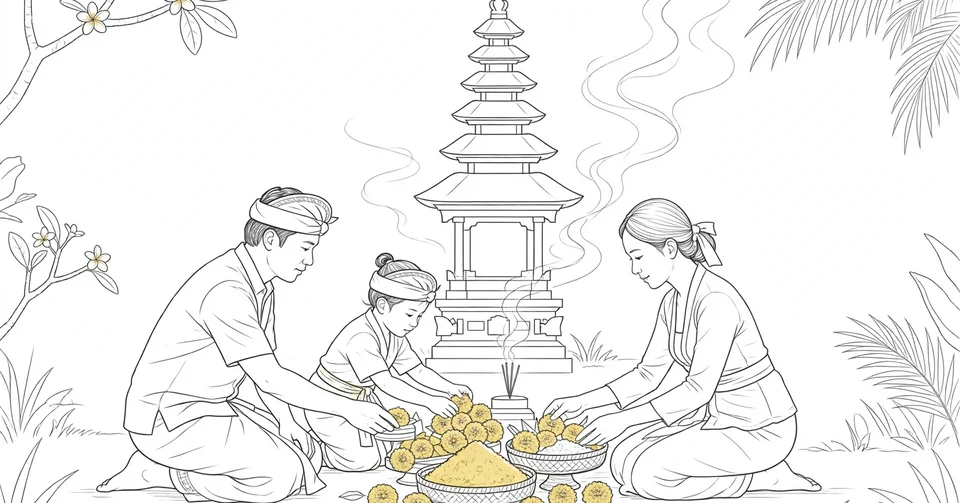
I like Tumpek Kuningan for exactly that reason. Galungan gets the penjor poles and the crowds, but Tumpek Kuningan is the day a family sits in its own shrine, sets out a small yellow meal, and says thank you to people it can no longer see. It is a festival that fits inside a family compound, and that is where its meaning lives.
Tumpek Kuningan closes a ten day visit
Galungan is the festival that opens the door. It marks the victory of dharma, righteousness, over adharma, disorder, and it is the point in the Balinese year when the spirits of ancestors return to visit the family homes they came from. For ten days the living are responsible for hosting them properly, with prayer, offerings, and food. The tall penjor poles outside each house mark which home has guests.
Tumpek Kuningan is the day the visit ends. The ancestral spirits who descended to the household shrines during Galungan return to the divine realm, to Swarga Loka, and the family sends them off with a final meal. After Tumpek Kuningan, the Galungan decorations, including the penjor, are traditionally taken down on Pegat Wakan, the day that closes the broader ritual period.
That is why Tumpek Kuningan feels different from the festivals around it. Galungan is an arrival, loud and public. Tumpek Kuningan is a departure, and departures are usually quieter. The Balinese believe the gods and the ancestors stay only for half a day during Tumpek Kuningan, so the whole ceremony runs from the morning until before noon. After that, the guests have gone, and the house belongs to the living again until the next cycle.
The Pawukon calendar sets the date, not the Gregorian one
Tumpek Kuningan does not have a fixed date in the Gregorian calendar. It is set by the Pawukon calendar, the Balinese ritual calendar of 30 weeks, called wuku, of seven days each, which completes in 210 days. Galungan always falls on Buda Kliwon Dungulan, a Wednesday in the week of Dungulan, and Tumpek Kuningan always follows ten days later, on Saniscara Kliwon Kuningan, a Saturday in the week of Kuningan.
The word Tumpek itself comes from a meeting of two cycles. It falls when Saniscara, Saturday, the fifth day of the five day pancawara cycle, coincides with Kliwon, and the name is said to come from the syllables tu, meaning beginning, and pek, meaning end. Saturday is the end of the seven day saptawara cycle and Kliwon is the end of the five day pancawara cycle, so a Tumpek day is the end of one round and the beginning of the next. That meeting happens every 35 days.
Bali actually keeps two calendars at once, and it is worth keeping them straight. The Pawukon calendar governs Galungan, Tumpek Kuningan, and most other recurring festivals. The Saka calendar is a lunar calendar, and it governs Nyepi, the day of silence that is the Balinese New Year. The two calendars answer different questions, and Tumpek Kuningan belongs firmly to the Pawukon one. If you want to understand the other half of the system, the day the whole island goes quiet, read about Nyepi.
Because the Pawukon cycle is 210 days, it does not divide neatly into a 365 day year, so Tumpek Kuningan drifts through the Gregorian calendar and falls roughly twice in most years. The Balinese do not find this strange. Their calendar was never meant to match the seasons. It was meant to mark the rhythm of ritual life, and it does that on its own time.
What the name Tumpek Kuningan means
The name carries two meanings at once, and both of them matter. The first is the colour. Kuning means yellow, and the yellow in question is the yellow of turmeric rice, nasi kuning, which sits at the centre of the day. The second is older and more abstract. The word Kuningan is traditionally associated with kauningan, meaning to receive enlightenment or awareness, and also with nguningang, a moment of notification or affirmation, when a person reminds themselves of their spiritual duties and of maintaining inner balance.
Put together, Tumpek Kuningan is a day of yellow food and clear thinking. The Balinese Hindu community treats it as a moment of spiritual attainment through introspection, a chance to look inward, ask forgiveness for past wrongs, and set things right before the ancestors leave. The official Bali provincial tourism site describes it the same way, as a moment to express gratitude for all the blessings bestowed by God and to pray for continued blessings in the future.
That pairing of food and reflection is the heart of the day. The offerings are not decoration. They are the meal shared between the living and the dead, and the prayer that goes with them is a promise to live better. The Balinese principle of Tri Hita Karana, harmony with God, with nature, and with fellow human beings, runs underneath the whole ceremony. Tumpek Kuningan is one of the days when that harmony is checked in person, at the family shrine, before noon.
Everything must be finished before noon
The single most important rule of Tumpek Kuningan is its deadline. All rituals must be completed before midday, because Balinese tradition teaches that the divine blessings are present only until the sun reaches its zenith. After noon, the gods and the ancestors are held to have returned to heaven, and an offering made in the afternoon has missed them.
The morning is therefore the whole festival. Families rise early, prepare the offerings, carry them to the sanggah, the family shrine, and to the village temple, and pray while the light is still rising. The Bali provincial site notes that the morning until midday is considered a time full of positive energy, and Hindus believe that prayers during this period yield the best results. After midday, the energy is thought to wane, which is why the main ceremonies are concluded by then.
I find the deadline strangely honest. Most festivals stretch as long as people feel like celebrating, but Tumpek Kuningan has a hard stop, and the hard stop is what gives the morning its weight. There is no putting it off until the afternoon, no second chance later in the day. The ancestors are here for half a day, and the family has half a day to say what needs saying. That is a small, strict kind of love, and it suits a farewell.
Visitors should take the deadline seriously too. If you are in Bali on Tumpek Kuningan, the ceremonies you can respectfully watch happen in the morning. By the afternoon the island has moved on, and anyone still looking for the festival has arrived too late.
Yellow rice is the centre of the table
The signature of Tumpek Kuningan is nasi kuning, yellow rice coloured with turmeric. In Balinese life, yellow is the colour of prosperity, similar to the colour of gold, and by offering yellow rice the family expresses gratitude for the blessings of the Creator and asks for protection, safety, and guidance from Ida Sang Hyang Widi Wasa. The rice is offered in the morning as a thanksgiving for suksmaning idep, the gift of life and all its blessings.
Around the rice, families arrange banten, ritual offerings of foods, fruits, flowers, and ceremonial items, and decorate the shrines with symbolic ornaments. The tamiang is a round ornament symbolizing protection and the cosmic cycle. The kolem represents resilience and spiritual defense. The endongan symbolizes provisions for the ancestral journey, food and supplies for the road back to the divine realm. Together these objects express gratitude for sustenance and remind the family to maintain harmony between humans, nature, and the divine.
The yellow food has a name of its own in the ceremony, ajengan kuning, and it is more than a dish. It is the last meal the living share with the ancestors before they leave, and it is eaten in the same spirit as it is offered, as thanks rather than as a feast. The Balinese make the same yellow rice at other genuinely significant moments, which is one reason the colour carries so much weight. It does not appear on ordinary days.
Some regions keep their own customs for the farewell. In Tabanan, the community performs Mesuryak, in which families symbolically send off the ancestors by scattering money that is collected by local residents. The practice is believed to bring joy to both the ancestors and the living, and to encourage generosity. It is a fitting detail for a day that is, at its core, about giving something away: food, money, prayer, and finally the guests themselves.
Tumpek Kuningan is one of six Tumpek days
Tumpek Kuningan is the third of six Tumpek days in the Pawukon cycle, and each of the six honours something different. All six fall on Saniscara Kliwon, and each one is a day of gratitude for a gift the Creator has given.
Tumpek Landep, the first, honours metal and the sharpness of mind, with offerings devoted to Sang Hyang Pasupati for the grace of clear thinking and the tools, from keris to kitchen knives to motorbikes, that help people live. If you want the full story of that day, read about Tumpek Landep.
Tumpek Wariga, also called Tumpek Uduh, comes 25 days before Galungan and honours plants and trees, with gratitude to Hyang Sangkara for the green things that sustain life, and with the hope that fruit and flowers will be ready for the Galungan offerings.
Tumpek Krulut honours sound, above all the gamelan, with offerings to Sang Hyang Iswara for the creation of sacred music. It is often called Odalan Gong, and through the ceremony families hope their instruments will carry taksu, the inner power that gives music its beauty.
Tumpek Uye, also called Tumpek Kandang, honours animals, with gratitude to Sang Hyang Rare Angon for the life, health, and healing of the household animals that work the farm, feed the family, and take part in ceremony.
Tumpek Wayang honours the puppets and the art of wayang, with offerings to Sang Hyang Iswara, who penetrated the darkness and awakened the power of art and beauty. It is also believed to affect birth, and parents whose child is born in Wuku Wayang, especially on Tumpek Wayang itself, hold a special purification ceremony, ruwatan, with a performance of Wayang Sapuh Leger.
Seen this way, Tumpek Kuningan is the most personal of the six. The others honour tools, plants, music, animals, and art. Tumpek Kuningan honours the dead, and it does so at home, in the family compound, with a meal the family cooked itself. That is a smaller stage than a temple festival, and it is the reason the day stays with people.
What a visitor should know
Tumpek Kuningan is a household rite before it is a public one, and that shapes how a visitor should behave around it. The ceremonies happen in family compounds and at the sanggah, not on a stage, and the family is busy saying goodbye to its own dead. The respectful thing is to watch quietly from a distance, dress modestly with a sarong and sash if you enter a temple area, and never push a camera into a prayer.
Do not expect a parade. Galungan has the penjor poles and the travelling crowds. Tumpek Kuningan has a family, a shrine, and a plate of yellow rice, and the whole thing is over by noon. That is not a disappointment. It is the point. The festival is small because the farewell is personal, and the personal scale is what makes it worth witnessing at all.
If you are invited to share food after the prayers, accept it. The yellow rice is blessed food, and sharing it is part of the goodbye. And if you are not invited, that is fine too. Some farewells belong to the family alone, and standing back is its own form of respect.
The most useful thing a visitor can do on Tumpek Kuningan is to be on time. Come in the morning, while the offerings are still out and the prayers are still being said, and leave before noon, when the ancestors are understood to have gone. A festival with a deadline rewards the people who respect it.
A goodbye that repeats
Tumpek Kuningan comes around every 210 days, and each time it asks the same small thing of a family: cook something yellow, set it out before noon, and remember the people who came before you. It is not a grand ceremony. It is a repeated act of attention, and repetition is what turns it into a tradition.
That is what I take from the day. We tend to think of remembering the dead as something sad and heavy, but Tumpek Kuningan treats it as something ordinary and warm, a meal shared across a boundary, finished before the sun is high. The ancestors visit, they eat, and they go home. The living stay, wash the plates, and get on with the next 210 days. When the cycle turns again, the rice will be yellow, the prayers will be short, and the morning will be enough.
More in Culture & Society
- Desa Pakraman Is the Name the Law Gave the Old Village
- A Primbon Reads Your Life From the Day You Were Born
- Pasaran Is the Five-Day Week Java Never Gave Up
- A Ceper Folds a Coconut Leaf Into a Crescent Moon
- Your Neptu Is the Number Hidden Inside Your Birthday
- Tilem Is the Dark Moon Bali Counts Its Year By
Latest posts
- The Saka Calendar Sets Nyepi on a Different Date Every Year
- Garuda Carried a Mountain to the Middle of the Ocean
- Vasuki Was the Rope That Churned the Ocean of Milk
- En No Gyoja, the Mystic Shugendo Calls Its Patriarch
- A Saito Goma Burns Its Prayers Outdoors
- Kongobuji Still Governs the Mountain Kukai Left Behind
- A Shukubo Lets You Sleep Inside a Working Temple
- Okunoin Is Japan's Largest Cemetery and Its Quietest Forest
- Suka Duka Means the Banjar Shows Up for Joy and Grief Alike
- Tabuh Rah Spills Blood So the Ground Stays Calm
- The Bendesa Adat Speaks for a Village That Has Two Governments
- Catur Brata Is Four Silences Kept at the Same Time
- On Koyasan the Founder Is Said to Be Still Meditating
- Your Weton Is the Day You Were Born, Counted Two Ways
- Rahu and Ketu Still Chase the Sun and Moon Across the Sky