Your Weton Is the Day You Were Born, Counted Two Ways
· 8 min read
A weton is the pairing of your birth weekday with a day of the Javanese five day pasaran cycle, a personal signature in the calendar that returns every 35 days instead of once a year.
Ask a Javanese grandmother for her birthday and she may give you two answers. The first is the date printed on her identity card, the one the Gregorian calendar agrees with. The second is her weton, the pairing of the weekday and the market day on which she was born. The difference matters, because the two birthdays run on different clocks. The card date comes back once a year. A weton comes back every 35 days, about ten times a year, whether anyone remembers to mark it or not.
That is because a weton is not a date. It is a meeting point. Java keeps two weeks running side by side, a familiar seven day week and an older five day cycle called pasaran, and every day carries one name from each. Your weton is simply the pair you were born under, something like Tuesday Wage or Friday Kliwon. Because five and seven share no common rhythm, the pairs shuffle through 35 combinations before yours lines up again.
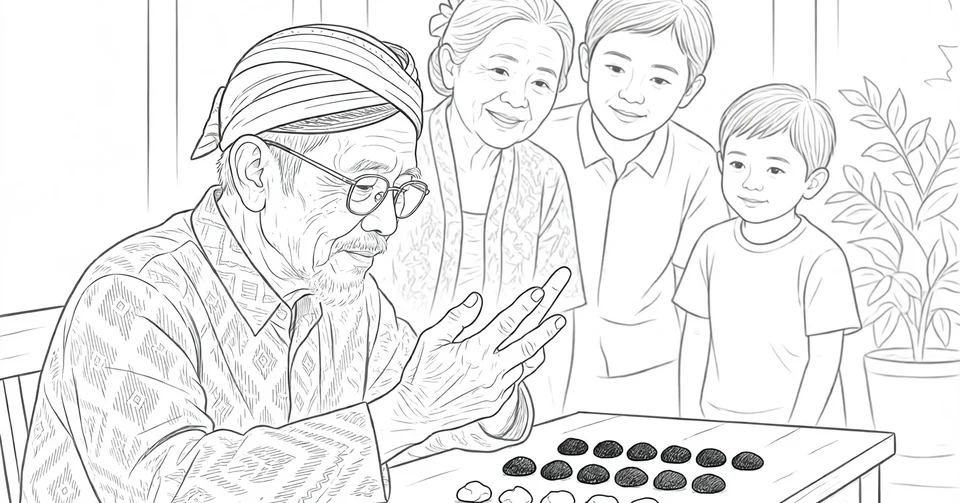
The system behind it is the Javanese calendar, formalised by Sultan Agung of Mataram in 1633 and still used across Java for cultural and spiritual purposes, alongside the Gregorian calendar that runs offices and schools. Sultan Agung kept the old Saka year count but rebuilt the calendar on lunar years. Inside it, cycles overlap like gears: lunar months, eight year windu cycles, and the two small weeks that produce the weton. Of all those gears, the smallest pair is the one ordinary people actually carry in their heads.
What your weton is made of
The five day cycle is the older and stranger of the two. Its name, pasaran, comes from pasar, the market. Villages in Java once held their markets in rotation, so a trader could walk a circuit of five villages and find a market day waiting in each one in turn. The five days are Legi, Pahing, Pon, Wage and Kliwon. Most markets today open every day, but the old names stuck to the places themselves. Towns across Java still have a Pasar Legi or a Pasar Kliwon, and those markets are still noticeably busier when their own name day comes around. Your weton takes one name from this short list, and it takes it again every five days for your whole life.
The seven day week arrived later, with Islam, and its Javanese names still lean on the Arabic ones they came from. The two weeks turn independently, so any weekday can land on any pasaran day. A Friday that falls on Kliwon is Jumat Kliwon. A Tuesday that falls on Wage is Selasa Wage. There are 35 possible pairs, no more and no fewer, and each one is a weton waiting for its owner. One more detail changes the count for some people. The Javanese day begins at sunset, not midnight, so a child born in the evening may already belong to the next pairing.
Some pairings carry fame. The Proclamation of Indonesian Independence on 17 August 1945 fell on Jumat Legi, a fact still taught in primary schools. It was also, by tradition, the weton of Sultan Agung himself, the day of both his birth and his death, which is one reason Jumat Legi nights draw pilgrims to his grave. Most weton are not famous. They are just personal, a small signature the calendar wrote on the day you arrived.
The numbers called neptu
A pairing alone would only be a label. What turns a weton into a tool is that every day in both cycles carries a number, called neptu. The weekdays run like this: Sunday 5, Monday 4, Tuesday 3, Wednesday 7, Thursday 8, Friday 6 and Saturday 9. The pasaran days run: Legi 5, Pahing 9, Pon 7, Wage 4 and Kliwon 8. Add the weekday number to the pasaran number and you have the neptu of your weton, so every weton in existence lands somewhere between 7 and 18. A person born on Saturday Pon holds 9 plus 7, a neptu of 16. A person born on Wednesday Kliwon holds 7 plus 8, a neptu of 15.
The arithmetic is fixed and anyone can check it with a pencil. Nothing about the count is secret, and printed tables of it have circulated for generations. What the number means is another matter, and that is where the primbon comes in. In my own reading, that split is the honest way to hold the whole system. The count is mathematics. The meanings are inheritance, and inheritance is allowed to vary from house to house.
What the primbon does with your weton
Primbon is the name for the Javanese almanacs, part calendar and part handbook, that collect this lore. Their counting method, petungan, starts from the weton. Read one way, your weton is said to sketch your character and tendencies, much as a zodiac sign does in the West. Read another way, it becomes a tool for timing. The neptu of two people can be added together and sorted into categories to judge how a marriage might run. Single numbers and pairings are checked before fixing a wedding date, a circumcision, a move to a new house, or the first digging on a building plot.
The counting reaches into craft as well. A keris is traditionally an owner's blade, matched to one person, and the empu who forges it works inside the same world of birth days, fasting and auspicious timing. It is part of why a blade can take months to finish. Heirlooms made under that calendar are then cared for by it, washed and re-oiled in the yearly jamasan ritual, so the weton sits quietly behind objects as well as people.
Today the primbon is a printed book sold in market stalls and, just as often, a phone screen. Online weton calculators will take any birth date and return the pairing and the number in seconds. The readings that follow are not identical from book to book, and practitioners know it. Two primbon can sort the same couple into different categories. The count never changes. The interpretation is where families argue, gently, over coffee.
A birthday that comes back every 35 days
Because the pairing repeats, so does the birthday. The return of your weton is called wetonan, and the 35 day span it completes is a selapan. The first wetonan of a life is a milestone. At 35 days old, a Javanese baby is traditionally held up to the community in a selapanan ceremony, a small selametan of shared food and prayer asking that the child be kept safe and live long. Research on villages in Kediri, in East Java, describes families still keeping the wetonan observance on that same rhythm long after infancy, as a birthday that simply refuses to wait for the year to turn.
For adults the marking is modest, and it is meant to be. A family might cook a little extra, share a bancakan meal with neighbours, or simply note the day and say a prayer. There is no cake and no number of years to announce, because nothing is being counted up. A weton asks little of anyone. What returns is not your age. It is your day, the exact combination under which you started, arriving again like a tide.
Bali keeps the same idea on a longer clock
Drive east to Bali and the same instinct runs on a different calendar. The Balinese Pawukon is a 210 day cycle of thirty weeks, and inside it sits otonan, the Balinese birth day observance. Where a Javanese weton returns every 35 days, an otonan returns every 210 days, roughly every seven months. A child's first otonan, held 210 days after birth, is the big one, led by a priest or the family's eldest, with offerings and prayers at the family shrine. After that the day keeps returning for the rest of a person's life, and many Balinese treat it as more important than the birthday on the Gregorian calendar.
The kinship is more than a resemblance. Balinese writers point out that the word pawukon itself grows out of wuku, a week, and that wuku traces back to weton. Even the five day week survives the crossing, with Legi renamed Umanis and Kliwon spelled Keliwon. Two islands, two calendars, one shared conviction: the day you were born is not finished with you after a single appearance.
I find something kind in that conviction. A yearly birthday measures distance: how far you have travelled from the start, how much has changed. A weton measures return instead. It assumes the day you began is still part of the pattern of your life, and it offers you ten small chances a year to notice it, cook something simple, and be grateful in passing. You do not have to believe a number can read your character to enjoy the rhythm. Your weton will be back in five weeks, regular as weather, asking almost nothing of you.
More in Culture & Society
- Suka Duka Means the Banjar Shows Up for Joy and Grief Alike
- Tabuh Rah Spills Blood So the Ground Stays Calm
- The Bendesa Adat Speaks for a Village That Has Two Governments
- Catur Brata Is Four Silences Kept at the Same Time
- Rahu and Ketu Still Chase the Sun and Moon Across the Sky
- Hiwatari Asks You to Walk Across the Fire
Latest posts
- On Koyasan the Founder Is Said to Be Still Meditating
- Ngembak Geni Is the Morning Bali Starts Talking Again
- Karang Ayahan Is the Plot of Land a Village Trusts You With
- On Tumpek Landep Bali Blesses Everything Made of Metal
- Sudachi Is the Sharpest of Japan's Sour Citrus
- Shugendo Turns a Mountain Into a Place of Testing
- A Canang Sari Is Made Fresh Every Morning and Gone by Night
- The Aling-Aling Wall Exists Because Spirits Walk in Straight Lines
- Oi-Nishin Sent Tohoku Farmers Chasing Herring Every Spring
- The Nishin Goten Were Palaces Paid for by Fish
- The Tobi Were Edo's Daredevils Before They Were Its Firemen
- Kabosu Is Oita's Gentle Answer to Yuzu
- A Yamabushi Trains Where the Mountain Is the Temple
- Tri Hita Karana Holds a Village in Three Balances
- Shingon Has Kept Its Fire Ritual Burning for 1,200 Years