Japanese Beer and the Dry Wars That Changed How Japan Drinks
· 13 min read
Japanese beer looks simple, a cold lager in a frosty glass, but behind it sits a century of foreign brewers, a navy, a tax maze, and a 1987 bottle that started a war between breweries.
Sit down at almost any izakaya in Japan and the first word out of your mouth will probably be beer. You do not order it by brand, you do not study a menu, and you do not wait for anyone to ask what you want. The word is toriaezu biru, beer for now, and a frosty glass arrives before the food does. Japanese beer is the default drink of Japan, the thing that starts nearly every evening out, and yet the story behind the glass is far stranger than the lager inside it. Japan did not invent beer. It borrowed the drink from foreigners, rebuilt it for Japanese tastes, and then fought a series of commercial wars over it that changed what the whole country drinks.
Japanese beer is, at its simplest, a pale lager of about 5 percent alcohol, cold, dry, and built to go with food. The big four brewers, Asahi, Kirin, Sapporo, and Suntory, make almost all of it, and their flagship lagers taste deliberately clean rather than bold. That restraint is the point. Japanese beer was shaped by a century of compromises between German brewing, British tastes, Japanese food, and a tax code that treats a drink differently depending on how much malt went into it. The result is a beer culture that looks uniform from the outside and turns out to be full of arguments once you look closer.
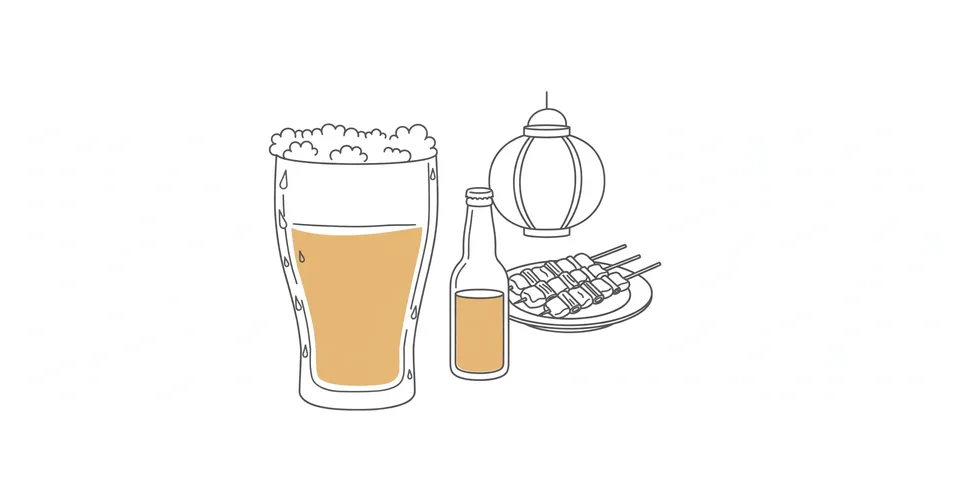
That is the part worth sitting with. Most countries that love beer have a brewing tradition that goes back centuries, with monks or farmers at the start of it. Japan has none of that. Its beer history starts with a Norwegian businessman in a treaty port, runs through a government brewery in Hokkaido, a wartime merger, and a single bottle launched in 1987 that was so successful it started a trade war. Japanese beer is a story about how a country can adopt something foreign completely, and still make it unmistakably its own.
How Japanese beer arrived from abroad
Beer reached Japan the way many Western things did, through the treaty ports that opened in the late 19th century. Dutch traders had introduced the drink during the Edo period, but commercial brewing began in Yokohama in the late 1860s and 1870s, when a Norwegian-American businessman named William Copeland opened the Spring Valley Brewery. His brewery was later sold to a Japanese company, and that company eventually became Kirin, one of the giants of Japanese beer today. The history of beer in Japan traces this line from Copeland's small Yokohama brewery to the industry that now fills every convenience store in the country.
The second founding story starts further north. In 1876, the Meiji government's Hokkaido Development Commission set up the Kaitakushi Beer Brewery in Sapporo and put a German-trained brewer named Seibei Nakagawa in charge of it. The first Sapporo lager followed in 1877, and the brewery was bought by private investors in 1886 and turned into the Sapporo Beer company. Sapporo is now Japan's oldest surviving beer brand, and its star logo still nods to the Hokkaido frontier where it began. If Kirin came from a foreign merchant in a port city, Sapporo came from the state itself, building a new industry in a new territory.
Asahi arrived a decade later. The Osaka Beer Brewing Company was founded in 1889, and it began selling beer under the Asahi name in 1892. By the early 20th century the industry had consolidated, with Asahi, Sapporo, and the company behind Kirin and Yebisu merging into the Dai-Nippon Beer Company. The wartime government later broke that giant apart again, which is how the four companies we know today, Asahi, Kirin, Sapporo, and Suntory, ended up as separate rivals. Suntory, the whisky maker behind Yamazaki, entered the beer market in 1963, completing the quartet. Japanese beer, in other words, was built by merchants, by the state, and by a whisky company looking for a second act.
The four giants and the lager they agreed on
Walk into a Japanese convenience store and the beer shelf tells you what Japanese beer is. Almost everything on it is a pale lager, golden, clear, and around 5 percent alcohol. Asahi Super Dry, Kirin Ichiban Shibori, Sapporo Black Label, and Suntory's Premium Malts all sit in the same narrow band of flavour: crisp, lightly bitter, and gone quickly. That sameness is not an accident. For most of the 20th century the big brewers competed on distribution, advertising, and price, not on flavour, because the mass market wanted a beer that went with anything and offended no one.
Each brand still has its own story. Sapporo leans on its Hokkaido origin and its German-trained first brewmaster. Kirin leans on its Yokohama roots and its Ichiban Shibori, a lager made using only the first press of the wort, which Kirin says gives it a cleaner taste. Asahi leans on a string of firsts: Japan's first canned beer in 1958, and the world's first outdoor brewing tanks in 1965. Suntory, the latecomer, leans on the Premium Malts and on the prestige of its whisky business. The four of them dominate the market so thoroughly that Japanese beer, to most drinkers, simply means one of these four names.
The lager itself is worth understanding. Japanese brewers use rice as an adjunct in many of their beers, which lightens the body and keeps the finish dry. The water matters too. Sapporo's founders chose Hokkaido partly for its cold climate and clean water, and Yamazaki's founders chose their site for the same reason when they built the whisky distillery that later made Japanese whisky famous. Japanese beer is a German style filtered through Japanese ingredients and Japanese habits, and the result is a drink that feels lighter than the lagers it descended from.
1987 and the Dry Wars
The year that changed Japanese beer was 1987, when Asahi launched Asahi Super Dry. Asahi had spent years researching what drinkers actually wanted, and the answer was a beer with a sharper taste and a cleaner finish, a karakuchi, or dry, beer that suited Japanese food better than the sweeter lagers of the time. Super Dry was an immediate hit, and it did something no product launch had done before: it pushed Asahi past Kirin to become Japan's biggest brewer.
The rivals answered at once, and the years that followed became known as the Dry Wars, or dorai senso. Kirin launched its own dry beer, Sapporo and Suntory followed, and the four companies spent the late 1980s fighting over a single word. The war changed the market permanently. Before 1987, Japanese beer was a stable business where the brands barely moved. After it, the market rewarded the brewer that understood drinkers best, and Asahi has held the lead ever since. The Dry Wars also changed the flavour of Japanese beer itself. The dry, crisp profile that Super Dry made famous became the default taste of the whole category, and it is still the taste you get when you order a beer in Japan today.
There is a lesson in the Dry Wars that goes beyond beer. Japan's big brewers are famously cautious companies, and for decades they had competed by being identical. One product, built on actual research into what people wanted, broke the stalemate in a single year. The companies that survived were the ones that learned to listen to drinkers instead of copying each other, and the drinkers got a better beer out of it. That is a pattern you see across Japanese industry, from cars to electronics, and beer was one of its clearest examples.
Happoshu and the tax maze
If you have ever bought a cheap can in a Japanese supermarket and wondered why it was not called beer, the answer is the tax code. Japanese law defines beer by its malt content, and drinks made with less malt fall into a separate category called happoshu, literally sparkling liquor. Because happoshu is taxed at a lower rate than beer, it can be sold much more cheaply, and the big brewers have sold enormous quantities of it since the 1990s. Suntory's Hop's Draft, launched in 1994, was made with 65 percent malt and sold for about 30 percent less than regular beer.
The tax maze did not stop there. When the government raised the tax on happoshu, brewers invented a third category, drinks made with little or no malt at all, often called the third beer. Each change in the tax code produced a new kind of drink, and each new drink produced a new change in the code. The result is a shelf where cans that look like beer, taste roughly like beer, and cost half as much as beer are legally something else entirely. For a visitor, the practical rule is simple. If the can says beer, it is beer. If it says happoshu, it is a cheaper cousin, and the taste difference is smaller than the price difference suggests.
The maze also explains why Japanese beer innovation looks the way it does. Brewers in most countries invent new styles. Brewers in Japan spent decades inventing new legal categories, because the tax code rewarded it. That is not a complaint. The competition produced drinks that are genuinely good value, and it kept beer affordable in a country where alcohol tax is high. But it is a reminder that Japanese beer is shaped as much by accountants and lawmakers as by brewmasters.
Craft beer and the ji-biru boom
The other great change in Japanese beer came in 1994, when the government lowered the minimum production level needed for a brewing licence. Before that year, only large companies could afford to brew legally. After it, small breweries could open, and they did, in the hundreds. Japan now counts roughly 300 microbreweries, making everything from German-style wheat beers to American-style IPAs, and the movement has a name of its own: ji-biru, local beer. The craft beer scene in Japan has grown from a curiosity into a genuine alternative to the big four.
The craft breweries cluster in the big cities and in the countryside alike. Tokyo and Osaka have craft beer bars that pour local brews alongside imports, and smaller towns have breweries that use local ingredients, from yuzu in Shikoku to mountain water in Nagano. Many of the early microbrewers learned their trade from German or American brewers, and the influence shows. The styles are international, but the setting is Japanese: a tiny bar, a small menu of food, and a brewer who will talk to you about the beer if you ask.
Craft beer is still a small share of the market, and the big four still dominate the shelves. But the ji-biru movement matters because it broke the idea that Japanese beer had to be one thing. For a century the category was defined by four companies making the same lager. Now it is defined by hundreds of small brewers making whatever they want, and the big brewers have started to copy them, launching craft-style lines of their own. The Dry Wars were a fight between giants. The craft boom is a fight between giants and everyone else, and it is still going on.
How Japan actually drinks beer
Japanese beer is not really about the beer. It is about the moment it arrives. In an izakaya, the first order is almost always beer, and the first toast is kanpai, said with glasses raised before anyone has eaten anything. In summer, beer gardens open on department store rooftops, and office workers drink under strings of lights with plates of edamame and fried chicken. At home, a can of beer with a bowl of instant noodles is a perfectly respectable dinner. The drink is the same in all of these places. The ritual is what changes.
There are a few customs worth knowing. Beer in Japan is served cold, often in a frosty glass, and draft beer, called nama, is the default in bars. Pouring for others is polite, and topping up someone's glass before it empties is a small kindness. The drinking age is 20, and the law is taken seriously, with vending machines and convenience stores checking ID. And if you are at a work dinner, the unspoken rule is that you do not fill your own glass first. Someone else will do it for you, and you will do the same for them.
The food pairing is part of the design. Japanese beer is dry and light because it is meant to be drunk with food, from yakitori to sashimi to a simple bowl of rice. A heavy, bitter beer would fight the food. A dry lager cleans the palate and lets the next bite taste fresh. That is why the brewers spent a century making their beer lighter, and why the Dry Wars ended the way they did. Japanese beer is not a drink that demands attention. It is a drink that makes room for everything else on the table.
What Japanese beer gets right
My own view, after years of drinking it in Shizuoka, is that Japanese beer is best understood as a background drink, and that is a compliment. Some beer cultures celebrate the beer itself, with strong flavours and long tasting notes. Japan celebrates the evening, and the beer is there to make the evening work. A cold lager that arrives fast, tastes clean, and never gets in the way of the food or the conversation is doing exactly what it was designed to do.
That does not mean the beer is boring. The history is full of gambles, from Copeland's brewery in Yokohama to the Dry Wars to the hundreds of small brewers who opened after 1994. Each of them bet that Japanese drinkers wanted something different, and each of them was right in turn. The big four survived by learning, and the small brewers survive by refusing to be the same. Japanese beer looks uniform because the market is honest about what most people want on a hot evening, and it looks diverse because the brewers keep trying to change their minds.
If you visit Japan, start with the obvious. Order a Super Dry in an izakaya, pour for the person next to you, and say kanpai. Then, on another night, find a craft beer bar and try something a small brewer made a hundred kilometres away. The two glasses will taste different, and they will both be Japanese beer. That is the whole story in a glass: a foreign drink, adopted completely, argued over for a century, and still changing every time someone new decides to brew it.
More in Food & Travel
Latest posts
- Yokozuna Is the Rank Sumo Never Takes Back
- Tazukuri Turns Tiny Sardines Into a Wish for a Good Harvest
- Kazunoko Is the Herring Roe That Promises Children and Plenty
- Kuromame Turns Black Beans Into a Wish for Health
- Gyoji Are Sumo's Referees in Silk and Calligraphy
- Japanese Baseball and the Game Japan Made Its Own
- Jubako Layers a Family's Luck One Box at a Time
- The Banzuke Remembers Every Basho in Calligraphy
- Osechi Packs a Whole Year of Luck Into Stacked Boxes
- Fifteen Days of Basho Decide Who Sumo Remembers
- Kojiri Is the End Cap That Takes Every Knock for a Katana
- Kurikata Is the Chestnut Knob That Holds a Katana at the Hip
- Koshirae Is the Formal Mounting That Turns a Blade Into a Katana
- Shirasaya Is the Plain White Scabbard Where a Katana Rests
- The Togishi Polishes a Katana for Weeks Before It Ever Cuts