Otohime, the Small Sound That Protects Privacy in Japanese Toilets
· 8 min read
Press the otohime button in a Japanese restroom and a speaker plays the sound of running water, so nobody outside the stall has to hear a thing. This is the story of the Sound Princess, the embarrassment she was built to erase, and the water she saved.
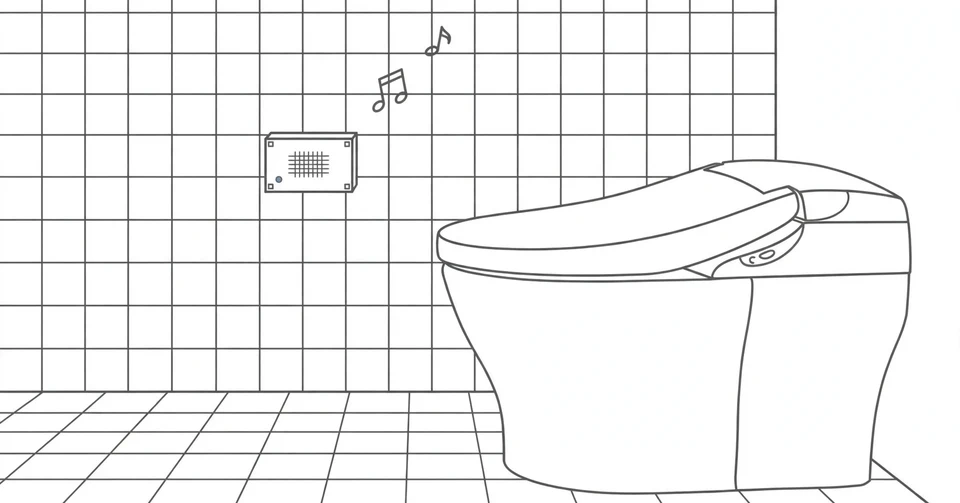
In most countries, the loudest thing in a public restroom is the plumbing. In Japan, the loudest thing might be a recording. Press a button on the wall of the stall, or wave a hand in front of a small sensor, and a speaker begins to play the sound of running water. The water is not real. Nothing has been flushed. The sound is the entire product, and its name is Otohime.
The Otohime exists to protect a feeling. Many people, and in Japan especially many women, are embarrassed at the thought that a stranger in the next stall might hear the sounds their body makes. That embarrassment once had an expensive cure, which was to flush the toilet again and again. The otohime button replaced all that wasted water with 25 seconds of polite noise.
It sounds like a joke about Japanese technology, one more gadget in search of a problem. It is actually the opposite. Few products anywhere have solved so small a problem so completely, or saved so much water while doing it. To understand the Otohime, you have to start with its name.
A princess from the Dragon Palace
Otohime is written with the characters for sound and princess, and it translates directly as Sound Princess. But the name is a pun, and the pun is the point. In the fairy tale of Urashima Taro, one of the best known folk stories in Japan, a kind young fisherman is carried under the sea to the Dragon Palace, where he is welcomed by a beautiful princess named Otohime, the daughter of the Dragon King. Her name is written with different characters, but it sounds exactly the same.
TOTO, the company that created the device, chose the name deliberately. A spokeswoman for the company explained that it was meant to symbolise the shyness and modesty of the women it was built for. A toilet accessory is a hard thing to name gracefully. Borrowing a sea princess from a fairy tale turned an awkward product into a small piece of poetry, and it gave users a word they could say out loud without embarrassment.
The problem was never the noise
The problem the Otohime solved was not really sound. It was water. For years, the standard practice among Japanese women in public restrooms was to flush twice, once on sitting down to cover any noise, and once at the end for the usual reason. Some flushed continuously. Public awareness campaigns asked them to stop, and the campaigns failed, because the habit was never about ignorance. It was about shame, and shame does not respond to posters.
The waste was not trivial, especially in a country that knows drought. A severe drought hit Fukuoka in 1978, rationing water in a city not far from TOTO's home base in Kitakyushu, and company spokespeople later pointed to it as part of the motivation to act. When TOTO did its sums, it estimated that replacing the courtesy flush with a sound could save as much as 20 litres of water on a single restroom trip. In an office building with 400 women, on TOTO's arithmetic, the saving could pass 10 million litres a year. Numbers like those made the Otohime an easy sell to the people who run buildings.
The idea itself is older than electronics. A large bronze urn from the 19th century, now kept at a folk museum in Yakage, in Okayama, is thought to be an early sound masker, its dragon shaped spout pouring water so that a privy could be used without being overheard. The Otohime is that urn, electrified: the same running water, the same wish not to be heard, carried across two centuries by better plumbing.
TOTO launched the Otohime in 1988, and it spread through department stores, offices, stations and schools. Rival maker INAX brought out a similar device the same year. Shipments in Japan eventually passed one million units, and the little wall box became standard equipment in new public buildings. For years, South Korea was the only other country where TOTO marketed it, a small hint that the embarrassment it treats is not uniquely Japanese, even if the solution is.
How the Otohime works
The hardware could hardly be simpler. In its classic form the Otohime is a small battery powered box fixed to the wall of the stall, with a speaker, a button marked with a musical note, and sometimes a motion sensor. In newer restrooms the function is built into the washlet itself, on the same control panel as the features that make the Japanese toilet so different from toilets elsewhere, the heated seat, the warm water spray and the self cleaning nozzle. Using it takes one gesture.
- Press the button, or wave a hand in front of the sensor
- A recording of flowing water plays for about 25 seconds
- Press again to stop it early, or to begin another round
The sound itself has been refined over the years. The first Otohime units produced an electronic imitation of a flush. Later versions play recordings of real water, gathered by TOTO technicians who travel around Japan looking for the right stream to capture. Some models now offer birdsong instead. The original 1988 unit, a plain box with one large button, is kept at the TOTO Museum in Kitakyushu, which tells you how seriously the company takes its own princess.
A sound mostly for women, spreading slowly
From the start, the Otohime was aimed at women, and women's restrooms are still where you will almost always find it. Men's rooms are a different story. As one SoraNews24 reporter discovered after ending up in the wrong restroom as a student, many men in Japan reach adulthood without ever learning what the button does, because the toilets they use rarely have it, and on the rare occasions they do, few men bother to press it.
That is beginning to change. Recent reporting describes the Otohime becoming common in men's restrooms too, with TOTO saying that younger men are more conscious of toilet noise than their fathers were. Unisex restrooms, where nobody can assume anything about the person in the next stall, are pushing the device further into the mainstream. The princess, it turns out, was never only for women. She was for anyone who wanted a little privacy, and it took the culture a few decades to admit how many people that includes.
The princess leaves the restroom
Success has also made the Otohime portable. Toy maker Takara Tomy Arts sold a pocket version called the Keitai Otohime, small enough to hang from a handbag, and its first run of 30,000 units sold out soon after launch. Phone apps followed, offering the same flowing water at the tap of a screen, for restrooms that lack the real thing and for travellers far from Japan. Abroad, the idea is still mostly a curiosity, although at least one Australian voice artist, tired of double flushing in her own country, has launched a rival product of her own.
The pattern is familiar. Japan has a talent for small, precise inventions that answer an unglamorous problem and then travel the world, the same talent that produced the QR code, a pattern of squares designed for tracking car parts that now sits on restaurant tables everywhere. The Otohime is the QR code's quieter cousin. It never conquered the world, but it solved the problem it was given, completely.
Designing for embarrassment
What I find most admirable about the Otohime is the thing it refuses to do. It does not lecture anyone. TOTO could have run campaigns telling women that bodily sounds are natural and nothing to be ashamed of. The campaigns would have been correct, and they would have failed, just as the earlier water saving posters failed. Instead, the company accepted the feeling as a fact of the culture and designed around it. The embarrassment was treated as a requirement, like the size of the stall or the height of the seat.
There is a lesson in that for anyone who designs things for strangers. People do not always want to be improved. Sometimes they want to be accommodated, quietly, without a speech. The Otohime accommodates. It asks nothing, explains nothing and leaves no trace. For the price of a battery and a speaker, it gives a person in a tiled room full of strangers the one thing the room was not designed to provide, which is the feeling of being alone.
Every country has its small mercies built into daily life, most of them too ordinary to notice. In Japan, one of them hangs on the wall of the restroom stall, named after a princess who lived under the sea. Press the button, and for 25 seconds the water sounds, the room minds its own business, and nobody has to pretend anything. It is a tiny technology, and that is all the Otohime has ever promised to be. It is also, in its way, a kind one.
More in Tech & Internet
Latest posts
- Fuji Ko, the Pilgrim Societies That Climbed Mount Fuji Together
- Dashi, the Quiet Stock Under Almost Everything Japan Cooks
- Ayu, the Sweetfish That Rules Japan's Clear Rivers
- Gensen Kakenagashi, the Onsen Water That Never Circles Back
- Shiko, the Leg Stamp That Starts Every Sumo Day
- Semar, the God Who Chose to Work as a Servant
- Kyushoku and the Japanese School Lunch
- Sumadori, Japan's Smart Drinking for People Who Do Not Drink
- Sake Kasu, the Sake Lees Japan Cooks With Instead of Throwing Away
- Bureiko, the Drinking Party Where Rank Is Left at the Door
- Kagami Biraki, Japan's Ceremony of Breaking Things Open
- Kopi Tubruk and the Indonesian Way to Drink Coffee
- Capsule Hotels and Sleeping in a Pod in Japan
- Subak and the Rice Terraces of Bali
- Hiroshima and the City That Chose Peace