How to Use a Suica Card in Japan
· 9 min read
A Suica card is the simplest way to ride trains in Japan. This is how to buy one, charge it, use it beyond the station, and get your deposit back.
A Suica card is the small green card that makes Tokyo travel feel easy. You tap it on the reader when you enter a station, tap it again when you leave, and the fare comes off the balance. No ticket machines, no fare tables, no counting coins at the gate.
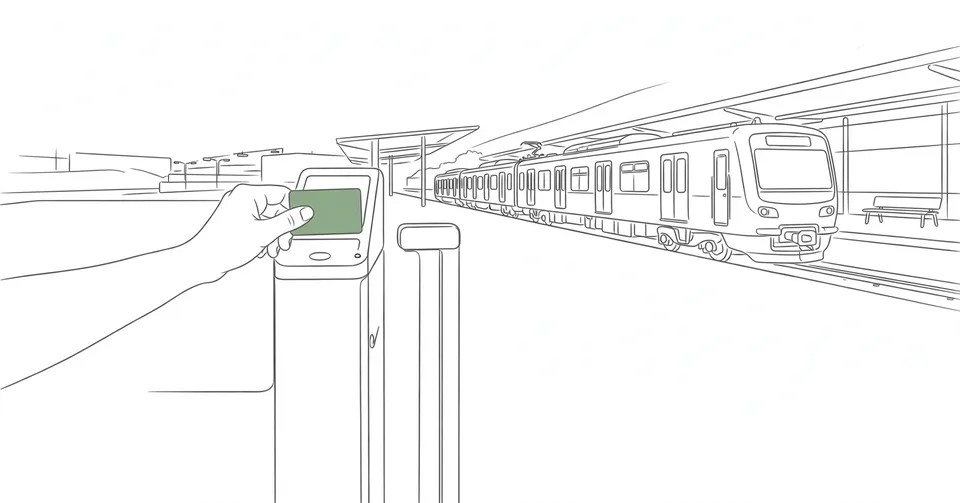
That is the whole trick, and it is worth learning before you land. A Suica card also pays at convenience stores, vending machines and station lockers, so it quietly becomes the second wallet in your pocket. The regular card went back on sale on 1 March 2025 after a two year pause caused by a chip shortage, so older guides that say you cannot buy one are now out of date.
What a Suica card actually is
A Suica card is a rechargeable IC card issued by JR East, the railway company that runs the trains in Tokyo and eastern Japan. JR East launched it on 18 November 2001.
The card holds money, not tickets. You load yen onto it, touch it flat on the blue reader at the ticket gate, wait for the beep, and walk through. You do the same when you leave, and the correct fare is taken from the balance. If the balance runs low, a red light tells you to top up before the gate will open.
A Suica card works far beyond JR East trains. It covers most subways, private railways and buses in the Tokyo area, and through nationwide mutual use it works on IC card networks in other parts of Japan too. The same card that opens the gate at Shinjuku can pay for a bus in Kyoto or a train in Osaka, as long as you stay inside one IC area at a time.
That reach is part of why the card matters, and you can read about the system behind it in our article on why Japanese trains are almost never late.
Which Suica card to get
There is more than one Suica card, and the right choice depends on how long you are staying and what phone you carry, especially the refund rules.
| Card | Deposit | Validity | Refund |
|---|---|---|---|
| Regular Suica card | 500 yen | No short expiry, invalid after 10 years without use | Deposit back in full, balance back minus a 220 yen fee |
| Welcome Suica | None | 28 days from purchase | No refund of any kind |
| Welcome Suica Mobile | None | 180 days from issue | No refund of any kind |
| Mobile Suica | None | No short expiry | Balance refundable through the app |
The regular Suica card is the best choice for most people. It costs a 500 yen deposit, has no short expiry, and suits repeat visitors, longer stays, and Android users who want a physical card.
The Welcome Suica is the visitor card. It needs no deposit and nothing to return, and the whole amount you pay is spendable. The trade off is that it stops working 28 days after purchase and any balance left on it is lost, so load modestly and top up as you go.
The Welcome Suica Mobile is the phone version of the visitor card. JR East launched it for iPhone on 6 March 2025. It runs in English, needs no registration, lasts 180 days, and tops up from a credit card in Apple Pay. The balance is not refundable.
Mobile Suica is the regular card on a phone. On iPhone you can add one in Apple Wallet before you leave home and top it up with Apple Pay. Most Android phones bought outside Japan cannot hold a Suica at all, because the card needs a Japanese mobile wallet chip, so plan on a physical card if your phone is not from Japan.
How to buy a Suica card
Buying a regular Suica card is simple, but the sales history is worth knowing. Because of a worldwide semiconductor shortage, JR East stopped selling unregistered Suica cards on 8 June 2023. Registered cards returned on 1 September 2024, and unregistered cards followed on 1 March 2025, so today a regular Suica card is on sale again at JR East stations.
You buy one from a ticket machine at a JR East station, including the airport stations. Look for a machine with the Suica symbol and press the English button. A new card costs from 1,000 yen, the 500 yen deposit plus 500 yen loaded onto the card, and you can load more at the same time up to 10,000 yen. The machines take cash, and a physical Suica card cannot be topped up with a credit card.
A Welcome Suica comes from dedicated machines at Narita Airport and Haneda Airport Terminal 3, and from JR East Travel Service Centers at major stations. JR East changes the sales points from time to time, so check its purchase page before you fly.
If you use an iPhone, the easiest route is to add a Suica card in Apple Wallet before you leave home. Open Wallet, add a transit card, choose Suica, and load it with Apple Pay. Once Express Transit is on, you do not even need to unlock the phone at the gate, just hold it near the reader.
How to use a Suica card day to day
At the gate, touch the card flat on the reader and wait for the beep. Do not wave it or tap twice. The reader shows your remaining balance as you pass, which is worth watching, because a low balance means a red light on the next trip. The same tap works on buses: touch the reader when you board and again when you get off.
When the balance runs low, top up at any station ticket machine with the IC mark. Insert the card, choose an amount, and pay in cash. Top ups come in fixed amounts of 500, 1,000, 2,000, 3,000, 5,000 or 10,000 yen, and a Suica card holds a maximum of 20,000 yen.
The card is not only for trains. A Suica card pays anywhere you see the Suica logo, which in practice means most convenience stores, vending machines and station lockers. You can buy breakfast at a convenience store with the same card that got you there, and pay for a drink from a vending machine without digging for coins. Some taxis and restaurants accept it too, so the card turns into a small electronic wallet, and the balance is real money.
One more practical point: keep the card away from other IC cards. If two cards sit in the same wallet, the reader may pick the wrong one or fail to read either, so take the Suica card out and tap it on its own.
A Suica card, Pasmo, and the JR Pass
A Suica card is not the only IC card in Japan, and the names confuse first time visitors. Pasmo is the equivalent card from Tokyo's private railways and subways, launched in 2007. For almost all travel in Tokyo, a Suica card and a Pasmo work identically. The practical difference is the issuer: a Suica card is refunded at a JR East station, a Pasmo at a Tokyo subway or private railway station.
The JR Pass is a different product entirely. It is a rail pass for visitors that covers long distance JR travel, such as the Shinkansen between Tokyo and Kyoto, for a fixed number of days. A Suica card covers city travel, the short hops on the Yamanote line, the subway, and the bus. They complement each other: the pass gets you between cities, the Suica card gets you around inside them.
Japan also invented the QR code, which now shows up in payment apps across the country, and you can read how it began in our article on the QR code invented in Japan. At a station gate, though, the card is still faster than opening an app.
Getting your money back
A regular Suica card gives your money back. Take the card to a JR East ticket office, the Midori no Madoguchi, at a station in the Suica area. You get the 500 yen deposit back in full, plus your remaining balance minus a 220 yen handling fee.
JR East gives worked examples. With 1,000 yen on the card, you receive 1,280 yen. With 100 yen on it, the 100 yen is taken as part of the fee and you still get the 500 yen deposit back. With nothing on it, you get the 500 yen back.
A Suica card issued by JR East can only be returned at a JR East station. A card issued by another company, such as Tokyo Monorail, goes back to that company instead. If your balance is below 220 yen, the sensible move is to spend it down at a convenience store or a vending machine on the way to the airport, then hand in an empty card for the deposit.
Welcome Suica and Welcome Suica Mobile are different: no refund of any kind, whatever balance is left. Plan to spend the balance down on your last day and load the card in small amounts near the end of the trip.
One last detail: a regular Suica card becomes invalid if it is not used for 10 years, which means the card you buy on this trip will still work on the next one if you keep it in a drawer.
A few things that catch people out
Japan's IC areas are still separate. JR East currently splits its Suica network into six areas, including Greater Tokyo, Sendai and Niigata, but in September 2026 it announced it will merge all six into one area in spring 2027, once its new server based gate system is complete. Until then, do not expect one tap to carry you from Tokyo to Sendai.
Since 25 March 2026, eleven Kanto operators, including Tokyo Metro, Toei Subway, Keikyu and Odakyu, accept contactless credit and debit cards at the gate. JR East is not part of that scheme, so on the Yamanote line and other JR trains you still need a Suica card or a paper ticket.
A Suica card is a small thing, a piece of green plastic or a card in your phone, but it removes a daily friction. The first morning in Tokyo, you will understand why almost nobody in Japan buys a paper ticket anymore. Get the card, load it with a few thousand yen, and let the city move around you.
More in Tech & Internet
- Otohime, the Small Sound That Protects Privacy in Japanese Toilets
- Disaster Vending Machines in Japan That Give Their Drinks Away
- Japan's Maglev Train That Runs at 500 Kilometres an Hour
- Jakarta's MRT, the Subway That Changed a Megacity
- Why Japanese Trains Are Almost Never Late
- The World's First Bullet Train
Latest posts
- The Dalang, the Single Voice Behind Every Wayang Puppet
- Yadnya Kasada, the Festival That Feeds the Crater of Mount Bromo
- Chankonabe, the Hot Pot That Feeds a Sumo Stable
- The 8050 Problem, When Retired Parents Still Carry Their Adult Children
- Koji Mold, the Quiet Engine Behind Japanese Food
- Moai, Okinawa's Lifelong Circles of Friends
- Anak Krakatau, the Child of Krakatoa That Keeps Growing
- Yozakura, Japan's Cherry Blossoms After Dark
- Nomikai, the After-Work Drinks That Are Part of the Job in Japan
- Coelacanth and the Living Fossil of the Deep Sea
- Sakura Ebi and the Tiny Shrimp Only Suruga Bay Catches
- Senbon Matsubara and the Pine Grove of Numazu
- Shirasu and the Whitebait Bowls of Shizuoka
- Uchiura and the Quiet Fishing Village Behind Love Live Sunshine
- Love Live Sunshine and How Anime Changed Numazu