Japan's Maglev Train That Runs at 500 Kilometres an Hour
· 10 min read
Japan's maglev train floats on magnets instead of rolling on wheels, and it is built to run at 500 kilometres an hour. Here is how it works, the 603 km/h record it already holds, and why you still cannot ride it.
Japan has already built the fastest train in the world. It does not run on rails. It floats on magnets, it has already reached 603 kilometres an hour in a test, and it is designed to carry passengers between Tokyo and Nagoya in about 40 minutes. Yet as of late 2026, no ticket exists for it, and no date is fixed for its first run.
That train is Japan's maglev train, the L0 Series, built by JR Central for a new line called the Chuo Shinkansen. The technology works, the record is real, and the tunnels are being dug. What has slowed it down is not engineering. It is a river, a prefecture, and a disagreement about water that lasted almost a decade.
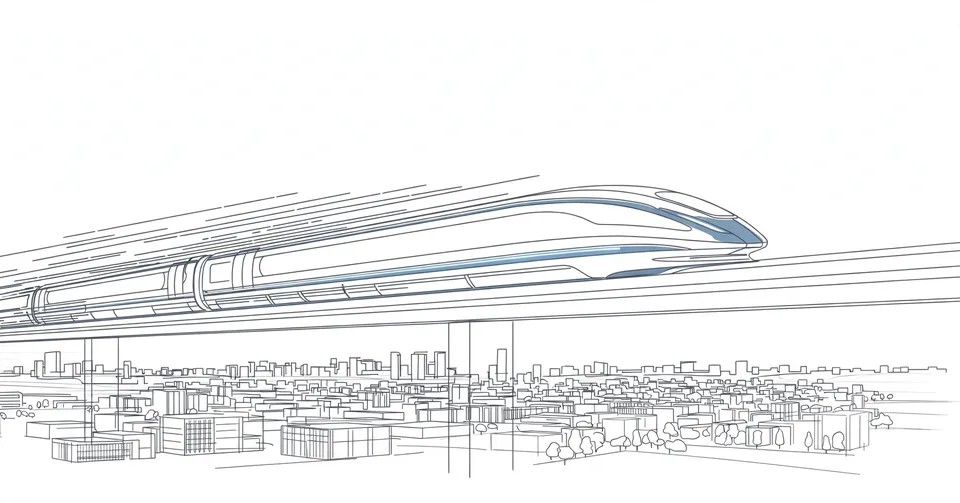
The maglev train matters even before it opens, because it shows how Japan thinks about speed. The country that gave the world the first bullet train in 1964 is now trying to replace wheels with magnets. The result is a train that could make the busiest intercity route in Japan feel like a metro ride, if the line ever finishes on time.
What a maglev train actually is
A maglev train does not touch the track. The name is short for magnetic levitation, and the Japanese version uses superconducting magnets cooled to extremely low temperatures. Coils in the guideway push the train up and forward, so the vehicle floats about 10 centimetres above the track and glides without friction from wheels or rails.
That matters because friction is the enemy of speed. A conventional train, even a fast one, still has steel wheels on steel rails, and that contact creates drag, noise, and wear. A maglev train removes the contact entirely. At low speed the L0 Series still runs on wheels, but once it passes about 150 kilometres an hour it lifts off the guideway and flies, in the only sense a train can fly.
The system is called SCMaglev, short for superconducting magnetic levitation. Japan has been developing it since the 1960s, when the former Japanese National Railways and Japan Airlines first funded the research. JR Central, the company that operates the Tokaido Shinkansen, took over the project and has run test trains on a dedicated track in Yamanashi Prefecture since 1997. The test line is 42.8 kilometres long, built only for maglev trials.
The train built for passengers is the L0 Series, first unveiled in 2010. Its long nose is practical: at 500 kilometres an hour, a train entering a tunnel pushes a wall of air ahead of it, and the nose decides how loud the pressure wave is when it bursts out the other side. The L0 Series is shaped like a needle because, at these speeds, air behaves almost like a solid.
The 603 km/h record
The maglev train already holds the world record for the fastest crewed rail vehicle. On 21 April 2015, a seven car L0 Series train reached 603 kilometres an hour on the Yamanashi test line. Guinness World Records lists it as the fastest any magnetically levitated train has ever travelled, and no manned train of any kind has gone faster since.
Five days earlier, on 16 April 2015, the same train had set the previous record at 590 kilometres an hour. The 603 run held its top speed for 10.7 seconds, covering 1.11 miles in that time, with passengers on board. The crew was proving that the train stays stable and safe at speeds far above what it will ever need in service.
In normal service the maglev train will run at 500 kilometres an hour, not 603. That is still far beyond anything else on rails. The fastest commercial train service in the world today is the Shanghai maglev in China, which runs at up to 431 kilometres an hour between Shanghai Pudong Airport and the city. The fastest conventional trains, like China's Fuxing at 350 kilometres an hour, are slower still. Japan's maglev train is designed to beat them all by a clear margin, every day, not just on a test track.
The line it will run on
The maglev train will run on the Chuo Shinkansen, a brand new line between Shinagawa Station in Tokyo and Nagoya Station. The route is about 286 kilometres long, and the trip is planned to take around 40 minutes. The fastest Shinkansen today needs about 100 minutes for the same journey, so the maglev train would cut the trip by more than half.
There will be six stations on the first section: Shinagawa in Tokyo, Sagamihara in Kanagawa, Kofu in Yamanashi, Iida in Nagano, Nakatsugawa in Gifu, and Nagoya. The line is mostly underground. Most of the 286 kilometre route runs through tunnels under the mountains of central Japan, including a long tunnel under the Southern Alps. That is one reason the project is so expensive, and one reason it has taken so long.
A second section will extend the line to Osaka, cutting the Tokyo to Osaka trip to about 67 minutes. That extension was once planned for 2045, but after a government loan in January 2026 the target moved forward to as early as 2037.
Japan's railways are famous for running on time, and the Japanese trains article on this site explains how that reputation was built. The maglev train is the next chapter of that story: the same company, JR Central, trying to do for the 2030s what the first bullet train did for the 1960s.
Why it is a decade late
The original opening target was 2027. That date is now impossible, and the honest answer about when the maglev train will open is that no date is confirmed. JR Central said in March 2024 that 2027 could no longer be met, and in 2025 the company pushed the target to no earlier than 2035. Japanese news reports in 2026 put the earliest opening at 2036. The delay is close to a decade, and the cause is a single stretch of tunnel less than nine kilometres long.
That stretch runs through Shizuoka Prefecture, under the Southern Alps. The tunnel passes beneath the Oi River, a river that waters rice paddies and tea fields and supplies about 620,000 people downstream. The former governor of Shizuoka, Heita Kawakatsu, blocked construction from 2017, arguing that tunnelling could drain water from the river system and damage the livelihoods of the people who depend on it. JR Central said the work was safe. The two sides talked for years and agreed on nothing.
The deadlock broke in July 2026. The new governor, Yasutomo Suzuki, approved construction after JR Central accepted all 28 environmental measures the prefecture demanded, and the two sides signed a formal agreement on 18 July. Boring could then begin, but the Shizuoka section alone is expected to take more than ten years to finish. That is why the opening is now talked about in terms of 2036 at the earliest, and why even that date depends on nothing else going wrong.
The cost has grown with the delay. The Shinagawa to Nagoya section was estimated at about 5.5 trillion yen in 2014. By 2026, Japanese news reports put the figure at about 11 trillion yen, roughly 68 billion dollars. Tunnelling has also caused trouble elsewhere: a road buckled during excavation in Tokyo's Shinagawa Ward, and groundwater gushed out at a site in Gifu Prefecture in 2023, drying up wells and causing the ground to subside. Tunnelling there is still suspended.
None of this means the maglev train is a failure. It means the hardest part of building a 500 kilometre an hour railway through mountains was never the train. It was the mountains, the water, and the people who live with both.
How it compares with the fastest trains
The table below puts the maglev train next to the fastest trains running today. The gap between a test record and a daily service speed is the point: the L0 Series holds the record at 603, will run at 500, and even that service speed is far above anything in commercial use.
| Train | Country | Top speed | In service |
|---|---|---|---|
| L0 Series maglev train | Japan | 603 km/h (test), 500 km/h (service) | Not yet, mid-2030s at the earliest |
| Shanghai maglev | China | 431 km/h | Yes, since 2004 |
| Fuxing | China | 350 km/h | Yes |
| Tokaido Shinkansen | Japan | 285 km/h | Yes, since 1964 |
The Shanghai maglev is the useful comparison, because it is the only other maglev train carrying passengers. It runs 30 kilometres from Shanghai Pudong Airport to Longyang Road station in about eight minutes, but it is a short airport shuttle, not an intercity line. Japan's maglev train is meant to be the first maglev line that connects two major cities at full speed, every day.
Speed is not the only measure. The Tokaido Shinkansen carries about 150 million passengers a year between Tokyo and Osaka at 285 kilometres an hour, with a safety record no other high speed railway can match. The maglev train does not need to beat that record to be worth building. It needs to carry the same crowds, at twice the speed, without a single accident. That is the standard JR Central has set for itself, and it is why testing has run for almost thirty years.
Can you ride one today
Not yet, but you can get close. The Yamanashi Maglev Exhibition Center sits beside the test line, and visitors can watch test runs from its viewing deck. The center also runs a lottery for seats on test rides, so a few lucky visitors each year have already travelled at speeds no passenger train has ever reached in service. It is the only place in the world where the public can ride a train at 500 kilometres an hour, and only by luck.
For everyone else, the wait continues. The maglev train exists, it works, and it is the fastest train ever built. The line it needs is being dug through mountains, under rivers, and through a decade of arguments about water. The train will be ready long before the track is, which is an odd position for a railway, and a familiar one for a country that treats patience as part of engineering.
Japan built the first bullet train when the rest of the world said high speed rail was impossible, then spent sixty years making it boringly reliable. The maglev train is the same bet made again: a technology that looks like a stunt, pursued until it becomes ordinary. When it finally opens, the remarkable thing will not be the speed. It will be that a train floating on magnets at 500 kilometres an hour through a tunnel under the Southern Alps feels as unremarkable as a morning commute. That is the point of the whole project, and it is worth the wait.
More in Tech & Internet
Latest posts
- The Dalang, the Single Voice Behind Every Wayang Puppet
- Yadnya Kasada, the Festival That Feeds the Crater of Mount Bromo
- Chankonabe, the Hot Pot That Feeds a Sumo Stable
- The 8050 Problem, When Retired Parents Still Carry Their Adult Children
- Koji Mold, the Quiet Engine Behind Japanese Food
- Moai, Okinawa's Lifelong Circles of Friends
- Anak Krakatau, the Child of Krakatoa That Keeps Growing
- Yozakura, Japan's Cherry Blossoms After Dark
- Nomikai, the After-Work Drinks That Are Part of the Job in Japan
- Coelacanth and the Living Fossil of the Deep Sea
- Sakura Ebi and the Tiny Shrimp Only Suruga Bay Catches
- Senbon Matsubara and the Pine Grove of Numazu
- Shirasu and the Whitebait Bowls of Shizuoka
- Uchiura and the Quiet Fishing Village Behind Love Live Sunshine
- Love Live Sunshine and How Anime Changed Numazu