Kagami Biraki, Japan's Ceremony of Breaking Things Open
· 8 min read
Kagami biraki is Japan's ceremony of breaking things open for luck at the start of the year. From the kagami mochi on the home altar to the lid of a sake barrel, kagami biraki turns a hard, round object into a shared blessing.
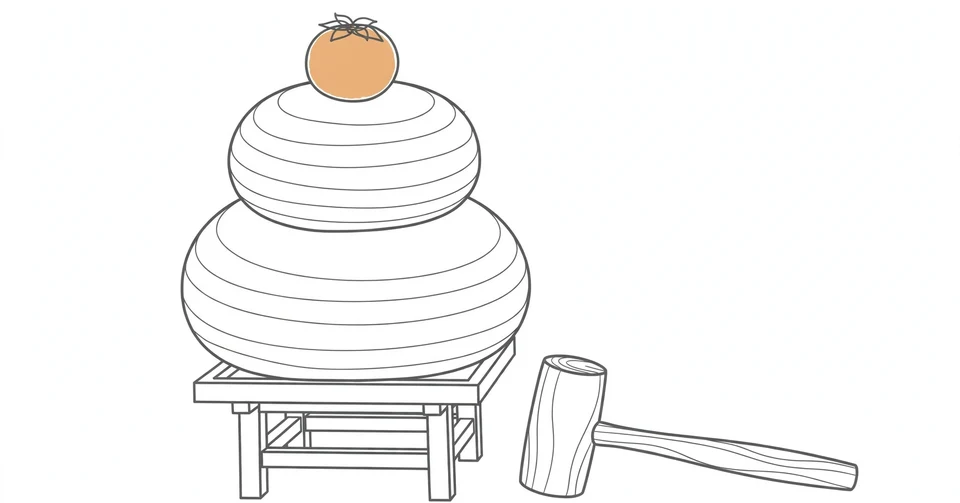
On January 11, in homes across Japan, a small decoration comes down from the shelf where it has sat since the end of December. It is a pair of round rice cakes, one stacked on the other, and by now they are hard, dry, and cracked. The family does not slice them with a knife. They break them apart by hand or with a small wooden mallet, and the pieces go into soup. The ceremony is called kagami biraki.
The same name covers a much louder scene. At weddings, company openings, and new year parties, guests of honor stand around a big wooden barrel of sake, raise wooden mallets together, and bring them down on the lid. The lid cracks open, the sake is ladled out for everyone, and the celebration can begin. That, too, is kagami biraki.
Two ceremonies, one idea. Kagami biraki is about opening something round and sealed, and sharing what is inside. Nothing is cut, nothing is discarded, and the good luck is divided among everyone present rather than kept by one person.
What kagami biraki means
Kagami means mirror. The round rice cakes and the round wooden lid of a sake barrel both take their shape, and their name, from the polished bronze mirrors of old Japan, objects that were never just tools for checking your face. Biraki comes from the verb hiraku, which means to open. Put together, kagami biraki is the opening of the mirror. The Wikipedia entry on kagami biraki gives exactly that literal translation, and it captures the spirit of the thing better than the common English rendering, the breaking of the mochi.
The choice of word matters more than it might seem. Japanese has ordinary words for cutting and breaking, kiru and waru, and both were deliberately avoided here. Cutting suggests severed ties, and for the samurai families who shaped many of these customs it also carried an echo of seppuku, ritual suicide by the blade. Breaking sounded almost as unlucky. So the language reached for opening instead. A kagami biraki does not destroy the round thing at its center. It opens it, the way you open a door for a guest.
I find that small act of vocabulary hard not to admire. The whole point of the day is to start a year without severing anything from the year before, and the name itself refuses to use the vocabulary of damage.
The mochi that waits on the altar
The home version of kagami biraki begins in late December, when the kagami mochi goes on display. It is made of two round, flattened rice cakes, the lower one a little larger than the upper one, stacked on a small stand. On top sits a daidai, a bitter orange. The stack is placed on the kamidana, the household Shinto altar, or in the tokonoma alcove, as an offering to the deity of the New Year who is believed to take up residence in it for the holidays.
In the past, families pounded the mochi themselves at the end of the year. Most no longer do. Supermarkets in Japan fill with kagami mochi in December, many of them plastic shells shaped like the real thing, holding small individually wrapped portions of mochi inside. The shape is what carries the meaning, and the shape survives the shortcut. Living in Shizuoka, I have come to read the New Year partly by these displays, stacked in pyramids near the entrance of every grocery store in town.
The kagami mochi is not decoration for its own sake. It is a vessel. For roughly the first ten days of January it holds the visiting god of the year, and everything that happens at kagami biraki follows from that. You do not throw away something a god has lived in. You open it carefully, and you eat it.
Breaking the kagami mochi on January 11
Kagami biraki traditionally falls on January 11. The date was not always the 11th. In the Muromachi period the ceremony is said to have been held on January 20, and one widely told explanation says the date moved because the third Tokugawa shogun, Iemitsu, died on January 20 in 1651, making the day one to avoid for a celebration. January 11 had the further advantage of being an odd numbered day, and odd numbers are considered auspicious in Japan. Not every region agreed, then or now. Parts of western Japan keep January 15, and Kyoto and its surroundings have traditionally held the ceremony as early as January 4.
By the time the day arrives, the mochi has changed. Fresh rice cake is soft and giving, but after days in the dry winter air of a Japanese house it turns brittle, with cracks running across its surface. Nobody minds. The dryness is part of the ritual, and it makes the breaking easy work for hands or a light wooden mallet. What nobody reaches for is a knife, for the reasons of language and luck already described. The pieces are pried and snapped apart, and the rough edges are considered perfectly fine.
Then the pieces are eaten, and this is the destination of the whole ceremony. The broken mochi goes into ozoni, the soup eaten through the New Year holidays, and into sweet red bean soups known as oshiruko or zenzai. Some families turn the drier pieces into kakimochi, little rice crackers. The Just One Cookbook guide to kagami biraki lists the same spread of dishes, and the logic behind all of them is simple. Eating the mochi that sheltered the New Year deity is a way of taking in its blessing, a prayer for health and good fortune in the year just begun. The ceremony ends at the table, not at the altar.
The other kagami biraki, a barrel of sake
The second form of kagami biraki needs no altar and no waiting. A wooden barrel, a komodaru, is filled with iwai-zake, celebration sake, and set in front of the guests. At breweries the round wooden lid of the barrel is called the kagami, the mirror. Guests of honor, often wearing happi coats, line up with wooden mallets, count together, and strike the lid as one. It gives way with a crack, and sake is ladled with a wooden scoop into square masu cups for everyone in the room. When a shinnenkai opens the working year in January, this barrel ceremony is frequently its centerpiece, the moment the party stops being a formality.
The barrel version has the better origin story. About 300 years ago, Tokugawa Ietsuna, the fourth shogun, gathered his daimyo in his castle on the eve of a battle and broke open a cask of sake with them. His side won, and the gesture stuck, becoming the standard way to mark a hopeful beginning with a drink shared from the same source. The drink itself is far older than the ceremony, as the long history of Japanese sake shows, but Ietsuna gave it a piece of theatre that has never really left.
Strictly speaking, the barrel ceremony has other names. It is also called kagami wari, mirror breaking, or kagami nuki, mirror pulling. Yet for happy occasions people reach for kagami biraki, because opening sounds like prosperity and breaking sounds like an accident. The round lid, meanwhile, is read as a symbol of harmony, a circle with no corners to catch on anything. Break the circle open, the thinking goes, and harmony and good fortune spill out together and are shared before they can escape.
Where kagami biraki shows up now
Once you know the gesture, you start seeing kagami biraki everywhere a beginning needs marking in Japan. It appears at weddings, where the couple and their parents strike the lid together. It appears at the opening of a new shop or office, at groundbreakings and completions, at graduations and at sporting events. The barrel is sometimes a working cask and sometimes mostly for show, but the choreography stays the same, because the choreography is the message.
Martial arts dojos have made the ceremony their own. For many schools of judo, karate, kendo, and aikido, kagami biraki is the name of the first training of the year, usually held on the second weekend of January so that every student can attend. There may be no mochi broken and no sake opened at all. The name alone does the work, framing the first practice as an opening of the year rather than a return to routine. A ceremony that began with offerings and war councils now also opens a year of being thrown to the mat, which feels like a healthy demotion.
Japan has plenty of rituals for ending things. Kagami biraki is one of the few built entirely around beginning, and it begins not with a speech or a ribbon but with food and drink that nobody keeps for themselves. The mirror opens, the contents are shared, and the year is underway. It is a modest ceremony, and that is exactly its charm.
More in Culture & Society
Latest posts
- Every Prefecture Argues About What Goes in Ozoni
- KRL Commuterline and the Trains That Move Jakarta
- Kecap Manis and the Sweet Soy Sauce of Indonesia
- In Mamoiada, Two Hundred Families Still Make Wine at Home
- Shochu and the Quiet Spirit of Japan
- A Dried Shiitake Is Louder Than a Fresh One
- Loma Linda's Long Lives Run on Saturdays
- Maruten Numazu and the Towering Kakiage Bowl of the Port
- The Three Sisters Grow Better Together
- Tatamiishi Terraces Filter a River Through Stone
- Wasabi-Zuke Puts the Whole Plant in Sake Lees
- Konyoku Is Still Out There, Past the Last Train Station
- Dry January Lasts a Month on Purpose
- Ikaria Runs on Island Time
- Why Nicoya Cooks Its Corn in Lime