A Glass of Cannonau a Day in the Sardinian Hills
· 11 min read
Cannonau is the red wine of Sardinia's mountain villages, poured in small glasses with food and friends in one of the world's famous longevity regions. This is what the wine is, where it comes from, and why the honest story is about a way of life rather than a miracle in a bottle.
In the mountain villages of central Sardinia, the day has long been measured partly in small glasses of cannonau. The wine appears at lunch beside bread and cheese, again in the evening among neighbours, poured modestly and drunk slowly. Nobody in these villages treats the glass as medicine. It is simply part of the furniture of a day spent walking steep land, tending animals and eating with other people.
Cannonau is a red wine made from the grape of the same name, the Sardinian member of the Grenache family, known as Garnacha in Spain and Grenache in France. It is the island's signature red, full bodied and warm with alcohol, tasting of ripe cherry, raspberry and Mediterranean herbs. What makes it famous far beyond Sardinia, though, is not only the flavour. It is the address. The grape's heartland overlaps the mountainous region that researchers and writers turned into one of the world's celebrated longevity zones.
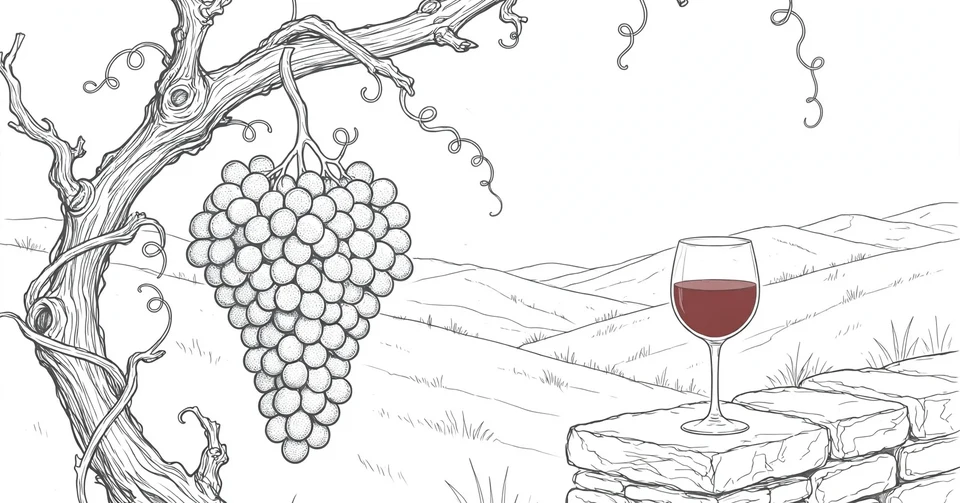
That fame deserves a careful telling. A glass of cannonau a day is the catchy version of the story, and like most catchy versions it leaves almost everything important out. The wine is real, and so are the long lived villagers. The connection between the two is where honesty has to do some work.
What cannonau is in the glass
The cannonau grape ripens late and loves heat and drought, which makes it well suited to a dry Mediterranean island. Bush vines, many of them old and some reportedly over a century in age, grow across Sardinia, from coastal plains to granite slopes in the interior. Yields are often low, the berries small and concentrated, and the wines that result are generous rather than delicate.
A typical glass of cannonau is deep ruby, warm and rounded, with red fruit up front, dried herbs and spice behind it, and alcohol commonly around 14 to 15 percent. Younger bottles lean on cherry, strawberry and plum. Older and more structured ones drift toward leather, tobacco and dried fig. It is a wine built for roasted meat and aged cheese, not for sipping alone on an empty stomach, and in its home villages it is almost never asked to perform without food beside it.
One grape, two homelands
Ask where cannonau comes from and you start a friendly argument that has run for generations. The older, widely taught account gives the grape to Spain. Grenache most likely emerged in Aragon in northern Spain, and plantings spread through lands ruled by the Crown of Aragon, reaching Sardinia after the Aragonese conquest of the island in the early 14th century. On that reading, cannonau is Garnacha that crossed the sea and took a local name.
Sardinian researchers answer with archaeology. Studies of ancient grape seeds found on the island have been read as evidence that vines closely related to cannonau were cultivated in Sardinia far earlier than the Spanish period, possibly thousands of years ago. On that reading, the grape is not an import at all but a native that Spain later received from the island rather than the other way around.
The honest position is that the case is not closed. Grapes moved around the Mediterranean with traders, soldiers and farmers for millennia, and the cannonau of today is genetically the same variety as Grenache and Garnacha whichever direction it first travelled. What nobody disputes is what happened next. Cut off in dry hills and stubborn villages, the variety developed its own accent in Sardinia, and Sardinians built an identity around it that no Spanish or French region can claim.
Cannonau di Sardegna, a DOC that covers an island
Most Italian wine denominations guard a valley or a cluster of hillsides. Cannonau received something much larger. The Cannonau di Sardegna DOC, established in 1972, covers the entire island of Sardinia, and by Decanter's account the grape accounts for roughly a fifth of all the wine the island produces.
The rules require a Cannonau di Sardegna to contain at least 85 percent cannonau grapes, rising to 90 percent for the Classico category associated with the historic growing areas of the interior. Within the island wide denomination, three subzones carry their own names. Nepente di Oliena comes from the town of Oliena under the limestone massif of Supramonte. Jerzu covers vineyards around Jerzu and Cardedu in Ogliastra. Capo Ferrato sits in the south east, where the vines feel the sea. Riserva bottlings must age for at least two years, including time in barrel, and the denomination also allows rosé, sweet passito and fortified liquoroso styles, though the dry red is the version the world knows.
That legal frame matters because it explains the range of the wine. A coastal cannonau bottled young can be soft and fruit driven. A mountain riserva from old vines can be firm, savoury and built to age for a decade. One grape, one DOC, many dialects.
Mamoiada, the village of two hundred family cellars
If cannonau has a capital of the heart, it is Mamoiada, a village of about 2,500 people in the Barbagia mountains. Its vineyards climb granite slopes to around 900 metres, divided into some fifty named plots called ghirade. The remarkable fact about Mamoiada is not any single producer. It is that more than two hundred families farm those roughly 350 hectares, and most of them still make their own house wine, the vino di casa poured for family and friends or sold locally in bulk.
Wine writer Andrew Jefford has praised the granite uplands around Nuoro and singled out Mamoiada, where at 600 to 800 metres the variety sheds its lowland sweetness and gains freshness and stony purity. Traditionally the wine here was not even drunk from stemware. It went into tall, fluted glasses closer to shot glasses, a small measure by design. At village festivals, when the Mamuthones process in their heavy bells and dark masks, a blend drawn from the stocks of the town's producers circulates as a kind of common wine of the whole community.
The village's modern chapter began when Francesco Sedilesu, from a local winemaking family, started bottling the family cannonau in 2000 under the Cantina Giuseppe Sedilesu name, putting a label on what had always been a household product. In 2015 he helped found Mamojà, an association of Mamoiada producers whose members agree to farm organically, ferment with ambient yeasts and actually live in the village. Younger winemakers with enology degrees have since joined the old growers, some making lighter, earlier picked styles. The through line is scale. Mamoiada chose many small cellars over one big one, and the wine stayed a village craft instead of becoming an industry.
How the shepherds actually drink it
The drinking pattern matters more than the drink. In the longevity villages of Ogliastra and Barbagia, cannonau was the wine of shepherds and farmers, people whose work meant walking kilometres of steep pasture every day. The glass arrived with meals, in small amounts, spread across the day, and almost always in company.
Dan Buettner, the writer who popularised the Blue Zones idea, describes this pattern in his account of Sardinia, where the daily cannonau is taken as two or three small glasses with friends and food rather than as a bottle opened alone at night. I wrote about his wider map of long lived places in my piece on the blue zones and the five places where people live the longest, and Sardinia's corner of that map is defined by exactly this combination. Steep land that forces daily movement. A diet of bread, beans, vegetables, cheese and modest amounts of meat. Strong family structures that keep old people at the centre of the table rather than at its edge. And a glass of strong red wine that is present at that table, in moderation, as food rather than as an event in itself.
Strip away any one of those elements and the story changes. A strong wine at 14 or 15 percent alcohol, drunk quickly and alone, is not a longevity habit. The same wine in a fluted half glass, at lunch, after a morning on the hills, among three generations, is a different substance in practice even if the liquid is identical.
The polyphenol question, told carefully
The modern fame of cannonau rests heavily on one word: polyphenols. These are compounds found in grape skins, including flavonoids and resveratrol, that show antioxidant activity in laboratory settings. Several studies comparing traditionally made red wines have reported that cannonau tends to carry relatively high levels of these compounds, in some comparisons higher than many other Grenache based wines. Strong sun, water stress and low yielding old vines push the grapes to grow thicker skins, and the skins are where the polyphenols concentrate. Decanter's guide to the grape puts it cautiously, noting that cannonau is said to contain high levels of polyphenols and anthocyanins that have been linked to heart health.
Two cautions belong beside that paragraph, and honest wine writing should never separate them. The first is that the popular claim of two or three times the antioxidants of other wines is far too sweeping. Polyphenol levels vary enormously from bottle to bottle with vineyard, vintage and winemaking, and a single comparison cannot define a whole category. A careful long read on cannonau and the longevity question at Zafferano and Co makes the same point, adding the second caution. Cannonau is alcohol. Whatever interesting chemistry sits in the skins, the ethanol is in the glass too, and no responsible reading of the evidence turns wine into medicine or gives non drinkers a reason to start. Association is not causation. Villages with many centenarians also walk more, eat differently, stress less about status and keep their grandparents busy and wanted. Singling out the wine because it is the easiest element to bottle and sell says more about marketing than about Sardinia.
My own view, after reading around this grape for a while, is that the polyphenol research is genuinely interesting and also the least important part of the story. The Sardinians were not drinking a supplement. They were drinking their own wine, made from their own vines, in quantities their customs kept small. The chemistry is a footnote to the culture, not the other way around.
A shared grammar of enough
There is a Japanese parallel I keep coming back to. In Okinawa, another of the celebrated longevity regions, the old rule of hara hachi bu teaches eating until you are eighty percent full and then stopping. The Sardinian small glass is the same grammar applied to wine. Pleasure is not refused. It is portioned by custom before appetite has to negotiate with itself.
That, I think, is the real export hidden in the cannonau story. Not a bottle with a health halo, but a set of guardrails that a community built so long ago that nobody experiences them as rules. Small glasses. Wine with food. Wine with people. Work that keeps the body moving on real hills. The wine is woven through all of it, which is precisely why it cannot be lifted out of it.
Finding cannonau at your own table
Outside Sardinia, the bottle to look for is labelled Cannonau di Sardegna DOC, and one in five bottles of Sardinian wine carries some version of that name, so it is easier to find than its remote homeland suggests. Producers from the mountain interior, around Nuoro, Oliena and Mamoiada, tend to give the most structured and savoury expressions. Coastal and young bottlings are softer and simpler, pleasant everyday reds rather than cellar wines.
Serve it a little cooler than a warm room, around 16 to 18 degrees, in a generous glass, and give structured young bottles some air. At the table, follow the Sardinian lead. Cannonau loves roasted and grilled lamb, slow cooked pork in the style of porceddu, wild boar where you can get it, and hard aged sheep cheese such as Pecorino Sardo with a slice of pane carasau, the island's crisp flatbread. Those pairings are not decoration. Salt, fat and roasted flavours are exactly what this warm, tannic wine evolved beside, in villages where the same families tended the vines and the flocks.
In the end, a glass of cannonau a day was never really a prescription. It was a description, of shepherds on granite hills who drank a little of their own strong wine, slowly, together, inside lives that gave them a hundred reasons to keep going. The wine deserves its fame, as long as we credit the whole table and not just the glass.
More in Food & Travel
Latest posts
- Manza Onsen Bathes at 1,800 Metres
- Irezumi Was an Art Before It Was a Warning
- The Oshi Kept Fuji's Pilgrims Fed, Housed, and Devout
- Japan's Population Decline and the Villages It Leaves Behind
- KRL Commuterline and the Trains That Move Jakarta
- Loma Linda's Long Lives Run on Saturdays
- Maruten Numazu and the Towering Kakiage Bowl of the Port
- The Three Sisters Grow Better Together
- Half the Old Springs in Japan Thank Kobo Daishi
- Tatamiishi Terraces Filter a River Through Stone
- Wasabi-Zuke Puts the Whole Plant in Sake Lees
- Konyoku Is Still Out There, Past the Last Train Station
- Karo Is the Tengger's Other Great Gathering
- Dry January Lasts a Month on Purpose
- Urashima's Dragon Palace Had a Name, Ryugu