Climbing Mount Fuji, Japan's Sacred Peak
· 9 min read
Climbing Mount Fuji is a summer-only climb up Japan's tallest peak, with four trails, a ¥4,000 fee, and a daily cap on the Yoshida Trail. This is how the climb works, and how to plan it.
Climbing Mount Fuji is the most famous walk in Japan, and it is simpler than it looks. The mountain is 3,776 metres high, the climb is open only in summer, and almost everyone starts from the 5th Station, already more than halfway up. Fit walkers with no technical skills can reach the summit in one long day and night, provided they respect the altitude, the weather, and the new rules.
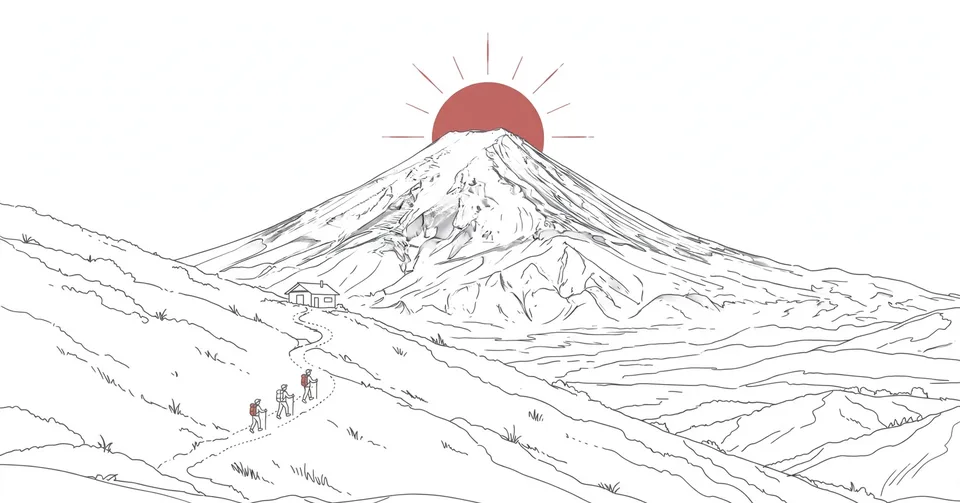
The classic plan for climbing Mount Fuji is an overnight one. You take a bus to the 5th Station in the afternoon, walk up to a mountain hut, sleep a few hours, then wake around 2 in the morning and climb the last stretch in the dark. The reward is goraiko, the sunrise from the summit, watched with hundreds of other climbers above a sea of clouds. Then you walk down, usually in 3 to 5 hours, and you are back at the bus by late morning.
Climbing Mount Fuji has changed in recent years. Since 2025 there is a mandatory fee of ¥4,000 per person on all four trails, and the popular Yoshida Trail limits climbers to about 4,000 a day. The gates also close from 2 in the afternoon to 3 in the morning to stop bullet climbing, the non-stop overnight ascent without rest. These rules are not there to put people off. They are there because the mountain was getting loved to death, and a limit is what keeps the climb worth doing.
The mountain in a few numbers
Mount Fuji is the tallest peak in Japan at 3,776 metres, and it is a volcano that last erupted in 1707. It became a UNESCO World Heritage Site in 2013, listed as Fujisan, a sacred place and source of artistic inspiration. Most of the mountain and its foothills sit inside Fuji-Hakone-Izu National Park, and the cone you see from Tokyo is so perfect that it has been painted, photographed, and printed on postcards for centuries.
Walking around the crater rim takes about 90 minutes.
Like Japan's cherry blossom season, climbing Mount Fuji has a short window. The official season runs from 1 July to 10 September. Outside those dates the trails are closed, the huts are shut, and climbing is dangerous, with snow, ice, and strong winds. The closed season is not a quieter alternative.
The four trails, and which one to choose
There are four official trails for climbing Mount Fuji, and they are not equal. Yoshida is the classic first choice, Fujinomiya is the shortest, Subashiri runs through forest, and Gotemba is the longest and quietest.
| Trail | Trailhead altitude | Distance up | Time up |
|---|---|---|---|
| Yoshida | 2,305 m | 6.8 km | About 6 hours |
| Fujinomiya | 2,400 m | 4.3 km | About 5 hours |
| Subashiri | About 2,000 m | About 5.8 km | About 6 hours |
| Gotemba | About 1,440 m | About 7.5 km | About 7 to 8 hours |
Yoshida, on the Yamanashi side, takes about 70 percent of all climbers. It has the most mountain huts, the most facilities, and the easiest access by bus from Kawaguchiko. That also makes it the busiest, which is why it is the only trail with a daily cap. First timers climbing Mount Fuji should still choose it, because the crowds are also a safety net: there is always someone ahead of you, and the huts are never far apart.
Fujinomiya, on the Shizuoka side, starts highest and climbs shortest, so it suits people who want the quickest route to the top. The trade off is a steeper, rockier path and fewer huts. Subashiri starts in forest, which makes the lower half of the climb the prettiest of the four, and it joins the Yoshida route near the top. Gotemba starts lowest, takes longest, and has the fewest climbers, which suits experienced walkers who want space. Each trail has its own colour on the signposts, so remember yours at every junction, because taking the wrong path down is the most common way climbers get lost.
The descent is a different trail on Yoshida, a long switchback of loose volcanic gravel that is hard on the knees. Trekking poles help, and so does taking it slowly. Most injuries while climbing Mount Fuji happen on the way down, not on the way up, because tired legs meet loose ground.
The new rules: fee, cap, and closed hours
Climbing Mount Fuji used to be free and unlimited, and the mountain paid for it. In the 2024 season, 204,316 climbers reached the trails, down from 221,322 in 2023, but the crowds at the summit at sunrise were still so thick that the experience felt more like a queue than a climb. The new rules, introduced in 2025, are the answer.
The fee is ¥4,000 per person, paid on all four trails. On Yoshida you register and pay in advance through Yamanashi Prefecture's official reservation system, and the trail is capped at about 4,000 climbers a day. When the cap is reached, only climbers with a mountain hut reservation can continue past the 5th Station. The other three trails have the fee but no daily cap, though advance registration is still required.
The gates close from 2 in the afternoon to 3 in the morning. Anyone without a hut reservation is turned back during those hours. The target is bullet climbing, the practice of starting late, walking through the night without sleep, and reaching the summit exhausted. It is the main cause of altitude sickness, hypothermia, and rescue call outs on the mountain. The official site for these rules is the Mt. Fuji Climbing official website, and the route comparison page lists the official times and distances for each trail.
The fee money from climbing Mount Fuji goes to trail maintenance, toilets, and safety, which is fair enough when you consider that a single season puts more than 200,000 pairs of boots on one volcano. A mountain that gives this much can reasonably ask for a ticket. If you are climbing Mount Fuji next season, check the official site first, because the dates and the cap change every year.
Climbing Mount Fuji in practice
A typical day climbing Mount Fuji on the Yoshida Trail starts with a bus from Kawaguchiko Station to the Fuji Subaru Line 5th Station, at 2,305 metres. Buses run from early morning, and the first ones arrive around 5 in the morning. Many climbers start in the early afternoon, reach their hut by evening, and sleep in a shared bunk room until the 2 AM wake up call.
The night climb is slow and strangely beautiful. A line of headlamps winds up the dark cone, and the air gets colder with every station. At the summit, climbers wait in the cold for the sun, and the sunrise, when it comes, is worth every step. After that, many walk the crater rim, visit the shrine, and buy a stamp for their walking stick at the summit hut. The walk down takes 3 to 5 hours on Yoshida, and the bus back to Kawaguchiko is full of people asleep before it leaves the parking lot.
Book the hut early. The good huts for climbing Mount Fuji sell out weeks ahead in July and August, especially on weekends, and without a reservation you cannot pass the gate at night. Bring cash, because the huts and the summit shops do not all take cards. Bring layers, rain gear, a headlamp, sun protection, and more water than you think you need, because there is no water source on the upper mountain. Altitude sickness is real at 3,776 metres, so climb slowly, drink often, and turn back if a headache gets worse. The mountain will still be there next year, and that is not a consolation. It is the whole point of a sacred peak.
After the descent, the area around the mountain rewards a slow day. The Five Lakes are at the northern foot, and in autumn the maples there turn the shoreline red and gold, as I wrote about in my guide to Japan's autumn leaves. A soak in a hot spring the evening after the climb is the best recovery I know, and Japan's bathing culture is built for exactly that kind of tired body, which is why I wrote about why Japan's hot springs are a way of life.
What to pack, and what to respect
Pack light but complete. The essentials are broken-in hiking shoes with grip, warm layers for the summit, a rain jacket, a headlamp with spare batteries, sunscreen, a hat, two litres of water, snacks, cash, and a small bag for your rubbish, because there are no bins on the mountain. Trekking poles are worth their weight on the descent. Oxygen cans are sold at the 5th Station, but they are no substitute for climbing slowly and resting when your body asks.
Respect is part of the climb. Fuji is a sacred mountain, with shrines on its slopes and at its summit, and pilgrims have climbed it for centuries. Stay on the trail, do not pick plants or take rocks, use the toilets and pay for them, and carry everything you brought back down. The fee and the cap are the modern form of that same respect: they say the mountain is not an amusement park, and the people who manage it would rather have fewer climbers who behave well than a crowd that tramples it.
The best time for climbing Mount Fuji is a weekday in early July or early September, when the crowds thin and the weather is still fair. Weekends in August are the busiest days of the year, and Obon week in mid-August is the peak of the peak. If your dates are flexible, choose the quiet week. The sunrise is the same, and the trail is yours.
Climbing Mount Fuji is not a conquest. It is a slow walk up a volcano that Japan has revered for over a thousand years, and the new rules have made climbing Mount Fuji a better walk, not a harder one. Go in season, book a hut, climb slowly, and let the sunrise do the talking. The mountain has been there long before us, and if we treat it well, it will be there long after.
More in Food & Travel
- Numazu Deep Sea Aquarium and the Creatures of Suruga Bay
- Numazu Himono and the Art of Dried Fish
- Numazu Port and the Freshest Seafood in Shizuoka
- Bullet Climbing Mount Fuji, the Overnight Ascent Japan Is Trying to Stop
- Climbing Mount Semeru, Java's Highest Volcano
- Tamago Sando and Japan's Konbini Egg Sandwich
Latest posts
- Love Live Sunshine and How Anime Changed Numazu
- Numazu Imperial Villa and Japan's Seaside Imperial Retreat
- Disaster Vending Machines in Japan That Give Their Drinks Away
- The E33G Remote Worker Visa and How to Legally Work from Bali
- Wabi-Sabi and the Japanese Beauty of Imperfect Things
- Women Only Train Cars in Japan and the Problem They Answer
- Maneki Neko and Japan's Beckoning Lucky Cat
- The Baduy People and Life Without Modern Technology
- The Salaryman and Japan's Loyal Office Culture
- Onsen Tattoo Rules in Japan and How They Are Slowly Changing
- Key Money in Japan and Why Renting Costs Four Months Up Front
- Sento, Japan's Everyday Public Bathhouse
- The Fuji Five Lakes and the Best Views of Mount Fuji
- The Obon Festival, Japan's Week for Honouring Ancestors
- Visiting the Ghibli Museum and Ghibli Park in Japan