Bhuta Kala Are the Guests Bali Feeds Instead of Fighting
· 13 min read
Bhuta kala are the restless forces of the unseen world in Balinese belief, and Bali keeps its balance by feeding them at ground level instead of trying to destroy them.
Walk through a Balinese village in the early morning and you will see two kinds of generosity. On the shrines, small trays of flowers and rice are lifted toward the gods. On the ground, at gateways and crossroads, other trays sit directly on the earth. Those low trays are for the bhuta kala, and they are laid with the same care as the high ones.
The bhuta kala are the restless forces of the unseen world in Balinese belief, and Bali treats them as guests. The island does not promise that they can be destroyed, so it feeds them instead, on schedule and at their own level, in the hope that a fed neighbour stays a quiet neighbour. If that sounds strange, it is because most of us were taught that frightening things should be fought. Bali chose a different answer, and it has kept that answer for centuries.
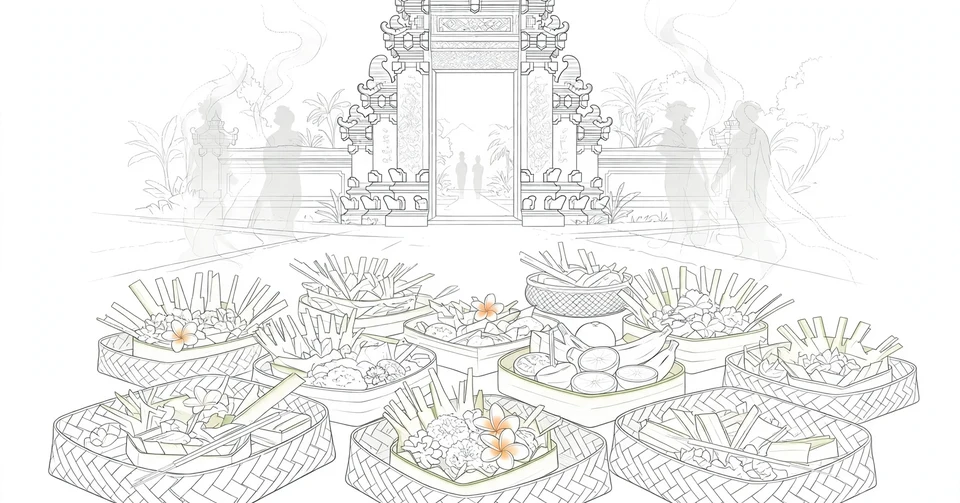
The height is the whole message. Offerings for the gods are lifted high because the gods are imagined above, in the direction of the mountain and the sky. Offerings for the bhuta kala stay on the ground because their realm is the lower one, the earth under the house and the road outside it. Priests are careful to say this is not an insult, and not a claim that spirits live in the dirt. It is simply correct addressing. Everyone in the Balinese cosmos receives their offering at the level where they belong, and the tray on the ground belongs to the guests nobody invites and everybody serves.
What the name bhuta kala actually means
The two words come from Sanskrit, and neither one translates neatly as demon. Bhuta means an impure element that constitutes the body, or a supernatural being. Kala means time, fate, or the god of death. Put together, the bhuta kala stand for everything in the universe that is coarse, restless and inclined to disturb: appetite and temper, sickness, greed, the hunger that makes people and animals behave badly. That is the plain meaning, and it is worth holding on to, because the English word demon carries luggage the Balinese idea does not. A demon in the Western sense is an enemy to be cast out. The bhuta kala are closer to weather: powerful, sometimes damaging, and impossible to banish by decree.
Priests give the bhuta kala a more philosophical reading. For them, the bhuta are centres of destructive force, imbalance and obstruction, forces that must be smoothed out and nullified through offerings rather than confronted head on. The distinction matters, because it changes the whole relationship. If the bhuta kala were simply evil, the correct response would be a war. If they are imbalance, the correct response is maintenance, and maintenance is something a village can do every day without waiting for a hero.
There is a second address for the bhuta kala, and it is closer than the crossroads. Balinese teaching holds that a human being is a small copy of the universe, so the same forces run inside a person, as illness in the body or a bad streak in the character. Greed, passion and hunger are named as the bhuta kala within, which means the guest list is not only about the world outside the gate. It is also about the appetites each of us carries around, and the daily work of keeping them fed in their proper portion rather than letting them run the house.
Where the bhuta kala are met
The bhuta kala are met at the edges of ordered space. Crossroads are their classic address, the places where one territory blurs into another and where ceremonies of offering to them are held. Gateways and thresholds work the same way, which is why Balinese house compounds keep a screen wall just inside the gate, the aling aling. Troublesome forces are believed to travel in straight lines and to corner badly, so the wall gives them something to run into before they reach the family rooms. The offerings wait for them at exactly those corners, a small tray set where trouble would enter first.
Big trees belong on the same map. The banyan trees a village wraps in black and white checked cloth are believed to house spirits, and the cloth marks the spot where the unseen world is close. Temples carry the warning in stone: monsters with long fangs, bulging eyes and a malicious grin are carved on the walls, not as decoration but as portraits of the beings the offerings are meant for. A visitor who learns to read those markers starts to see the island differently. The bhuta kala are not hiding in some far away underworld. They have addresses, and the village knows them all.
That is why the feeding is done in public, in daylight, without secrecy. A segihan tray at a doorway is not a shameful errand. It is housekeeping at the boundary, as ordinary as sweeping the step, and the neighbours can see it being done. The bhuta kala are treated as part of the neighbourhood, difficult neighbours with a permanent address, and the village deals with them the way any community deals with a powerful neighbour it cannot move away from. It learns what they eat, and it never lets them go hungry.
Why Bali feeds them instead of fighting them
The thinking behind the feeding comes straight from rwa bhineda, the Balinese philosophy of paired opposites that must be held in balance rather than resolved by victory. I have written about rwa bhineda as the idea that light needs darkness and good needs evil, not as enemies to be annihilated but as counterweights that keep the universe level. The bhuta kala are the working half of that philosophy. On that view, the dark side of things cannot be eradicated once and for all, because it is half of how the world is built. What can be done is maintenance, and a caru is the main tool of that maintenance.
Balinese people do not believe that negative forces can be defeated once and for all or banished entirely, and the tradition is frank about why. A victory that cannot last is not a victory, it is a debt that comes due with interest. So the bhuta kala are subdued and appeased, never annihilated, and the appeasement is deliberately generous. A detailed account of these rites notes that a well fed guest is expected to do more than stay quiet. At times, it says, the fed forces may even turn their power to helping the household. Fear, in this system, is handled the way you would handle a powerful neighbour. You learn what he eats, and you keep the plate full.
I have come to think this is the most practical theology I have met in this series. It does not ask anyone to love the forces that frighten them, and it does not ask anyone to pretend those forces are not real. It asks for something more modest and more achievable: put them on the guest list, feed them on time, and keep the relationship in good repair. The bhuta kala are not honoured because they are good. They are honoured because they are powerful, and power that is acknowledged on schedule is power that does not need to make a scene to be noticed.
The menu, from a pinch of rice to a payment
The feeding has a ladder, and every rung of it is a caru, the class of offerings made for the bhuta kala. I described the ladder in full in a piece on the caru itself, and the shape of it is worth repeating here, because the ladder is really a price list for peace. At the bottom sits the segihan, the only caru that involves no animal life at all. Its commonest form, the ituk ituk, is a small triangular cup of coconut leaf holding a shallot and ginger. Shallot is considered cold and ginger is considered hot, so even this smallest offering carries the whole philosophy in miniature, a cold thing and a hot thing laid side by side to remind its recipients about balance.
From the segihan the ladder climbs by size and seriousness. Eka sata centres on a single multicoloured chicken and is performed at a melaspas, the purification of a new house, or on the day before a tooth filing. Panca sata asks for five chickens of five different colours, set out for the directions of the compass, and many villages perform it once a year before Nyepi at their road intersections. Higher rungs add a dog of a particular colouring, then a white duck, then a goose, each step matched to a weightier occasion, such as the rebuilding of a temple. The animals at these levels are treated with formal respect and given prayers of their own, and tradition holds that an animal offered this way takes a step upward in its next life.
The top of the ladder is the tawur, and the word is worth pausing on, because tawur literally means payment. The greatest of them, Tawur Kesanga, is held every year before Nyepi at Pura Besakih, the mother temple on the slopes of Mount Agung, and its offerings run from chickens up through a goat, a cow, a black pig and a water buffalo. Practitioners say the size of a caru is proportional to how long its peace is expected to last. A segihan buys a day. A small caru is credited with about six months. The offerings of the Eka Dasa Rudra, the vast ceremony held only in the longest of cycles, are said to hold for a hundred years. Whether or not a visitor shares the belief, the bookkeeping is revealing. Peace, in this religion, is not a permanent achievement. It is a subscription, and the bhuta kala are paid on time.
There is one more form of the same logic, and it is the one visitors find hardest to watch. Blood spilling, known as tabuh rah, offers blood on the ground for the bhuta kala, and the ritual cockfights called tajen are part of the same offering, since the blood spilled in them is believed to please the negative forces. An overview of blood sacrifice in Balinese religion describes these rites as part of the same spectrum, from a pinch of rice to a feast, and it makes the same point the caru ladder makes. The goal is not to eradicate evil but to appease it and restore balance, in the world outside and inside the person alike. I will not pretend the practice is gentle. It is not, and the Balinese sources do not pretend otherwise. But it is consistent, and it is honest about what it costs to keep a bargain with forces that cannot be wished away.
The night before the silence
Once a year, the whole island stages the bargain in public. On the eve of Nyepi, villages parade ogoh-ogoh, giant demon figures with the same fangs and bulging eyes carved on the temple walls, through the streets in the Pengerupukan procession. The figures are the bhuta kala given a body for one night, shaken and spun at the crossroads, and then usually burned. The parade is loud, crowded and deliberately theatrical, and it ends the old year by putting its monsters on display before putting them away.
Behind the noise sits the tawur. First the world is cleansed, when villages carry their gods down to the sea to be washed. Then the restless forces are paid in full at the great Tawur Kesanga. Only then can the island afford its day of silence, when the airport closes, the streets empty, and nobody works, travels or lights a fire. The order is the whole teaching in one weekend. The bhuta kala are not fought on the eve of the new year. They are feasted, paid, and asked to let the year begin level, and the silence that follows is the receipt.
The guests inside us
There is a last address for the bhuta kala, and it is the one the philosophy returns to again and again. A human being is a small copy of the universe, so the same forces that gather at the crossroads gather inside a person too. Greed, appetite and temper are the bhuta kala in their domestic form, and they are managed the same way as their cousins outside: fed their proper portion, kept in their place, never invited to run the house. The offerings at the doorway and the discipline inside the person are two halves of one practice, and the village that feeds its demons at ground level is also teaching its children to feed their own appetites on schedule.
I find that last turn the most useful part of the whole idea, and the part that travels best beyond Bali. Most of us carry something we wish we could delete: a temper, a craving, a streak of envy that shows up at the worst moments. The Balinese answer is not to declare war on it, because wars against parts of yourself are the ones you lose twice, once in the fighting and once in the wreckage. The answer is to give it its portion, at its level, on time, and to keep the rest of the house for better things. The bhuta kala, inside and out, are not going anywhere. The question is only whether they are fed or starving, and Bali has made its choice.
Bali raises its most beautiful offerings toward the sky, and it lays its humblest ones on the ground, and both gestures belong to the same religion. The island does not promise a world without trouble, and it does not pretend that trouble can be voted out of existence. It promises something smaller and more durable: a schedule, a tray, a payment made on time, and a year that begins level. A frightening guest is still a guest, and Bali has decided, century after century, that it is cheaper to feed one than to fight one. The bhuta kala eat at ground level, and the island, fed and quiet, goes on.
More in Culture & Society
- Suka Duka Means the Banjar Shows Up for Joy and Grief Alike
- Tabuh Rah Spills Blood So the Ground Stays Calm
- The Bendesa Adat Speaks for a Village That Has Two Governments
- Catur Brata Is Four Silences Kept at the Same Time
- Your Weton Is the Day You Were Born, Counted Two Ways
- Rahu and Ketu Still Chase the Sun and Moon Across the Sky
Latest posts
- On Koyasan the Founder Is Said to Be Still Meditating
- Hiwatari Asks You to Walk Across the Fire
- Ngembak Geni Is the Morning Bali Starts Talking Again
- Karang Ayahan Is the Plot of Land a Village Trusts You With
- On Tumpek Landep Bali Blesses Everything Made of Metal
- Sudachi Is the Sharpest of Japan's Sour Citrus
- Shugendo Turns a Mountain Into a Place of Testing
- A Canang Sari Is Made Fresh Every Morning and Gone by Night
- The Aling-Aling Wall Exists Because Spirits Walk in Straight Lines
- Oi-Nishin Sent Tohoku Farmers Chasing Herring Every Spring
- The Nishin Goten Were Palaces Paid for by Fish
- The Tobi Were Edo's Daredevils Before They Were Its Firemen
- Kabosu Is Oita's Gentle Answer to Yuzu
- A Yamabushi Trains Where the Mountain Is the Temple
- Tri Hita Karana Holds a Village in Three Balances