Saisen Is the Small Coin You Offer Before You Pray
· 22 min read
This guide explains saisen, the small coin you drop into the offering box at a Shinto shrine before you pray, which coin to choose, the order of the ritual, and why the amount matters far less than the gesture.
Stand in front of a shrine hall in Japan and you will see a large wooden box with slats across the top. People step up to it, drop in their saisen, and then bow and clap. That coin is saisen, and it is one of the smallest and most repeated gestures in Japanese religious life.
Saisen is a monetary offering placed in the offering box before prayer at a Shinto shrine, and sometimes at a Buddhist temple too. It is usually a single coin, often just five yen, and it is offered with thanks rather than as a payment. There is no fixed amount for saisen, no ticket, and no one checking what you put in.
The habit is easy to copy and easy to misunderstand. The saisen coin looks like a tip, the box looks like a collection plate, and the whole act takes about two seconds. But saisen carries a different logic from either of those things, and once you understand it, the small coin starts to make sense.
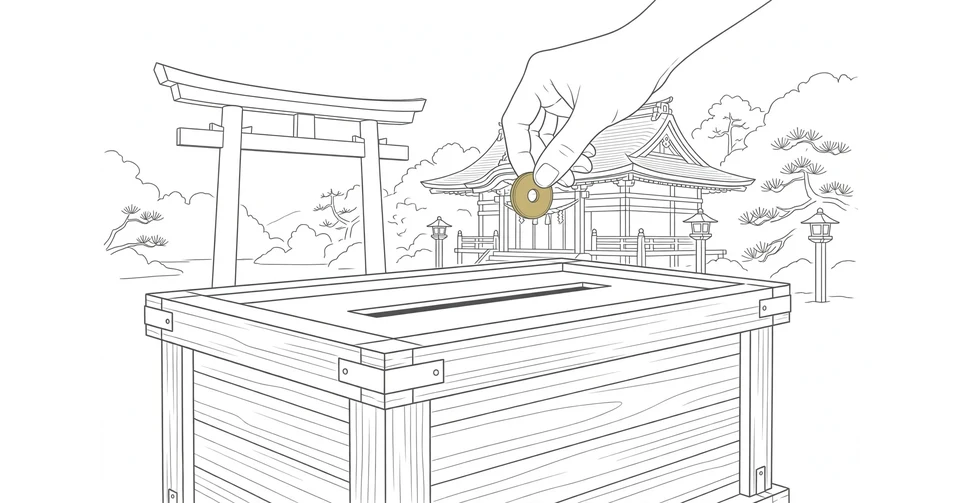
The word itself is simple. Saisen, written with the characters for offering and money, means the money offered at a shrine or temple. Add the polite prefix and it becomes osaisen, the form you will hear most often in guidebooks and polite conversation. The box that receives it is the saisen-bako, the offering box, a heavy wooden chest that stands in front of the hall where visitors pray.
If you have read about the first shrine visit of the year, you may already have met this coin. In an earlier article about hatsumode, the New Year shrine visit, the moment is described in one short line: "At the main hall, you toss a small coin into the offering box, called saisen, as a gesture of thanks." That single sentence hides a whole custom, and this article opens up the story of saisen.
What saisen actually is
Saisen is best understood as a greeting before a conversation. You arrive at the hall, you offer something small, and then you speak, silently, to the kami enshrined inside. The saisen offering comes first because gratitude comes first. Many Japanese visitors begin their prayer with thanks for the past year, for a safe journey, or simply for being able to stand there, and only then add a wish.
That order matters. Saisen is not a fee for a wish, and it is not a purchase. You are not buying good fortune, and a larger coin does not buy a larger result. The sources that explain shrine etiquette agree on this point with unusual consistency: there is no set amount, and what matters is sincerity rather than value. A five yen coin offered with a clear mind is worth more in the logic of the ritual than a thousand yen note offered carelessly.
This is why saisen stays small. The coin is a token, a physical sign that you have paused, turned your attention toward the kami, and marked the moment as different from the rest of your day. Money is used for saisen because it is the most ordinary valuable thing a person carries, and offering a little of it is a way of saying that this moment is worth something to you. The smallness is the point. A grand saisen would turn a quiet act into a display, and a shrine visit is meant to be quiet.
There is also a practical side. Japan has roughly 80,000 Shinto shrines, from grand complexes in city centers to tiny roadside shrines with a single stone lantern. Most of them are open all day, and anyone may walk in. Saisen is the one offering that every visitor can make, whether they are a regular worshipper or a tourist who arrived ten minutes ago. It needs no appointment, no priest, and no knowledge of Japanese. You only need a coin for saisen and a moment of attention.
The saisen-bako and where to find it
The offering box stands in front of the haiden, the hall where visitors pray. At some shrines the main hall and the offering hall are separate buildings, and at others they are combined into one structure. Either way, the box is easy to find, because it sits directly in front of the hall, often under a thick rope with a bell attached, and usually with a queue of people waiting their turn.
The saisen-bako is built to be used hard. Japan Guide describes the layout plainly: visitors make their prayers and offerings at the offering hall, while the sacred object itself rests unseen in the innermost chamber of the main hall. It is a large wooden chest, often darkened by years of hands and weather, with a slatted or grated top that lets coins fall in while keeping hands and rain out. Some boxes have a cloth or a small shelf in front, and at busy shrines the box can be very wide, with several people standing along it at once. During the New Year holidays, when millions of people make their first shrine visit of the year, the boxes at famous shrines are surrounded by crowds, and visitors may have to toss their coin from a few steps back.
The tossing of saisen is worth a word of care. The usual advice is to place the coin gently, or to toss it softly, rather than to throw it hard. The distinction is one of attitude. A gentle drop of saisen shows respect for the place, while a hard throw treats the box like a target. At crowded times, a soft toss from a distance is accepted, because there is no other way to reach the box. The point is not the arc of the coin but the care behind it.
Stand to the side of the center if you can. The middle of the approach path and the space directly in front of the hall are traditionally reserved for the kami, a passage called the seichu. Most visitors step slightly to one side before they pray. Nobody will correct you if you forget, and at a crowded shrine it may not even be possible, but the habit is a good one to know, because it shows that you understand the hall is not a stage built for you.
The order of the prayer after the coin
Saisen is only the first step of a short sequence. Once the coin is in the box, the standard prayer at a Shinto shrine follows a pattern called ni-rei ni-hakushu ichi-rei, which means two bows, two claps, one bow. The full order, as described in shrine etiquette guides, runs like this.
First, offer your saisen. Second, if there is a bell rope hanging from the ceiling of the hall, shake it gently to ring the bell. The sound is understood as a way of announcing your presence and clearing the air before prayer. Not every shrine has a bell, and some disable theirs during peak times, so if there is no rope, simply skip this step.
Third, bow deeply from the waist twice. Fourth, press your palms together and clap twice, with your right hand positioned slightly lower than your left when your hands meet. Fifth, keep your hands pressed together and make your prayer silently. Sixth, bow once more deeply to close.
The whole sequence after saisen takes less than a minute, and it is worth learning before you go, because knowing it removes the anxiety of standing in front of the box wondering what to do next. The sequence exists to help you focus, not to test you. A respectful, unhurried visit matters more than getting every step exactly right, and nobody at a shrine is keeping score.
There is one famous exception to the count. At Izumo Taisha, one of the most important shrines in Japan, visitors clap four times instead of two. Local traditions vary, and when in doubt the best guide is to watch what the people ahead of you do, or to follow any sign posted near the offering box. That advice applies to saisen too. If a shrine has a particular custom, the people who worship there every week will show it to you without a word.
The clapping is one of the clearest signs that you are at a shrine rather than a temple. At a Buddhist temple, saisen is placed in a similar box, but the prayer is different. You bow, join your hands together in front of your chest, pray silently, and bow again at the end. There is no clapping. The difference is worth remembering, because it stops you from clapping in a temple hall where the custom does not belong.
Why five yen is the favorite coin
Ask any guide which coin to offer as saisen, and the answer is almost always the same: five yen. The reason is a piece of wordplay that most Japanese people know from childhood. The word for five yen is go-en, and it sounds exactly like the word go-en, written with different characters, which means a good connection, a fortunate tie, or good fortune. Offering a five yen coin as saisen is therefore a small pun and a small wish at once: may this offering bring a good connection.
The five yen coin, the classic saisen coin, is easy to recognize. It is brass colored, it has a hole in the middle, and it is worth so little that you can carry a handful without noticing the weight. Its low value is part of its charm. Nobody offers five yen as saisen because they cannot afford more. They offer it because the pun makes the offering feel personal, and because the small amount keeps the gesture honest. A coin that costs almost nothing cannot be mistaken for an attempt to buy favor.
The wordplay around saisen does not stop at five yen. Some people offer 45 yen as saisen, because shijuu-go-en sounds like a phrase meaning good connections throughout. Others offer 15 yen, playing on a phrase about sufficient good fortune, or 115 yen, playing on a phrase about good fortune in every way. These combinations are folk customs rather than rules, and they vary by region and by family. They are the kind of thing a grandmother teaches a child, not the kind of thing written on a sign at the shrine. You do not need to memorize them. The five yen coin alone is enough, and it is the choice that most visitors make.
What matters is that the choice of saisen coin is a choice, not an obligation. The pun gives the offering a little warmth and humor, and that is probably why it has lasted so long. Religion in Japan is often quiet and undemonstrative, and the go-en pun is one of the few places where it allows itself a smile. The coin in your pocket becomes a wish for connection, and connection is something most people want, whether they are praying for love, for work, for health, or simply for a good year.
Which coins people use, and the ten yen story
Five yen is the favorite saisen, but it is not the only coin in the box. A fifty yen coin is also a common saisen, and so is a hundred yen coin. Some visitors offer a five hundred yen coin, and at the New Year some offer a thousand yen note. There is no rule against any of these. The shrine accepts whatever is offered, and the kami, by every account, are not counting.
The saisen coin that attracts the most discussion is the ten yen coin. Some people avoid it, because of another piece of wordplay. Ten yen can be read in a way that suggests distance, or a connection that stays far away, and a few guides describe it as unlucky for that reason. Other guides say plainly that any saisen coin is fine and that the ten yen superstition is not something most people worry about. The sources do not fully agree, and that disagreement is itself informative. The ten yen rule, if it is a rule at all, is a folk belief rather than a doctrine, and many Japanese visitors use ten yen coins without a second thought.
My own view is that the disagreement is a useful reminder. Saisen is a folk practice as much as a religious one, and folk practices are full of small local beliefs that contradict each other. The five yen pun is nearly universal, and the ten yen warning is not. If you have a five yen coin for saisen, use it and enjoy the wordplay. If you only have a ten yen coin for your saisen, use that and do not worry. The sincerity of the offering is what the ritual measures, and no kami is going to refuse a prayer because of a pun.
There is a similar caution about throwing money in handfuls. A single coin, or a small number of coins chosen with intention, is the normal offering. Emptying a pocketful of change into the box, or making a show of a large sum, misses the point. The offering is meant to be quiet and personal, and a performance turns it into something else. Keep the gesture small, keep it calm, and step aside for the next person.
Why the amount is small on purpose
The smallness of saisen is not an accident of history. It is the design. A large saisen would change the meaning of the act, turning gratitude into a transaction and prayer into a purchase. A small offering keeps the meaning clear: this is a token, not a payment, and the value lies in the attention you bring to it.
There is a practical wisdom in this too. Because the amount of saisen is small, the offering is open to everyone. A child with a single coin can make the same offering as a company president. A traveler with almost no cash can still take part. The shrine does not sort its visitors by wealth, and the box does not keep a ledger. That openness is part of why the custom has survived so long, and part of why it feels welcoming to people who are not religious at all.
It also protects the visitor from a misunderstanding. If the offering had to be large, people would start to wonder whether a bigger offering buys a better result, and whether a poor person's prayer counts for less. The custom answers that question before it can be asked. Five yen of saisen is enough. The coin is a sign, and a sign does not need to be expensive to be sincere.
This is where saisen differs most sharply from the other money that changes hands at a shrine. Charms, fortune slips, and wooden prayer plaques all have prices, usually a few hundred yen each, and a goshuin stamp typically asks for a small offering of around 300 to 500 yen. Those are purchases or set offerings, and they are handled at the shrine office. Saisen is different. It has no price, no receipt, and no fixed amount, because it is not a purchase at all. It is the one part of a shrine visit that money cannot price.
How a temple offering differs
Visitors often ask whether saisen works the same way at a Buddhist temple, and the honest answer is that it is similar but not identical. Temples also have offering boxes, and visitors place saisen in them before praying. The gesture is the same, and the small amount is the same. What changes is what follows.
At a temple, there is no bell rope to ring in the same way, and there is no clapping. The prayer is made with hands pressed together, a bow at the start, and a bow at the end. Incense is often part of the visit, and the offering may be connected to a specific hall or statue rather than to the kami of a shrine. The saisen money is still a token of respect and gratitude, but the ritual around it belongs to Buddhism rather than Shinto.
The distinction matters because shrines and temples are easy to confuse. Their architecture has blended over the centuries, and many temple grounds contain small shrines while many shrines show Buddhist influence. The reliable signs are the torii gate at the entrance of a shrine and the practice of clapping, which belongs to shrines alone. If you see a torii, you are at a shrine, and the two bow, two clap, one bow pattern applies. If you are at a temple, leave the clapping out and pray with your hands together.
The word osaisen is used at both kinds of place, and the offering box is called a saisen-bako at both as well. The shared vocabulary reflects a shared history. For centuries, Shinto and Buddhism were practiced side by side, often at the same site, and the habit of offering a coin before prayer became common to both. The difference is not in the coin but in the prayer that follows it.
What happens to the money
A natural question follows the saisen coin into the box. Where does it go? The short answer is that it stays with the shrine. Saisen offerings are collected by the shrine and used to maintain the grounds, the buildings, and the festivals that fill the shrine calendar. A shrine is a working place, with roofs to repair, gardens to tend, priests to support, and ceremonies to prepare, and the coins in the box are one of the ways that work is paid for.
The amounts involved are modest. A single saisen is a few yen, and even a busy shrine collects its saisen a coin at a time. Famous shrines at the New Year receive far more, because millions of visitors pass through in a few days, and the boxes fill quickly. But for most shrines, on most days, the offering box holds a quiet accumulation of small coins, each one a separate visit and a separate prayer.
It is worth noting what saisen is not used for. Saisen is not a fee for entry, and it is not a charge for prayer. Nobody is turned away from a shrine for offering nothing, and nobody is asked to pay before they pray. The box is there for those who wish to offer, and the offering is voluntary in the fullest sense. That is why the guides are careful to say that saisen is not an entrance fee. The distinction protects the meaning of the act, and it protects the visitor too.
Some shrines have begun to accept electronic saisen, with a small terminal or a QR code near the box, and the change is worth a moment of thought. A tap on a screen can carry the same intention as a saisen coin, and for a cashless traveler it may be the only option. But something is lost when the saisen coin disappears, because the coin is the part of the ritual you can feel. Its weight, its temperature, the small sound it makes as it lands in the box, all of these are part of the pause that the offering creates. The coin makes the gesture physical, and the physical part is what slows you down. My own preference is to keep a few five yen coins in my pocket when I visit a shrine, not because the shrine needs them, but because the small ritual of choosing a coin and dropping it in is what turns a walk into a visit.
Mistakes visitors make, and how to avoid them
Most mistakes around saisen are small, and none of them will ruin a visit. But a few are worth knowing, because they are easy to avoid and because avoiding them shows respect for the people around you.
The first is treating the saisen box like a wishing well. Tossing a coin hard, aiming from far away, or throwing several coins at once turns a quiet offering into a game. Place the coin gently, or toss it softly if the crowd forces you back. The box is not a target, and the prayer that follows is not a prize.
The second is forgetting the order. Some visitors clap before they offer the coin, or bow after they have already walked away. The order is coin, bell, bow, clap, pray, bow. If you forget, nothing bad happens, but the sequence is designed to move you from arrival to attention to prayer in a calm progression, and following it makes the visit feel settled rather than rushed.
The third is blocking the box. At a busy shrine, it is tempting to linger in front of the hall to take a photograph or to admire the building. The hall is beautiful, and the urge is understandable. But the space in front of the box is a passage for people who have come to pray, and the kindest thing is to make your offering, finish your prayer, and step aside. Take your photograph from the side, after you have moved away from the front.
The fourth is photographing the prayer itself. Do not photograph inside worship halls unless you have confirmed it is permitted, and do not photograph other people while they pray. A shrine is a place of worship first and a sightseeing spot second, and the people around you are entitled to their privacy.
The fifth is assuming that more money means more luck. It does not, and the belief that it might is the one misunderstanding that saisen is designed to prevent. A five yen coin offered with attention is a complete offering. There is nothing to add, and nothing to prove.
The sixth is skipping the purification before the offering. The usual order of a shrine visit is to bow at the torii gate, wash your hands and mouth at the temizuya basin, and only then approach the hall. The water basin is where every shrine visit begins, and the short ritual of rinsing your hands is what prepares you to stand before the kami. The offering comes after that preparation, not before it. If the basin is closed or dry, skip it and continue, because the intention matters more than the procedure, but when the water is running, take the thirty seconds it asks for.
None of these mistakes will get you scolded. Shrine staff are used to visitors who are learning, and other visitors are usually too focused on their own prayer to notice yours. The point of knowing them is not fear but care. A visit goes better when you know what you are doing, and the people around you can tell the difference between someone who is trying and someone who is not.
When the box is full, and when it is empty
There are two moments that show what saisen means better than any explanation. The first is the New Year, when the offering boxes at famous shrines fill with coins and the queues stretch far down the approach. Millions of people make their first shrine visit of the year in the first days of January, and each of them drops a coin into the box. The sound of the coins, the shuffle of the crowd, the ringing of the bells, all of it adds up to a national habit performed at the same time. The boxes are emptied regularly during those days, and the coins are counted and collected by the shrine.
The second moment is the opposite: a small rural shrine on a weekday, with no one else around. The box is there, the hall is quiet, and the only sound is the gravel under your feet. You drop in a single coin, and the sound of it landing is the loudest thing you have heard in minutes. The offering feels larger then, not because the coin is worth more, but because the quiet around it is deeper. The ritual is the same, and the meaning is the same, but the setting changes what you notice about it.
Both moments are worth experiencing, because they show the two sides of saisen. At a crowded shrine, the offering connects you to a crowd of strangers doing the same thing at the same time. At an empty shrine, the offering connects you to the place itself. Either way, the coin is the link, and the link is small on purpose.
A small coin, and what it teaches
Saisen survives because it asks so little and gives so much in return. It asks for a coin and a moment of attention. In exchange, it gives a visitor a way to pause, to offer thanks, and to make a wish without needing to know a prayer, speak a language, or belong to a religion. That openness is rare, and it is worth protecting.
The custom also teaches something that is easy to forget in a country where so much can be bought. Some things are not for sale, and the proof is that the price is left blank. The offering box has no menu, no tariff, and no minimum. It trusts you to decide, and it trusts that your decision will be honest. That trust is part of the ritual, and it is part of why the gesture feels good to perform.
So keep a few five yen coins in your pocket when you visit a shrine. Drop one into the box, ring the bell if there is one, bow twice, clap twice, pray quietly, and bow once more. Then step aside and let the next person do the same. The coin you offered will join thousands of others in the box, and the shrine will use it to keep its roofs sound and its festivals alive. Your prayer will stay with you, and the small habit of offering before asking will stay with you too, long after you have left the shrine grounds behind.
More in Culture & Society
- Goshuin Collects Your Shrine Visits One Red Stamp at a Time
- Hamaya Is the Arrow That Breaks Demons at New Year
- Japanese Gardens and the Quiet Art of Borrowed Scenery
- A Himorogi Is the Shrine Before Shrines Had Walls
- Sakaki Is the Sacred Tree Shinto Cannot Do Without
- Tamagushi Is the Sakaki Branch You Offer to the Kami
Latest posts
- Tenkasu Turns Tempura Scraps Into Japan's Favorite Crunch
- Tanuki Udon Is the Bowl Named After a Raccoon Dog
- Wagyu Beef and Why One Small Steak Costs More Than Dinner
- Inari Sushi Turns Fried Tofu Into a Portable Feast
- Aburaage Is the Fried Tofu Japan Simmers Sweet
- The Miko Who Dance Between People and Kami
- Kotodama and the Spirit That Lives Inside Japanese Words
- Japanese Cheesecake and the Fluffy Cake That Jiggles
- Kagura Is the Sacred Dance Shinto Still Performs
- Norito Give a Shinto Ceremony Its Voice
- The Gohei Wand Carries the Kami Into the Ceremony
- Kitsune Udon Is the Bowl the Fox Would Order
- Origami and How a Single Sheet of Paper Became Japan's Quiet Art
- A Hishaku Is the Bamboo Ladle That Starts Every Shrine Visit
- A Kitsune Is the Fox Messenger Who Guards the Shrines of Japan