Japanese Gardens and the Quiet Art of Borrowed Scenery
· 15 min read
Japanese gardens use stone, water, and gravel to build whole landscapes in small spaces. Here is how to read them, from the rock garden of Ryoan-ji to the Three Great Gardens.
A Japanese garden is not a garden in the way most visitors expect. There may be no flowers at all, and the most famous garden in the country is a rectangle of gravel with fifteen rocks. Yet people stand in front of it for a long time, saying nothing. Japanese gardens work on a different idea of what a garden is for. They are not there to impress you with colour. They are there to slow you down, and to make a small piece of land feel as large as a landscape.
That is the first thing to understand before you visit one. Japanese gardens are built from a small set of elements, stone, water, gravel, moss, and pruned trees, arranged with rules that have been refined for more than a thousand years. Once you know the rules, even the smallest Japanese gardens open up. You start to see the mountain in the rock, the sea in the gravel, and the borrowed hill beyond the wall.
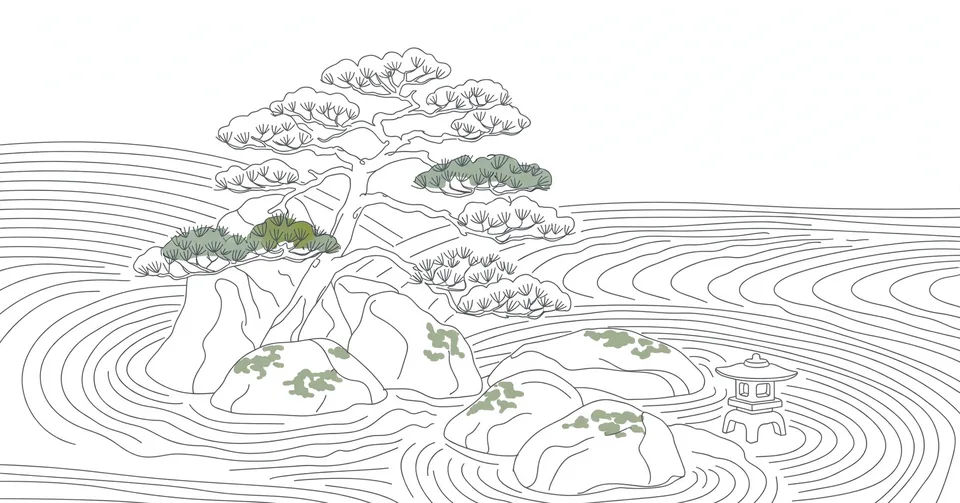
The best way to enjoy Japanese gardens is to treat them as places to look slowly, not as photo stops. Walk the path, sit on the veranda if one is offered, and let the composition do its work. This guide explains Japanese gardens in three kinds, the famous names worth the trip, and the quiet trick called borrowed scenery that makes a walled garden feel endless.
What Makes Japanese Gardens Japanese
The history of Japanese gardens begins in the Heian period, from 794 to 1185, when aristocrats built pond gardens beside their villas in Kyoto. The model came from China, but Japan made it its own, shaped by Shinto reverence for nature and later by Zen Buddhism. By the eleventh century someone had already written a manual about it. The Sakuteiki, or Records of Garden Making, is the oldest surviving gardening treatise in Japan, and among the oldest anywhere in the world. It is conventionally attributed to Tachibana no Toshitsuna, who lived from 1028 to 1094, though that attribution was made by a garden historian in the Meiji era, and the manuscript itself names no author. Its most quoted instruction is to follow the request of the stone, meaning that a rock should be placed where it seems to want to sit, not where a plan says it should go.
Three principles run through Japanese gardens of every period. The first is asymmetry, called fukinsei. Perfect symmetry feels dead and manufactured, so stones are set in odd-numbered groups of three, five, or seven, ponds are irregular, and paths meander instead of running straight. The second is miniaturisation. A cluster of rocks becomes a mountain range, a pond becomes the sea, and a clipped shrub becomes a distant hill. The third is a way of seeing called mitate, seeing one thing as another. White gravel stands for water. A standing stone stands for a waterfall. The garden does not copy a landscape. It suggests one, and your mind completes it.
Underneath all of this sits wabi-sabi, the acceptance of imperfection and impermanence. Moss is allowed to grow on the stones. Wood weathers. A garden is never finished, because the seasons keep rewriting it. That is why the same garden can feel like a different place in spring and in winter, and why regular visitors often have a favourite season rather than a favourite garden. The idea connects closely with ikigai, the Japanese sense of a reason to live, which also values small, repeated, imperfect things over grand gestures.
The elements repeat across Japanese gardens, and learning to spot them changes how you look. Stones come first, and the best gardens are designed around them. Water follows, either real water in a pond or stream, or raked gravel standing in for water. Stepping stones, called tobi-ishi, set the pace of your walk. Stone lanterns, or ishi-doro, began as practical lights and became ornaments. The tsukubai, a low stone basin, is where visitors to a tea garden rinse their hands and mouth before entering the tea room. None of these objects in Japanese gardens is decorative in the Western sense. Each one has a job, and the art is in making the job look effortless.
Three Kinds of Japanese Garden
For a first visit, three words will carry you through almost all Japanese gardens. The first is chisen, a garden with a pond. Water is the main subject. Some pond gardens are built to be walked around, in the stroll style called chisen kaiyu-shiki. Others are built to be looked at from one seated position, in the style called kansho-shiki. Kenroku-en in Kanazawa and the pond garden of Tenryu-ji in Kyoto belong to the first kind, and both are Japanese gardens that reward a slow circuit. You walk a circuit path, and the view changes with every few steps.
The second kind is karesansui, the dry landscape garden. There is no water at all, only gravel and stone. The gravel is raked into patterns that suggest ripples or currents, and the rocks stand as islands or mountains. These Japanese gardens are not meant for walking. They are meant for sitting and looking, usually from the veranda of a temple hall, and for meditation. Ryoan-ji in Kyoto is the ultimate example, and it is also the most misunderstood of all Japanese gardens, as the next section explains.
The third kind is roji, the dewy path, also called the tea garden. This is the garden you walk through to reach a tea room, and it exists to prepare your mind for tea. The path is deliberately narrow and uneven, the lanterns are low, and the planting is quiet and green. Everything is designed to make you slow down before you sit down. The tea garden and the tea ceremony belong together, and if you want to understand one, it helps to know the other. The full ritual is described in the Japanese tea ceremony, where the garden path is the first step of the ceremony, not an afterthought.
One honest caveat is worth stating. This three-way split is a beginner's convenience, not an official classification. A single temple often has a pond garden, a dry garden, and a tea garden all at once. The categories help you know what to do with your feet, walk, sit, or slow down, and that is enough.
The Three Great Gardens
Japan has an official trio, the Three Great Gardens, or Nihon Sanmeien. They are the large stroll gardens built by feudal lords in the Edo period, and each one is worth a day on its own. Kenroku-en in Kanazawa is usually named first. Koraku-en in Okayama and Kairaku-en in Mito complete the set. All three charge only a few hundred yen to enter, which makes them some of the best value sightseeing in the country. For current entry fees and opening hours across the famous gardens, the practical guide at Japan Pocket Guide is worth checking before you travel.
| Garden | City | Entry for adults |
|---|---|---|
| Kenroku-en | Kanazawa | 320 yen |
| Koraku-en | Okayama | 500 yen |
| Kairaku-en | Mito | 320 yen |
Kenroku-en takes its name from the six sublimities, six qualities a perfect garden was supposed to hold at once, spaciousness, seclusion, artifice, antiquity, water, and panoramas. The garden was built by the Maeda lords of Kaga, the richest domain outside the shogun's own lands, and it remains the classic example of what Japanese gardens do best, holding many small scenes inside one walk. Its centrepiece is the pond Kasumi-ga-ike, where an island stands for Horai, the legendary island of eternal youth. In winter, the pine branches are held up by ropes in the practice called yukitsuri, which has become a symbol of Kanazawa itself. If you visit in snow season, go early, before the crowds arrive and the ropes disappear behind camera phones.
Koraku-en in Okayama was begun in 1687 by the lord Ikeda Tsunamasa and completed in 1700. It is a spacious, open Japanese garden with wide lawns, which makes it feel different from the enclosed temple gardens of Kyoto. The name means the garden of pleasure after, a reference to the idea that a ruler should suffer first and enjoy himself only after his people are content. Kairaku-en in Mito was built by Tokugawa Nariaki and opened in 1842. This Japanese garden is famous for its plum blossoms, about 3,000 plum trees in around 100 varieties, which flower in late February and early March. The plum festival there is one of the first signs of spring in eastern Japan, and it draws crowds that the garden's wide paths handle gracefully.
These three Japanese gardens are the best place to learn the stroll garden properly, because they are large enough to walk for an hour without repeating a view. Take the circuit path slowly. The designers placed each turn so that a new composition appears as the old one disappears, a technique that feels like turning the pages of a book. If you rush, you will see lawns and ponds. If you walk at the pace the path suggests, you will see a sequence of small landscapes, each one framed like a painting.
Ryoan-ji and the Garden That Refuses to Explain Itself
No article about Japanese gardens can avoid Ryoan-ji, the Zen temple in Kyoto whose rock garden is the most famous in the world. It is a rectangle of raked white gravel, about 25 metres by 10 metres, holding fifteen moss-covered rocks arranged in five groups, enclosed by a low clay wall. You look at it from the wooden veranda of the abbot's hall, the hojo. There is no water, no flowers, and no path through it.
Here is the remarkable part. What makes Ryoan-ji stand out among Japanese gardens is not its fame but its honesty. The temple that owns the garden says, on its own website, that the intention of its creator is now unknown. It may resemble a Zen koan, it says, but there is nothing to do except leave it to the free interpretation of the viewer. The creator remains, to this day, a mystery. That honesty is rare in tourism, and it is the reason the garden keeps its power. It does not tell you what to think. It gives you fifteen rocks and silence, and lets your mind do the rest.
People have proposed many readings of these fifteen rocks over the centuries, and Japanese gardens invite exactly that kind of open interpretation. Some say the rocks are islands in the sea. Some say they are mountain peaks above clouds. Some say the arrangement is a tigress carrying her cubs across a river. The story most often repeated is that from any single spot on the veranda, you cannot see all fifteen rocks at once, and that at least one is always hidden. Treat that as a story rather than a measured fact, and it still captures something true about the garden. It is designed to be incomplete from every angle, which is exactly the point of wabi-sabi, the beauty of the unfinished. The same sensibility shapes kintsugi, the art of repairing broken pottery with gold, which treats damage as part of an object's history rather than something to hide.
Ryoan-ji is a UNESCO World Heritage site, listed in 1994 as part of the Historic Monuments of Ancient Kyoto. Entry costs 600 yen. Go early in the morning if you can, when the veranda is quiet and the gravel has just been raked. Sit for ten minutes without taking a photograph. The garden rewards patience in a way that a snapshot cannot capture, and the patience is the visit.
Borrowed Scenery, or How to Steal a Mountain
The cleverest trick in Japanese gardens has a name, shakkei, which means borrowed scenery. It means taking a mountain, a stand of trees, or a building that lies outside the garden and treating it as part of the composition. The term first appears in a Chinese garden treatise, the Yuanye, published in 1628, but Japanese designers made it their own. The great example is Tenryu-ji in Arashiyama, in western Kyoto. Its Sogenchi pond garden is attributed to the Zen priest Muso Soseki, who designed it in the fourteenth century to borrow the forested slopes of Mount Arashiyama as its backdrop. The mountains are not in the garden. They are the garden.
Borrowed scenery is why Japanese gardens often feel much larger than they are. A walled garden in the middle of a city can contain a mountain range, because the wall is built low enough, or the planting is arranged carefully enough, that the distant hill becomes part of the view. The technique needs a cooperative landscape, which is one reason so many great gardens sit at the foot of hills. It also needs restraint. The designer must resist the urge to fill every corner, and leave a gap where the outside world can enter.
You can practise spotting borrowed scenery in Japanese gardens anywhere in the country. Stand in a garden and look for the view that seems too good to be inside the walls. Then find the wall, and notice how low it is, or how the trees frame the gap. Once you have seen it once, you will see it everywhere, in temple gardens, in the gardens of old villas, and even in small private gardens glimpsed from a train window. It is a generous idea, and a very Japanese one, that beauty does not need to be owned to be enjoyed. A mountain that belongs to nobody can belong to a garden for an afternoon.
How to Visit Japanese Gardens Well
Japanese gardens reward a little planning, and the seasons matter more here than at almost any other kind of attraction. Spring brings cherry blossom, and the gardens that frame blossom against ponds and pagodas are among the most photographed places in the country. The blossom season is covered in detail in Japan's cherry blossoms, which explains when to go and where the crowds thin out. Autumn is the other great season. Maples turn red and gold, and the evening illuminations at temples like Tenryu-ji and Eikando are worth planning a trip around. The autumn colours are the subject of Japan's autumn leaves, which names the best weeks for each region.
Summer is the season for moss in Japanese gardens. The moss temple, Saiho-ji, in western Kyoto, is covered in more than 120 kinds of moss, and it is one of the most peaceful places in the city. It requires an advance reservation by postcard or through its website, and the visit includes copying a sutra by hand before you are allowed into the garden. That sounds like a chore, and it is the point. The copying slows you down, and the garden feels different afterwards. Winter belongs to the snow gardens. Kenroku-en under snow, with the yukitsuri ropes on its pines, is quietly spectacular, and the crowds are thinner than in spring.
If you want a fuller planning guide to the main garden types and the best seasons for each, this Japan garden tour guide covers the three main types and the top national gardens in one place. A few practical notes will make any visit to Japanese gardens better. Go early, ideally within the first hour after opening, when the gravel has been freshly raked and the light is low. Walk on the paths and sit where sitting is offered, but do not step onto the moss or the gravel. The raked patterns are the gardener's work for the day, and one footprint ruins them. Photography is allowed in most gardens, but tripods are often banned, and some temples ask for silence in the viewing halls. Check the rules at the gate rather than assuming. Entry is cheap almost everywhere, usually between 300 and 600 yen, and the great gardens are far less crowded on weekday mornings than on weekends.
If you are staying overnight near a garden town, consider a ryokan, a traditional inn, where the garden is often part of the stay. Many ryokan have their own small Japanese gardens, and the view from the room is part of what you pay for. The etiquette and the experience are explained in ryokan, Japan's traditional inns. And if the pruned pines in the gardens catch your eye, the same patience applied to a single tree becomes bonsai, the thousand-year art of tiny trees, which is the garden reduced to the size of a pot.
My own view, after years of visiting these gardens as a resident rather than a tourist, is that they are Japan's most honest art form. A temple can impress you with gold. A castle can impress you with size. A garden impresses you with nothing at all, just stones and gravel and the space between them, and it trusts you to bring the rest. That trust is what stays with me after each visit. I have never left a Japanese garden feeling hurried, and I have rarely left one without noticing something small on the way out, a lantern I missed, a stone I had walked past, a view that only appears when you turn around. Japanese gardens do not shout. They wait, and the waiting is the gift.
More in Culture & Society
- Goshuin Collects Your Shrine Visits One Red Stamp at a Time
- Hamaya Is the Arrow That Breaks Demons at New Year
- Saisen Is the Small Coin You Offer Before You Pray
- A Himorogi Is the Shrine Before Shrines Had Walls
- Sakaki Is the Sacred Tree Shinto Cannot Do Without
- Tamagushi Is the Sakaki Branch You Offer to the Kami
Latest posts
- Tenkasu Turns Tempura Scraps Into Japan's Favorite Crunch
- Tanuki Udon Is the Bowl Named After a Raccoon Dog
- Wagyu Beef and Why One Small Steak Costs More Than Dinner
- Inari Sushi Turns Fried Tofu Into a Portable Feast
- Aburaage Is the Fried Tofu Japan Simmers Sweet
- The Miko Who Dance Between People and Kami
- Kotodama and the Spirit That Lives Inside Japanese Words
- Japanese Cheesecake and the Fluffy Cake That Jiggles
- Kagura Is the Sacred Dance Shinto Still Performs
- Norito Give a Shinto Ceremony Its Voice
- The Gohei Wand Carries the Kami Into the Ceremony
- Kitsune Udon Is the Bowl the Fox Would Order
- Origami and How a Single Sheet of Paper Became Japan's Quiet Art
- A Hishaku Is the Bamboo Ladle That Starts Every Shrine Visit
- A Kitsune Is the Fox Messenger Who Guards the Shrines of Japan