Tanuki Udon Is the Bowl Named After a Raccoon Dog
· 25 min read
Tanuki udon is thick udon in a hot dashi broth topped with tenkasu, the crisp scraps of tempura batter, and its name changes meaning depending on where in Japan you order it.
Tanuki udon is thick udon noodles in a hot dashi broth, topped with tenkasu, the crisp golden scraps of fried tempura batter. That is the whole dish in one sentence, and it is also the whole joke. The tanuki is a raccoon dog, a small wild animal from Japanese folklore, and there is no raccoon dog in the bowl. The name is a pun, the topping is fried batter, and the bowl is one of the cheapest, quickest lunches in Japan.
What makes tanuki udon worth a whole article is not the recipe, which is almost too simple to write down. It is the name. Order tanuki udon in Tokyo and you get exactly what this article describes. Order the same words in Osaka and you may get a bowl topped with sweet fried tofu. Order them in Kyoto and you may get something else again. Tanuki udon is a simple bowl with a complicated passport, and the only way to understand it is to learn what the word means in each city.
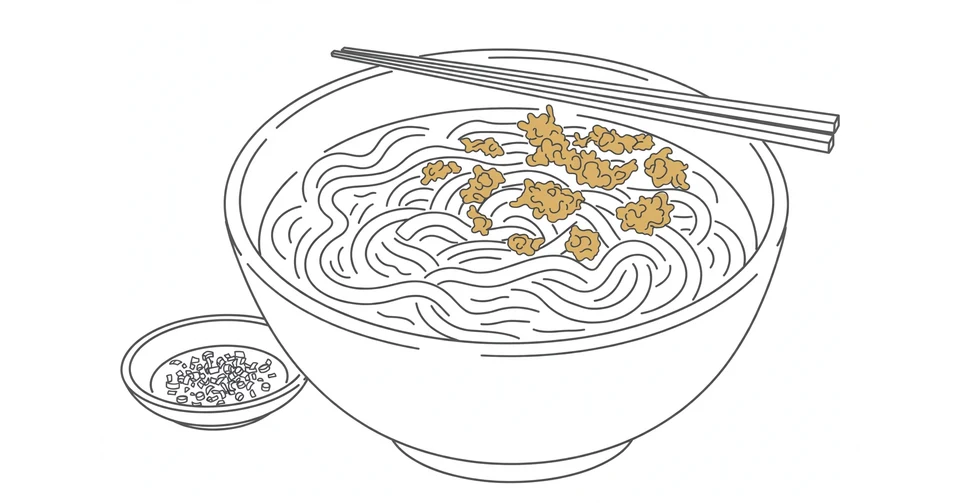
I first ordered tanuki udon because of the animal, the same way I once ordered kitsune udon because of the fox. A menu full of animal names is hard to resist, and the raccoon dog sounded like the funnier of the two. The bowl that arrived looked plain, almost unfinished: pale broth, white noodles, and a scatter of golden crumbs on top. Then I tasted it, and the plainness turned out to be the point. The crumbs were crisp for about a minute, then softened into the broth and gave it a faint fried richness, and the noodles did the rest. I finished the bowl quickly, which is exactly what tanuki udon asks of you, because the crunch does not wait.
Our earlier piece on kitsune udon puts the relationship between the two bowls in one neat sentence: "Tanuki udon is the closest cousin of kitsune udon, and the easiest to confuse with it. Where kitsune udon is topped with fried tofu, the tanuki bowl, named after the raccoon dog, is topped with tenkasu, the crisp scraps of fried tempura batter." That sentence is the starting point for everything that follows. The two bowls are a pair, one soft and sweet, the other crisp and oily, and the animal names are the menu's way of telling them apart. Kitsune udon is the bowl where sweet fried tofu does the work, and tanuki udon is the bowl where fried batter does it instead.
What tenkasu actually is
Tenkasu is the topping that makes tanuki udon what it is, so it deserves a proper introduction. Tenkasu, also called agedama, is small crunchy bits of deep fried flour batter, the scraps left behind when tempura is fried. When a cook dips prawns and vegetables in batter and lowers them into hot oil, loose drops of batter fall into the oil and fry into crisp golden flakes. A careful cook skims them out instead of throwing them away, and those flakes are tenkasu.
The name is honest about what the stuff is. Ten means tempura, and kasu means dregs or lees, the leftover part. Tenkasu is literally tempura dregs, and Japanese cooking has a long habit of turning dregs into food. Nothing is wasted if it still tastes good, and tenkasu tastes good. It is light, airy, faintly oily, and it carries the flavour of fried batter without any filling inside.
You can buy tenkasu ready made. Just One Cookbook notes that premade tenkasu comes in packages at Japanese supermarkets, and that you can also use the leftover crumbs from making tempura at home, or make your own from scratch. If your local shop does not stock it, the homemade version is simple. Food in Japan gives a small recipe for one serving: 30 grams of cake flour, 20 millilitres of water, and a teaspoon of vinegar, mixed until the flour is just incorporated, then dropped into hot oil and fried until golden. A slotted spoon lifts the flakes out, and they keep for about a week in the fridge or two to three months in the freezer.
Tenkasu is not only a noodle topping. It is also mixed into the batter for takoyaki, the octopus balls, and okonomiyaki, the savoury pancake, where it makes the inside lighter and fluffier. It turns up in hiroshimayaki too. In all of these dishes it plays the same role: a little fried crunch and a little extra richness, added cheaply. That cheapness matters. Tenkasu is a way of adding the flavour of frying to a dish without frying anything new, and that is why a bowl of tanuki udon costs so little and still tastes like more than plain noodles in broth.
There is one thing to know about eating tenkasu, and it shapes the whole experience of tanuki udon. The crunch is temporary. The flakes start crisp, then soften as they soak up the hot broth, and after a few minutes they are soft altogether. Some pieces stay crisp while others go soft, so the texture changes with every spoonful. That is not a flaw. It is the dish. But it does mean that tanuki udon rewards fast eating, and that a bowl left sitting on the table for ten minutes is a different, quieter bowl than the one that arrived steaming.
Why the bowl is named after a raccoon dog
The tanuki is a real animal, a small wild canid native to Japan, about the size of a badger, with a masked face and a thick coat. In folklore it is much more than an animal. The tanuki is a shapeshifter and a trickster, a cheerful creature that can change its form, fool travellers, and bring good fortune. Statues of tanuki stand outside shops and restaurants all over Japan, round bellied and grinning, often holding a bottle of sake. They are a wish for prosperity, and a joke at the same time, which suits the animal perfectly.
So why would a bowl of noodles be named after it? Nobody knows for sure, and the honest sources say so plainly. There are two main theories, and both are worth hearing, because each one tells you something different about the dish.
The first theory is a wordplay, and it is the one most often repeated. The Japanese phrase ta-ne nuki means without fillings, or with the main ingredients removed. Tempura udon is topped with a real piece of tempura, a prawn or a vegetable in batter. Take the filling away and all that is left is the batter itself, the tenkasu. So the bowl became ta-ne nuki, noodles without the filling, and over time the words slid together into tanuki. Just One Cookbook calls this a prominent theory, and Food in Japan tells the same story with a practical detail: during the Edo period, the ingredients for tempura udon were so expensive that cooks replaced the tempura with tenkasu, the cheap batter scraps left after frying. The pun stuck, and the cheap bowl got a funny name.
The second theory is simpler and more visual. The golden brown colour of a bowl of tanuki udon, with its scatter of fried crumbs, is said to resemble the coat of a raccoon dog. Food in Japan mentions this theory alongside the first one, and adds honestly that the origin is still unclear. Both theories may be true at once. A pun and a colour can share a name, and Japanese food names often carry more than one joke.
What is known is the time and place. Food in Japan says tanuki udon is widely thought to have originated in the Kanto region, the east of Japan around Tokyo, during the late Edo period, which ran from 1603 to 1868. That makes tanuki udon an Edo dish, born in the same crowded city streets that produced so much of Tokyo's everyday food. It was a working person's lunch then, and it still is one now.
There is also a pleasing symmetry in the name. The fox and the raccoon dog are the two great trickster animals of Japanese folklore, a pair that appears together in stories, statues, and festivals. It makes sense that the two most famous animal noodle bowls would be named after them as a pair too. Kitsune udon takes the fox, tanuki udon takes the raccoon dog, and the menu becomes a small piece of folklore you can eat.
Tanuki udon in Tokyo is not tanuki udon in Osaka
Here is the part of the story that catches travellers out, and it is the most important thing in this article. The word tanuki does not mean the same dish everywhere in Japan. It changes by region, and the change is not small. It is the difference between fried batter and fried tofu, which is the difference between two entirely different bowls.
Food in Japan lays out the split clearly. In Kanto, including Tokyo, people call the usual noodles topped with tenkasu tanuki, whether the noodles are udon or soba. In Kansai, the west of Japan around Osaka and Kyoto, the word works differently. There, tanuki is used for soba only, and it means soba topped with fried tofu. Udon topped with tenkasu is simply called tenkasu udon, not tanuki udon at all. And kitsune udon, the bowl topped with fried tofu, is the Kansai name for what Tokyo would call kitsune either way.
Just One Cookbook gives the same warning city by city, and its version is worth quoting in full because it is so plain. In Tokyo, tanuki refers to tenkasu. In Kyoto, it refers to kitsune udon, and also to kitsune soba with ankake, a thick starchy sauce poured over the ingredients. In Osaka, it refers to kitsune soba, not udon, and udon with tenkasu is simply called tenkasu udon. The cookbook adds, with feeling, that this is totally confusing to people outside of Kyoto, and it is right.
The table below gathers the regional meanings in one place, following the table in the Food in Japan guide.
| City or region | What "tanuki" means there |
|---|---|
| Tokyo, Kanto | Udon or soba topped with tenkasu |
| Osaka, Kansai | Soba topped with fried tofu, never udon |
| Kyoto | Kitsune udon, or kitsune soba with ankake, a thick sauce |
| Hokkaido | Udon or soba topped with kakiage, a mixed tempura fritter |
Our earlier piece on aburaage states the Osaka rule in the plainest possible words, and it is worth repeating here because it is the warning that saves a traveller from ordering the wrong lunch: "in Osaka, kitsune means udon with aburaage and tanuki means the same tofu on soba, while in Tokyo you would get kitsune either way and tanuki means crunchy tempura crumbs." Aburaage is the fried tofu at the centre of this whole confusion, and once you know what it is, the regional split starts to make sense.
Why did the split happen? The short answer is that the two regions built their noodle cultures separately, and the names grew up with them. Kansai cooking, centred on Osaka, prizes a light, pale dashi broth made with kelp and light coloured soy sauce, and its classic noodle topping is the sweet simmered fried tofu that gives kitsune udon its name. When Osaka people put that tofu on soba instead of udon, they needed a second animal name, and tanuki was available. Kanto cooking, centred on Tokyo, leans on a darker broth built on bonito and dark soy sauce, and its classic cheap topping was tenkasu, so tanuki became the name for the batter crumb bowl. Kyoto then added its own twist, a thickened sauce, because Kyoto adds its own twist to almost everything.
The split also explains why the two bowls are so often confused. A visitor who learns the Tokyo meaning in Tokyo and then orders the same word in Osaka is not making a mistake with the language. They are using a word that genuinely means something else two hundred miles to the west. The word did not change. The map did.
I think there is something generous about this confusion, once you know it is there. It is a reminder that Japanese food is not one cuisine but many local cuisines that happen to share a language, and that a noodle menu is a small map of the country. The same word can be a different lunch in a different city, and that is not a problem to be solved. It is a reason to pay attention, and to ask what is in the bowl before you order it.
Tanuki udon against kitsune udon
The closest comparison for tanuki udon is kitsune udon, and the two bowls are best understood side by side. They share the same base, thick udon noodles in a hot dashi broth, and they differ in exactly one thing, the topping. That single difference changes the whole bowl.
Kitsune udon is topped with aburaage, a sheet of deep fried tofu simmered in sweet soy dashi until it turns soft, glossy, and juicy. The tofu is sweet against the salty broth, and when you lift it with your chopsticks a little of the sweet liquid runs back into the soup. Tanuki udon is topped with tenkasu, which is crisp, oily, and savoury, with no sweetness at all. One topping softens the broth, the other sharpens it. One is gentle, the other is crunchy. The kitsune article says it well: one is soft and sweet, the other is crisp and oily, and the animal names are the menu's way of telling them apart.
The table below sets out the difference at a glance.
| Tanuki udon | Kitsune udon | |
|---|---|---|
| Topping | Tenkasu, crisp tempura batter scraps | Aburaage, sweet simmered fried tofu |
| Texture | Crunchy, then softening in the broth | Soft and juicy from the first bite |
| Flavour | Savoury, oily, faintly fried | Sweet against salty broth |
| Animal | Tanuki, the raccoon dog | Kitsune, the fox |
| Home region | Kanto, around Tokyo | Kansai, around Osaka |
Which one should you order? It depends on what you want from lunch. Kitsune udon is the comfort bowl, the one you order when you want something soft and soothing, and its sweet tofu makes it the friendlier choice for a first timer. Tanuki udon is the livelier bowl, the one you order when you want texture and a little fried richness, and it is better eaten fast, while the crumbs are still crisp. I like both, but for different reasons, and I would not call one better than the other. They are two answers to the same question, what to put on top of a bowl of noodles, and the fox's answer is the sweetest while the raccoon dog's answer is the crunchiest.
There is also a practical difference for the cook. Aburaage needs simmering, seasoning, and time. Tenkasu needs nothing but a spoonful from a packet, or the scraps from the last time you fried tempura. That is why tanuki udon is the quicker bowl to make at home, and the cheaper bowl to buy at a noodle counter. It asks less of everyone, and it still delivers a proper lunch.
Tanuki udon against tempura udon
The second comparison worth making is with tempura udon, because the two bowls look alike at first glance and come from the same idea. Both involve fried batter. The difference is what the batter is attached to.
Tempura udon is topped with a real piece of tempura, usually a large prawn or a slice of sweet potato or a piece of fish, fried in batter and laid across the noodles. It is a substantial topping, and it costs more, because the prawn or vegetable inside it costs more. Tanuki udon is topped with the batter alone, with no filling inside it, which is exactly what the ta-ne nuki theory says. The crumbs are the leftover of tempura, not tempura itself.
That makes tanuki udon the lighter and cheaper of the two, but not the lesser one. A prawn tempura is rich and filling, and it turns a bowl of noodles into a full meal. Tenkasu is light and scattered, and it seasons the broth rather than dominating it. Tempura udon is a bowl you order when you are hungry and want something generous. Tanuki udon is a bowl you order when you want noodles first and frying second, and you want lunch to be quick.
There is also a third cousin worth knowing. In Hokkaido, the northern island, the word tanuki can mean noodles topped with kakiage, a mixed tempura fritter made from chopped vegetables and small prawns fried together in a loose patty. Kakiage is more substantial than tenkasu and less neat than a single piece of tempura, and it sits somewhere between the two. If you order tanuki udon in Hokkaido and get a fritter instead of crumbs, you have not been given the wrong dish. You have been given the local one.
The lesson in all of these comparisons is that Japanese noodle menus are built from a small set of parts combined in different ways. Noodles, broth, and one topping. Change the topping and you change the name, the price, and the character of the bowl. Tanuki udon is the version where the topping is almost nothing, a handful of crumbs, and the fact that it became a classic anyway says something about how much Japan values the small things done well.
How to order tanuki udon without getting the wrong bowl
Ordering tanuki udon is easy, as long as you know where you are. The rules below are simple, and they will save you from the most common mistake a visitor makes with this dish.
First, remember the region. In Tokyo and the east, tanuki udon means what this article describes, udon with tenkasu. In Osaka, the same words on a menu may mean soba with fried tofu, and the udon with tenkasu will be listed as tenkasu udon. In Kyoto, the word may mean kitsune udon with a thick sauce. The safest habit is to read the topping, not the animal. If the menu shows a picture, look at the topping. Crumbs mean tenkasu. A golden sheet of tofu means aburaage.
Second, say the topping out loud if you are unsure. Asking for tenkasu udon instead of tanuki udon removes all doubt in Osaka, and it works in Tokyo too, where everyone will understand what you mean. The staff at a noodle counter hear this question often, and nobody will think less of you for asking. It is better to ask than to eat the wrong bowl in silence.
Third, expect a ticket machine. Many cheap noodle shops in Japan, especially the standing counters near stations, use a machine where you buy a ticket and hand it to the staff. Tanuki udon is usually one of the cheapest buttons on the machine, near the plain kake udon, and it is a good choice when you are in a hurry. The bowl arrives fast, often within a minute or two, because there is almost nothing to cook. The noodles are already boiled, the broth is already hot, and the topping is a spoonful of crumbs.
Fourth, eat it quickly. This is not a bowl to linger over while you check your phone. The tenkasu softens in the broth within minutes, and the crispness that defines tanuki udon is gone once it does. Slurp the noodles, spoon up the broth, and finish while the crumbs still have some bite. Slurping is normal and expected, and it cools the noodles as you eat. Nobody will mind the noise. In a noodle shop, the noise is part of the meal.
Fifth, know the cold version. In summer, many shops serve hiyashi tanuki udon, chilled tanuki udon, with the noodles cooled in an ice bath and served with a cold dipping sauce or a small amount of cold broth. Just One Cookbook describes it as a perfect lunch on hot days, refreshing and easy to prepare, and its recipe is a good guide to the home version. The cold bowl keeps the same topping, tenkasu, and adds summer vegetables like cucumber and tomato. If you visit Japan in July or August, the cold version is the one to try, and it is just as much tanuki udon as the hot bowl.
A last practical note: tanuki udon is a small, light lunch, not a feast. The broth is mostly dashi and water, the noodles are wheat and salt, and the topping is a spoonful of fried batter. According to the Food Composition Database of Japan's Ministry of Education, Culture, Sports, Science and Technology, a 400 gram serving of tanuki udon comes to about 352 calories, with about 10 grams of protein, about 4 grams of fat, and about 65 grams of carbohydrate. Those are modest numbers, and they match the character of the dish. It is a bowl that fills you without weighing you down, which is exactly what a working lunch should do.
Making tanuki udon at home
Tanuki udon is one of the easiest Japanese noodle dishes to make at home, and that is part of its charm. There is no topping to simmer, no tempura to fry, and no long cooking time. If you have noodles, broth, and tenkasu, you have the dish. The Just One Cookbook recipe for cold tanuki udon shows how little work is involved, and it is worth reading in full before you cook.
The cold version serves two people and takes about fifteen minutes in total, ten minutes of preparation and five minutes of cooking. The ingredients are simple: a third of a cup of mentsuyu, the concentrated noodle soup base, diluted two to three times with water; two servings of udon noodles, about 500 grams of frozen noodles or 180 grams of dried noodles; and for the topping, two teaspoons of dried wakame seaweed, a sliced green onion, a julienned cucumber, two inches of grated daikon radish, half a cup of tenkasu, a soft or hard boiled egg cut in half, four cherry tomatoes, a quarter teaspoon of toasted white sesame seeds, and a little wasabi on the side.
The method is four steps. First, prepare the toppings: rehydrate the wakame, slice the green onion, julienne the cucumber, and grate the daikon. Second, boil the udon noodles, then cool them in an ice bath and drain them well. Frozen Sanuki udon needs only about a minute in boiling water, which is one reason it is the recipe's favourite. Third, make the sauce by diluting the mentsuyu and adding ice cubes to keep it cool. Fourth, serve the noodles with the toppings arranged on top, and pour the sauce over at the table. That is the whole recipe, and it is hard to get wrong.
The hot version is even simpler, and the Food in Japan guide to tanuki udon gives a compact recipe for two people. The noodle soup is 350 millilitres of water with two tablespoons of mentsuyu and a teaspoon of dashi granules, brought to a boil in a pan. The noodles go into the same pan, and the bowl is served with about 10 grams of tenkasu, a gram of dried wakame soaked for ten to fifteen minutes, and half a boiled egg. The whole thing takes about as long as boiling the noodles, which is to say almost no time at all.
Three pieces of advice make the difference between a decent bowl and a good one. First, add the tenkasu last, at the very moment of serving, and eat the bowl right away. The crumbs lose their crunch fast in hot broth, and the timing matters more than any other detail. Second, buy the best noodles you can find. Frozen Sanuki udon is chewier and less doughy than many dried options, and it will not break as easily in the pot. Third, do not skip the garnishes. A little green onion, a little wakame, and half an egg turn a plain bowl into a proper lunch, and they cost almost nothing. The tenkasu is the name of the dish, but the garnishes are what make it feel like a meal.
If you cannot find tenkasu at your local shop, you can make it yourself with the simple recipe given earlier, or you can use the leftover crumbs from the next time you fry tempura. Just One Cookbook makes the point bluntly: you can skip the tenkasu entirely and still enjoy the noodle soup, but you cannot call it tanuki, because the word refers to the tenkasu. The topping is the dish. Without it, you have plain udon in broth, which is a fine lunch, but it is not tanuki udon.
Where to eat tanuki udon
The honest answer to where to eat tanuki udon is that you can eat it almost anywhere in Japan, from department store food halls to standing noodle counters to convenience stores, and most versions will be good. It is an everyday dish, not a destination dish, and that is a compliment. But a few places are worth a deliberate visit, because they show what the dish can be when a shop takes it seriously.
The Food in Japan guide recommends Daitsune Udon in Ginza, Tokyo, a shop that has operated for five generations since the Edo period and uses carefully chosen vegetables delivered directly from the market, with no chemical additives. Its address is 7-15-17 Daitsune Building, first floor, Ginza, Chuo, Tokyo, and its phone number is 03-3541-2227. It opens Monday to Friday from 11:00 to 15:00 and from 17:00 to 21:00, and on Saturdays and holidays from 11:00 to 15:00. It is busy at lunch, as a good Ginza noodle shop should be, so go early or go late.
Kagawa Prefecture, on the island of Shikoku, is the home of Sanuki udon, and it is worth a visit for any noodle lover. The prefecture has more than 600 udon shops, and it celebrates Udon Day on the 2nd of July, a date that comes from Hangesho, the traditional day that marks the end of rice planting season. Kotohira shrine, one of the prefecture's famous sights, has 785 steps from its entrance to the main hall, and udon shops line the way up. Musashi, a well known Kagawa udon restaurant, is one of the names the Food in Japan guide suggests, and it is a good starting point if you are in Takamatsu.
Kyoto has its own udon culture, and the same guide names three shops there: Taiya, a popular handmade udon restaurant with long queues even on weekdays; Shofukutei, a small and cosy shop that serves what the guide calls the most original Kyoto taste; and Osakaya, a casual shop that serves Tokyo, Osaka, and Nagoya styles and offers its menu in five languages, which is convenient for visitors. If you eat tanuki udon in Kyoto, remember the regional rule: the word may mean something different there, so look at the topping before you order.
Prices and hours change, so treat the details in this article as a starting point and check the shop before you go. That is true of every restaurant recommendation, and it is especially true of small noodle shops, which may change their hours with the seasons. The bowl itself, though, does not change much. Wherever you eat tanuki udon, you will get noodles, broth, and a scatter of golden crumbs, and the pleasure is in how little fuss surrounds them.
A bowl that rewards eating fast
Tanuki udon has lasted for more than two centuries because it does three things at once, and few dishes manage even one of them. It is cheap, it is quick, and it is honest. The cheapness comes from the topping, which is the leftover of another dish. The quickness comes from the same place, because there is almost nothing to cook. The honesty comes from the name, which is a joke that the dish tells about itself: noodles without the filling, named after a trickster animal, served without pretence.
There is something else here that I keep coming back to. Tanuki udon is a dish built from scraps, and it never pretends otherwise. It does not dress its topping up as something grand. It calls it dregs, fries it crisp, and puts it on noodles. That is a generous way to cook, and a wise one, because it turns waste into flavour and makes a proper lunch out of almost nothing. Most of the food we love begins that way, with someone looking at what is left over and deciding it is good enough to serve.
So order tanuki udon for the raccoon dog if you like, or order it because you are hungry, or order it because the crumbs are still crisp and the broth is still hot. Any of those reasons will do. A bowl of tanuki udon does not ask much of you. It asks only that you eat it while it is hot, finish the broth, and remember that the trickster animal on the menu is a promise, not a warning: this bowl will be simpler than you expect, and better than it looks.
More in Food & Travel
- Wagyu Beef and Why One Small Steak Costs More Than Dinner
- Inari Sushi Turns Fried Tofu Into a Portable Feast
- Aburaage Is the Fried Tofu Japan Simmers Sweet
- Japanese Cheesecake and the Fluffy Cake That Jiggles
- Kitsune Udon Is the Bowl the Fox Would Order
- Tokyo Disneyland and Why Japan Loves It Differently
Latest posts
- A Himorogi Is the Shrine Before Shrines Had Walls
- Sakaki Is the Sacred Tree Shinto Cannot Do Without
- Tamagushi Is the Sakaki Branch You Offer to the Kami
- The Miko Who Dance Between People and Kami
- Kotodama and the Spirit That Lives Inside Japanese Words
- Kagura Is the Sacred Dance Shinto Still Performs
- Norito Give a Shinto Ceremony Its Voice
- The Gohei Wand Carries the Kami Into the Ceremony
- Origami and How a Single Sheet of Paper Became Japan's Quiet Art
- A Hishaku Is the Bamboo Ladle That Starts Every Shrine Visit
- A Kitsune Is the Fox Messenger Who Guards the Shrines of Japan
- Temizuya Is Where Every Shrine Visit Begins With Water
- Shide Are the Paper Lightning That Marks a Sacred Space
- Yabusame Turns Horseback Archery Into a Moving Prayer
- Walking Through Senbon Torii Feels Like Entering Another World