Hamaya Is the Arrow That Breaks Demons at New Year
· 19 min read
A hamaya is the demon-breaking arrow bought at shrines during the Japanese New Year, a charm that guards the home and points the year ahead in the right direction.
On the first morning of January, among the food stalls and the long queues at a shrine, there is a small stall selling arrows. They are not weapons. They are hamaya, white-feathered arrows with blunt tips, sold as charms for the year ahead, and they are one of the most quietly meaningful things you can buy at the Japanese New Year.
A hamaya does not promise wealth or luck in the lottery. It promises something simpler and, I think, more honest. It promises that the year ahead will be watched over, that bad luck will be kept at the door, and that the person who carries it home has aimed at something worth aiming at. That is why the hamaya has lasted for centuries, and why it still sells out at shrines every January.
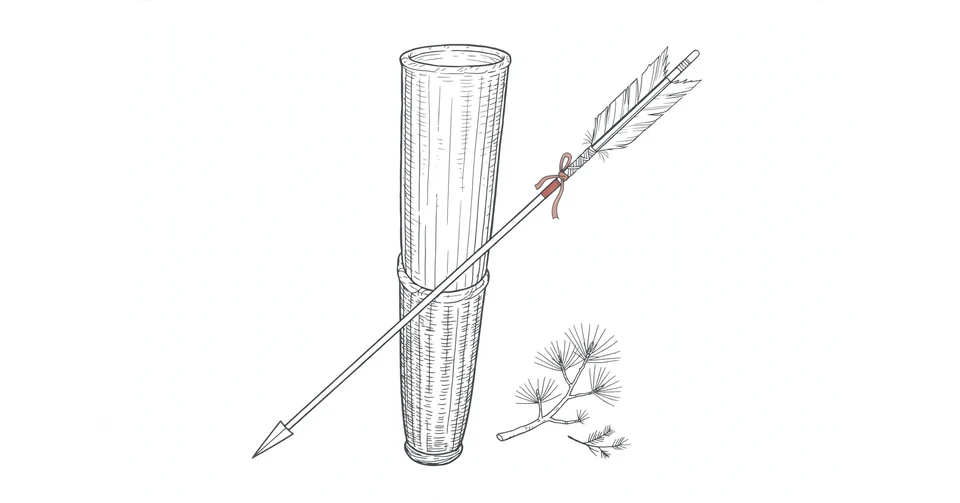
This is the story of that arrow: what its name means, where it came from, why parents once gave one to a baby boy, how it is displayed at home, and what happens to it when the year is over. The hamaya is small enough to hold in one hand, and its story reaches back to archery rituals, New Year divination, and the oldest idea in Japanese folk belief, that evil can be turned away by a straight shot.
What hamaya means
The word hamaya is written with three characters, and each one does part of the work. Ha means to break or destroy. Ma means demon or evil spirit. Ya means arrow. Put together, hamaya means the arrow that breaks demons, or the evil-destroying arrow, and the name is a job description rather than a decoration.
That plain meaning matters, because it tells you what the object is for. A hamaya is not a souvenir in the ordinary sense, and it is not a toy, even though it looks like one. It is a tool with a single purpose, to break and clear away the evil that might enter a home in the year ahead. The arrow is the instrument, and the breaking is the point.
The bow that goes with it is called a hamayumi, the demon-breaking bow. In the old custom, the arrow and the bow were a pair, and the pair was given together. Today most people buy the hamaya on its own, and the bow is understood to be held by an unseen hand, by the kami, or by the priest who blessed the arrow. The arrow alone is enough, because the person who owns it is the one who aims it.
One detail tells you everything about the spirit of the hamaya. Its tip is not sharp. A real arrow is made to pierce, but a hamaya is made to purify. It is not meant to harm a person or an object. It is meant to break apart evil intentions and bad fortune, and to leave the living world untouched. That blunt tip is the difference between a weapon and a charm, and it is why a hamaya can sit in a family living room without frightening anyone.
The name also explains why the hamaya belongs to the New Year. The turn of the year is the moment when the old year is weakest and the new year is still unformed, and in Japanese folk belief that is when evil finds its opening. An arrow that breaks demons is exactly what you want at the threshold of a new year, standing guard while the year is still young.
Where the hamaya comes from
The hamaya did not start as a shop item. It started as an arrow used in a New Year archery ritual, and its history is the history of archery in Japan, which was once a sacred skill as much as a martial one. Long before bows and arrows were only weapons, they were believed to have the power to drive away evil spirits, and that belief shaped the rituals of the New Year.
One of the oldest of these rituals was called hamauchi, the demon-breaking shoot, held on New Year’s Day as a form of divination. In this ritual, a target about one meter across, made of straw rope, was set up in front of children holding bows and arrows, and the children were asked to shoot through its center. The bow and arrow used in the ritual were then brought home as a charm for the child’s growth, and that, according to the tradition, was the beginning of the hamaya as a good luck charm.
A related ceremony was jarai, an archery event held on New Year’s Day to test skill with the bow. The arrows used to shoot at the targets were called hama-ya, and the bows were called hama-yumi. The word hama was a homophone for the characters meaning to destroy evil, so the two meanings merged. The arrows of a shooting contest became the arrows that break demons, and the custom of giving bow-and-arrow charms to families with boys at New Year was born.
Archery never left the shrine. At Fushimi Inari in Kyoto, there is a sacred archery festival called busha sai, and at Matsuo Taisha, also in Kyoto, an archery event called hosha shiki is held on January 10 and 12. In that ceremony, paper streamers are placed before the stage, archery targets are hung up with the character for demon written on their backs, and the archers shoot first toward the northeast, then to the four quarters, then heavenward. The target wears the face of the demon, and the arrow does the work of breaking it. A detailed account of these sacred archery festivals, and of the hamaya itself, is given on the Green Shinto page on sacred arrows.
I find this part of the story the most moving. The hamaya is not a charm that was invented for tourists. It grew out of something people actually did, standing in the cold in January, drawing a bow, and shooting at a target that stood for everything they feared. The charm you buy at a shrine today is the small, quiet descendant of that shot.
Why people buy a hamaya at hatsumode
Hatsumode is the first visit to a shrine or temple after the year turns, and it is when most hamaya change hands. The visit itself is simple. You walk in, you pray for health and safety and good fortune, and on the way out you stop at the stalls around the main hall. The hamaya is one of the three classic purchases of hatsumode, alongside the omamori amulet and the omikuji fortune slip, and it is the one that stays visible in the home all year.
The reason is practical as well as spiritual. An omamori goes into a bag or a pocket, and an omikuji is folded into a wallet or tied to a rack at the shrine. A hamaya goes on display, in the living room or near the entrance, where the whole household can see it every day. It is a charm that does its work in public, and its presence is a daily reminder of the prayer made at the start of the year.
The stalls sell hamaya in many sizes and designs. Some are plain, with a white feathered shaft and a small wooden plaque. Some carry the design of the year’s zodiac animal. Some are large and decorative, meant for a family that wants the arrow to be a centerpiece. None of them is expensive, and none of them is required. People choose the one that fits their home, and the choice itself is part of the ritual.
What surprises first-time visitors is how matter-of-fact the purchase is. There is no long ceremony at the stall, and nobody will ask you to prove your faith. You pay, you receive the arrow, and you carry it home in a paper bag. The blessing, if you want to call it that, is already in the object, placed there by the shrine. The rest is up to you, and the hamaya asks for very little: a place on the wall, and a year of attention.
The full picture of that first visit, the crowds, the stalls, and the custom of buying new charms and disposing of the old ones, is described in the article on Japan meets the New Year at hatsumode. The hamaya belongs to that morning, and it is hard to understand the arrow without understanding the walk that leads to it. The hatsumode season, and the way visitors buy lucky charms for a fortunate new year and dispose of the previous year’s charms, is also described on the Japan Guide page on visiting Japan during New Year.
The first New Year of a baby boy
The oldest and most touching use of the hamaya has nothing to do with adults buying a charm for themselves. It has to do with a baby boy and his first New Year. From the Edo period to the early Meiji period, arrows were given as gifts to celebrate the first New Year of a male baby’s life, frequently in a set together with a pair of decorative bows called hamayumi.
The gift was a wish for the child’s healthy growth. A baby boy’s first New Year was a milestone, a sign that the child had survived the fragile first months of life, and the family marked it with an object that said, plainly, may nothing evil touch this child. The arrow and the bow were a promise from the adults around him, that they would stand guard while he grew.
The custom of selling the arrow alone is thought to be a later abbreviation of this older gift. The bow dropped away, the arrow stayed, and the gift became something anyone could buy for themselves or for their home. But the original meaning never quite disappeared. Even today, a hamaya bought for a newborn’s first New Year carries the same wish, and relatives still give one to a family with a new baby boy.
There is also a wider version of the same custom. Hamaya and hamayumi are given to newborns for their hatsuzekku, the first annual festival, which for a boy is Children’s Day and for a girl is Hinamatsuri. The arrow is not only a New Year object. It is a gift for the beginnings of a life, and its job is the same in both cases: to guard the child as he or she grows.
I think there is something wise in the way this gift works. It does not give the child anything he can use, and it does not ask him to understand it. It simply places a guardian in the room where he sleeps, and it tells the adults in the house that their job is to protect what is small and new. A society that marks a baby’s first New Year with an arrow that breaks demons is a society that takes the safety of its children seriously, and that is a value worth keeping.
How to display a hamaya at home
Buying a hamaya is only half of the custom. The other half is where you put it, and the rules are simple, practical, and a little poetic. The arrow is displayed on the household altar, in the tokonoma alcove, at the entrance, or in the living room, in other words, in a place the family sees every day and a place where the arrow can watch over the home.
There is no single correct direction for the arrow in an ordinary home, but there are a few guidelines that most people follow. The tip should not point up toward the sky, out of respect for the deities above, and the arrow should be kept as high above head height as possible. Some guides suggest pointing the tip toward the unlucky direction of the year, which is the direction opposite the year’s zodiac sign, so that the arrow faces the bad luck it is meant to break. Others say the direction does not matter, and what matters is that the arrow is placed with care and respect.
The most common spot, in my experience, is near the entrance or on a high shelf in the living room. The entrance makes sense, because that is where the outside world comes in, and the arrow stands guard at the threshold. The living room makes sense too, because that is where the family gathers, and the arrow watches over the people it protects. Either way, the hamaya is not hidden in a drawer. It is put where it can be seen, because a guardian that nobody sees is a guardian nobody remembers.
A hamaya is also used beyond the home. At the roof-raising ceremony of a newly built house, hamaya and hamayumi are stood at the northeast and southwest corners, the directions thought particularly open to evil influence. The northeast is called kimon, the demon gate, the direction from which demons are traditionally believed to come, and the arrow is placed there to block the way. A new house, like a new year, is a beginning, and beginnings are guarded.
If you buy a hamaya and you live outside Japan, the same simple rules apply. Put it high, put it where you can see it, and do not point it at the ceiling. The rest is a matter of taste. The arrow does not need a shrine to do its work. It needs a home that takes it seriously.
What happens to last year's hamaya
A hamaya is a charm for the year in which it was bought, and only for that year. When the next New Year arrives, the old arrow is returned to the shrine, and a new one takes its place. That yearly exchange is one of the quiet engines of hatsumode. It gives people a reason to return, and it gives the shrine a way to mark the passing of the year.
To return an old hamaya, you look for the nosatsusho, the collection point for old charms, usually a small wooden structure near the shrine office or the main hall. You place the old arrow there, along with last year’s omamori and any other charms you are returning, and you leave it in the shrine’s care. The old charms are then burned at a later date in a ceremony called otakiage, a respectful burning in which offerings are returned to heaven.
Many shrines hold the otakiage as part of a fire festival on January 15, often called dondoyaki and in some regions dontosai. That date is a natural deadline for returning the old arrow, but it is not a strict one. Shrines accept returned charms all year round, so if you miss the January fire festival, you can still bring the old hamaya back whenever you next visit. The important thing is that the old arrow is returned rather than thrown away, because it was a sacred object, and it deserves a respectful end.
There is one rule worth knowing. Shrine items should be returned to a shrine, and temple items to a temple. If you cannot return the arrow to the shrine where you bought it, another shrine will accept it. The shrine that receives it will treat it with the same respect, and the burning will happen just the same.
For visitors who cannot return to Japan the following year, there is a gentler option. The arrow can be wrapped in white paper, sprinkled with a pinch of coarse salt to purify it, and then burned or disposed of with gratitude. The paper and the salt are a small purification, and the gratitude is the real point. A hamaya that guarded your home for a year should not be tossed out like rubbish. It should be thanked and let go, and that is true whether the letting go happens at a shrine fire or at home.
Hamaya, omamori, and omikuji: three different jobs
At a hatsumode stall, the hamaya sits beside two other charms, and it is worth knowing how the three differ, because they do three different jobs. The omamori is a small cloth amulet, carried on the person or kept in a bag, believed to carry a little divine protection with it. The omikuji is a paper fortune slip, drawn at random, that tells you what the coming year may hold. The hamaya is an arrow, displayed in the home, that breaks demons and guards the house.
The omamori protects a person. The omikuji tells a person something. The hamaya protects a place. That is the simplest way to remember the difference, and it explains why so many people buy all three. A person can carry protection, read a fortune, and guard a home, and none of the three makes the others unnecessary.
The omamori and the hamaya also share the yearly rhythm of return. Both are said to last about a year, and both are brought back to the shrine to be burned and replaced. The omikuji is different. If the fortune is good, you keep it. If it is bad, you tie it to a rack or a tree at the shrine and leave the bad luck behind. The full story of the fortune slip, how it is drawn and what its grades mean, is told in the article on omikuji tells your fortune on a slip of paper.
| Charm | What it is | What it does | Where it lives |
|---|---|---|---|
| Hamaya | A ceremonial arrow | Breaks demons and guards the home | On display in the house |
| Omamori | A small cloth amulet | Carries protection for a person | In a bag or pocket |
| Omikuji | A paper fortune slip | Tells what the year may hold | Kept, or tied at the shrine |
The table makes the division look neat, and in practice the three blur together in the best way. A visitor who buys a hamaya, draws an omikuji, and takes home an omamori is not shopping for three separate kinds of magic. They are buying a single thing, a good beginning, in three different forms. The arrow guards the house, the amulet guards the person, and the fortune gives the year a story. Together they cover the year from three directions, and that is why the three have survived side by side for so long.
The arrow as a wish aimed at the year ahead
There is a second meaning of the hamaya that has nothing to do with demons, and it may be the reason the arrow has survived into modern Japan. An arrow is the oldest image of aiming. It flies in a straight line toward a single point, and it either hits the mark or it does not. A hamaya, bought at the start of the year, is a wish that has been given a direction.
That is why the hamaya is often described as a symbol of aiming high in the year ahead. The person who buys one is not only asking for protection. They are choosing a target, a goal for the year, and placing an arrow in their home that points toward it. The arrow does not do the aiming for you. It reminds you that you have already aimed, and that the year is the distance between the bow and the target.
The archery rituals behind the hamaya make the same point. In the old New Year shoot, children aimed at a straw target and tried to pierce its center, and the result was read as a sign of the year to come. In the hosha shiki at Matsuo Taisha, archers shoot at a target marked with the character for demon, and the shot is the prayer. The arrow is a wish that has been given a form, and the form is honest. It admits that a wish needs effort, that it travels a distance, and that it can miss.
I think that honesty is what makes the hamaya worth keeping in a modern home. A charm that promised success without effort would be a lie, and people would stop believing in it. A hamaya promises only that the year has a direction and a guardian, and it leaves the rest to the person who bought it. That is a fair promise, and it is one a person can keep.
There is also a quiet lesson in the way the arrow is used. You do not shoot a hamaya. You display it. The shot has already been made, by the priests, by the archers, by the tradition itself, and what you keep at home is the result of that shot, standing guard over the year. The work of aiming belongs to you, and the work of guarding belongs to the arrow. That division of labor feels right to me, and it is a good way to begin a year: aim carefully, then let the arrow stand watch.
A small ritual worth keeping
The hamaya asks very little of the person who buys it. It asks for a place on a high shelf, a little respect, and a return to the shrine when the year is done. In exchange, it offers a year of quiet protection and a daily reminder that the year has a direction. That is a good bargain, and it is why the arrow has outlasted so many louder and flashier New Year customs.
If you are in Japan in early January, the hamaya is easy to find, and easy to understand. Go to a shrine, make your prayer, and look at the stall where the arrows are standing. Choose the one that fits your home. Carry it back carefully, put it high where you can see it, and let it stand guard over the year. When the next January comes, bring it back, thank it, and buy a new one. That is the whole ritual, and it has been enough for generations.
The hamaya is a small object with a large idea inside it, that evil can be broken, that a year can be aimed at like a target, and that a home can be guarded by something as simple as an arrow. Hold that idea for a year, and see how the year goes. The arrow will not do the work for you, but it will remind you, every morning, that the work has a direction. That is what the demon-breaking arrow has always done, and that is why it is still worth buying.
More in Culture & Society
- Goshuin Collects Your Shrine Visits One Red Stamp at a Time
- Saisen Is the Small Coin You Offer Before You Pray
- Japanese Gardens and the Quiet Art of Borrowed Scenery
- A Himorogi Is the Shrine Before Shrines Had Walls
- Sakaki Is the Sacred Tree Shinto Cannot Do Without
- Tamagushi Is the Sakaki Branch You Offer to the Kami
Latest posts
- Tenkasu Turns Tempura Scraps Into Japan's Favorite Crunch
- Tanuki Udon Is the Bowl Named After a Raccoon Dog
- Wagyu Beef and Why One Small Steak Costs More Than Dinner
- Inari Sushi Turns Fried Tofu Into a Portable Feast
- Aburaage Is the Fried Tofu Japan Simmers Sweet
- The Miko Who Dance Between People and Kami
- Kotodama and the Spirit That Lives Inside Japanese Words
- Japanese Cheesecake and the Fluffy Cake That Jiggles
- Kagura Is the Sacred Dance Shinto Still Performs
- Norito Give a Shinto Ceremony Its Voice
- The Gohei Wand Carries the Kami Into the Ceremony
- Kitsune Udon Is the Bowl the Fox Would Order
- Origami and How a Single Sheet of Paper Became Japan's Quiet Art
- A Hishaku Is the Bamboo Ladle That Starts Every Shrine Visit
- A Kitsune Is the Fox Messenger Who Guards the Shrines of Japan