A Himorogi Is the Shrine Before Shrines Had Walls
· 22 min read
A himorogi is a sacred space made from a sakaki branch, a rope, and a fence of green branches, and it is the oldest form of shrine in Japan.
A himorogi is a sacred space in Shinto, a small square of ground set apart for a ritual, with a branch of sakaki standing at its centre and a sacred straw rope marking its edge. There is no roof, no hall, and no permanent building. For the length of the ceremony, that square of ground is the shrine. When the rite ends, the rope comes down, the branch is taken away, and the ground goes back to being ordinary land. A himorogi is the simplest answer Shinto ever gave to the question of where the kami can be met, and it may also be the oldest.
If you ever pass a building site in Japan and see four green bamboo poles at the corners of a bare patch of earth, joined by a thick straw rope hung with white paper streamers, you are looking at a himorogi. A priest will come to that patch of earth before the first digger arrives, and the ceremony he performs there is called a jichinsai, a ground breaking rite. The himorogi is the centre of that rite, and everything else, the offerings, the prayers, the first ceremonial cut of the spade, happens around it.
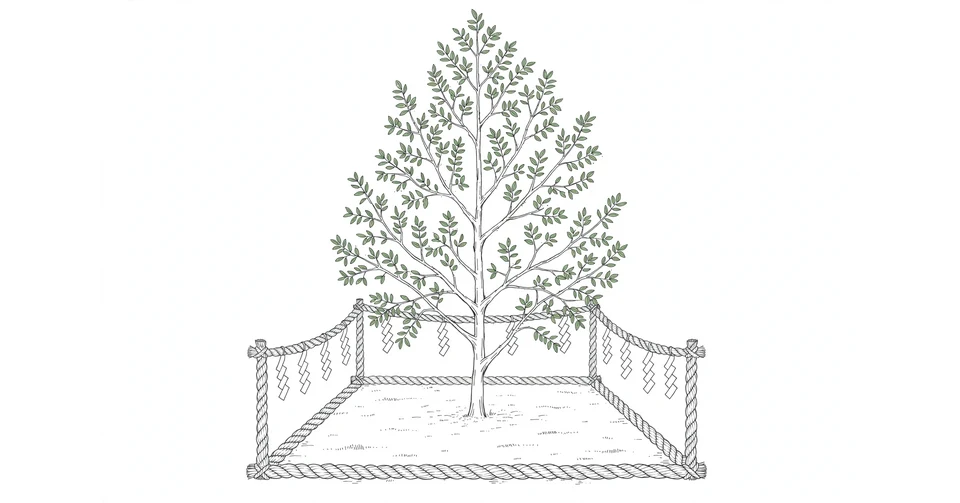
What makes a himorogi worth understanding is what it says about the whole religion. Shinto did not begin with buildings. It began with a tree, a rope, and a patch of ground that people agreed to treat as different from the ground around it. The grand halls came later, and they never replaced the idea. A himorogi is still built today, in the middle of cities, on ground that will soon hold a house or an office, and the rite performed inside it is taken as seriously as any rite performed in a hall that has stood for centuries.
What a himorogi is made of
In its simplest form, a himorogi is a square area with green bamboo or sakaki at the corners, and those corner poles support sacred ropes, shimenawa, decorated with streamers called shide. A branch of sakaki, or some other evergreen, stands at the centre and acts as a yorishiro, a physical seat for the presence of the kami. The kami themselves are incorporeal, so the branch gives them a place to rest that human eyes can see. That is the whole structure, and it can be put up in an afternoon and taken down in an hour.
A more elaborate himorogi is built around an eight legged wooden stand, called a hassoku-an, set on a straw mat on the ground. The stand is decorated with shimenawa and sacred emblems, and a frame is placed on it with a sakaki branch at the centre of the frame. The branch is dressed with shide and with yu, fibres of kozo, the paper mulberry tree. In the form described in the old studies of Shinto ritual, a himorogi generally consists of a gohei or a branch of the sakaki tree, hung with strips of paper or hemp, and set upon a table covered with a clean straw mat. Sometimes it is a fenced in sakaki tree, or some other specific kind of evergreen, hung with strips of paper or hemp, or possibly a mirror.
There is a third form, and it is the one that explains the name. In the earliest days, a himorogi could be a single great tree in a grove, fenced off with evergreen branches and a straw rope, so that the tree itself became the shrine. The tree was not cut and carried to the rite. The rite came to the tree. That version is rarely built today, because the land it needs is hard to find in a city, but it is the form that the oldest descriptions remember, and it is the reason the word has survived.
The materials are worth noticing, because they are all things that rot, fade, or dry out. Bamboo, straw, paper, a cut branch, a fibre of mulberry bark. Nothing in a himorogi is built to last, and nothing in it is expensive. That is not an accident of poverty. It is a statement about what a sacred place is made of in Shinto. The sacredness does not live in the materials. It lives in the agreement of the people who gather there, in the care of the priest who sets the branch upright, and in the boundary that the rope draws around a patch of ground for an hour or a day.
The sakaki branch at the centre
Everything in a himorogi points toward the branch at its centre, and that branch is almost always sakaki. Sakaki is the evergreen tree at the heart of Shinto ritual, and its role in the himorogi is the oldest of all its jobs. The branch stands upright in the middle of the square, dressed with shide and yu, and it serves as the yorishiro, the object into which the kami are invited to descend. Without the branch, the square is only a fence. With the branch, it is a seat for a god.
The choice of sakaki is not decorative. Sakaki is an evergreen, Cleyera japonica, and it stays green through the winter when other trees stand bare. Its name is thought to come from sakai ki, a border tree, the tree that stands on the border between the gods and humankind. That meaning fits the himorogi exactly. The branch stands on the border that the rope draws, at the centre of the square, and it marks the place where the two worlds meet. A himorogi built around a sakaki branch is a border made visible, with the tree standing at its middle.
In the oldest myths of Japan, the sakaki already does this work. In the Kojiki, when the sun goddess Amaterasu hides in the rock cave of heaven and the world goes dark, the assembled kami dig up a five hundred branched true sakaki from the heavenly Mount Kagu and hang their treasures on it, jewels on the upper branches, a mirror on the middle branches, offerings on the lower ones. The decorated tree is the frame of the plan that lures the goddess out of the cave. Every sakaki branch set up in a himorogi today is a smaller, quieter version of that tree, and the gesture is the same. A living branch is set up, adorned, and presented, and the kami are invited to come and rest on it.
The branch at the centre of a himorogi is dressed for the occasion, and the dressing matters. The shide, zigzag strips of white paper, are the same folded streamers that hang from the sacred straw ropes at shrine entrances, and they carry the same message wherever they appear. This place, this object, this moment has been set apart. The yu, stringy fibres of the kozo tree about a foot in length, are older than the paper, a reminder of a time when offerings were made of cloth and fibre rather than folded paper. Together they dress the branch the way a host dresses a table for a guest, with care and with things that took time to prepare.
The rope that draws the line
A himorogi has no walls, so it needs something else to say where it begins and ends, and that something is the shimenawa, the thick twisted straw rope. The rope is strung between the corner poles, and the white shide hanging from it make the boundary visible from a distance. Step inside the rope and you are in sacred space. Step outside it and you are back on ordinary ground. The line is thin, and it is made of straw, and it is treated as absolutely real for as long as the rite lasts.
The rope has a myth of its own. In the story of the cave of heaven, after Amaterasu is drawn out of the rock cave, the gods throw a sacred straw rope across the door so she cannot return, and light is restored to heaven and earth. The shimenawa at a shrine, and the rope around a himorogi, are descendants of that rope. They do the same work in a smaller place. They mark the point beyond which something must not pass, and they mark the space inside which something sacred is present.
There is a practical wisdom in marking sacred space with a rope rather than a wall. A wall says the sacred lives here permanently, and it needs a building to protect it. A rope says the sacred can be invited here for a morning, and then the ground can go back to being a field or a building site. The himorogi is built on that second idea, and it is why the form has survived for so long. It asks for almost nothing, a few poles, a length of rope, a branch, and it can be set up anywhere a ritual is needed.
I think there is also a lesson in the rope for anyone who has ever felt that a sacred place must be grand to count. The rope around a himorogi is not grand. It is straw, twisted by hand, hung with paper, and it will be taken down before the day is over. Yet the people who stand inside it bow, speak quietly, and treat the ground as holy, because the rope tells them to. The sacredness is not in the straw. It is in the attention the straw asks for, and attention is something any of us can give, in any place, with almost nothing in our hands.
The gohei and the paper that speak
At the centre of a himorogi, beside or in place of the sakaki branch, there may stand a gohei. The gohei is a wooden wand with two white paper streamers, and it stands on the altar as a sign that the kami are present. When a gohei is attached to a himorogi, it indicates the seat of the kami and is at the same time a token of the kami's presence. The wand is a smaller, portable version of the whole idea of the himorogi, a trunk with paper where the leaves would be, and it does the same work in a form a priest can carry in one hand.
The paper on the gohei and the paper on the himorogi are the same paper, and that is worth pausing over. The shide are strips of white paper, folded and cut into a zigzag, and wherever they hang they carry the same message. This place, this object, this moment has been set apart. The zigzag shape is usually read as lightning, which in Shinto is linked to rain, fertility, and the power of the kami, though some writers on ritual caution that the shape may simply be the most practical way to make paper visible and alive in the wind. Either way, the shape works. The folds catch the air, so the paper moves even in a still room, and the movement makes the sacred present in a way a bare branch never would.
White is the colour of the paper for a reason. In Shinto, white conveys purity, and the himorogi carries that purity into the open air in a form everyone can see. The branch is green, the rope is the pale gold of straw, and the paper is white, and the three colours together say what the enclosure is. Living green at the centre, a boundary of straw around it, and the white of purity marking both. It is a simple palette, and it is used the same way at shrines all across Japan, so that a visitor who has learned to read it in one place can read it in any other.
The paper is also a reminder that the sacred, in this tradition, is not meant to last forever in its materials. Shide are believed to collect impurities over time, so they are replaced regularly, and old ones are disposed of respectfully, usually burned. A himorogi is renewed in the same way, and more completely. It is built, used, and taken down, and a new one is built the next time it is needed. I find something deeply sane about a sacred space that admits it is temporary. It asks for maintenance rather than worship of the structure itself, and that keeps the attention on what the structure points to.
Why a himorogi is the oldest form of shrine
The claim that a himorogi is the oldest form of shrine in Japan is made plainly in the old studies of Shinto ritual, and it is worth understanding what it rests on. In the earliest days of Shinto, there were no shrine buildings. Festivals were held by inviting a kami, one at a time, to a place prepared for the occasion, instead of building a shrine and enshrining a god in the building. To invite a kami, a giant tree was surrounded by a fence and by shimenawa to keep the tree sacred, and those places were called himorogi. The building came later. The fenced tree came first.
A scholarly study of Shinto symbols sets out the reasoning in full, and that study of Shinto symbols describes how the earliest Japanese believed that kami descended to abide in trees and groves, so trees and groves served as the sites of rituals. Later, the most sacred tree was especially selected as the object through which the kami could be invoked. It was decorated with strips of paper and perhaps a mirror, and enclosed by evergreen trees. The combination of the sacred tree and these devices was called a himorogi, and himorogi were the first shrines of Japan.
The origin of the word itself has been the subject of much controversy, and the sources I read say so plainly. Four theories are commonly listed. A himorogi may originally have signified a place enclosed by evergreen trees for invoking the kami, or sacred trees in a grove in which kami dwelt, or trees which protected the kami, or a sacred fence made of cypress for use in rituals. The most widely accepted theory is the one about the tree, but the existence of four theories is itself informative. Scholars are divided on the details, and the honest answer is that the form grew over centuries and gathered meanings as it went.
The word itself carries the tree theory in its syllables. According to a reference entry on the subject, the name breaks down as hi, a divine spirit, moro, from amoru, meaning descending from heaven, and ki, a tree, so that a himorogi is a tree where a divine spirit descends from heaven, or a yorishiro of god. The kanji used to write the word, which pair the character for kami with the character for a bamboo fence, were originally read as kamigaki or mizugaki, a divine fence. A detailed reference entry on the himorogi, its history, and its name is given in that reference entry on the himorogi, which also records how the evergreen at the centre came to be called by the same name as the enclosure around it.
The word is old in a way that can be checked. It appears already in the Nihon Shoki, the second great chronicle of Japan, and in the Man'yoshu, the great anthology of early poetry. In the Nihon Shoki, in the narrative of the descent of the heavenly grandson to earth, the deity Takamimusubi erects a himorogi together with an iwasaka, a sacred rock enclosure, in preparation for the descent. The pairing is telling. A himorogi of green branches and an iwasaka of stone, side by side, are the two oldest forms of sacred space in the tradition, one made of living wood and one made of rock, and both of them older than any roof.
Where you will see a himorogi today
The most common place to see a himorogi today is a construction site. Before a house, a shop, or an office block is built, a priest is invited to perform a jichinsai, a ground breaking ceremony, and a himorogi is built for the rite. Green bamboo poles are placed at each of the four corners of the site, with shimenawa hung between them to form the ceremonial space, and an eight legged wooden stand is placed at the centre as an altar. At the centre of the stand, a himorogi is erected, a branch of the evergreen sacred sakaki adorned with a gohei and with yu, into which the god is invited to descend. Offerings of sake, water, rice, salt, vegetables, and fish are placed on the altar, and in some regions sand or salt is brought from the beach near Ise Grand Shrine and put in the four corners of the stand.
The ceremony follows a clear shape. It begins with purification, and the four corners of the land are cleansed and sprinkled with rice, salt, and hemp. Then comes koshin, the calling down of the god, in which the priest summons the god of the land and the guardian god of the community to the himorogi that has been erected on the altar, announcing the descent with a long voiced sound. The main rite follows, appeasing the god of the land, with the ceremonial mowing of grass, levelling of the land, and ploughing, performed in miniature with ritual tools. Then comes shoshin, the sending up of the god, in which the god who descended to the himorogi is sent back to his original residence. The himorogi is left standing for a while after the ceremony, before the actual work begins, and then it is taken down and the building goes up.
The purpose is practical as well as religious. The rite asks the permission of the ujigami, the guardian god of the land and the community, to use the ground, and it prays for safety during the construction work. It is sometimes called an anzen kigan sai, a ceremony to pray for safety, and that name is honest about what the builders want. They want the work to go well, and they want no one to be hurt, and they ask for that in the oldest way the tradition knows, by setting up a himorogi and inviting the god of the place to be present while the request is made.
You will also see a himorogi at festivals. During the Aoi Festival in Kyoto, one of the oldest festivals in Japan, the himorogi is a square space surrounded by green branches, with an evergreen tree at the centre as a yorishiro. The form is more elaborate than the one at a building site, dressed for a festival rather than for a morning of digging, but the structure is the same. Four sides, a rope, a tree at the centre, and a space set apart for the kami to enter. The festival version shows that the himorogi is not only a practical device for blessing ground. It is also a ceremonial form in its own right, used wherever a rite is held away from a shrine building.
A himorogi and a shrine building are not the same thing
It is easy to confuse a himorogi with a shrine, and the confusion is understandable, because a himorogi is a shrine in the oldest sense of the word. But the two are not the same thing, and the difference is worth learning, because it explains how Shinto grew. A shrine building is a permanent home for a kami, a place where the god is understood to reside all the time. A himorogi is a temporary seat, a place prepared for a single occasion, where the kami is invited to descend, honoured, and then sent back to his original residence. One is a house. The other is a room prepared for a guest.
The difference shows in every part of the form. A shrine has a roof, walls, a hall, an offering box, and a staff of priests. A himorogi has four poles, a rope, a branch, and a priest who arrives for the morning and leaves when the rite is over. A shrine is fixed to one place and one god. A himorogi can be built anywhere, for any god, on any patch of ground that has been cleaned and marked. A shrine is maintained for centuries. A himorogi is maintained for a day, and then it is gone, and the ground forgets it was ever there.
The difference also shows in what happens after the rite. When a ceremony ends at a shrine, the god stays, and the hall is closed until the next rite. When a ceremony ends at a himorogi, the god is sent back, the rope is taken down, the branch is removed, and the space returns to ordinary use. That sending back, the shoshin, is as important as the calling down. It is the rite admitting, honestly, that the sacredness was borrowed for the morning, and that the ground belongs to its ordinary life again.
A short comparison helps keep the two forms straight.
| Feature | Himorogi | Shrine building |
|---|---|---|
| Form | Square of ground, poles, rope, branch | Hall with roof, walls, and altar |
| Duration | One rite, then taken down | Permanent, maintained for centuries |
| Kami | Invited to descend, then sent back | Resident, enshrined in the building |
| Place | Any cleaned ground, including a building site | Fixed site, usually a shrine precinct |
| Materials | Bamboo, straw, paper, a cut branch | Wood, lacquer, stone, tile |
The table is a guide, not a rule book. Real shrines vary, and the line between a temporary enclosure and a permanent shrine has always been softer than a table suggests. Some shrines keep a himorogi inside their own precincts, and some permanent shrines began as a fenced tree that was never taken down. What matters most is the shared idea underneath both forms, that a place becomes sacred when it is set apart with care, and that the setting apart can be as simple as a rope and a branch.
What a visitor should do
If you come across a himorogi, the most likely place is a building site on a weekday morning, with a priest in white, a small group of people in suits, and a table of offerings on a patch of bare earth. The ceremony is a working rite, not a tourist event, and the right behaviour is the same as at any shrine ceremony. Stand outside the rope, keep your voice down, and do not step inside the square or reach toward the branch. The rope is the boundary, and respecting it is the whole of the etiquette.
Photography is a question of intent rather than of rules. There is no general ban on photographing a himorogi from a respectful distance, and a building site is a public place. But the people inside the rope are asking a god for permission to build, and for safety while they work, and pointing a camera at them while they do it is a choice worth thinking about twice. If you want a photograph, take one from far enough away that you are clearly not part of the rite, and do not use a flash. Better still, remember the shape, four poles, a rope, a branch, and look for it again the next time you pass a site where a building is about to rise.
If you are invited to attend a jichinsai, which sometimes happens when a friend is building a house, the invitation is a mark of trust, and the rite is simple to follow. Bow when others bow, clap when others clap, and present the tamagushi, the sakaki branch offered to the kami, if one is handed to you, turning it slowly and laying it down with the base toward the altar. The branch you hold is the same branch that stands at the centre of the himorogi, and holding it for a moment is the closest most visitors will ever come to the centre of the enclosure.
The shrine that fits in an afternoon
A himorogi is, in the end, a very small thing. It is four poles, a length of straw rope, a branch of sakaki, and a few strips of white paper. It will be taken down before the day is over, and the ground it stood on will hold a house, a shop, or an office within a year. Nothing about it is built to impress you, and that is precisely why it stays with you once you have learned to see it.
What I take from the himorogi is a lesson about how little it takes to make a place matter. We tend to assume that importance needs size, expense, or permanence, and that a sacred place needs walls and a roof. Japan has spent centuries proving the opposite with a square of ground you could walk across in four steps. A sacred space can be a branch and a rope. A shrine can be built in an afternoon and taken down by evening. A god can be invited, honoured, and sent home, all before lunch, and the rite is no less serious for being brief.
The next time you walk past a building site in Japan and see the green poles and the straw rope, stop for a moment. Inside that square, for one morning, is the oldest shrine in the country, older than the hall down the road, older than the torii at the end of the street, older than the shrine itself. It is a branch, a rope, and a patch of ground that people agreed to treat as holy, and it has outlasted empires. That is worth a moment of your attention, and the himorogi will still be there, green and quiet inside its rope, when you give it one.
More in Culture & Society
Latest posts
- Tanuki Udon Is the Bowl Named After a Raccoon Dog
- Wagyu Beef and Why One Small Steak Costs More Than Dinner
- Inari Sushi Turns Fried Tofu Into a Portable Feast
- Aburaage Is the Fried Tofu Japan Simmers Sweet
- Japanese Cheesecake and the Fluffy Cake That Jiggles
- The Gohei Wand Carries the Kami Into the Ceremony
- Kitsune Udon Is the Bowl the Fox Would Order
- Origami and How a Single Sheet of Paper Became Japan's Quiet Art
- A Hishaku Is the Bamboo Ladle That Starts Every Shrine Visit
- A Kitsune Is the Fox Messenger Who Guards the Shrines of Japan
- Temizuya Is Where Every Shrine Visit Begins With Water
- Shide Are the Paper Lightning That Marks a Sacred Space
- Tokyo Disneyland and Why Japan Loves It Differently
- Yabusame Turns Horseback Archery Into a Moving Prayer
- Walking Through Senbon Torii Feels Like Entering Another World