Mekugi Holds a Katana Together With a Single Bamboo Pin
· 17 min read
A mekugi is a single bamboo pin no thicker than a pencil, yet it is the only thing keeping a katana blade inside its handle. This is the story of the smallest part of the sword, and why it carries the largest responsibility.
Hold a katana by the handle and swing it, and the whole sword feels like a single piece of steel. It is not. The blade and the handle are two separate pieces, and the only thing locking them together is a mekugi, a bamboo pin about the length of a thumbnail. Remove that pin and the sword comes apart in your hands. Leave it in place and a swordsman could stake his life on it, which is exactly what generations of samurai did.
The idea sounds reckless at first. A blade made for cutting, held in place by a sliver of grass. Yet the mekugi is one of the oldest and most deliberate choices in the Japanese sword, and it has survived centuries of testing for a reason. The mekugi is small because it needs to be small, it is bamboo because bamboo behaves the way a sword needs it to behave, and it is removable because a katana is meant to be taken apart, cleaned, and put back together for as long as it lives.
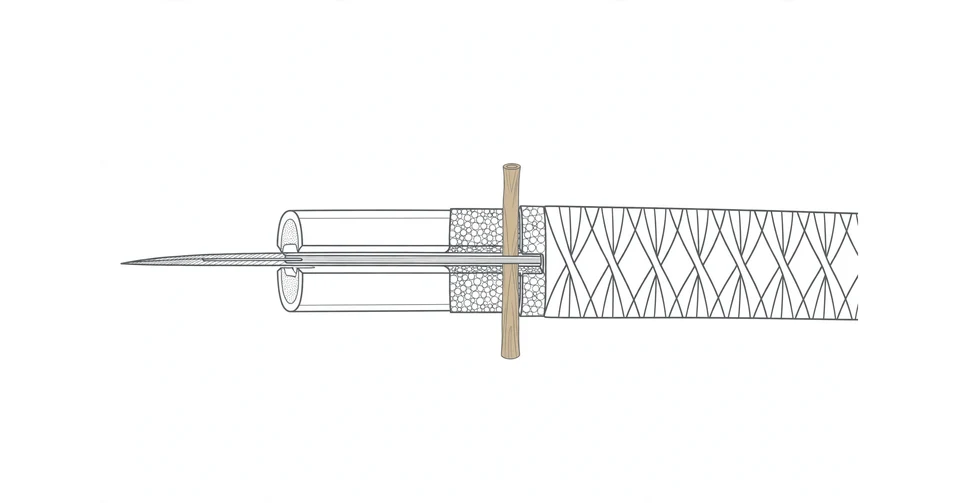
This article looks at that pin up close. It explains what a mekugi does, why bamboo won out over metal, whether one pin is really enough, and how the mekugi is checked and replaced. It also looks at what a piece of bamboo this small can teach us about craft, and about trusting the parts of a thing that nobody sees.
What a mekugi actually does
The tsuka, the wrapped handle of the katana, is built around the nakago, the tang of the blade. The tang is the unpolished lower part of the blade, hidden inside the handle, and it is where the smith signs the blade with his mei. A hole is drilled straight through the handle and the tang, and the mekugi is pushed through that aligned hole. The hole has its own name, the mekugi-ana, and the pin is carved as a slight wedge so that it tightens as it is driven home.
The job of the mekugi is simple to describe and hard to overstate. Every time the blade meets a target, the shock travels down the steel and into the handle. Without the mekugi, the blade would slide forward out of the grip, and the sword would come apart at the worst possible moment. With the mekugi in place, the blade and the handle move as one. The tsuka is the wrapped grip that lets a katana speak, and the mekugi is the quiet fastener inside that grip that makes the whole assembly trustworthy.
There is a useful way to think about the pin. It does not hold the sword together by brute force. It holds it together by fit. A well made mekugi fills the mekugi-ana snugly from one side of the handle to the other, with no rattle and no gap, and the wedge shape means that any force trying to pull the blade out only seats the mekugi more firmly. The pin is not glued in, it is not screwed in, and it is not riveted. It is held by shape, by friction, and by the spring of the bamboo itself.
That last point matters more than it sounds. A katana is not a sealed object. It is a kit of parts that fit together, and every part can be separated for care. The blade can be removed from the handle, the handle can be re-wrapped, the tang can be inspected for rust, and the mekugi itself can be checked and swapped. Nothing about the mounting is permanent, and that reversibility is part of the design. A sword that can be taken apart can be kept alive for centuries. A sword that is glued shut can only age in secret until something fails.
The size of the pin surprises most people who first learn about it. One specialist guide puts a typical mekugi at about 18 millimetres long and 5 to 7 millimetres across, roughly the size of a short pencil stub. The version made for a shirasaya, the plain wooden storage mounting, is thinner still, because a sword in storage is not expected to take the shock of cutting. The working mekugi is small, but it is not fragile. Its smallness is the point. A larger pin would need a larger hole, and a larger hole would weaken the tang. The mekugi is sized to the smallest hole that can still do the job, because every millimetre of steel removed from the tang is steel that can never be put back.
Why bamboo, and not metal
Metal seems like the obvious choice for a pin that holds a weapon together. In fact, iron and brass were used for this job in early Japan, and they were abandoned. Bamboo replaced them, not because it was cheaper or easier to find, but because it behaves better under the exact forces a sword produces. That is a decision worth pausing over, because it runs against the instinct that the strongest material is always the best one.
The first problem with metal is wear. A metal pin is harder than the steel of the tang, and every cut makes the two rub against each other. Over time the hard pin wears the hole wider, the fit loosens, and the sword becomes less safe with every use. Bamboo is softer than steel, so the pin wears instead of the tang. A worn mekugi can be replaced in minutes. A worn tang cannot be repaired at all.
The second problem is what happens when the pin fails. Metal under sudden shock tends to bend and stay bent, or to snap without warning. It can also jam in the hole, which makes it difficult to remove for maintenance. Bamboo behaves differently. It is fibrous, so it deforms gradually and gives a warning, and it tends to crush or split slowly rather than failing all at once. The Toyama Ryu maintenance guide puts it plainly: wood pegs snap more easily than bamboo, which tends to deform. That slow failure is a safety feature in itself. A mekugi that shows its damage before it breaks is a pin you can replace before it matters.
The third problem is rust. A sword lives in a scabbard, it is handled with bare hands, and it is used outdoors in rain and humidity. A metal pin can corrode inside a hole nobody can see, losing strength in silence. Bamboo does not rust. It can dry out, it can crack, and it can wear thin, but it does not quietly dissolve the way iron does.
Not just any bamboo will do. The mekugi is carved from the outer part of the bamboo, where the grain is tightest and hardest, and the best material is susudake, bamboo that has been smoked and aged for a very long time, sometimes for decades in the rafters of old houses. Another respected type is madake, cut in winter and dried for years, then soaked in plant oil such as camellia or rapeseed oil to make it stronger. A detailed guide to the mekugi describes both types and explains why ordinary soft bamboo, and chopsticks most of all, are not suitable. The material is chosen with the same care as the steel, because the pin is asked to do a job that no other part can do.
There is a lesson in this that goes beyond swords. We often assume that the hardest, heaviest, most expensive material is the right one, and that a lighter choice is a compromise. The mekugi shows the opposite. The right material is the one whose failure mode you can live with, whose wear you can see, and whose replacement is easy. Bamboo is not the strongest choice. It is the wisest one, because it fails kindly and it can be renewed. That is a good test for any design, not just a sword: ask not only how strong a part is, but how it behaves on its worst day.
One mekugi, or two
Here the sources disagree, and the disagreement is worth reporting honestly rather than smoothing over. The traditional position, held by the Toyama Ryu school, is that a katana is held together with a single mekugi, and that one properly fitted pin is better than two or three poor ones. Their maintenance guide states it directly: two or three poorly done mekugi are not as good as a single properly done one. In this view, the second pin is not a sign of care. It is a sign that the first pin was not trusted, and that the maker tried to fix a fitting problem by adding more parts.
The modern position is different. Many swords made today, especially those used in martial arts practice and in test cutting, carry two pins. The second pin, sometimes called the hikae mekugi, acts as a backup. If the first pin breaks during repeated hard cutting, the second one keeps the blade in the handle long enough for the cut to finish safely. Some guides go further and argue that two pins are simply the best option for any sword that will actually be swung. They point out that records from the Showa era wars list the breaking of these pegs as the most common type of damage to Japanese swords, and that samurai carried spare pins they had made themselves for emergencies.
Both sides have a point, and the truth depends on what the sword is for. A historical blade kept as an art object, handled gently and never swung at a target, needs one pin, fitted with great care. A modern practice sword that will be swung hundreds of times in training benefits from the extra margin of a second pin, because the cost of failure is a blade flying across a room. The conservative version, and the one this article follows, is the traditional one: one mekugi, properly made and properly fitted, is the standard. Two is a modern safety choice for hard use, not a correction of a flaw in the original design.
What matters most is not the count but the fit. A mekugi that rattles, a mekugi that needs force to remove, or a mekugi that shows dents and bends has already told you something is wrong, whether it is the only pin or one of two. Counting pins is easy. Checking them is the real work.
The four parts that work together
A mekugi never works alone. It is one part of a small system, and each part has a job that only it can do. The table below sets out the four parts so the relationship is easy to see.
| Part | What it is | What it does |
|---|---|---|
| Mekugi | A small bamboo pin, carved as a wedge | Locks the handle to the tang through the aligned holes |
| Mekugi-ana | The hole drilled through handle and tang | Gives the pin its seat and sets the angle of the wedge |
| Nakago | The unpolished tang of the blade | Carries the smith signature and takes the force of every cut |
| Tsuka | The wooden core handle, wrapped in cord | Gives the hands their grip and holds the tang in place |
Look at the table and one thing stands out. Three of the four parts are hidden. The tang is hidden inside the handle, the hole is hidden inside the wood and steel, and the pin itself is mostly hidden, with only its two trimmed ends showing at the surface of the grip. The only part you actually hold is the wrapping. A katana looks like a blade, but its safety depends on parts you cannot see, and that is why inspection matters so much. The visible parts get all the admiration. The hidden parts do the holding.
The tang deserves a closer look, because it explains why the hole is where it is. The nakago is left unpolished on purpose, and its rusted surface, its file marks, and its shape tell experts about the age and origin of the blade. The smith signs it there, in the part nobody sees when the sword is assembled. The hole for the mekugi passes through that same quiet part of the sword. There is something fitting about that. The signature and the pin share the hidden heart of the blade, the part that is never displayed and never polished, and the part that carries the whole weight of the sword.
How a mekugi is removed and replaced
Checking the mekugi is a routine part of owning a Japanese sword, and it is a routine that rewards patience. The guide published by Toyama Ryu recommends removing and inspecting the pins often, and warns against waiting for the pin to fail. A failing pin can turn a swung sword into what their guide calls a three foot razor sharp projectile flying across the room. That image is dramatic, but it is also honest about the stakes. The pin is small, and the consequence of its failure is not small at all.
Removal starts with finding the pin. Its ends may sit under the tsuka-ito, the cord wrapping of the handle, and the wrapping may need to be shifted slightly to reach it. The traditional tool is the mekuginuki, a small brass hammer with a pin that unscrews from the top. The pin of the tool is placed against one end of the mekugi, and gentle taps drive the pin out of the handle. A brass hammer or a wooden mallet and a punch can also be used. Most pins can only be removed in one direction, because the wedge shape tightens one way and loosens the other, so the thinner end is the one to push from. A step by step guide to mekugi replacement from Toyama Ryu walks through the whole process, including the tools, the direction of removal, and the warning signs to look for.
Once the mekugi is out, the inspection is straightforward. The mekugi should not be dented, bent, or damaged in any way, and it should be replaced immediately if it shows any sign of harm. A rattling guard can be a sign that the pin needs replacement and should be inspected. The pin should not need excessive force to be removed or put back. If it does, that is a sign the blade is not fully seated in the handle, or the hole is not shaped properly, and forcing it will only make things worse.
Fitting a new pin is a craft in itself. The pin is carved as a wedge with the same angle as the hole, using a block plane or a carving knife, and the bamboo must pass completely through the handle and fit snugly in the mekugi-ana. The ends are marked while the pin is fitted, then trimmed with a very fine saw and sanded smooth. Orientation matters. The dense outer part of the bamboo, where the pores are smaller and darker, should face away from the blade, toward the kashira, the end cap of the handle. That puts the strongest part of the bamboo where the force is greatest. The hole itself may need work too. A rough hole can damage the pin, so it is deburred with a countersink or a file, and a badly shaped hole is reshaped with needle files or a tapered reamer until the wedge can seat properly.
Re-wrapping a tsuka is a normal part of a sword life, and it is a good moment to check the pin and the fit of the tang. The handle wrapping wears, the cord loosens, and the wood beneath it shifts slightly with the seasons. Each re-wrap is a chance to look at parts that are usually hidden, and to replace a small pin before it becomes a large problem. There is no shame in replacing a mekugi. It is not a repair of something broken. It is maintenance of something that is working, done early enough that it keeps working.
What the mekugi teaches about craft
It is easy to love the visible parts of a katana. The curve of the blade, the pattern of the steel, the shine of the polish, the diamond pattern of the handle wrap. These are the parts that photographs capture and museums display. The mekugi is none of those things. It is a sliver of bamboo that most owners will never see unless they take their sword apart, and even then it looks like nothing much. Yet without it, the rest of the sword is a beautiful object that cannot be used.
That gap between appearance and importance is the real subject of this article. Every well made thing has a mekugi somewhere in it: a small part, cheap to replace, easy to overlook, carrying a load far out of proportion to its size. In a house it might be a single bolt in a staircase. In a friendship it might be the habit of answering honestly when a question is uncomfortable. In a life it might be the ten minutes of rest that keep a long day from falling apart. We spend our attention on the large and the shining, and we forget the small fastener that holds it all together, until the day it fails and we learn what it was doing all along.
The mekugi also teaches something about trust. A samurai trusted his life to a bamboo pin, not because he was careless, but because he understood the pin and inspected it. Trust without inspection is superstition. Inspection without trust is anxiety. The healthy middle is the one the sword tradition practises: trust the part, and check it often, and replace it at the first sign of wear, without waiting for proof that it has failed. That is a good rule for more than swords. The things we rely on most deserve the most regular attention, not the least, and the fact that something has held so far is not evidence that it will hold tomorrow.
There is a final lesson in the way the pin is made to come out. A katana is not sealed shut. It is built to be opened, cleaned, and reassembled, and that openness is what lets it survive for centuries. Things that are sealed against inspection age in the dark. Things that can be taken apart can be cared for, and care is what turns a useful object into an heirloom. The mekugi is removable on purpose, and that purpose is a kind of wisdom. Build things so that they can be opened. Make the small parts easy to replace. Let the hidden parts be seen sometimes. A design that welcomes maintenance will outlast a design that only welcomes admiration.
The history of the katana is usually told through its blade, and the blade deserves its fame. How the katana became the soul of the samurai tells that larger story, of a weapon that became a symbol of a whole culture. But the soul of the sword, if it lives anywhere, lives in the fit between its parts, and the smallest of those parts is a bamboo pin. The blade cuts. The handle guides. The mekugi holds. Take away any one of the three and the sword is no longer a sword, and the smallest of the three is the one that makes the other two a single thing.
A katana held together by a single bamboo pin sounds fragile until you understand the pin. It is not fragile. It is fitted, inspected, and replaceable, and those three qualities matter more than size. The next time you look at a beautiful object, ask what holds it together, and whether that part is being checked. The answer is often small, often hidden, and often made of something humbler than you expected. That is not a flaw in the design. That is the design, and it has held for centuries.
More in Culture & Society
- Wakizashi Was the Short Sword a Samurai Never Took Off
- Tsuba Is the Small Guard That Stops a Katana From Cutting Its Owner
- Yokote Is the Small Line That Tells a Katana's Age
- Seppa Are the Thin Washers That Keep a Katana From Rattling
- Kissaki Is the Small Tip That Finishes a Katana
- Nakago Is the Hidden Tang That Carries a Katana's Signature
Latest posts
- Why a Katana Stays Put, Thanks to the Koiguchi
- Tsuka-Ito Is the Cord That Binds a Katana Grip
- Fuchi Is the Collar That Frames a Katana Grip
- Kashira Is the Small Cap That Finishes a Katana Grip
- Sageo Is the Cord That Ties a Katana to Its Samurai
- Menuki Are the Small Ornaments Hidden Under a Katana Grip
- Habaki Is the Copper Collar That Locks a Katana in Its Sheath
- Maedate Is the Crest That Turned a Samurai Helmet Into a Banner
- Samegawa Is the Ray Skin Hiding Under Every Katana Grip
- Tatara Is the Clay Furnace Where Tamahagane Begins
- Tsuka Is the Wrapped Grip That Lets a Katana Speak
- The Tanto Was the Small Blade a Samurai Trusted With His Life
- Tamahagane Is the Jewel Steel Behind Every Katana
- Seppuku Was the Ritual a Samurai Chose Over Disgrace
- Saya Is the Lacquered Sheath That Guards the Katana