Why a Katana Stays Put, Thanks to the Koiguchi
· 19 min read
A katana has no clasp, no strap, and no lock, yet it never slips from its sheath. The answer is the koiguchi, the small mouth of the saya that grips the blade collar with friction alone.
A katana has no clasp, no strap, and no latch. Nothing clicks shut when the blade slides home, and nothing needs to be undone before a draw. Yet a properly fitted katana can be carried edge up, tipped upside down, and shaken gently without the blade moving at all. The whole secret sits in a piece of wood and horn no wider than a thumb. It is the koiguchi, the mouth of the saya, and the friction where it meets the blade collar is the only lock the sword has ever needed.
The word koiguchi means carp's mouth in Japanese. It is the opening at the top of the saya, the lacquered wooden scabbard, and it is the part of the sheath that works hardest. Every time the sword is drawn and returned, the collar at the base of the blade wedges into this mouth, and the grip between the two is what holds the sword in place. The koiguchi is often reinforced with buffalo horn, because plain wood alone would wear out too fast under that daily pressure.
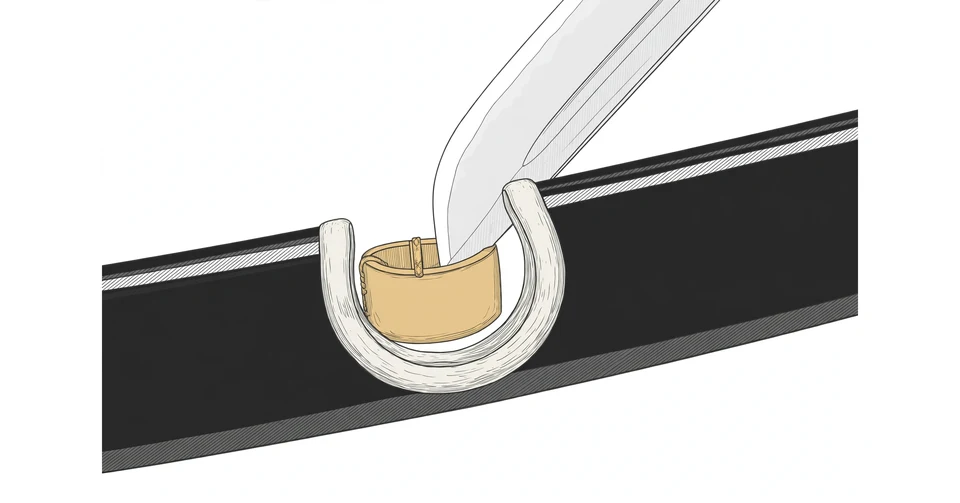
That grip is not an accident of tight wood. It is a deliberate piece of engineering, refined over centuries, and it depends on a fit so precise that a craftsman measures success in fractions of a millimetre. A koiguchi that is too tight makes the draw stick and the return scrape. A koiguchi that is too loose lets the blade rattle, and a rattling blade is a dangerous one. Between those two failures lies a narrow band of perfect friction, and staying inside it is the quiet work of the saya maker.
What a koiguchi actually is
The koiguchi is the mouth of the saya, the opening through which the blade enters and leaves the scabbard. Look at a sheathed katana and you will see it as a thin dark rim at the top of the lacquered sheath, just below the guard. It looks modest, almost like trim, and a casual observer could easily mistake it for decoration. In truth it is the hardest working part of the whole mounting, the single point where the sword and the sheath truly meet.
The saya itself is made from two halves of light wood, usually magnolia, hollowed out, glued together, and finished with lacquer. The inside of the saya is carved slightly wider than the blade, so the sharp edge floats free and never touches the wood while the sword rests inside. Only one part of the blade makes contact with the scabbard at all, and that contact happens at the koiguchi. This is the first thing to understand about the design. The rest of the sheath protects, but only the mouth holds.
Wikipedia describes the koiguchi plainly as the mouth of the saya or its fitting, traditionally made of buffalo horn, in its guide to Japanese sword mountings. That short definition hides a great deal of craft. The horn is not there for looks. Horn is harder and more wear resistant than lacquered wood, so it takes the daily friction of the blade collar sliding in and out without widening as fast as wood would. On cheaper or plainer mountings the mouth may be wood alone, but on a well made saya the horn rim is standard, and its presence is one of the small signs that tell an experienced eye the scabbard was built to be used, not just displayed.
The name itself is worth pausing over. Koi is carp, and kuchi is mouth. The opening of the saya is oval and slightly pursed, and someone long ago saw a carp's mouth in it. Carp in Japanese culture are symbols of perseverance, famous for swimming upstream, and the image suits a part that must endure endless repetition without complaint. The koiguchi does not get the glory of the blade or the beauty of the lacquer. It simply does its job, thousands of times, and asks for nothing.
The habaki and the koiguchi, a lock with no moving parts
The lock works because of a partnership. The koiguchi is only half of it. The other half is the habaki, the wedge shaped copper collar fitted around the base of the blade, just above the guard. When the sword slides home, the habaki presses into the koiguchi and stops. The friction of that single meeting point is the whole lock. There is no spring, no catch, and no second mechanism waiting behind it. The sword stays put because two surfaces, shaped to match each other exactly, refuse to slide apart without a deliberate push.
The habaki is slightly tapered, wider at its lower end, so it wedges tighter the further it enters the mouth. That taper is the key to the whole system. Push the blade home and the collar meets the koiguchi, then sinks a fraction further until the friction is enough to hold the full weight of the sword. Pull the blade out and the taper releases almost at once, so the draw does not drag. It is a simple idea, and like many simple ideas it only works when the execution is exact. If the taper is wrong, or the mouth is worn, the lock fails in one direction or the other.
This is why the habaki and the koiguchi must be fitted to each other, not merely made to a standard size. Every blade is slightly different in width, thickness, and curvature, and every saya is carved for one blade alone. Swap the blade into another sword's saya and the fit will be wrong, even if the lengths match. A saya that fits one katana perfectly may let another rattle, or grip it so tightly it cannot be drawn smoothly. The koiguchi remembers exactly one habaki, and it is loyal to that one alone.
For the full story of the collar itself, the companion article on the habaki, the copper collar that locks a katana in its sheath explains how that wedge is made and fitted. The two parts belong together in any honest account of the sword, because neither one locks anything on its own. The habaki without a mouth to wedge into is only a collar. The koiguchi without a habaki to grip is only a hole. Together they are a lock.
There is something admirable about a mechanism with no moving parts. Modern life is full of locks that depend on springs, batteries, and tiny parts that fail in ways nobody can fix at home. The koiguchi has none of that. It is wood and horn and friction, and it has worked the same way for centuries. When it wears out, a craftsman can repair it with shavings of the same wood it was made from. That is not a flaw in the design. It is the design. A lock you can understand is a lock you can trust, and a lock you can repair is a lock that can last longer than its owner.
Why the blade never touches the inside of the saya
One of the cleverest details of the system is what does not happen. The cutting edge of a katana is its most delicate feature, ground to a fineness that a careless touch can damage, and the saya is designed so that the edge never contacts the wood. The interior of the scabbard is hollowed slightly wider than the blade, with clearance along the edge, so the blade floats inside the sheath, touching nothing except the habaki seated in the koiguchi.
This matters more than it might sound. A blade that rubbed against wood every time it was drawn would dull quickly and develop fine scratches along its length. Worse, wood traps moisture, and a blade pressed against damp wood would rust. By giving the edge room to breathe, the saya protects the part of the sword that matters most, and it does so by asking the mouth to do all the holding. The koiguchi carries the whole burden so the edge can rest untouched.
It also explains why the fit at the mouth is so sensitive. Because nothing else touches the blade, the koiguchi is the only thing preventing the sword from shifting, rattling, or sliding out. There is no backup grip further down the sheath. The design puts all its trust in one small ring of horn and wood, and that trust is repaid only when the fit is exact. It is an elegant trade. The edge is protected absolutely, and in exchange the mouth must be perfect.
The same principle shows up in the way a katana is returned to its sheath. The swordsman does not simply push the blade in. The blade is guided in with the edge turned slightly, the back of the blade sliding along the inside of the saya, so the sharp edge never catches the wood on the way home. Only at the very end, when the habaki reaches the koiguchi, does the blade seat itself with a soft, firm stop. That final moment, the quiet seating of collar into mouth, is the sound of the lock engaging, and experienced practitioners listen for it the way a driver listens for a car door closing properly.
Koiguchi o kiru, the thumb that starts the draw
Drawing a katana begins with a small, precise movement that has its own name. The left thumb pushes the guard forward, just enough to break the seal between the habaki and the koiguchi. The move is called koiguchi o kiru, which translates as cutting the mouth of the scabbard. It is not a yank or a shove. It is a short press, a deliberate breaking of the friction lock, and once it is done the blade is free to slide out smoothly.
Wikipedia notes the same technique under the name koiguchi no kirikata, describing how the thumb presses the guard to unwedge the habaki from inside the scabbard before the blade can be drawn quickly. The two names describe the same moment, and the fact that the movement has a formal name tells you how central the koiguchi is to the whole art of the sword. The draw does not begin at the handle or the shoulder. It begins at the mouth.
There is a lesson in the size of that movement. The thumb moves perhaps a centimetre, and the whole lock releases. That is the nature of a wedge. A tiny displacement breaks the friction, and the blade that would not budge under its own weight suddenly slides free. The swordsman does not fight the lock. He simply removes the condition that made it hold, and the sword does the rest. It is worth remembering the next time a problem looks immovable. Sometimes the answer is not more force but a small, well placed shift that changes the geometry of the whole situation.
The phrase koiguchi o kiru has travelled beyond the sword arts. In modern Japanese the related expression tanka o kiru is used to mean getting ready to begin something, or clearing one's throat before speaking up. The image is the same, a seal being broken before action starts. A mouth opens, words or a blade come out, and whatever was held back is now in motion. It is a small piece of evidence for how deeply the sword once sat in everyday Japanese life, when the act of drawing a blade was familiar enough to lend its language to ordinary speech.
When a koiguchi wears loose, and how a craftsman fixes it
Every koiguchi wears out eventually. The mouth is the hardest working part of the saya, and thousands of draws slowly widen it. The horn resists longer than wood, but nothing resists forever. A loose mouth is the most common fault in an old saya, and it is also the most dangerous, because a sword that can slip from its sheath on its own is a sword that can hurt someone. A katana that rattles in its saya is not a minor annoyance. It is a warning.
The signs are easy to recognise once you know them. The blade moves when the sheathed sword is tipped. It rattles softly when the sword is carried. The soft stop at the end of sheathing becomes vague, and the sword no longer seats with the same firm confidence. Any of these signs means the koiguchi has widened past the point where friction alone can hold the habaki, and the saya needs attention before the sword is carried again.
A craftsman restores the fit by shimming the mouth with thin shavings of magnolia wood, the same wood the saya is made from. The shavings are glued inside the koiguchi, then carefully trimmed and shaped until the habaki seats snugly once more. It is patient, fiddly work, and it cannot be rushed, because removing too much wood would make the mouth too tight, and too tight is its own problem. A mouth that grips too hard makes the draw stick, and a sticking draw is dangerous in a different way, since a swordsman who has to tug at the blade loses control of the timing.
The repair is a reminder that the koiguchi is a living fit, not a fixed measurement. It changes with use, and it can be brought back. That is one of the quiet virtues of a wooden scabbard over a metal one. Metal, once worn, is hard to build back up. Wood accepts shims, and a skilled craftsperson can renew the fit again and again across the life of the sword. The saya is not a disposable case. It is a companion to the blade, maintained across decades, and the koiguchi is where that maintenance matters most.
Wood, weather, and the living fit
Magnolia wood, the traditional choice for a saya, breathes with the seasons. It swells slightly in humid weather and shrinks in dry air, and because the koiguchi is the tightest fitting part of the scabbard, it feels those changes first. A saya that fits perfectly in a damp Japanese summer may grip a little tighter in a dry winter, and a saya kept in a heated room may loosen over time. The fit is never truly finished. It responds to the air around it, day by day.
A too tight saya can be eased by filing carefully inside the koiguchi, removing a whisper of material until the habaki seats smoothly again. A too loose one is tightened with the shims described above. Both adjustments are small, reversible in spirit if not in fact, and both require a steady hand and a good eye. The work is not dramatic. It is the kind of slow, careful craft that looks like nothing from the outside and means everything to the person carrying the sword.
This sensitivity to weather is worth knowing for anyone who owns or handles a katana today, even a modern made one. A sword stored in a damp basement or a dry attic will not hold its fit the way one kept in a stable room will. The lacquer on the outside of the saya protects the wood from rapid changes, but it cannot stop them entirely. Keeping the sword in a room with steady temperature and moderate humidity is not fussiness. It is the same care the saya maker built into the design, extended across the years.
There is also a broader point hiding in this detail. The koiguchi works because it is made of a living material, and living materials change. The craft does not pretend otherwise. Instead of fighting the wood, the design leaves room for adjustment, and the tradition of repair keeps the fit true across the seasons. That attitude, build for adjustment rather than permanence, is one the modern world could borrow more often. We tend to design things that work perfectly until they fail completely. The koiguchi is designed to drift a little, be noticed, and be put right, and that is why it has lasted.
The parts around the koiguchi
The mouth does not work alone, even within the saya. Several small fittings share the job of making the scabbard safe and practical, and knowing them helps to place the koiguchi in its proper context. The table below lists the fittings a reader is most likely to meet.
| Part | Material | Job | | Koiguchi | Buffalo horn over magnolia wood | Grips the habaki and locks the sword | | Kojiri | Buffalo horn or metal | Caps the tip of the saya and protects it from knocks | | Kurikata | Horn or metal | Knob on the side where the cord passes through | | Sageo | Silk, cotton, or leather cord | Ties the saya to the belt when the sword is worn |
The kojiri, the cap at the far tip of the saya, is the mirror of the koiguchi. Where the mouth is reinforced against the daily friction of the habaki, the tip is reinforced against the knocks of everyday life, bumping into door frames, floors, and the ground when the sword is set down. Like the koiguchi it is traditionally made of buffalo horn, and like the koiguchi it is a small part doing an unglamorous job that the whole sword depends on.
The kurikata and the sageo handle a different problem, which is how the sword stays attached to its wearer. The sageo, a cord threaded through the kurikata knob, ties the saya to the belt, so the scabbard does not slide forward when the sword is drawn. It is worth noting the division of labour here. The sageo holds the scabbard to the person. The koiguchi holds the blade to the scabbard. Two different grips, two different jobs, and neither one substitutes for the other. A sword with a fine sageo but a worn koiguchi is still a sword that can slip free at the worst moment.
A good guide to the whole scabbard, including the role of the koiguchi among these fittings, is the detailed overview of the saya and its parts, which explains how each fitting contributes to a scabbard that must protect the blade while allowing a smooth draw. For the broader story of the lacquered sheath itself, the companion article on the saya, the lacquered sheath that guards the katana covers the wood, the lacquer, and the craft of the scabbard as a whole.
Why a carp
It is fair to ask why a carp, of all things, lends its name to the mouth of a scabbard. The shape is part of the answer. The opening of the saya is an oval, slightly pursed, and a carp's mouth has the same soft oval shape. But the name probably stuck for more than the shape. In Japanese folklore the carp is the fish that swims upstream and, in the old stories, becomes a dragon when it reaches the top of the waterfall. It stands for perseverance, for pushing forward against the current, and for strength that does not show off.
Those qualities fit the koiguchi well. The mouth endures friction that would wear out lesser materials, and it does so without complaint, thousands of times over. It is not beautiful in the way the lacquer is beautiful, and it is not sharp in the way the blade is sharp. Its virtue is endurance, and endurance is a quieter thing. A carp does not leap for applause. It swims, and keeps swimming, and that is the whole of it.
There may also be a practical reason the name survived. Sword fittings have many technical names that mean little to outsiders, but carp's mouth is a picture anyone can hold in their mind. A student hearing the term for the first time knows at once where to look and what shape to expect. Names that paint pictures are remembered, and remembered names keep knowledge alive across generations. The koiguchi is a good name because it teaches even as it labels, and a craft that depends on exact, unwritten knowledge needs names like that.
The quiet lesson of the koiguchi
A katana stays put because a small mouth grips a small collar, and nothing else is required. No spring, no catch, no hidden mechanism. Just two surfaces, shaped to match, holding each other through friction. It is one of the simplest locks ever devised, and it has worked for centuries, through wars and peace, through damp summers and dry winters, through the hands of samurai and the hands of collectors who will never draw the blade in anger.
The lesson is not really about swords. It is about the kind of strength that does not announce itself. The koiguchi is not the part of the katana that gets photographed, and it is not the part that collectors argue over at auction. It is a rim of horn on a wooden sheath, a few centimetres wide, doing a job so well that nobody notices it until it fails. That is the fate of most good design, and of most good work in general. The things that hold our lives together are rarely the things we praise. They are the small, exact fits, the daily maintenance, the quiet friction that keeps everything in place.
So the next time you see a katana resting in its saya, look at the mouth. That small, unassuming opening is doing the whole job, and it has been doing it the same way for longer than any lock you own. A carp's mouth, a copper collar, and a craftsman's patience. Sometimes that is all a lock needs to be.
More in Culture & Society
- Wakizashi Was the Short Sword a Samurai Never Took Off
- Tsuba Is the Small Guard That Stops a Katana From Cutting Its Owner
- Yokote Is the Small Line That Tells a Katana's Age
- Seppa Are the Thin Washers That Keep a Katana From Rattling
- Kissaki Is the Small Tip That Finishes a Katana
- Nakago Is the Hidden Tang That Carries a Katana's Signature
Latest posts
- Mekugi Holds a Katana Together With a Single Bamboo Pin
- Tsuka-Ito Is the Cord That Binds a Katana Grip
- Fuchi Is the Collar That Frames a Katana Grip
- Kashira Is the Small Cap That Finishes a Katana Grip
- Sageo Is the Cord That Ties a Katana to Its Samurai
- Menuki Are the Small Ornaments Hidden Under a Katana Grip
- Habaki Is the Copper Collar That Locks a Katana in Its Sheath
- Maedate Is the Crest That Turned a Samurai Helmet Into a Banner
- Samegawa Is the Ray Skin Hiding Under Every Katana Grip
- Tatara Is the Clay Furnace Where Tamahagane Begins
- Tsuka Is the Wrapped Grip That Lets a Katana Speak
- The Tanto Was the Small Blade a Samurai Trusted With His Life
- Tamahagane Is the Jewel Steel Behind Every Katana
- Seppuku Was the Ritual a Samurai Chose Over Disgrace
- Saya Is the Lacquered Sheath That Guards the Katana