Nakago Is the Hidden Tang That Carries a Katana's Signature
· 25 min read
The nakago is the rough, unpolished tang hidden inside a katana's handle, and it holds the smith's signature, the file marks, and the rust that tell experts who made the blade and when.
A katana is judged by what you can see. The curve of the blade, the wave of the hamon, the polish that catches the light. Yet the part of the sword that tells the most honest story is the part you never see at all. The nakago is the tang of the blade, a rough length of steel that lives its whole working life hidden inside the handle, and it is where the smith signs the work.
This hidden piece of steel is not a leftover or an afterthought. It is the anchor that holds the blade in the grip, the surface that takes the shock of every cut, and the record that no amount of polishing can rewrite. When a sword is taken apart for maintenance, the handle slides off and the nakago appears, dark with rust, marked with file lines, and sometimes carrying a name carved centuries ago. That moment, when the hidden part finally shows itself, is the closest a sword comes to introducing itself.
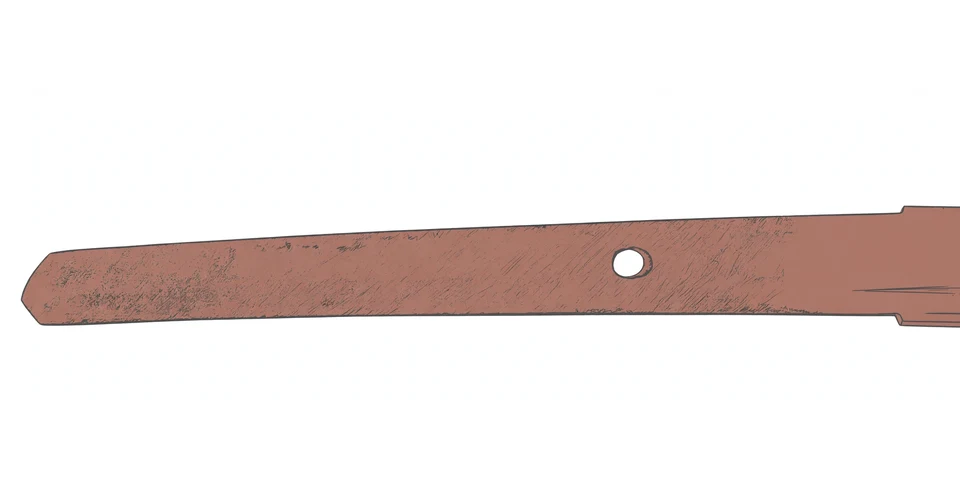
The idea for this article grew from a single line in the earlier piece on how the katana became the soul of the samurai, which noted that the part you never see in a museum photograph is the nakago, the tang hidden inside the handle, and it is where the smith signs the blade. That line deserved a whole article of its own, because the nakago is where the katana stops being a beautiful object and starts being a document. Everything about it, its shape, its rust, its file marks, and its signature, can be read by someone who knows the language.
What a nakago actually is
The nakago is the extension of the blade that fits inside the tsuka, the handle. It is the same piece of steel as the blade, not a separate part welded on, and it runs from the notches at the base of the cutting edge down to the butt end of the nakago. In a mounted sword you cannot see it at all. The handle covers it completely, and a single bamboo peg passes through the handle and through a hole in the nakago to lock the whole assembly together.
That invisibility is the point. The visible blade is polished to a mirror finish and kept oiled and protected. The nakago is left exactly as the smith finished it, rough, dark, and unpolished. The contrast is deliberate, and it is the first thing to understand about this part of the sword. The blade is made to be seen. The nakago is made to work, and to remember.
A katana's handle, the tsuka, is a wrapped grip built around the nakago, and the fit between the two has to be exact. If the nakago is too loose, the blade rattles and the shock of a cut travels wrong. If it is too tight, the wood of the handle can split. The rough surface of the nakago helps here, because the file marks and the slight texture of the steel grip the inside of the handle. The nakago does not need to be pretty. It needs to hold.
Why the nakago is left rough
It seems strange at first. A swordsmith spends days forging and folding steel, and a polisher spends weeks bringing the blade to a finish that can take a reflection, yet the nakago is left looking unfinished. The reason is practical, and it reveals something about how Japanese craftsmen think about function.
The rough, filed surface of the nakago gives the handle something to bite into. A polished nakago would be smooth, and a smooth nakago could twist inside the handle under the force of a cut. The file marks act like tiny teeth, holding the blade steady. The grip that holds a katana together depends on this friction, and the single bamboo pin that passes through the nakago is a backup, not the whole system. The pin locks the assembly, but the grip of the nakago inside the handle does the daily work.
There is a second reason, and it matters more for history. Once a nakago is polished, the evidence it carries is gone. The file marks disappear, the rust that records age is stripped away, and the signature can be thinned or lost. Leaving the nakago untouched preserves a record that cannot be recreated. A blade can be repolished many times over its life, and each polishing changes its surface a little. The nakago cannot be touched without destroying the very evidence it carries, so the tradition is to never touch it at all. The rule among collectors and caretakers is simple, and it is worth remembering. Never clean the nakago. Never oil it. Never polish it. The dark patina on its surface is not dirt to be removed. It is the sword's own archive.
I find this restraint moving. In a culture that polishes so much to perfection, the most honest part of the sword is the part that is deliberately left alone. There is a lesson in that for anyone who makes things, or who cares for old things. Not every surface needs to shine. Some surfaces need to be left as they are, because their value is in what they remember, not in how they look.
The signature carved in steel
The most famous thing about the nakago is the signature. The smith's name, the mei, is chiselled into the nakago, usually on the side that faces outward when the sword is worn. Alongside the name there may be a date, a province, or the name of the person who ordered the blade. For a sword that has survived for centuries, this small inscription is often the only direct statement of who made it and when.
But the signature is not a certificate, and the relationship between a signature and a sword's value is more complicated than most people expect. A genuine mei by a recognised smith adds certainty and usually adds value. Yet the presence of a signature is not proof of authenticity on its own, because signatures can be faked. A false signature, known as gimei, has been practised since the Muromachi period, and it remains the main form of fraud in the historic sword market. A gimei blade is often a genuine sword, but the name on it belongs to someone else, usually a more famous smith, and its value is the value of the real maker's work, not the inscribed name.
Then there is the opposite case, the unsigned blade, or mumei. A blade without a signature is not a lesser blade. Many of Japan's most celebrated historical swords are mumei, including works by Masamune and by Go no Yoshihiro, two of the most revered smiths in the tradition. A blade can be unsigned for several honest reasons. The smith may have chosen not to sign a particular commission. The blade may predate the practice of signing. Or the signature may have been lost when the blade was shortened, which is a story of its own.
The signature also has to be consistent with the rest of the blade. An appraiser does not simply read the name and accept it. The character of the inscription is compared with known examples of the smith's signing style. The depth and freshness of the carving are checked against the age of the surrounding patina. If the engraving looks fresher than the rust around it, that is a warning sign, because a genuine signature ages together with the steel it sits in. The patina should settle naturally into the carved characters, not sit awkwardly around them. A signature that was added after the patina had already developed often betrays itself this way.
How to read the file marks
The file marks on the nakago, called yasurime, are the parallel lines left by the smith's file as the nakago was shaped after forging. To an untrained eye they look like scratches. To an appraiser they are a fingerprint. Different schools used different filing patterns, and the angle, direction, and depth of the marks varied systematically across the major traditions and periods. These patterns were part of each school's transmitted technique, as characteristic as the school's preferences for grain or temper line.
Some patterns are easy to picture. Kiri marks run horizontal, straight across the nakago. Sujikai marks run diagonal. O-sujikai marks are steeply diagonal, and they are associated with the Soshu tradition and the school of Masamune. Katte-sagari marks slant diagonally toward the edge, and they appear often in Shinto period work and in many Edo era schools. Higaki marks cross each other in a lattice pattern. Sensuki marks are very fine parallel lines, found in high quality Shinto work. There are more patterns than these, and the details matter, but the principle is simple. The file marks are not decoration, and they are not random. They are a habit of the hand, passed from teacher to student, and they survive on the nakago long after the teacher is gone.
In kantei, the appraisal practice of attributing a blade from its physical evidence, the yasurime are examined alongside the grain of the steel and the temper line as one of the primary diagnostic indicators. A filing pattern that does not match the claimed period or school is significant evidence against the attribution. A forger can copy a signature, but copying the exact filing habit of a school, with the right angle and depth and rhythm, is far harder, and the file marks are one of the first things a careful appraiser checks.
The file marks also tell a smaller, more human story. They show whether the smith was right handed or left handed, and they show the confidence of the hand that made them. A steady, even pattern speaks of a smith working in a settled tradition. An uneven pattern can suggest a provincial workshop, or a later hand touching an old blade. Either way, the marks are evidence, and they are evidence that cannot be faked convincingly in a hurry.
The rust that tells the age
The patina on the nakago, called nakago-sabi, is the rust that develops naturally on the unpolished steel over decades and centuries. It is the single most reliable indicator of a sword's genuine age, and it is the feature that forgers have never convincingly reproduced.
Steel that has been oxidising for two hundred years develops a specific depth, colour, and texture of rust that is fundamentally different from steel exposed to air last year. The colour shifts from reddish brown in younger blades toward a deeper, almost blackish brown in very old ones. The texture becomes finer and more integrated with the surface of the steel, and the patina settles into the file marks rather than sitting on top of them. A recent chemical treatment can darken steel quickly, but the result looks wrong to an experienced eye. The colour is too uniform, the depth is wrong, and the relationship between the patina and the file marks is different.
This is why the rule against cleaning the nakago matters so much. A cleaned or polished nakago is a nakago whose most important information has been partly or wholly destroyed. The patina is irreplaceable evidence, and once it is gone, no one can put it back. Collectors who are new to Japanese swords sometimes want to make the nakago look tidy, and that instinct is exactly backwards. The untidiness is the proof. The dark, reddish brown surface is the sword's built in age certificate, one that requires no issuing body and cannot be falsified.
There is a quiet honesty in this. The blade can be made to look new again by a skilled polisher, and the temper line can be brought out more clearly, but the nakago refuses to lie about its age. It carries its years openly, in a colour that only time can produce. I think that is why appraisers trust it. In a field full of beautiful objects that can be restored, copied, and improved, the rust on the nakago is the one thing that can only be earned.
The shape of the nakago tip
The tip of the nakago, the nakago-jiri, is another feature that speaks volumes. Different periods and schools developed characteristic tip shapes, and these were transmitted within each tradition and changed systematically over time. The shape of the tip is one of the most reliable period indicators available in nihonto appraisal.
Common forms include kurijiri, a rounded chestnut shape common in Kamakura and Nanbokucho work. Kengyo is pointed, like an inverted V, and is characteristic of certain Soshu and Yamato schools. Iriyamagata is a notched V shape. Haagari is a shape where the edge side rises, seen in certain Muromachi and Shinto period work. There are other shapes, and the full vocabulary is large, but the point is that these shapes were not random. They followed the same school specific transmission as every other element of the smith's technique.
An appraiser reads the tip shape together with the file marks and the patina. A rounded kurijiri tip on a blade claimed to be Shinto period would be unusual. A sharply pointed kengyo tip on a blade claimed to be early Kamakura work would need an explanation. A tip shape inconsistent with the claimed period is one of the fastest ways an experienced appraiser identifies a problematic attribution. The nakago tip is small, and it is hidden, but it is one of the most informative square centimetres on the whole sword.
The peg hole and the bamboo pin
The hole through the nakago, the mekugi-ana, is where the bamboo peg passes to lock the blade into its handle. Most katana have one hole, and some have two. The hole is not just a fastener point. It is also a record of the sword's history, because every time a blade is shortened or remounted, a new peg hole may be made.
When a blade is shortened, the nakago is cut down, and a new hole is drilled in the new position. The old hole may be plugged, sometimes with a sliver of wood or a plug of metal, and the plugged hole remains visible as a small circle in the steel. A nakago with two holes, one of them plugged, has been remounted at least once. A nakago with several holes has lived through several mountings, and each one marks a moment when someone cared enough about the blade to fit it to a new handle, or to a new style of wearing it.
The bamboo pin itself deserves a mention, because it is the smallest part of the sword and one of the most important. A single bamboo peg, the mekugi, holds a katana together, and the system works because the pin is designed to be the part that fails first. If the sword suffers a terrible shock, the bamboo pin shears before the blade or the handle breaks, and it can be replaced in minutes. The nakago and the pin are partners in this design. The nakago provides the steel and the hole, and the pin provides a replaceable, forgiving lock. The whole assembly is a lesson in designing for repair rather than for permanence.
How the nakago takes the force of a cut
A katana is a lever as well as a blade. When the edge meets a target, the shock travels back through the steel, through the nakago, and into the hands. The nakago is what carries that force, and its shape and fit decide how the shock is distributed.
Because the nakago is unpolished and rough, it grips the inside of the handle, and the force of a cut is spread across the whole contact surface rather than concentrated at the pin. The pin holds the blade in place, but the nakago does the work of transferring energy. This is why the fit between nakago and handle matters so much, and why a loose nakago is a serious problem. A blade that rattles in its handle does not just feel wrong. It concentrates force where it should not be concentrated, and it can damage the handle or the pin.
The tang also gives the sword its balance. The weight of the steel inside the handle counterbalances the weight of the blade outside it, and the length and thickness of the tang affect where the sword balances in the hand. A tang that has been shortened changes that balance, sometimes noticeably. Swordsmiths shape the tang with this in mind, tapering it toward the tip and thinning it in a way that keeps the sword lively without making it fragile. The hidden part of the sword, the part nobody sees, is part of what makes the visible part feel right in the hand.
Suriage, when the tang is shortened
One of the most important things a tang reveals is whether it is in its original condition, called ubu, or whether it has been shortened, called suriage. An ubu tang is exactly as the smith left it, with the original file marks, the original tip shape, and, if the blade was signed, the original signature. For attribution purposes, an ubu tang is the most informative possible state, because nothing has been removed.
Suriage means the tang has been cut down, usually because the blade was remounted in a shorter handle style at some point in its history. The most common reason was the transition from the long handled tachi, worn edge down from the belt, to the shorter katana, worn edge up through the belt, a change that became standard from the late Muromachi period. Shortening removes the lower portion of the original tang, and with it, in many cases, the smith's signature, the original tip shape, and some of the original file marks.
O-suriage is extensive shortening, typically leaving only a fraction of the original tang. Most o-suriage blades are unsigned, or mumei, as a direct result of the shortening having removed the signed portion. This is one of the most common legitimate reasons for unsigned status in antique blades. The signature was not absent from the original work. It was present on the portion that was later removed.
There were practical reasons for shortening beyond fashion. Steel was expensive, and shortening a fine old blade to fit a new style of fighting was cheaper than forging a new sword. Radical changes in fighting styles, from horseback to foot soldiers, and later Tokugawa regulations on the lengths of swords that people could legally wear, also pushed many fine old swords through shortening. A good blade was too valuable to discard, so it was adapted, and the tang paid the price.
Shortening was always done on the tang, never on the tip of the blade, because cutting the tip would have destroyed the tempering of the point. The work was done carefully, but it was still a loss. The notches at the base of the blade, the hamachi and munemachi, were moved higher up, and a new peg hole was drilled. Each change left traces, and those traces are exactly what an appraiser reads today.
When the signature survives shortening
Losing a signature to shortening was so common that sword workers developed ways to save it. The most ingenious of these is orikaeshi-mei, the folded back signature. The portion of the tang bearing the signature is thinned down and bent around to the opposite side of the newly shortened tang. The original signature is preserved, but it appears upside down on the opposite part of the tang. An experienced appraiser will note the presence of an orikaeshi-mei and account for it, because a displaced signature tells its own story about the blade's history.
Another method is gaku-mei, the framed signature. The metal bearing the signature is cut out in a rectangular shape, thinned, and then reattached to the new tang. It is sometimes called tanzaku-mei, because the cut out signature resembles a tanzaku, a small vertical poem card. A related technique, hari-mei, or patched signature, attaches the cut out section with small rivets. These methods saved many signatures that would otherwise have been lost, but they also created new problems, because a signature taken from one blade can be attached to another. Assessing an added signature is more challenging than evaluating an ordinary signature, and the junction where the panel meets the tang is examined closely. With a genuine orikaeshi-mei, the signature and the tang are one continuous piece of metal, folded over. With a faked one, the join betrays itself.
There is also a museum case that shows how complicated this can get. A sword in the Western Australian Museum bears two signatures dated about 350 years apart, and its tang was shortened more than once, removing vital information each time. The older signature was cut across and partly lost, and a later signature was added over a plugged peg hole. The museum's own record treats the blade as a 19th century copy of a 16th century tachi, and it is honest about the doubt. That case is a reminder that the tang does not always give a clean answer. Sometimes it gives a puzzle, and the honest response is to say so.
Tachi-mei and katana-mei, the signature changes sides
Where a signature sits on the tang depends on how the sword was worn, and that detail alone can tell an appraiser whether a blade began life as a tachi or as a katana. A tachi was worn suspended from the belt with the cutting edge facing down, and its signature, the tachi-mei, was carved on the side of the tang that faced outward when the sword was worn. A katana was worn thrust through the belt with the cutting edge facing up, and its signature, the katana-mei, was carved on the side that faced outward in that position. Because the two styles of wearing face opposite ways, the signature sits on opposite sides of the tang.
Most swords produced during the Muromachi period feature tachi-mei, and most swords produced after the Muromachi period feature katana-mei. There are exceptions, and they are well known enough to be worth naming. Some smiths, such as Yukihira and the Ko-Aoe school, signed their tachi on the inner side, facing the body. Some later smiths, such as Yamashiro no Kami Kunikiyo and the Tadayoshi and Suishinshi schools, inscribed their work with tachi-mei even when the sword was a katana. These exceptions do not break the rule. They refine it, and they show why attribution is a matter of weighing many small pieces of evidence together rather than following a single rule.
The placement of the signature is also useful when a blade has been shortened and remounted. A tachi that was cut down and remounted as a katana may carry a tachi-mei on a blade that is now worn the other way around. That mismatch is not an error. It is the fingerprint of the blade's conversion, and it is one of the ways an appraiser can reconstruct a sword's history from the tang alone.
What a polisher and an appraiser read from it
A polisher and an appraiser look at the same tang, but they look for different things, and the difference is instructive. A polisher looks at the tang to understand what must not be touched. The tang tells the polisher where the blade begins and where the work of polishing must stop. The notches at the base of the tang mark the boundary, and a polisher who works past them has damaged the sword. The polisher also reads the tang to understand the blade's history before touching the steel, because a shortened blade, or a blade with a repaired tang, may need different treatment.
An appraiser reads the tang as a document. The sequence is methodical. First, the overall condition. Is the patina even and integrated, or does it show signs of having been disturbed. Are there areas of different colour that suggest partial cleaning, or evidence of artificial patination. Second, the patina colour and depth, checked against the claimed period. A reddish brown, fine grained patina with good depth suggests a blade of significant age. A coarser, lighter, or more superficial patina suggests a younger blade or a tang that has been disturbed. Third, the file marks, checked for pattern, consistency, and whether they match the claimed school and period. Fourth, the tip shape, checked against the period. Fifth, if a signature is present, the character of the inscription, its consistency with the claimed smith's style, and whether the patina settles naturally into the carved characters.
The fullest account of this sequence comes from a detailed guide to the nakago published by a Japanese sword dealer, which describes the tang as the single most reliable source of information about what a sword actually is, when it was made, who made it, and whether what you are being told about it is true. That guide is worth reading in full by anyone who wants to go deeper, and it is linked in this article. The same guide notes that the NBTHK's appraisal specialists examine the tang as carefully as the blade when attributing unsigned or uncertified pieces, because for attribution purposes the tang is often the primary source, not a secondary one.
A short table of what the tang records
A table helps to hold the details together, because the tang records so many things at once, and each of them points in a different direction.
| Feature | Japanese term | What it records |
|---|---|---|
| Signature | Mei | Smith, province, date, sometimes the patron |
| File marks | Yasurime | School, period, handedness of the smith |
| Patina | Nakago-sabi | Age, and whether the tang was ever cleaned |
| Tip shape | Nakago-jiri | Period and school |
| Peg hole | Mekugi-ana | Number of remountings, and shortening history |
| Tang condition | Ubu or suriage | Whether the blade is original or shortened |
The table is only a summary, and it does not replace looking at a real tang. But it shows why the tang is described as a record rather than a part. Each row is a different kind of evidence, and together they let an appraiser cross check a blade from several directions at once. A signature can be faked, but a signature plus the right file marks plus the right patina plus the right tip shape is far harder to fake, because each piece of evidence comes from a different hand and a different century of handling.
Why the hidden part matters most
There is a reason the tang is the part of the sword that appraisers trust. The blade can be repolished, and the polish can make a tired blade look fresh. The handle can be replaced, and a new handle can make an old sword look new. The scabbard can be relacquered. Almost everything about a katana that you see can be renewed, and renewal is part of the tradition. The tang is the exception. It is never renewed, and that is what makes it honest.
A second guide to the tang, focused on the condition of shortened blades, makes the same point from the other direction. It notes that some of the finest old swords survive only because they were shortened, and that a shortened tang from a renowned smith can still possess considerable value. The tang's condition is not a simple scale from good to bad. An original tang is the most desired condition, but a shortened tang with a preserved signature, or a tang that tells a clear story of conversion from tachi to katana, has its own historical value. What matters is not whether the tang is perfect. What matters is whether it is honest, and whether its story can be read.
That feels like the right way to think about the nakago, and perhaps about old things in general. We are used to judging objects by their visible surfaces, and we are used to restoring those surfaces when they fade. The tang refuses that treatment, and in refusing it, it preserves something that restoration would destroy. It is a small, dark, rough piece of steel that nobody sees, and it is the most truthful part of one of the most beautiful objects ever made.
The next time you see a katana in a museum, behind glass, remember that the part you are looking at is only half the sword. The other half is hidden inside the handle, dark with centuries of rust, marked with the file strokes of a smith whose name you may never know, and carrying a signature that may have survived the cutting down of its own tang. The blade is what the sword shows the world. The nakago is what the sword keeps for itself, and it is worth learning to read.
More in Culture & Society
- Wakizashi Was the Short Sword a Samurai Never Took Off
- Tsuba Is the Small Guard That Stops a Katana From Cutting Its Owner
- Yokote Is the Small Line That Tells a Katana's Age
- Seppa Are the Thin Washers That Keep a Katana From Rattling
- Kissaki Is the Small Tip That Finishes a Katana
- Mekugi Holds a Katana Together With a Single Bamboo Pin
Latest posts
- Why a Katana Stays Put, Thanks to the Koiguchi
- Tsuka-Ito Is the Cord That Binds a Katana Grip
- Fuchi Is the Collar That Frames a Katana Grip
- Kashira Is the Small Cap That Finishes a Katana Grip
- Sageo Is the Cord That Ties a Katana to Its Samurai
- Menuki Are the Small Ornaments Hidden Under a Katana Grip
- Habaki Is the Copper Collar That Locks a Katana in Its Sheath
- Maedate Is the Crest That Turned a Samurai Helmet Into a Banner
- Samegawa Is the Ray Skin Hiding Under Every Katana Grip
- Tatara Is the Clay Furnace Where Tamahagane Begins
- Tsuka Is the Wrapped Grip That Lets a Katana Speak
- The Tanto Was the Small Blade a Samurai Trusted With His Life
- Tamahagane Is the Jewel Steel Behind Every Katana
- Seppuku Was the Ritual a Samurai Chose Over Disgrace
- Saya Is the Lacquered Sheath That Guards the Katana