Shuzenji, the Oldest Hot Spring Town in Izu
· 9 min read
Shuzenji is the oldest hot spring town on the Izu Peninsula, a compact riverside town in Izu City built around a temple and a spring that both trace back to 807, with a bamboo path, a 700 yen public bath and the largest maple grove in Izu.
Some hot spring towns sprawl across a whole mountainside. Shuzenji does not. The oldest hot spring town on the Izu Peninsula fits into a single river valley in Izu City, where a temple, a bamboo grove, a handful of red bridges and one very old spring all sit within a few minutes of each other. You can walk across the whole town before your coffee goes cold.
Almost everything here traces back to a single year, 807, and a single travelling monk. The story the town still tells about Kukai, better known across Japan as Kobo Daishi, is part history and part legend, and Shuzenji has never felt the need to separate the two.
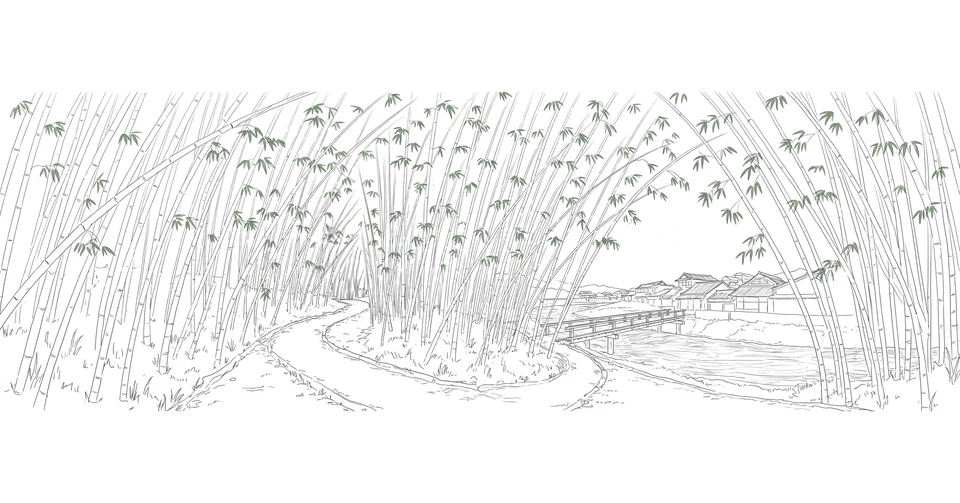
What grew from that year is a small and unusually complete onsen town, the kind people call the Little Kyoto of Izu. It is a flattering nickname, but walking the riverside at dusk, with the lanterns coming on and the water moving below the old inns, it does not feel like much of an exaggeration.
A spring that began with a monk and a rock
According to local tradition, Kukai came to Shuzenji in 807 and found a boy washing his sick father in the cold water of the Katsura River. Moved by the boy's devotion, he struck a rock in the river with a tokko, a Buddhist ritual implement he carried, and hot water began to flow from beneath it.
That spring became Tokko no Yu, and the town treats it as the birthplace of Shuzenji Onsen and the beginning of hot spring bathing on the whole peninsula. The stone bath still sits beside the river in the middle of town, inside a small pavilion that has become the symbol of Shuzenji.
There is one catch. You cannot bathe in it. Tokko no Yu is preserved for viewing only, and it cannot be used even as a footbath. I find something honest in that. The most important bath in town is one nobody enters, kept as a reminder of where the town started rather than another attraction with a ticket window. If your feet need warm water, free footbaths nearby, such as Kawara-yu beside the river, do the job instead.
The legend, the temple and the walking routes are laid out in detail in this guide to Shuzenji Onsen, which is worth reading before a visit.
The temple that gave Shuzenji its name
Across the river stands Shuzenji Temple, and tradition credits Kukai with founding it in the same year as the spring, 807. Temple and town share a name and, confusingly, slightly different characters in Japanese, although both are pronounced exactly the same way.
The temple began as a Shingon temple, belonging to the school Kukai himself founded, and later became a Soto Zen temple. Under the Hojo family in the Kamakura period it grew rich and powerful, and that power pulled the town into darker history. Minamoto no Yoriie, the second shogun of the Kamakura shogunate, lost a struggle for power against his mother's family, was sent here and confined, and was assassinated in 1204 while still in his early twenties.
His grave survives on the wooded slope opposite the temple, beside Shigetsuden, a small hall his mother built to pray for him, which is considered the oldest surviving wooden building in Izu. Inside the temple grounds there is a quieter detail I like even more. The water basin is supplied with hot spring water, so visitors wash their hands in warm onsen before entering. In this town, even the temple plumbing remembers the spring.
The town's literary fame rests on a grimmer visit. In August 1910 the novelist Natsume Soseki came here for treatment of a stomach ulcer and stayed at the Kikuya inn. His condition collapsed, and on 24 August he suffered a massive haemorrhage that left him close to death. He slowly recovered and reached Tokyo again in October, and the episode is still remembered as the Great Illness at Shuzenji. Kikuya still operates beside the river.
Walking the river and the bamboo path
The real centre of town is the Katsura River itself, crossed by red bridges that connect the temple side with the ryokan and the wooded slopes opposite. Upstream, the Bamboo Forest Path, Chikurin no Komichi, follows the river for a few hundred metres between Katsura Bridge and Takishita Bridge.
Tall bamboo closes in around the stone path, with the river visible through gaps in the grove, and a large round bamboo bench sits in the middle for anyone sensible enough to stop. The path is lit after dark, and the town quietly rewards anyone who stays overnight. Mornings, before the day visitors arrive from the station, are the calmest time to walk it.
My own feeling is that the path works best as an excuse rather than a destination. Cross the bridges, climb the slope to Shigetsuden, come back down past the temple, then stop for a footbath or a coffee. The centre is compact enough that an exact route would only get in the way.
Bathing at Hakoyu, the town's public bath
For all its history, bathing here today mostly means one modest building. The town once had seven public baths along the river, but they disappeared one by one during the twentieth century. Hakoyu opened in 2000 to bring that communal bathing tradition back, and its name reaches back to a bath said to have been used by Yoriie himself.
Inside there is a simple indoor stone bath filled with the local spring water, an alkaline simple spring that comes out of the ground at around 61 degrees and reaches the bath clear, soft and without any smell of sulphur. Admission for adults is 700 yen, the doors are open from morning to nine at night, and a small observation tower next door looks out over the roofs of the onsen quarter. It is the same everyday bathing culture you find in a city sento, just practised with water that has been famous for twelve centuries.
The usual rules apply, wash before entering and keep your towel out of the water, and policies on tattoos vary from bath to bath across the country, as the long debate over onsen tattoo rules makes clear. At Hakoyu the scale is small enough that nobody is performing for anyone. It feels like a neighbourhood bath that happens to sit in a famous town.
The maple grove and the late autumn
The town saves its biggest show for last. The Shuzenji Maple Forest is said to be the largest maple grove in Izu, and the nearby nature park holds roughly 1,000 maple trees, one of the largest concentrations of autumn colour on the peninsula.
Because Izu is mild, the colour arrives late. The main season runs from mid November to early December, later than almost anywhere else in the region, and the maples around the temple and the onsen streets can hold on towards the middle of December. Parts of the town are illuminated after dark during the season, and extra buses run for the crowds.
There is a pleasing symmetry in the timing. Most of Japan's famous autumn spots have peaked and emptied while this valley is still green, so the town gets its moment after everyone else has gone home. Spring and early summer bring a gentler version of the same walks, with fresh green maple leaves from around mid April and fireflies beside the river in late May and early June.
Mountain food, wasabi and black rice
Inland Izu cooks from the mountains rather than the sea. The signature ingredient is hon wasabi, real wasabi, grown in the cool and clean streams of the Amagi mountains, and Izu remains one of Japan's major wasabi producing areas.
Look for a meal where you grate the fresh root yourself at the table. Fresh wasabi is more aromatic and far less aggressive than the paste squeezed from a tube, with a sweetness that fades within minutes of grating. The town even puts it on soft serve ice cream, where the heat cuts through the vanilla better than it has any right to. Local shiitake mushrooms, grown slowly on natural hardwood logs, and black rice, sold as rice, sweets and mochi around the onsen quarter, round out a table that tastes of the hills rather than the harbour.
Getting to Shuzenji
Shuzenji Station is the terminus of the Izu Hakone Railway Sunzu Line, but the hot spring town is not beside the station. Buses take roughly ten minutes from the station to the onsen quarter, and taxis wait outside.
From Tokyo there are two simple routes. The Odoriko limited express runs direct through Atami and Mishima and reaches Shuzenji in about two hours. Or take the Tokaido Shinkansen to Mishima and change onto the local line, about 32 minutes of slower railway through the hills, which usually gives you more departures to choose from. Current bath prices, opening hours and seasonal dates are tracked in this Everything Tokyo guide to Shuzenji. Once you arrive in the town itself, you will not need any transport again until you leave.
Plenty of onsen towns in Japan are bigger than this one, and a few are grander. What Shuzenji has instead is proportion. Twelve centuries of history fit inside one short valley, and the town has resisted the urge to spread them out or dress them up. A spring you cannot enter, a public bath that costs 700 yen, a bamboo path you could walk in five minutes and should walk in thirty. That restraint, more than the legend of the monk and the rock, is why Shuzenji stays with you.
More in Food & Travel
- Katsuobushi Is a Fish You Shave Like a Block of Wood
- Why Kagami Mochi Is Never Cut With a Knife
- Narazuke Pickles Spend Years Asleep in Sake Lees
- Tomozuri Sends a Living Fish to Do the Fishing
- Dashi, the Quiet Stock Under Almost Everything Japan Cooks
- Ayu, the Sweetfish That Rules Japan's Clear Rivers
Latest posts
- How Supersemar Borrowed the Authority of a God
- Bali Has Its Own Semar, and His Name Is Twalen
- White Silk Means You Made It as a Sekitori
- The Dohyo-Iri Gives a Yokozuna Three Minutes to Own the Ring
- Nobody Commutes to a Heya
- Tokyo Keeps a Hundred Tiny Fujis Called Fujizuka
- One Thousand Three Hundred Years of Ukai Nights on the Nagara River
- Fuji Ko, the Pilgrim Societies That Climbed Mount Fuji Together
- Gensen Kakenagashi, the Onsen Water That Never Circles Back
- Shiko, the Leg Stamp That Starts Every Sumo Day
- Semar, the God Who Chose to Work as a Servant
- Kyushoku and the Japanese School Lunch
- Sumadori, Japan's Smart Drinking for People Who Do Not Drink
- Sake Kasu, the Sake Lees Japan Cooks With Instead of Throwing Away
- Bureiko, the Drinking Party Where Rank Is Left at the Door