One Strike of a Priest's Staff Opened Tokko No Yu
· 11 min read
In the middle of the Katsura River at Shuzenji sits tokko no yu, the spring that legend says Kobo Daishi opened with one strike of his ritual staff in 807, and that the town calls the oldest hot spring in Izu.
In the middle of the Katsura River in Shuzenji, standing on a sandbar in the current, there is a small roofed stone bath that nobody is allowed to use. The town calls the spring beneath it tokko no yu, and it treats this one modest pool as the place where hot spring bathing in Izu began.
By local legend, it started with a single blow. In the year 807 the monk Kukai, better known across Japan as Kobo Daishi, struck a rock in the river with the ritual implement he carried in his hand, and hot water came up out of the stone. Twelve centuries of bathing culture in this one valley trace themselves back to that strike.
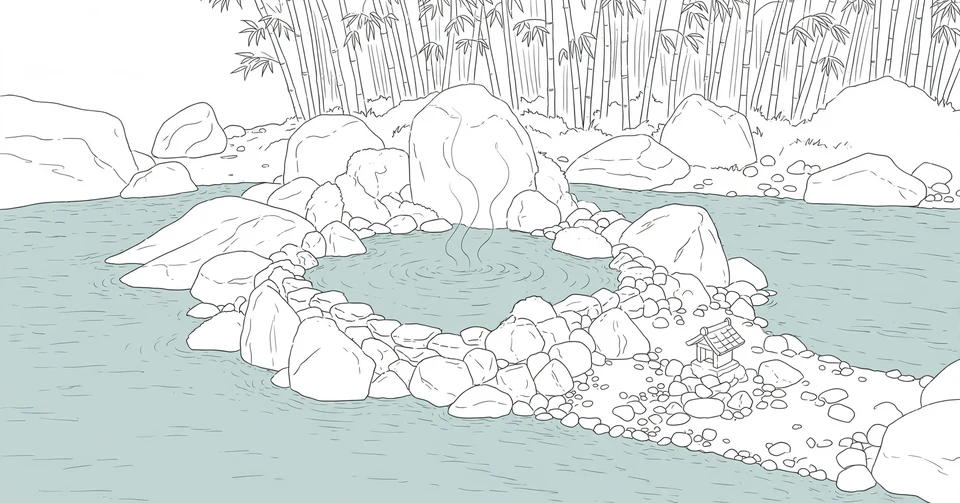
What makes tokko no yu unusual among famous springs is how little the town has done with it. There is no ticket gate and no changing room. You stand on the bank or on one of the red bridges, watch the steam lift off the water, and that is the whole experience. Everything else in Shuzenji, the inns, the public bath, the footbaths along the bank, exists because this small spring was here first.
The legend of the boy, the father and the rock
The story the town tells is specific, and it is worth telling in full. Kukai, who lived from 774 to 835 and founded the Shingon school of Buddhism in Japan, was travelling through the Izu mountains in 807, in the early Heian period. Beside the Katsura River he came across a boy washing his sick father in the cold water of the stream.
Moved by the boy's devotion, the monk struck a rock in the river with his tokko, and hot water began to flow from beneath it. In the fuller versions of the tale, the father bathed in the new spring and his long illness lifted within days. That spring is tokko no yu. It kept the name of the tool that opened it, and the town that grew around it has repeated the story ever since.
Shuzenji is careful, in its own telling, to present this as legend and tradition rather than documented history, and that honesty is part of its charm. Stories of Kobo Daishi opening springs with a strike of his staff are attached to hot springs in many parts of Japan, because the monk travelled widely and his name gathered miracles the way famous names do. What is unusual here is the precision of the claim. The town gives a year, a river, a named rock in a named stream, and it has organised its whole centre around the spot for the twelve centuries since.
The town that grew around the spring has its own story, from the temple across the water to the bamboo path along the bank, and we have told it in our piece on Shuzenji, the oldest hot spring town in Izu. This article stays with the spring itself, because tokko no yu is the reason all of that exists.
What a tokko is, and why the spring kept its name
A tokko, also written tokkosho, is a Buddhist ritual implement, a single pronged vajra held in one hand during esoteric rites. It is a small object, closer to a hand bell in size than to a walking staff, whatever the English retellings of the legend sometimes suggest. In the story of tokko no yu, it is simply what the monk had in his hand when he saw the boy and his father.
Tokko no yu is named after it directly. The name means, more or less, the hot water of the tokko. There is no poetry in the name and no reference to healing, royalty or gods. A whole town's identity rests on the name of a small metal tool, which tells you how completely the legend, rather than the water alone, is what Shuzenji has been protecting.
The implement itself has not been forgotten either. Across the river, the treasure hall of Shuzenji Temple keeps a gilt bronze tokko that local tradition associates with the Kukai legend, alongside other objects tied to the history of the temple and the spring. Whether or not any traveller believes the object is the very one from 807, its presence shows how seriously the town curates the story of tokko no yu. The spring in the river and the implement in the hall are two halves of the same exhibit, and tokko no yu is unintelligible without both.
The temple across the river
Temple and spring arrived together, at least in the town's account of itself. Tradition credits Kukai with founding Shuzenji Temple in the same year as tokko no yu, 807, on the opposite bank of the Katsura. The temple began as a Shingon temple, belonging to the school Kukai himself founded, and in later centuries it became a Soto Zen temple, which it remains today.
Temple and town share a name and, confusingly, slightly different written characters in Japanese, although both are pronounced exactly the same. Under the Hojo family in the Kamakura period the temple grew rich and powerful, and that power pulled Shuzenji into darker history. Minamoto no Yoriie, the second shogun of the Kamakura shogunate, lost a struggle against his mother's family, was confined here, and was assassinated in 1204 while still in his early twenties. Local tradition places his death in a bath, which is a grim footnote for a hot spring town. His grave survives on the wooded slope opposite the temple, beside Shigetsuden, a small hall his mother built to pray for him and which is considered the oldest surviving wooden building in Izu.
My favourite detail in the temple grounds is a practical one. The basin where visitors rinse their hands before entering is supplied with hot spring water, so you wash in warm onsen rather than cold tap water. In most temple towns the sacred and the everyday sit side by side. In Shuzenji the plumbing itself connects them, and it connects both back to tokko no yu in the river below.
What you actually see at tokko no yu today
Today tokko no yu is a marker more than a bath. A small stone pool sits inside a modest open pavilion on a sandbar in the middle of the Katsura River, a short walk from the temple, and it has become the recognised symbol of Shuzenji Onsen. You view it from the bank or from the bridges. You do not get in.
That was not always the arrangement. For centuries the spring in the river was used as an open air bath, and some older guidebooks, and a fair number of websites copying them, still describe tokko no yu as a footbath. The current position on the ground is stricter. In 2009 the little pavilion of tokko no yu was shifted a short distance downstream during flood protection work on the river, and the spring is now preserved for viewing only. It cannot be used for bathing, and it cannot be used as a footbath either. The present rules and the layout of the town around the spring are set out clearly in this guide to Shuzenji Onsen, which is worth reading before a visit because so many other sources are out of date on exactly this point.
If your feet need warm water, the town provides it a few steps away. Free footbaths sit beside the river, Kawara-yu among them, so nobody has to feel cheated. The distinction matters to Shuzenji. Tokko no yu is kept apart, and the ordinary pleasure of soaking your feet happens in ordinary places built for the purpose.
There is one exception each year, and it is a telling one. Every April the town holds Yukumi-shiki, a ceremony of thanks to the hot spring and to the founder of the temple. Around thirty representatives chosen from the town put on traditional dress and draw water from tokko no yu in a formal rite. Tokko no yu, in other words, has not been retired. It has been promoted, from a bath anyone could use to a source the town itself approaches once a year, carefully and on behalf of everyone. The April ceremony and the rest of the town's seasonal calendar are described in this Shuzenji Onsen guide.
I find the town's restraint persuasive. A working bath in the middle of a river would have been rebuilt, retiled, fenced, monetised and repaired beyond recognition many times in twelve centuries. A spring that nobody enters can simply be kept. By refusing to let tokko no yu be used, Shuzenji has probably preserved more of it than any amount of careful restoration would have.
The water the legend points to
A legend can start a town, but only the water keeps it going, and Shuzenji's water has carried the place for a very long time. The water of tokko no yu, the water the whole town draws on, is an alkaline simple spring, clear and colourless, without the smell of sulphur or the heavy salinity of the peninsula's coastal sources. Tourism information puts the main source at around 61 degrees Celsius before individual properties adjust it for their baths.
Simple springs carry a relatively low load of dissolved minerals, which generally makes them gentle on the skin and easy to sit in. Japan's official onsen classification associates this water with relief of muscle and joint discomfort, sensitivity to cold and general fatigue. Those are the traditional indications attached to the spring type, not promises of treatment, and Shuzenji is a better place for understanding them as an old bathing culture's way of describing water that feels kind.
The everyday bathing that tokko no yu symbolises now happens elsewhere. The town once had seven public baths along the river, and they disappeared one by one during the twentieth century. Hakoyu opened in 2000 to bring the communal tradition back. Inside is a simple indoor stone bath of local spring water, adults pay 700 yen, and a small observation tower next door looks out over the roofs of the onsen quarter. The ryokan along the river run their own baths, and some make a point of water drawn straight from the source and never recirculated, the quality known as gensen kakenagashi. It is a fitting detail. A town founded by a spring that flowed freely out of a rock still cares, twelve centuries later, about whether the water in the bath arrived directly from the ground.
Standing on the bank
Getting to tokko no yu takes a little patience, which suits it. Shuzenji Station, the terminus of the Izu Hakone Railway Sunzu Line, is not beside the onsen quarter, and buses take roughly eight to ten minutes from the station to the centre of town. From Tokyo, the Odoriko limited express runs direct to Shuzenji in about two hours, or you can ride the Tokaido Shinkansen to Mishima and change onto the local line through the hills, which usually offers more departures.
Once you are in the centre, everything is a walk. Tokko no yu sits in the river between the temple side and the ryokan side, and the Bamboo Forest Path, Chikurin no Komichi, runs a few hundred metres along the water nearby. Morning is the best time to stand and look at tokko no yu, before the day visitors arrive and while the steam shows clearly against the cooler air. In late November and early December the maples around the river turn, later than almost anywhere else in the region, and in late May and early June there are fireflies along the banks in the evening.
None of this asks much of you, and that is rather the point. Tokko no yu, the most important hot spring in Izu, requires no towel, no fee and no reservation. It asks only that you stand on the bank for a minute and understand what you are looking at, a small pool in a river where a town decided its story began.
Most famous springs are famous because you can get into them. Tokko no yu is famous for the opposite reason, and standing beside the Katsura River it is hard not to feel that the town chose well. One strike of a priest's staff, real or legendary, gave Shuzenji a beginning. Twelve centuries of leaving the spring alone have given it something rarer, an origin you can still see, steaming quietly in the middle of the river, exactly where the story says it should be.
More in Life & Style
- A Yubatake Cools a Spring With Nothing but Wood and Gravity
- Toji Meant Moving to a Hot Spring Until You Got Better
- Nyuto Onsen Hides Seven Inns at the End of a Snow Road
- Nobody Just Watches a Panigyria, Everybody Dances
- Manza Onsen Bathes at 1,800 Metres
- KRL Commuterline and the Trains That Move Jakarta
Latest posts
- Sodoran Treats an Heirloom Like an Honoured Guest
- You Can Read a Pecalang From Across the Street
- A Donko Never Got the Chance to Open
- The Milpa Is a Garden That Thinks Like a Forest
- The Kitamaebune Came Home Loaded With Kelp
- When the Gara-Gara Starts, the Puppets Drop the Plot
- Forty Pounds of Cowbells, and the Mamuthones Say Nothing
- The Oarfish Still Answers to a Name From the Dragon Palace
- Ponzu Began With a Fruit Too Bitter to Eat
- Kombu Is the Quiet Half of Dashi
- Irezumi Was an Art Before It Was a Warning
- The Oshi Kept Fuji's Pilgrims Fed, Housed, and Devout
- Every Prefecture Argues About What Goes in Ozoni
- Japan's Population Decline and the Villages It Leaves Behind
- Kecap Manis and the Sweet Soy Sauce of Indonesia