Wagyu Beef and Why One Small Steak Costs More Than Dinner
· 13 min read
Wagyu beef is famous for its marbling and its price. Here is what the A5 grade really means, how Kobe beef earns its name, and what a first taste should cost.
A small plate arrives at the table, and on it sits a piece of beef no bigger than a deck of cards. The waiter names a price that would cover dinner for four at a normal restaurant. Nobody at the table laughs, because the first bite explains everything. The fat melts before you finish chewing, the flavour is buttery and sweet at the same time, and the meat barely asks your teeth to work. That is the promise of wagyu beef, and it is also the reason the price tag reads like a dare.
Wagyu beef is the most talked about meat in Japan, and also the most misunderstood. Visitors hear that it is the best beef in the world, that cows listen to music and drink beer, and that a single steak can cost hundreds of dollars. Some of that is true, some of it is marketing, and the difference matters if you are about to spend real money on a small plate of meat. This is the honest version: what wagyu beef is, how the grading works, why Kobe beef is only a small part of the story, and how to try it without regret.
The first thing to know is that wagyu beef is not a brand and not a grade. The word wagyu means Japanese cattle, and it covers only four native breeds: Japanese Black, Japanese Brown, Japanese Shorthorn, and Japanese Polled. Japanese Black, known as Kuroge Washu, accounts for about 90 percent of wagyu production, and it is the breed behind almost every famous name you will meet, from Kobe to Matsusaka. When a menu outside Japan says wagyu, it may mean a crossbreed raised in Australia or the United States, which is a different product with a shared name. In Japan, the label on wagyu beef is strict, and that strictness is part of what you pay for.
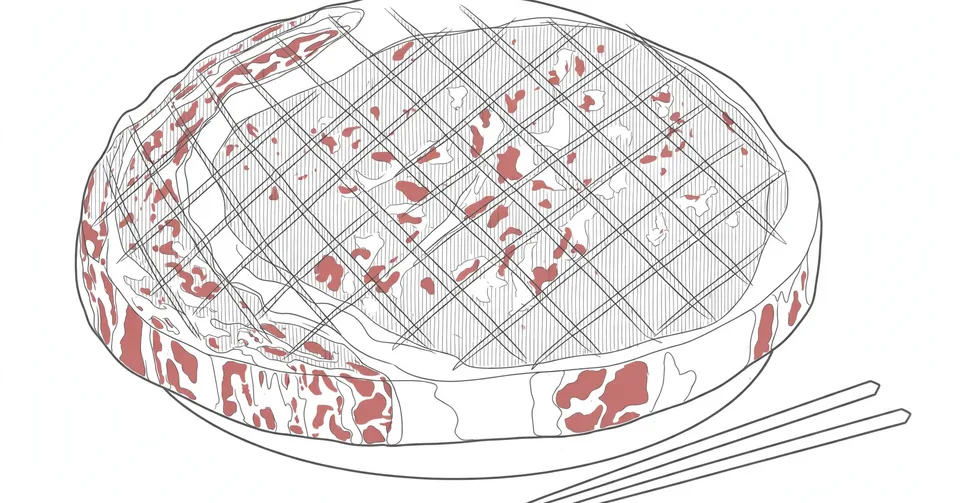
What makes wagyu beef different from other premium beef is the fat. In most beef, fat sits in thick layers around the muscle. In wagyu, fine threads of fat run through the muscle itself, in a white lacy pattern the Japanese call shimofuri, or frost. That marbling is not decoration. The fat melts at a low temperature, close to body temperature, so the meat begins to soften the moment it touches your mouth. The result is a texture that feels closer to butter than to steak, and a flavour that is rich without being heavy. A cut of wagyu beef at the top of the scale can be close to half intramuscular fat by weight, while a top American grade, USDA Prime, sits around 8 to 13 percent fat. That gap is the whole story.
How Japan Grades Wagyu Beef
Japan grades every carcass that will be sold as wagyu beef through the Japan Meat Grading Association, and the grade has two parts. The letter, A, B, or C, measures yield, how much of the carcass becomes usable meat. Grade A means 72 percent or more is usable, and it is the highest yield. The number, 1 to 5, measures meat quality across four traits: marbling, meat colour and brightness, firmness and texture, and fat colour and lustre. The final number is the lowest of the four scores, not an average, so a carcass with spectacular marbling and slightly off-colour fat drops to a 4. That is why some A4 beef eats better than some A5, and why the grade alone never tells the full story. The full grading tables, with retail price ranges per grade, are laid out in this wagyu beef guide from Food in Japan.
Marbling in wagyu beef is scored separately on the Beef Marbling Standard, a scale from 1 to 12. Quality grade 5 requires a marbling score of 8 or above, so every score from 8 to 12 collapses into the same A5 label on the menu. A BMS 8 sirloin and a BMS 12 sirloin look different and cost different amounts at wholesale, yet both are honestly sold as A5. Only about 2 to 3 percent of Japanese beef earns the A5 grade, which is part of why it commands the price it does. If a menu offers A5 at a price that looks too good, ask which BMS it is, or accept that you are probably eating the lower end of the range.
The practical lesson is simple. A5 is the highest grade in the system, but it is a wide band. A4 wagyu beef, usually 30 to 40 percent cheaper, is still exceptional, and for a first taste it is often the smarter buy. You get the same melting texture and the same buttery flavour, with a little less fat and a much smaller bill. Many Japanese regulars choose A4 on purpose, saving A5 for a celebration.
Kobe Beef and the Big Three Brands
All Kobe beef is wagyu beef, but not all wagyu beef is Kobe beef. That one sentence clears up most of the confusion. Kobe is a brand, not a breed and not a grade. Genuine Kobe beef comes from Tajima-gyu cattle, a Hyogo Prefecture strain of Japanese Black, and it must clear a strict set of rules: the animal is born, raised, and slaughtered in Hyogo, the carcass grades A or B with a marbling score of 6 or higher, and the carcass weight stays under a set limit. Only heifers and steers qualify. The Kobe Beef Marketing and Distribution Promotion Association certifies each animal, and every genuine cut carries a 10-digit traceability number that identifies the farm and slaughter date, which you can check on the association website. A practical checklist for spotting fake Kobe beef, including how to check that number, is published in Wherebest's Japan wagyu guide.
The other two names in the traditional big three are Matsusaka beef from Mie Prefecture and Omi beef from Shiga Prefecture. Matsusaka is known for rich, intense marbling and is often eaten as sukiyaki or yakiniku. Omi is the oldest of the three brands, with a history stretching back centuries, and it is prized for a fine, sweet fat. Beyond the big three, strong regional brands include Hida beef from Gifu, Yonezawa beef from Yamagata, and the recent award winners from Kagoshima and Miyazaki, which have beaten Kobe in national competitions. A Kagoshima A5 wagyu beef cut can out-marble a Kobe cut and cost less, because Kobe charges a premium for the name as well as the meat.
The honest consequence is that chasing the Kobe name is not always the best way to spend your money. If you want the finest possible first experience and the story matters to you, Kobe is worth it once. If you want the best eating for the price, a regional A5 from Miyazaki or Kagoshima will often give you more marbling per yen. Either way, buy from a certified shop or a restaurant that names its supplier, because Kobe beef is the most counterfeited wagyu beef brand in the world. A price that looks far below the market, a menu that says Kobe without a certificate or a traceability number, or a street stall selling Kobe skewers for a few hundred yen, should all make you suspicious.
What Wagyu Beef Costs in Japan
Prices for wagyu beef vary widely, and the range is the point. A lunch set at a casual yakiniku shop can start around 1,500 yen. A mid-range yakiniku course runs about 5,000 to 15,000 yen per person. A high-end teppanyaki dinner with certified Kobe beef runs 25,000 to 50,000 yen per person, and a full wagyu kaiseki course can reach 40,000 to 80,000 yen. At a department store food hall, the kind of basement market the Japanese call a depachika, retail A4 wagyu beef sells for roughly 2,000 to 4,000 yen per 100 grams, while retail A5 runs about 4,000 to 8,000 yen per 100 grams, with certified Kobe beef at the top of that range and beyond. Restaurant prices run higher, with authentic A5 Kobe beef roughly 6,000 to 15,000 yen per 100 grams depending on the cut and the restaurant.
| Where you eat it | What you get | Typical price |
|---|---|---|
| Casual yakiniku lunch | Wagyu set, 100 grams | 1,500 to 3,000 yen |
| Mid-range yakiniku course | A4 to A5, several cuts | 5,000 to 15,000 yen per person |
| Teppanyaki lunch, non-Kobe | A5 course, 100 grams | 8,000 to 20,000 yen per person |
| Certified Kobe dinner | Kobe course, 100 to 150 grams | 25,000 to 50,000 yen per person |
| Depachika, take home | Retail A5, per 100 grams | 4,000 to 8,000 yen |
The table makes the strategy obvious. The cheapest way to taste real wagyu beef is not a famous steakhouse, it is a lunch course or a small portion bought at a depachika and cooked at home. A hundred grams of wagyu beef is enough for a first taste, because the fat is so rich that a normal steak portion would be too much. Most first-timers order too much, feel full after a few bites, and remember the price more than the flavour. Order less than you think you need.
Raising wagyu beef is slow and expensive, which is where the price starts. The cattle are raised for 28 to 36 months, nearly double the 15 to 18 months of ordinary commercial beef, so that fat can develop slowly inside the muscle. A single A5 steer can cost a farmer 2 to 3 million yen to raise. Add the small number of animals that reach the top grade, the strict certification, and the short supply, and the price stops looking like a trick. It is still a luxury, but it is a luxury with a real cost behind it.
How to Eat Wagyu Beef for the First Time
The best way to eat wagyu beef depends on what you want to learn. Yakiniku, where you grill small slices of wagyu beef yourself over charcoal, is the most fun and the most forgiving, because you control the heat and you can try several cuts in one meal. Teppanyaki, where a chef cooks in front of you on a steel plate, is the most theatrical and the most expensive, and it suits a celebration. Sukiyaki and shabu-shabu, where thin slices are swished through hot broth, show off the fat in a lighter way, and they are a good choice if you worry that grilled fat will feel too heavy. Gyukatsu, breaded and lightly fried beef cutlet, is the budget entry point, with sets from about 1,500 to 3,000 yen, and it is an honest way to taste the flavour without the ceremony.
Whatever the style, two rules hold. First, cook it less than you would ordinary beef. The fat melts fast, so a few seconds per side is enough for thin slices, and a thick steak should stay rare to medium rare. Overcooking wagyu beef is the most common mistake, and it turns an expensive cut into an ordinary one. Second, season it lightly. Good wagyu needs little more than salt, and the sauces at yakiniku shops are there to complement the meat, not to hide it. Wasabi, lemon, and a pinch of salt are enough. If you find yourself reaching for a heavy sauce, the meat is probably not the problem, but the sauce will not fix it either.
There is also the question of how much to eat. For a first encounter, 100 to 130 grams is the right amount. That sounds small if you are used to a 300-gram steak, but wagyu fat is so rich that a full portion leaves most people uncomfortably full. Think of it the way the Japanese do, as a tasting rather than a meal, with rice, vegetables, and soup doing the filling work around a small amount of extraordinary meat. A wagyu beef kaiseki dinner follows the same logic, small courses building to a few perfect bites, and it is worth trying once if the budget allows, because it shows the meat in the context of Japanese fine dining rather than as a standalone showpiece.
Where to Try Wagyu Beef Without Regret
The city matters less than the shop. Kobe has the famous teppanyaki counters, and eating Kobe beef in Kobe is a fine story to bring home, but the best value is often elsewhere. Matsusaka, the home of Matsusaka beef, has small family restaurants where the same grade costs less than in Tokyo. Takayama in Gifu is known for Hida beef, and its old town has several shops selling Hida beef sushi and skewers for a few hundred yen, which is the cheapest honest taste of high-grade wagyu anywhere. In Tokyo, the depachika food halls beneath department stores in Ginza and Shinjuku stock A4 and A5 cuts to take home, and a lunch course at a good yakiniku shop in a side street will beat a famous name in a hotel basement.
A few checks protect you wherever you go. The restaurant should name the brand and the grade, not just say wagyu. For Kobe beef, ask to see the certificate or the traceability number. Prices should make sense against the ranges above, because a Kobe course for the price of a casual lunch is almost certainly not Kobe. And the restaurant should be busy with local customers, which is the most reliable sign in Japan that the quality matches the price. If you are in Osaka, the food culture that produced the takoyaki shops of Dotonbori also supports excellent yakiniku, and the same rule applies there, follow the locals, not the flashing signs.
My own view, after years of eating my way through Japan, is that wagyu beef is worth trying once at its best, and then worth eating sensibly after that. The first time, pay for the real thing, a certified cut, cooked simply, eaten slowly, in a place that cares about it. The memory of that first bite, the fat melting before you finish chewing, is genuinely unlike any other beef, and it justifies the price in a way no description can. After that, be practical. A4 at a neighbourhood yakiniku shop, a small portion from a depachika, or a Hida beef skewer on a walk through Takayama will give you most of the pleasure for a fraction of the cost. The people who are disappointed by wagyu beef are usually the ones who ordered the biggest, most expensive portion, cooked it too long, and expected a miracle instead of a very good piece of meat. Order small, cook it lightly, and let the beef do the talking.
The last thing to know is that the myths are mostly just stories. The famous beer and massages come from a small number of farms and a lot of retelling, and they are not what makes the meat good. What makes wagyu beef good is slower and less glamorous: careful breeding over generations, a long raising period, precise grading, and a culture that treats beef as something to perfect rather than something to produce in volume. That is a fairer story than the myths, and it is the reason a piece of meat the size of a deck of cards can cost more than dinner, and still be worth it.
More in Food & Travel
Latest posts
- A Himorogi Is the Shrine Before Shrines Had Walls
- Sakaki Is the Sacred Tree Shinto Cannot Do Without
- Tamagushi Is the Sakaki Branch You Offer to the Kami
- The Miko Who Dance Between People and Kami
- Kotodama and the Spirit That Lives Inside Japanese Words
- Kagura Is the Sacred Dance Shinto Still Performs
- Norito Give a Shinto Ceremony Its Voice
- The Gohei Wand Carries the Kami Into the Ceremony
- Origami and How a Single Sheet of Paper Became Japan's Quiet Art
- A Hishaku Is the Bamboo Ladle That Starts Every Shrine Visit
- A Kitsune Is the Fox Messenger Who Guards the Shrines of Japan
- Temizuya Is Where Every Shrine Visit Begins With Water
- Shide Are the Paper Lightning That Marks a Sacred Space
- Yabusame Turns Horseback Archery Into a Moving Prayer
- Walking Through Senbon Torii Feels Like Entering Another World