Inari Sushi Turns Fried Tofu Into a Portable Feast
· 18 min read
Inari sushi is vinegared rice tucked inside sweet simmered tofu pouches, a portable meal named for the fox messengers of Inari. This is the story of how a shrine offering became one of Japan's most loved lunchbox foods.
A piece of inari sushi fits in the palm of your hand. It is a small golden pouch of fried tofu, sweet and a little juicy, with vinegared rice tucked inside it like a letter in an envelope. There is no raw fish, no seaweed wrap, and nothing that needs a knife. You pick it up, you eat it in two bites, and you move on with your day.
The pouch is the whole idea. Our earlier piece on kitsune udon quotes the folklore plainly, that foxes love aburaage, and the same belief sits behind this dish too. Inari sushi is vinegared rice tucked inside the same kind of tofu pouch, and the pouch does two jobs at once. It seasons the rice with its sweet soy juices, and it wraps the rice in a skin that keeps it moist and portable for hours.
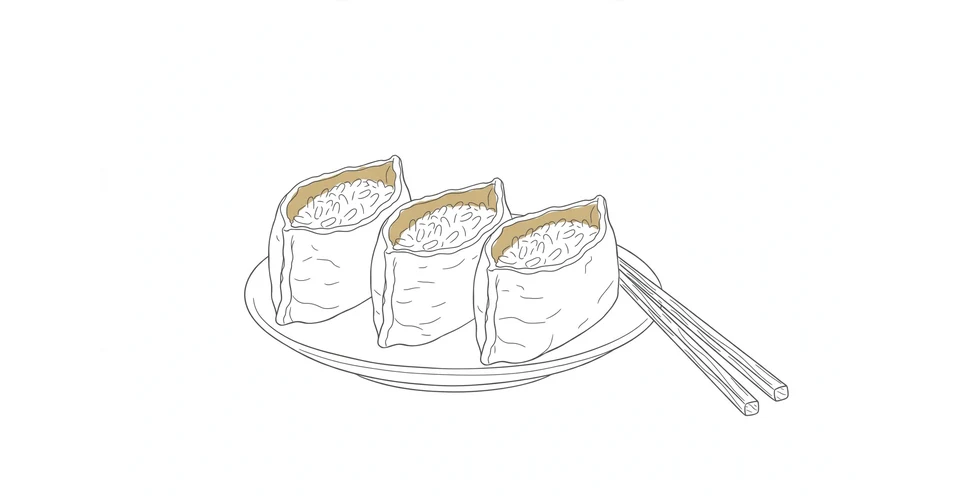
What makes inari sushi worth a whole article is not its complexity, because it has almost none. It is the way a single idea, rice inside a sweet tofu pouch, connects a Shinto shrine, a street vendor in old Edo, a family kitchen, and a convenience store shelf. Every version tells the same story in a different setting, and the story starts with a fox.
What inari sushi actually is
Inari sushi is vinegared sushi rice stuffed into a pouch of aburaage, thin deep fried tofu that has been simmered in a sweet and savoury dashi broth until it is saturated with flavour. Just One Cookbook describes it plainly: inari sushi is sweet and tangy sushi rice tucked inside seasoned deep fried tofu pouches called inari age. The rice is seasoned the same way as any sushi rice, with rice vinegar, sugar, and salt, and it is often mixed with toasted sesame seeds.
The result is a small parcel that is sweet, sour, and savoury all at once. The pouch gives sweetness and a soft, juicy bite, and the rice gives a gentle tang and a firm, satisfying chew. Eaten at room temperature, the flavours balance each other. Just One Cookbook calls inari sushi a home cooking favourite that is light, flavourful, and vegetarian and vegan friendly, and that description is honest. Nothing in the basic version needs fish, meat, or eggs, though shop bought pouches are sometimes seasoned with dashi that contains fish, so a strict vegan should check the label or simmer plain aburaage at home.
There is a second name worth knowing. In Japanese the dish is usually written as one word, inarizushi, because the s of sushi softens to a z in compound words. In Osaka it is also called kitsune-zushi, fox sushi, or simply kitsune, which is a reminder that the fox is never far from this food.
Inari sushi is also one of the few sushi that asks nothing of the eater. There is no wasabi to judge, no soy sauce to dip, and no order in which the pieces must be eaten.
How inari sushi took its name from a shrine
The name comes from Inari, the kami of rice and prosperity, and from the foxes who serve as the kami's messengers. Just One Cookbook puts it simply: the dish takes its name from the Inari deity of harvest, whose fox messengers are said to love fried tofu. For that reason many people affectionately call the dish O-Inari-san. Chopstick Chronicles tells the same story: the sushi was used as an offering to the Shinto god Inari, and the favourite food of the god's messenger fox is said to be aburaage.
The offering came first and the meal came second. Fried tofu was left at Inari shrines as food for the foxes, and at some point, nobody knows exactly when, someone put rice inside the offering and ate it. That small step turned a ritual gift into a portable lunch, and the shrine kept its name on the dish.
Fushimi Inari in Kyoto is the head shrine of about 30,000 Inari shrines across Japan, and our guide to the shrine records that small restaurants along the mountain trail serve inari sushi and kitsune udon, both made with aburaage. Eating the dish on the mountain where the foxes are honoured is a neat circle: the offering becomes the lunch, and the lunch is eaten in sight of the shrine. The shrine was founded in 711, and the dish is still served on its mountain today.
I find something quietly generous in this history. A god of rice is honoured with fried tofu, the tofu is given rice to carry, and the result feeds ordinary people on trains, at picnics, and at family gatherings. The sacred does not stay on the altar. It gets wrapped up, carried home, and eaten, and that seems like the right fate for an offering.
Inari sushi on the streets of Edo
The honest sources disagree about where inari sushi began, and the disagreement is worth reporting rather than smoothing over. One account, recorded in Morisada Manko, an illustrated encyclopedia of Edo customs, says inarizushi started in the Owari district around Nagoya and became popular during the Edo period. Another account places peddlers selling it from shoulder poles in Edo itself around 1844. A third story, told by the food writer Lucy Seligman, says it appeared in the early Tempo era, from 1830 to 1844, when a sushi shop employee called Jirokichi sold it cheaply from a night stall near Ryogoku Bridge in Edo, and by 1846 it had its own vending cry.
What the accounts agree on is the era and the character of the dish. Inari sushi was cheap, fast, and portable food for working people in the late Edo period. A drawing from 1852 shows an inari sushi merchant at work, and the price list in the drawing puts one piece at 16 mon, which the Japanese Food Guide converts to about 480 yen in today's money, or roughly 4 US dollars. That was not luxury food. It was the Edo equivalent of a sandwich from a cart, and the buyers were often provincial samurai in the capital on alternate attendance duty, who loved it enough to carry the recipe home.
The vending cry detail is my favourite part of this history. A dish that has its own street cry has become part of the soundscape of a city, and a cheap tofu pouch earning that honour says something about Edo. According to Seligman's account, Jirokichi could only sell after dark because the people of Edo were too proud to be seen eating such cheap food by day. Whether or not that detail is exact, it captures the dish's social position: humble food, loved in private before it was loved in public.
The careful version is that inari sushi was on the streets of Edo by the 1840s, that it was cheap street food before it was home cooking, and that Nagoya, Toyokawa, and Edo all have claims on its origin. A dish does not need a single birthday to have a real history.
Tokyo and Osaka disagree about the shape
Japan's great regional food argument, the Kanto versus Kansai divide, reaches even this humble pouch. In Tokyo and the Kanto region, inari sushi is shaped into an oval or a slightly rectangular form, resembling a small rice bale called a tawara. In Osaka and the Kansai region, it is formed into a neat triangle, often said to resemble the pointed ears of a fox. Just One Cookbook notes that both regions traditionally close the tofu pouch completely, so the difference comes down to shape, not ingredients. Chopstick Chronicles, written by a cook from Kansai, says the same thing from the other side: in Kansai the pocket is a triangle, while in Kanto the pockets are square or rectangle.
The fox ear story is the kind of detail that makes inari sushi such a pleasure to write about. The triangle is not a random shape. It is a visual joke about the animal whose name the dish carries, and the joke is told every time a cook in Osaka folds a pouch. The Tokyo shape tells a different story: a rice bale is a symbol of the harvest, and shaping the sushi like one ties the dish back to Inari as a god of rice. Two regions, two symbols, one dish, and both shapes are correct.
The table below sets out the two styles side by side, along with the less common variations that travellers may meet.
| Style | Region | Shape | Story behind the shape |
|---|---|---|---|
| Kanto style | Tokyo and eastern Japan | Oval or rectangular, like a rice bale | The tawara bale honours Inari as god of the rice harvest |
| Kansai style | Osaka and western Japan | Triangle | The pointed shape resembles a fox's ears |
| Inside out style | Found in various regions | Pouch turned inside out, rice on the outside | A playful reversal that shows off the rice |
| Open style | Modern shops and home cooks | Pouch left open and topped | The rice is dressed with toppings like salmon roe or shredded egg |
There is a practical difference too. The rectangular Kanto shape is easier to fill, because the rice goes into a straight pocket without fighting the corners, while the triangle takes a little more care. Home cooks should not worry about which is correct. Pick the shape that is easier to fill, and the foxes will not mind.
Inari sushi and kitsune udon are cousins
No two dishes in Japan share a pouch as closely as inari sushi and kitsune udon. Both are built on the same piece of sweet simmered aburaage, and both trace their names back to the same fox. In one dish the pouch is a container, filled with rice. In the other it is a topping, laid over a bowl of thick udon noodles in a light dashi broth. Our guide to kitsune udon puts the relationship plainly: the same pouch of seasoned fried tofu appears in a second famous dish, inari sushi, where vinegared rice is tucked inside the tofu instead of sitting under it.
The family history has a date that is better documented than the birth of inari sushi itself. According to the account our kitsune udon article records, a customer at a noodle shop called Matsubaya in the Semba district of Osaka in 1893 ordered fried tofu on the side and tipped it onto his plain udon as a topping. The combination proved popular, the shop began serving it that way, and the shop still exists today as Usami-tei Matsubaya. That makes kitsune udon about fifty years younger than inari sushi, and the gap makes sense: the pouch had to exist as seasoned, portable food before anyone thought to put it on noodles.
The two dishes also share the regional naming trap that catches travellers. In Osaka, kitsune means udon topped with aburaage, while in Tokyo the same word can mean the tofu on either udon or soba. Inari sushi escapes that confusion, because its name is the same everywhere and only its shape changes.
What I take from the cousin relationship is a small lesson about how cuisines grow. A single technique, simmering fried tofu sweet, produced two famous dishes, and neither one replaced the other. Cooking is often described as invention, but it is just as often recombination, and inari sushi is a reminder that one good idea, well seasoned, can feed a whole cuisine.
The pouch that makes it all work
Everything in inari sushi depends on the pouch, and the pouch depends on aburaage, the thin deep fried tofu that is one of the hardest working ingredients in Japanese cooking. Our piece on aburaage explains the ingredient in full, from the double frying that puffs the tofu into a hollow pocket to the sweet simmer that gives it flavour. Without the pouch, the rice would be ordinary sushi rice. With it, the rice is a gift wrapped in something sweet.
The most important step in preparing the pouch is also the least glamorous. Fresh aburaage carries excess oil from the frying, and Japanese cooks remove it before cooking in a step called abura nuki, which simply means taking the oil away. You put the aburaage in a colander, pour boiling water over it, and squeeze it gently. Chopstick Chronicles calls this step yunuki and lists it first among her aunt Keiko's three tips for making inari sushi, because the stale oil from the factory fryer muddies every flavour that follows. Skip it and the pouch tastes flat and greasy at the same time.
After the rinse, the pouch is simmered in dashi, soy sauce, mirin, and sugar until it is saturated and the liquid has mostly cooked away. Our aburaage guide puts the simmer at about 15 minutes, and Chopstick Chronicles says to cook the aburaage until all the liquid has evaporated, because that concentrates the sweet soy sauce base and lets the pouch absorb the flavour fully. Her aunt Keiko adds one secret ingredient, a tiny amount of miso paste, which she calls kakushi aji, the hidden flavour. You will not notice the miso, Chopstick Chronicles says, because it is not the dominant flavour, but it enhances the fragrance and enriches the flavour as a whole.
The pouch also has a practical virtue that matters for anyone who cooks ahead. Just One Cookbook notes that leftover inari age keeps in its liquid in the refrigerator for two to three days, or in the freezer for up to a month, so the pouches can be prepared in advance and filled just before serving. A bag of seasoned pouches in the freezer is a quiet promise that lunch is never more than ten minutes away.
How to make inari sushi at home
Making inari sushi at home is mostly a matter of patience and gentle hands, and it is one of the easiest sushi to learn because there is no raw fish and no rolling mat. The recipe below follows the methods of Just One Cookbook and Chopstick Chronicles, and the quantities make 12 pieces, enough for three or four people as a light meal.
Start with the rice, because everything else waits for it. Cook one and a half cups of Japanese short grain white rice, about 300 grams, with an equal amount of water and a small piece of kombu kelp for aroma. Just One Cookbook is firm on this point: you must use Japanese rice, or the sushi will fall apart. While the rice cooks, make the sushi vinegar from four tablespoons of rice vinegar, two tablespoons of sugar, and one teaspoon of salt, warmed gently until the sugar dissolves. When the rice is done, transfer it to a wide wooden bowl or a baking sheet, drizzle the vinegar over it while it is still hot, and slice through it with a rice paddle at an angle, fanning as you go so the grains cool, shine, and stay separate. Sprinkle over a tablespoon of toasted white sesame seeds and let the rice cool to body temperature.
While the rice cools, prepare the pouches. Take six pieces of aburaage and cut each one in half to make twelve pouches, then pour boiling water over them to remove the excess oil. Simmer them in a pan with one cup of water, a teaspoon of dashi powder, about 30 grams of sugar, and 25 millilitres of soy sauce, with a tiny amount of miso paste if you want the hidden flavour that Chopstick Chronicles recommends. Cook for about ten minutes, add the miso, and keep cooking until all the liquid has absorbed and evaporated. Turn off the heat and let the pouches cool completely in the pan.
To assemble, divide the rice into twelve portions of about 50 grams each and roll each one into a small oval. Open a pouch gently, without tearing it, and press the rice inside, pushing it softly into both corners. Just One Cookbook advises filling the pouch to about 80 percent full, so that it closes neatly, and placing the sealed side down on the plate. Repeat for the rest, and serve at room temperature with pickled ginger and a shiso leaf if you have them.
The most common mistakes are all avoidable. Do not overfill the pouch, or it will split and the rice will spill. Do not use long grain rice, or the pieces will crumble in the hand. Do not skip the hot water rinse, or the flavour will be greasy. Just One Cookbook recommends enjoying inari sushi the same day, and if it must wait, wrapping it tightly and covering it with a thick kitchen towel to stop the rice from hardening. Made fresh and eaten the same day, inari sushi is at its best: sweet, tangy, soft, and gone too quickly.
Chopstick Chronicles describes making it as a family activity, with children shaping rice balls and filling pouches together, and Just One Cookbook calls it a dish to cook with kids because it is fun and ridiculously easy. A dish that teaches children to cook is a dish that will be cooked for another generation.
Where to find inari sushi in Japan
For travellers, the easiest place to meet inari sushi is the convenience store. Just One Cookbook notes that today you will often find inari sushi at supermarkets, in bento boxes, and at family gatherings throughout Japan, and the convenience store version is the traveller's best friend. It sits on the shelf next to the onigiri, costs very little, needs no heating, and can be eaten on a train or on a park bench. It is not the finest version of the dish, but it is a faithful one, and it is available everywhere from Hokkaido to Okinawa.
Supermarkets sell it in the deli section, often in packs of three or five, and department store food halls, the depachika in the basement, sell more careful versions with mixed rice fillings, simmered shiitake mushrooms, julienned carrots, and sesame seeds. Sushi shops sell it too, usually as part of a set, and it is a standard item in the bento boxes sold at train stations. Because it keeps well at room temperature for a few hours, it is one of the few sushi that is genuinely made for travel.
The most atmospheric place to eat it is on the mountain at Fushimi Inari, where the small restaurants along the trail serve inari sushi and kitsune udon to climbers, within sight of the fox statues it is named for. Go early, walk past the crowded tunnel of gates, and eat at one of the quieter restaurants higher up.
Inari sushi also turns up at the moments when Japanese families cook for each other: at New Year gatherings, at school sports days, at picnics under the cherry blossom, and at the small celebrations that fill an ordinary year. It is food for a crowd, because it can be made in large numbers, carried in a box, and eaten without plates or cutlery. I think that is the real test of a recipe: not whether it impresses a restaurant critic, but whether it shows up, quietly and reliably, wherever people need to be fed.
Why inari sushi endures
Inari sushi has survived for nearly two centuries without changing its basic idea. Food trends come and go, and sushi itself has been reinvented many times, from the pressed sushi of Osaka to the raw fish nigiri of Tokyo to the inside out rolls of California. Through all of it, the sweet tofu pouch has stayed the same: rice, vinegar, sugar, soy, and a pocket of fried tofu. The dish does not chase novelty, and it does not need to, because its idea was complete from the start.
Part of the endurance is practical. Inari sushi is cheap, it travels well, and it needs no special equipment. Part of it is cultural. The dish carries a story that Japanese people learn as children, about a god, a fox, and a favourite food, and every piece retells that story without saying a word. A food that is both useful and meaningful is a food that gets cooked again and again.
There is also a quieter reason, and it is the one I keep coming back to. Inari sushi is gentle food. It does not shout with heat or salt or richness. It offers sweetness and tang in balance, a soft pouch and a firm grain of rice, and it asks the eater to slow down for the two bites it takes to finish a piece. In a cuisine that includes some of the most dramatic food in the world, there is room for something small and kind. Inari sushi is that small, kind thing, and it has been feeding people since the streets of Edo. The foxes knew what they were doing when they chose this as their favourite food, and Japan has agreed with them ever since.
More in Food & Travel
- Tanuki Udon Is the Bowl Named After a Raccoon Dog
- Wagyu Beef and Why One Small Steak Costs More Than Dinner
- Aburaage Is the Fried Tofu Japan Simmers Sweet
- Japanese Cheesecake and the Fluffy Cake That Jiggles
- Kitsune Udon Is the Bowl the Fox Would Order
- Tokyo Disneyland and Why Japan Loves It Differently
Latest posts
- A Himorogi Is the Shrine Before Shrines Had Walls
- Sakaki Is the Sacred Tree Shinto Cannot Do Without
- Tamagushi Is the Sakaki Branch You Offer to the Kami
- The Miko Who Dance Between People and Kami
- Kotodama and the Spirit That Lives Inside Japanese Words
- Kagura Is the Sacred Dance Shinto Still Performs
- Norito Give a Shinto Ceremony Its Voice
- The Gohei Wand Carries the Kami Into the Ceremony
- Origami and How a Single Sheet of Paper Became Japan's Quiet Art
- A Hishaku Is the Bamboo Ladle That Starts Every Shrine Visit
- A Kitsune Is the Fox Messenger Who Guards the Shrines of Japan
- Temizuya Is Where Every Shrine Visit Begins With Water
- Shide Are the Paper Lightning That Marks a Sacred Space
- Yabusame Turns Horseback Archery Into a Moving Prayer
- Walking Through Senbon Torii Feels Like Entering Another World