Sakaki Is the Sacred Tree Shinto Cannot Do Without
· 25 min read
This is the story of sakaki, the evergreen tree at the heart of Shinto ritual, the branch that carries prayers to the kami, marks sacred ground, and stands on the household altar.
Walk into almost any Shinto shrine in Japan and you will see it before you see anything else. Two green branches stand in white vases on either side of the altar, their glossy leaves catching the light. The branches look plain, almost too plain to matter. Yet without them the shrine would feel unfinished, like a table set for guests with no food on it. The branches are sakaki, and they are the quiet centre of Shinto worship.
Sakaki is an evergreen tree, Cleyera japonica to botanists, and it has been sacred in Japan for longer than anyone can prove. Its branches are offered to the kami, hung with paper streamers, planted in shrine grounds, and set on the small household altars that stand in Japanese homes. A single tree supplies the offering, the decoration, the boundary marker, and the seat where a kami is invited to rest. No other tree in Japan carries so much work, and no other tree is so easily overlooked while doing it.
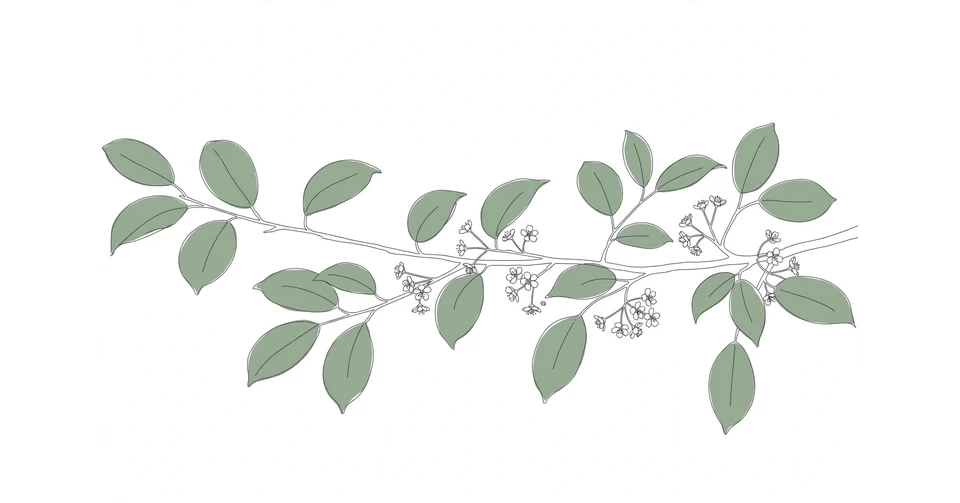
What follows is the story of that tree. It begins with a branch in the oldest myths of Japan, passes through the shrine hall and the family altar, and ends, as it should, in an ordinary home, where a pair of fresh branches is set in water on the first day of the month. The tree is not spectacular. That is the point. Shinto chose a tree that stays green in winter, grows quietly in the shade, and asks for nothing, and then built a whole religion of attention around it.
What sakaki is
Sakaki is an evergreen tree of the genus Cleyera, in the family Pentaphylacaceae, a family it joined only after botanists moved it out of the old tea family, Theaceae. It is native to the warm regions of Japan, growing wild from central Honshu westward through Shikoku and Kyushu to Okinawa, and it also grows in Korea, Taiwan, and mainland China. It is a modest tree rather than a giant. It may reach a height of about ten metres, and it often grows as a low spreading tree or a large shrub, content in the shade beneath taller trees.
The leaves are the first thing to learn. They are thick, oval, and alternate along the stem, with a smooth leathery surface and no serrated edges. They are about six to ten centimetres long, deep green on top and pale yellowish green underneath, and they shine as if they had been polished. In early summer, around June, the tree bears small scented cream white flowers, and by November those flowers have become small dark berries, red at first and then black. The wood is hard and useful, and people have long used it for building, for utensils, for combs, and for fuel. These details are set out in a reference entry on the tree, which describes the smooth leathery leaves, the white flowers of June, and the black berries that follow in November.
The tree is shade tolerant in a way that matters to its story. It flourishes as a shrub or a small tree in the poorly lit forest understory, beneath the chinkapins and other huge trees that form the canopy. One writer on Shinto notes that a local priest once explained it to him plainly. The tree grows on the boundary between the world of people and the world of the kami. It lives where the deep forest meets the clearing, where the dark grove meets the path, and that in between place is exactly where a sacred tree belongs.
The tree is also a familiar garden plant. It is commonly found in household gardens in rural areas, and it is a popular choice for home gardening because it is an evergreen. A family that keeps a kamidana, a household altar, may well grow its own sakaki in the garden, and cut a fresh branch when the old one wilts. The tree is sacred, but it is not remote. It grows beside the house, and that closeness is part of its meaning.
Why this tree became sacred
Shinto began with a simple belief, that kami dwell in the things of nature. Mountains, rocks, waterfalls, and old trees could all hold a kami, and people learned to watch for the places where the presence felt strongest. Among trees, the evergreens stood out. In a deciduous forest, where every other tree loses its leaves and stands bare through the cold months, an evergreen stays green. To ancient eyes, that constancy looked like a refusal to die, and a tree that refused to die was a fitting home for a spirit that never dies.
Sakaki became the evergreen that Shinto chose, and the reason seems to lie in its leaves. Since ancient times people believed that gods sometimes choose to dwell in plants, and branches with pointed leaves were considered yorishiro, objects that represent the gods, or more precisely objects into which kami descend. Plants with point tipped leaves, such as pines and thorns, were believed to be the landing point for spirits, and the association with sakaki arose from that belief. A yorishiro is an object capable of attracting kami, giving them a physical space to occupy during a ceremony, and the branch became the most common yorishiro of all.
There is a charming detail in this old idea. The magatama, the comma shaped jewel of ancient Japan, is sometimes described as a kind of hook for attracting kami, almost as if one were fishing for invisible spirits. The pointed leaf was thought to work in the same way, a small hook on which a kami could catch and rest. A Shinto scholar, Mark Teeuwen, has pointed out that there is no real hook on the sakaki leaf, and that it may have been the thick, almost plastic nature of the leaves that made them stand out instead. The leaves can be easily cleaned of dust and impurities, which matters when a branch must be presented to a kami. Whether it was the point or the polish, the leaves caught the attention of priests, and the tree was chosen.
The name itself carries the same idea. The word sakaki is thought to come from sakai ki, a border tree, the tree that stands on the border between the gods and humankind. Other theories derive it from sakaeru ki, an evergreen or always thriving tree, pointing to the sense of prosperity and growth. The name was not always limited to one species. In ancient times it seems to have referred to evergreens in general, and only gradually was it limited to Cleyera japonica and its close relatives. The border meaning is the one that has lasted, and it fits everything the tree does. The tree marks where the sacred begins and the ordinary ends.
I find something quietly radical in that choice. Shinto did not pick the tallest tree, or the oldest, or the rarest. It picked a small evergreen that grows in the shade and stays green when everything else is bare, and it made that tree the centre of its worship. The lesson is not about grandeur. It is about constancy, about the thing that endures without showing off, and about paying attention to the boundary where two worlds meet. A religion that honours a tree like that is a religion that has learned to look closely at ordinary things.
The branch in the cave of heaven
Sakaki enters Japanese mythology in the most famous scene the old texts contain. In the Kojiki, the oldest chronicle of Japan, the sun goddess Amaterasu, angry and frightened by the violent behaviour of her brother Susanoo, hides herself in the rock cave of heaven, Ama no Iwato, and fastens the door. Eternal night prevails, the alternation of night and day is unknown, and the whole world darkens. Eight hundred myriad kami gather and confer on how to lure her out.
Their plan centres on a tree. They dig up a five hundred branched true sakaki, a masakaki, from the heavenly Mount Kagu, and they decorate it with the most precious things they own. On its upper branches they hang an eight foot string of five hundred jewels. On its middle branches they hang an eight foot mirror. On its lower branches they place white and blue offerings. Then Ame no Uzume, the goddess of dance, hangs branches of sakaki as a headdress, ties club moss around her as a sash, takes bamboo grass in her hands, and performs a provocative dance on a sounding board before the cave door. The assembled kami roar with laughter. Amaterasu, curious about why the gods could be so merry while the world lay in darkness, peeks out, sees her own reflection in the mirror, and is drawn from the cave. The gods throw a sacred straw rope across the door so she cannot return, and light is restored to heaven and earth.
The Nihon Shoki, the second great chronicle, tells the same story with small differences. There the gods hang swords and mirrors from the branches, and the mirror is described as an eight hand mirror. The tree is the same, and its role is the same. It is the support on which the sacred objects rest, the frame that holds the jewels and the mirror and the offerings together while the liturgies are recited. Without the branch, the plan has nothing to hang from.
The tree appears elsewhere in the old texts as well. In the Nihon Shoki passage about Emperor Chuai, envoys hang an eight span jewelled necklace, a bronze mirror, and a ten span sword on an uprooted sakaki tree, and present it to the emperor with a blessing over mountains, rivers, and oceans. In the passage about Emperor Keiko, the chronicle mentions a flourishing sakaki of Mount Shitsu. In a poem attributed to Prince Karu in the Kojiki, a mirror and jewellery hung on a true sakaki are mentioned again, beside the raising of a sacred pillar by a river. The pattern is consistent. Wherever a kami or an emperor is to be honoured, a sakaki is brought, decorated, and set up as the frame of the rite.
The myth matters because it explains why the tree is still used the way it is. The masakaki in the cave story is not a decoration. It is a yorishiro, a seat for the kami, hung with the treasures that will catch the attention of a hidden goddess. Every sakaki branch offered at a shrine today is a smaller, quieter version of that tree. The jewels and the mirror have mostly gone, replaced by folded paper, but the branch is the same, and the gesture is the same. A living branch is set up, adorned, and presented, and the kami are invited to come and rest on it.
Sakaki as tamagushi
The most familiar form of the sakaki offering is the tamagushi, and it is worth knowing by name. A tamagushi is a different kind of offering, a branch of sakaki with shide attached, and it is the offering a visitor presents with both hands at a formal Shinto ceremony. The priest hands the branch over, the visitor steps forward, turns it slowly, bows, and lays it on the table before the altar. The branch is small, ten to twenty inches long today, though it was once four or five feet, and it is the most personal offering in the whole ceremony.
To understand the branch itself, it helps to know that a tamagushi is the sakaki branch you offer to the kami, and the rite of presenting it is called tamagushi hoten. The visitor holds the base of the branch from above with the right hand and supports the leaf apex with the left, keeping the leaves higher than the base. After one small bow, the branch is turned clockwise so that the base ends up pointing toward the altar, and it is laid down gently. Then come two bows, two claps, and one more bow. The turn is the heart of the rite. The gift is not thrown or dropped. It is rotated and set down in the correct orientation, the way you might turn a letter around before handing it to someone so they can read it.
The tamagushi shows what the tree means to Shinto in its purest form. The tree is not worshipped for itself. It is cut, dressed in paper, and given away. The offering is a piece of a living tree, lightly dressed, handed over by a human being to a spirit, and that directness is what makes it worth understanding. The branch wilts. It dries out. It is taken down and replaced, and a new branch is cut in its place. Nothing about it is built to last, and that is precisely why it stays with you once you have learned to see it.
Sakaki on the kamidana at home
The tree is not only a shrine tree. It is also a household tree, and the kamidana, the small household altar, is where most Japanese people meet it. Families place branches in white ceramic vases called sakaki date, set on the left and right of the altar, and the branches are offered in pairs. The custom is old. From the medieval period to the early modern period, the practice of enshrining kami at home spread among samurai and commoners, and the household altar became a fixture of Japanese domestic life. The branches on it are a daily reminder that the kami are present in the home, not only in the grand hall of a shrine.
The branches on a kamidana are replaced twice a month, on the first and the fifteenth of every month. Until the Edo period they were replaced on the first and fifteenth of each month according to the old lunar calendar, and the rhythm has survived the change of calendars. The replacement is a small act of care. The old branches are taken down, fresh water is poured into the vases, the stems of the new branches are trimmed, and the green is set back in place. It takes a few minutes, and it is done without ceremony, which is exactly why it matters. Faith that is renewed twice a month, quietly, in the corner of an ordinary room, is faith that has become a habit rather than an event.
Many families buy their branches rather than growing the tree. Branches of the tree are commonly found on sale in flower shops in present day Japan, and even in supermarkets, and in recent years the vast majority of sakaki or hisakaki branches sold in stores for use on Shinto altars are from trees grown in China and imported by Japanese companies. The trade is practical, and it is also a little melancholy. A tree that once grew in every rural garden is now often shipped across the sea in a box. But the branches still arrive green, and they still go up on the altar on the first and the fifteenth, and the custom survives the supply chain.
Shrines also send branches home with their visitors. At the end of a formal ceremony, many shrines give a tamagushi o harai, a branch that has been used in the rite, to worshippers who take it home and set it up on the family altar. The branch stays there until it is renewed. The home version is smaller and plainer than the one in the shrine hall, but it does the same work. It says the kami are present here too, not only in the grand hall but in the corner of an ordinary room.
There is a lesson in the way families care for these branches that I think applies far beyond the altar. The branches must be changed, or they wilt. The water must be fresh, or it clouds. The altar must be dusted, or it looks neglected. None of this is dramatic. It is maintenance, and maintenance is the most honest form of devotion there is. A religion that asks you to change two branches twice a month is a religion that understands that attention is a practice, not a feeling, and that a sacred thing stays sacred because someone keeps showing up for it.
Sakaki in the shrine yard and the himorogi
Step back from the altar and look at the shrine itself, and sakaki is there again, this time as architecture. A himorogi is a sacred space created temporarily for a ritual, where sakaki is erected in the centre and surrounded by a shimenawa, a sacred straw rope. The branch serves as a yorishiro for the kami to descend, and the space around it becomes, for the length of the rite, a shrine in miniature. The form is believed to be the primitive form of the Shinto shrine itself. Before there were halls and roofs, there was a plot of unpolluted land, a branch set upright in the middle of it, and a rope marking the boundary. Everything else was built around that.
The branch at the centre of a himorogi is dressed for the occasion. According to the old descriptions, yu, stringy fibres of a tree about a foot in length, and shide, zigzag strips of paper, are strung on it. The paper is the shared language of Shinto sacred objects. The shide on a tamagushi are the same folded streamers that hang from the sacred straw ropes at shrine entrances, and they carry the same message wherever they appear. To understand the paper itself, it helps to know that shide are the paper lightning that marks a sacred space, and the streamers on a sakaki branch are that same sign, folded onto a living branch and set up where the kami are invited to rest.
The tree also appears in the grandest ritual objects of the shrine. The masakaki, the true sakaki of the myth, survives today as a pair of decorative implements. In their modern form, fixed in 1875, they are two poles of Japanese cypress, hinoki, to the tips of which are attached branches of sakaki, below which are attached five coloured silks in blue, yellow, red, white, and purple. The pole on the right, when facing the shrine, is decorated with a sword, and the one on the left with a mirror and a jewel. They stand in the shrine hall as a permanent echo of the tree in the cave story, the branch that held the treasures of heaven.
The tree is used for purification as well. In Shinto purification rites, the onusa is a branch of the sacred sakaki tree, or another evergreen, to which linen or paper streamers are attached, and it is waved over people and spaces to cleanse them. The gohei, the wooden wand with two paper streamers that stands on the altar, works beside it as a sign of the presence of the kami. One marks presence, one is a gift, and one purifies. The branch is the same. The hands and the intentions are different.
Shrines also plant the tree on their grounds, and the trees themselves become sacred by association. A sakaki tree planted at a shrine is tended, protected, and never casually cut. At Kasuga Taisha in Nara, the sacred tree of the shrine, the Kasuga no shinboku, is made up of a twig of sakaki or nagi, the sacred straw rope, and the sacred mirror, kept together as the goshintai, the object of worship believed to contain the spirit of the deity. The tree is not merely near the shrine. In a very real sense, the tree is the shrine, or at least the oldest part of it, the part that was there before the buildings.
Sakaki at festivals after dark
Once a year, in a small town in Wakayama Prefecture, sakaki does something it does at no other time. It travels through the dark. The Yomisashi Matsuri, held at Omiya Shrine in Iwade Town, is a festival in which sacred sakaki branches are carried through the village at midnight, in complete darkness, so that nobody sees them, because they are identified with the kami, and nobody should see the kami in person.
The festival was traditionally held on October 6, on the day of the new moon, a date chosen for a good reason. The midnight rite is described in an academic paper on the tree from myth to modern Japan, whose author attended the festival in 2009 and watched the branches carried through the village in the dark. The kami should never be seen by anyone, and complete darkness is required. In recent years, because of modern constraints such as work and school, the festival has moved to the first Saturday in October, which sometimes falls on a full moon, defeating in a way the purpose of the festival. The contradiction is part of the story now. A rite designed for darkness is performed under a bright moon, and the community carries on anyway.
The rite itself is called yomisashi, and the name gives the festival its meaning. It means entry into the sacred period of a festival, and it is also the rite of marking the spatial range of a festival by setting up purified branches at important places, such as the village border. At midnight, when all the lights are out, young men start from the shrine after a purification rite and run to the temporary shrines located to the east and west, where they set up a large sakaki branch. The branches thus have the role of delimiting the territory, a role the sakaki has played since its name first meant border tree.
The rest of the village waits at the temporary shrines, feasting, and when the branches arrive, they all rush to grab the leaves, which are believed to cure all illnesses. It is a strange and joyful scene, a whole community waiting in the dark for a branch, and then fighting over its leaves as if they were medicine. The festival is held in complete darkness, and nobody is actually at the shrine during it. The shrine is empty, and the village is full, and the kami are somewhere in between, travelling on a branch through the night.
Similar festivals are held all over Japan through the year. At Yanahime Shrine in Iwata City, Shizuoka Prefecture, the naked festival includes a rite in which young men in starched white clothes run around town at night, setting up branches called mishiba sakaki at thirteen different places, reciting prayers as they go. The details change from town to town, but the idea is the same. A branch of sakaki, carried through the dark, draws a line around the community and says that inside this line, the kami are present, and the village is protected.
Sakaki, hisakaki, and the other substitutes
Sakaki is the tree Shinto prefers, but it is not always the tree Shinto gets. The tree grows mostly in warm regions, from central Honshu westward, and in colder country further north it will not thrive. When sakaki is hard to find, other evergreens are used instead, and the tradition accepts the substitution without fuss. The form matters more than the species. What the kami receive is a green branch, offered with both hands, and the tree it came from is a detail the tradition can bend on.
The usual substitute is hisakaki, Eurya japonica, a close relative of sakaki. The hisakaki can be a substitute for the Cleyera japonica, and in areas further north it is the branch most families actually use. Some say the name comes from hime sakaki, princess sakaki, because it is small. Others say it comes from the meaning of non sakaki, not sakaki at all. Either way, it does the same work. The hisakaki is also a plant that can be offered to household Buddhist altars, which the true sakaki is not, and that double duty has made it a familiar sight in Japanese homes.
Other trees have served as well. Oak, cryptomeria, boxwood, and fir are sometimes substituted in ritual use, and branches from evergreens like young pines and michelia compressa were also used until recently. The sakaki and the hisakaki grew in popularity because they are the most commonly occurring plants with the sort of pointed leaves appropriate to be yorishiro. At some shrines outside Japan, camellia branches take the place of sakaki. The list is long, and it is worth setting out plainly.
| Tree | Leaves | Where it is used |
|---|---|---|
| Sakaki, Cleyera japonica | Thick, oval, smooth, no teeth | Shrines and homes in warm regions |
| Hisakaki, Eurya japonica | Smaller, toothed, rough edges | Homes and shrines in colder regions, and Buddhist altars |
| Sugi, Japanese cedar | Needle like, evergreen | Substituted in ritual use |
| Kashi, oak | Broad, evergreen | Substituted in ritual use |
The table makes the pattern clear. Shinto has a favourite tree, and it also has a practical streak. When the favourite will not grow, the rite goes on with whatever evergreen is at hand, and the kami do not seem to object. I admire that flexibility. A tradition that can insist on one tree and accept another is a tradition that knows the difference between the essence of a rite and its materials, and it is not afraid to choose the essence.
How to tell sakaki from hisakaki
Because the two trees are so often confused, it helps to know how to tell them apart. The leaf edges give the clearest answer. The hisakaki has smaller and toothed leaves, with rough edges, whereas the sakaki has slick surfaced leaves with no rough edges. The sakaki can also be identified by its claw like shoot apices, the winter buds at the tips of its branches, which curl like small claws. To avoid confusion of pronunciation between sakaki and hisakaki, some people call the sakaki hon sakaki, true sakaki, and the hisakaki by regional names such as shashaki, shakaki, shitakusa, bishako, or hotokesan shiba, depending on the region.
The flowers help too. The sakaki bears small white flowers in June, in early summer, with a light scent. The hisakaki blooms in early spring, and its flowers have a distinct smell that regular users learn to recognise. A third relative, the hamahisakaki, Eurya emarginata, grows wild on the coast and is often planted along streets. Its leaves are round and clearly different from the leaves of the sakaki and the hisakaki, and it flowers in winter and smells like the hisakaki.
For a visitor buying branches at a flower shop, the check is simple. Look at the leaves. If they are thick, glossy, oval, and smooth edged, the branch is sakaki. If they are smaller and toothed, it is hisakaki. Either one will do on the altar, and the shop will usually know which it is selling. But knowing the difference is a small pleasure, the kind of knowledge that turns a green branch into a particular tree with a name and a history. The tree rewards the attention, and attention is what the tree was chosen for in the first place.
The tree that stays green
A full account of the sakaki tree, from myth to modern Japan, ends where it began, with a branch in a vase. The tree appears in the Kojiki and the Nihon Shoki, it stands at the centre of the himorogi, it is carried through the dark at festivals, and it is set on the household altar twice a month. It is decorated with jewels and mirrors in myth, and with folded paper in the shrine hall, and with nothing at all on the kamidana at home. In every form it does the same work. It marks the boundary between the world of the kami and the world of people, and it invites the kami to cross it.
What I take from the tree is a lesson about constancy that I think applies far beyond the shrine. We tend to admire the things that are loud, tall, and rare, and to overlook the things that simply endure. The tree is not loud, tall, or rare. It is a small evergreen that grows in the shade, keeps its leaves through the winter, and offers its branches twice a month without complaint. Its whole sacredness is built on staying green when everything else is bare, and on being there, in the same place, whenever it is needed. That is a quieter kind of holiness, and it may be the more useful kind.
The next time you stand in a shrine in Japan and see two green branches in white vases on either side of the altar, stop for a moment. They are not decoration. They are the oldest thing in the room, older than the hall, older than the rite, older than the shrine itself. They are a branch from a tree that once held the mirror of the sun goddess, carried through the dark by running men, and set on the family altar by hands that will change it again on the fifteenth. The tree is small, and the branches are plain, and they have outlasted empires. That is worth a moment of your attention, and the sakaki will still be there, green and quiet in its vase, when you give it one.
More in Culture & Society
Latest posts
- Tanuki Udon Is the Bowl Named After a Raccoon Dog
- Wagyu Beef and Why One Small Steak Costs More Than Dinner
- Inari Sushi Turns Fried Tofu Into a Portable Feast
- Aburaage Is the Fried Tofu Japan Simmers Sweet
- Japanese Cheesecake and the Fluffy Cake That Jiggles
- The Gohei Wand Carries the Kami Into the Ceremony
- Kitsune Udon Is the Bowl the Fox Would Order
- Origami and How a Single Sheet of Paper Became Japan's Quiet Art
- A Hishaku Is the Bamboo Ladle That Starts Every Shrine Visit
- A Kitsune Is the Fox Messenger Who Guards the Shrines of Japan
- Temizuya Is Where Every Shrine Visit Begins With Water
- Shide Are the Paper Lightning That Marks a Sacred Space
- Tokyo Disneyland and Why Japan Loves It Differently
- Yabusame Turns Horseback Archery Into a Moving Prayer
- Walking Through Senbon Torii Feels Like Entering Another World