Nobody Eats the Daidai, and That Is the Point
· 10 min read
The daidai is the bitter orange nobody eats, set on top of kagami mochi every New Year as a pun about generations. Here is why a fruit too sour for the table earned the most honourable seat in the house.
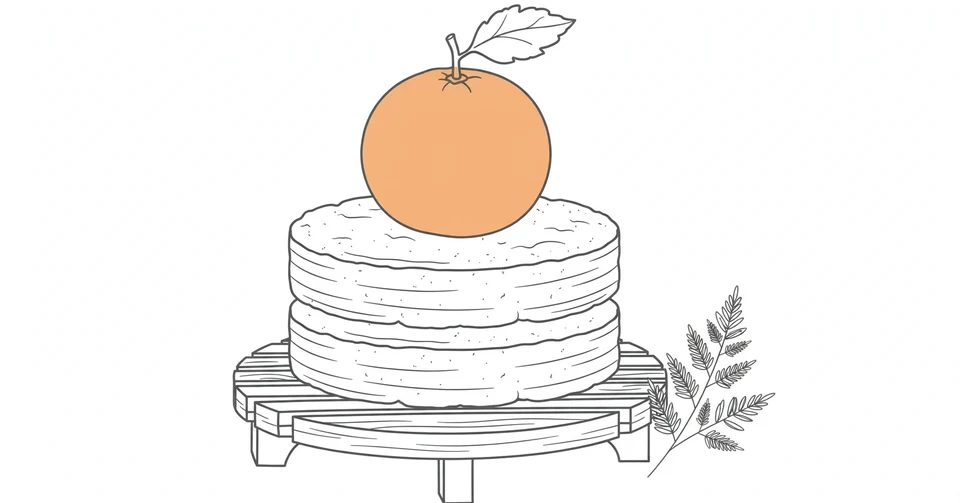
Every January, one of the most visible fruits in Japan is one that almost nobody eats. It sits on top of kagami mochi, the stacked rice cakes at the centre of the New Year display, in homes, shops, shrines, and station kiosks all over the country. The fruit is the daidai, a bitter orange so sour that a bite of one is a small punishment. And yet there it is, every year, in the seat of honour.
The daidai is not on the mochi as food. It is there as a word. Daidai is a perfect homophone of the Japanese phrase meaning "generation after generation", and the fruit earns the pun honestly. A daidai that nobody picks does not fall. It stays on the tree, season after season, sometimes for years, while younger fruit ripens on the same branches beside it.
So the little orange on top of the rice cakes is a wish you can read from across the room. It asks, quietly and without a single sweet quality of its own, that the family in that house continues the way the fruit does. By remaining.
It is worth asking how a fruit this inedible got the job, because the answer says a lot about what the New Year display is really for.
What a daidai is
The daidai is an Asian variety of bitter orange, listed by botanists as Citrus × daidai and often filed under Citrus aurantium, though its exact standing as a species is still not fully settled. Reference works trace the fruit from the Himalayas through the Yangtze valley in China and on to Japan, where it has been grown for centuries. On the Japanese citrus family tree it sits on the sour side, among the fragrant fruits kept for their juice rather than their flesh, alongside yuzu, sudachi, and kabosu.
A ripe daidai is small, round, and deep orange, with a thick skin, a crowd of seeds, and flesh that is sharply acidic and bitter underneath, with only a faint floral note to soften the blow. It comes in two main cultivars, kabusu and kaiseito, the second bearing the smaller fruit. It colours up in late autumn and is harvested from November to January, which happens to be exactly when Japan needs one perfect orange per household. Growers in Wakayama and Shizuoka do most of the cultivating, and almost none of the harvest is meant to be eaten fresh.
I live in Shizuoka, one of the fruit's two main growing prefectures, and the trees are an unremarkable sight here in winter: an old tree at the edge of a field, loaded with orange fruit that nobody seems in any hurry to pick. I used to read that as neglect. It is closer to the opposite. The fruit is not being forgotten. It is being kept.
The fruit that refuses to fall
Most citrus lives fast. A mikan ripens, softens, drops, and is done within a season. The daidai keeps a different calendar. If nobody picks it, the fruit simply stays attached to its branch, and it can stay there for several years. Stranger still, it changes colour while it waits. The orange fades back to green in spring, then the fruit colours up orange again when winter returns. One of its cultivars, kaiseito, carries the habit in its name, which is written with characters for returning to green.
The result is a tree that wears its own timeline. Old fruit and new fruit hang side by side on the same branches, last year's crop keeping company with this year's, neither in the other's way. Nobody had to invent a meaning for this tree. Anyone who has stood in front of one can see it.
That is where the name settled. Written with the characters 代々, daidai means generation after generation, and a fruit that holds several generations of itself on a single tree was always going to end up carrying that word. Botanical writing records a second possible source for the name, in the stepped shape of the kaiseito's base, as if the fruit were sitting on little stacked pedestals. It is a charming theory, and almost nobody uses it. The generations reading won, because it is the one the tree itself seems to argue for.
The tree is generous about the future in a more practical way as well. A single daidai is crowded with seeds, and the seeds germinate easily, so new trees start readily wherever the fruit is grown. The old tree holds its fruit for years, and at its feet, given the chance, the next tree is already possible. Continuation is not a metaphor the plant needs explained to it.
On top of the kagami mochi
Kagami mochi is the New Year offering built from two round, flat rice cakes, the smaller resting on the larger, set on a small wooden stand called a sanbo. In fuller traditional displays, the cakes rest on folded paper over a frond of urajiro fern, with a sheet of konbu kelp and sometimes dried persimmons alongside: rice from the fields, kelp from the sea, and the daidai from the mountains. The arrangement is set out for Toshigami, the god of the year, in the alcove of the best room or on the household altar. And on top of the upper cake, finishing the stack like the dot on a sentence, sits a single daidai, ideally still wearing one green leaf, to show that it is alive.
The cakes have rules of their own, including the one explored in why kagami mochi is never cut with a knife: the stack is a sacred object first and a food second. Tradition is fussy about the calendar, too, preferring the display to go up on the 28th and treating the last days of the month as inauspicious for setting out an offering. The fruit has the simpler assignment. It just has to be there, orange and patient, while the family photographs the display and the children ask, every year, whether anyone is going to eat that orange. The answer, every year, is no.
The leaf matters more than it seems to. A picked, drying fruit would be a picture of an ending. A fruit still wearing a living leaf is a picture of continuance, a thing caught mid-life rather than after it. The display is not a still life. It is meant to look, in a small way, alive.
Most households today buy the whole arrangement ready-made, sealed in plastic on a supermarket shelf in late December, which changes nothing about the casting. The plastic case still has a seat at the top, and the seat is still filled by a daidai.
The custom of placing one there is believed to date from the Edo period, so the small joke on top of the rice cakes is at least a few centuries old. The fruit also appears in shimekazari, the twisted rope decorations hung over doors and gates at New Year, repeating the same wish at the threshold of the house: may the people inside continue, generation after generation.
I will admit I like the modesty of this symbol. Other New Year ornaments promise wealth, luck, or long life in the abstract. The daidai promises only continuation, which is both less and more than the rest. It does not claim the family will prosper. It claims the family will still be there.
January comes down
The display stays in place through the first days of the year, and on January 11 it all comes apart at kagami biraki. The word biraki means an opening, and that is what the day is for. The mochi, hardened by then to something like pottery, is broken open by hand or with a wooden mallet, never cut, and the pieces go into ozoni, the clear New Year soup, or into sweet red bean soup. It is the heart of the kagami biraki ceremony, and it is a good end for an offering: the god's food becomes the family's lunch.
The daidai gets no such send-off. Nobody breaks it, cooks it, or passes it around the table. It comes down with the paper and the fern, its ceremonial career quietly over. If it is used at all in the weeks that follow, it goes to the work the daidai was actually built for, which has nothing to do with being looked at. It gets squeezed.
The small working life of the daidai
For a fruit that nobody eats, the daidai holds down a surprising number of jobs. Its juice is a traditional base for ponzu, the citrus and soy dipping sauce that arrives with hot pots and sashimi, and as Metropolis notes in its guide to Japanese citrus fruits, the juice also goes into marinades and dressings, adding a clean, citrusy edge to savoury dishes. Food writers trace the sauce's name back to the Dutch word pons, a kind of punch, picked up during the centuries when the Dutch were Japan's one window onto Europe. Yuzu gets the international reputation, and sudachi has Tokushima prefecture behind it, but the ponzu tradition began with sharper fruit, and daidai juice is still bottled and sold straight, notably by growers in Wakayama, for cooks who want that bitterness on purpose. Sellers of the bottled juice compare the flavour to bergamot, which sounds about right: perfume first, sweetness never.
The peel works as well. In kampo, the Japanese adaptation of Chinese herbal medicine, dried daidai peel is an old ingredient with two forms: kijitsu, the dried peel of the young fruit, used as a stomachic and expectorant, and tohi, the peel of the ripe fruit, doing similar work with a fragrance of its own. In the kitchen, cooks solve the bitterness the way every citrus culture solves it, by cooking the peel down with sugar into marmalade, or by candying it in strips.
The fruit even named a colour. The traditional Japanese word for the colour orange is daidai-iro, literally the colour of this fruit. It is a pleasing arrangement: the orange that nobody eats is the orange the language itself is painted with.
A wish you are not meant to eat
Most food symbols are eventually consumed, because eating the blessing is how a household takes it in. The daidai breaks that pattern, and its uselessness as food is exactly what protects its meaning. A sweet orange on top of the mochi would be eaten by January 2 and forgotten by January 3. The daidai cannot be eaten, so it stays, doing its one job through the whole holiday, keeping the wish in view for as long as the display stands.
There is something else, too. The daidai does not stand for generations the way a picture stands for a thing, from the outside. On its own tree, it actually does what it symbolises. The generations overlap. The old fruit does not make room for the new by disappearing; it hangs on, turns green, turns orange again, and the branch holds them all. As a hope for a household, that is a fairly exact picture of what a family is asking for.
So nobody eats the daidai, and that is the point. Japan took its sourest orange, watched it refuse to leave the tree, and gave it the one job it was perfectly made for: to sit at the very top of the New Year, uneaten and unbothered, holding a place for everyone who came before and everyone still to come.
More in Culture & Society
Latest posts
- Kombu Is the Quiet Half of Dashi
- Manza Onsen Bathes at 1,800 Metres
- Every Prefecture Argues About What Goes in Ozoni
- KRL Commuterline and the Trains That Move Jakarta
- Kecap Manis and the Sweet Soy Sauce of Indonesia
- In Mamoiada, Two Hundred Families Still Make Wine at Home
- Shochu and the Quiet Spirit of Japan
- A Dried Shiitake Is Louder Than a Fresh One
- Loma Linda's Long Lives Run on Saturdays
- Maruten Numazu and the Towering Kakiage Bowl of the Port
- The Three Sisters Grow Better Together
- Tatamiishi Terraces Filter a River Through Stone
- Wasabi-Zuke Puts the Whole Plant in Sake Lees
- Konyoku Is Still Out There, Past the Last Train Station
- Dry January Lasts a Month on Purpose