Ame-no-Uzume Danced the Sun Back Into the Sky
· 15 min read
Ame-no-Uzume, the goddess of dance and mirth, lured the sun goddess Amaterasu out of the Heavenly Rock Cave with one wild dance on an overturned bucket, and that dance became the origin of kagura.
The world went dark because a goddess hid in a cave, and the light came back because another goddess danced. That dancer was Ame-no-Uzume, and her dance is the most joyful rescue in Japanese myth.
Ame-no-Uzume did not argue with the sun goddess, threaten her, or drag her out by force. She climbed onto an overturned bucket, stamped her feet until the wood rang, let her clothes slip, and danced until the eight hundred myriad gods roared with laughter. Amaterasu heard the laughter, opened the cave to see what could possibly be worth celebrating, and stepped back into the light.
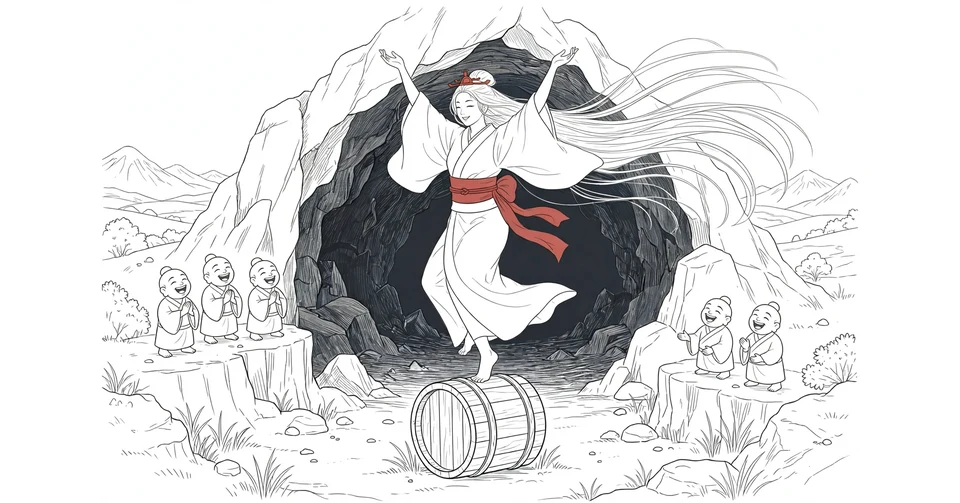
The story is told in the Kojiki and the Nihon Shoki, the two oldest chronicles of Japan, and it is more than a clever trick. The dance of Ame-no-Uzume became the origin of kagura, the sacred dance Shinto still performs, and it made her the patron of actors, dancers, and everyone who believes that joy can do what force cannot.
The night the sun went out
Amaterasu, the sun goddess, ruled Takamagahara, the Plain of High Heaven. Her younger brother Susanoo, the storm god, came up to heaven to say farewell, and what followed was a quarrel that turned into a rampage. He broke down the ridges between the rice fields and ruined the crops. He defiled the palace. Then he tore a hole in the roof of the weaving hall and threw a flayed horse through it. In the Kojiki version, one of the weaving women was so startled that she struck herself against a shuttle and died. In the Nihon Shoki version, Amaterasu herself was wounded. The two chronicles disagree on who was hurt, and the disagreement is a useful reminder that these stories were told and retold, with details shifting between tellings.
What both chronicles agree on is what happened next. Amaterasu, furious and grieving, shut herself inside the Ama-no-Iwato, the Heavenly Rock Cave, and rolled a great boulder across its mouth. With the sun goddess hidden, heaven and earth fell into total darkness. The gods could not see, the crops could not grow, and the world filled with the noise of restless spirits. The full story of that darkness is told in the article about the cave where Amaterasu hid the sun, and it is worth reading first, because the dance that follows only makes sense once you know how dark the world had become.
The gods gathered in the dark and did something unexpected. They did not argue about who was to blame, and they did not try to move the boulder by force. The wise god Omoikane proposed a festival instead. If the world outside the cave became joyful enough, Amaterasu might want to see it for herself. It was a strange plan, and it depended entirely on finding someone willing to be the entertainment. That someone was Ame-no-Uzume.
What Ame-no-Uzume actually did at the cave
The gods prepared the stage first. They gathered roosters, the long crying birds, and made them cry as if dawn were coming. They uprooted a sacred sakaki tree from a mountain and hung it with jewels, cloth, and a great mirror. The mirror was made by the smith god Ishikoridome, and the jewels by Tamanoya. Everything was ready except the performance, and then Ame-no-Uzume, the goddess of dance and mirth, stepped forward.
What she did next is described in both chronicles, and the Encyclopedia of Shinto gives the clearest short account of it. Ame-no-Uzume underwent divine possession, a state the old texts call kamigakari, and arrayed herself with willow and other plants before the door of the cave. She overturned a wooden tub, climbed on top of it, and stamped until it rang like a drum. The chronicles are frank about how uninhibited the dance was. She let her clothes fall into disarray and danced bare-breasted, laughing and calling out as she moved, and the watching gods burst into laughter with her. The Encyclopedia of Shinto sums her up in one line, calling her the goddess who danced so as to lure Amaterasu from the heavenly rock cave, and that is exactly what happened.
Inside the cave, Amaterasu heard the laughter and could not understand it. How could the gods be celebrating when she, the sun, was gone? She slid the boulder aside a little and asked what the noise was about. Ame-no-Uzume answered that they were celebrating because a goddess even greater than Amaterasu had appeared. Curious, Amaterasu leaned out further. The gods Ame-no-Koyane and Futodama held up the mirror, and Amaterasu saw her own shining face looking back at her. She stepped closer, thinking this must be the new goddess, and the strong god Ame-no-Tajikarao took her hand and pulled her out into the light. At once the other gods stretched a straw rope across the mouth of the cave so she could not go back inside, and light returned to the world.
Notice what Ame-no-Uzume did not do. She did not explain herself, apologize for the noise, or invite Amaterasu politely to come out. She made a scene so loud and so funny that curiosity did the work. The dance was a performance, but it was also a trap made of joy, and the bait was the one thing a goddess hiding in the dark could not resist, the sound of everyone else having a wonderful time without her.
Why laughter worked when force could not
It is worth asking why the gods chose this plan at all. A boulder can be moved by strength. Ame-no-Tajikarao, the god who eventually pulled Amaterasu out, was strong enough to do it. But force would have solved only half the problem. Amaterasu was not trapped in the cave. She had chosen to hide there, and a goddess dragged out against her will would have gone back inside the moment the gods looked away. The festival solved the real problem, which was not the boulder but the hurt. Ame-no-Uzume understood that, or at least the story credits her with understanding it, and her dance gave Amaterasu a reason to want to come out.
There is a human lesson hiding inside the myth, and it is one I keep coming back to. Anyone who has tried to coax a hurt friend out of a closed room knows that a lecture rarely works. The person inside the room already knows the arguments. What they do not know is whether the world outside is still worth joining, and the only honest way to answer that question is to make the world outside genuinely worth joining. Ame-no-Uzume did not argue that the darkness was wrong. She made the light outside louder than the darkness inside. That is a gentler kind of persuasion, and it is also a harder one, because it asks the persuader to be joyful first, before there is any reason to be.
The story also says something about who gets to save the world. It was not the strongest god, or the wisest, or the one with the mirror. It was Ame-no-Uzume, the goddess of dance and mirth, the one whose job was to make people laugh. Japan kept that idea. The dance of Ame-no-Uzume became the model for kagura, and the laughter at the cave became the reason sacred dance still begins with an invitation rather than a command.
The name that means a fearsome and courageous woman
The name Ame-no-Uzume carries a small puzzle. The Kogo shui, an early court text, explains the name as meaning a fearsome and courageous woman, which sounds like a description of a warrior. Yet Ame-no-Uzume herself never fights anyone. Her divine personality, as the Encyclopedia of Shinto puts it, was related more to the superiority of laughter and harmony than to confrontation and strength. The fearsome part of her was not a sword. It was the courage to make a fool of herself in front of eight hundred myriad gods, and to trust that laughter would do what force could not.
There is a second theory about the name, and it is worth knowing because it connects Ame-no-Uzume to the shrine maidens who still dance today. The character used to write uzu in her name is the same character used for kanzashi, the hair pin, and scholars have suggested the name may come from the hair pins and other ornaments worn by a divine medium, a miko, when she enters a state of possession. If that is right, then the name describes not a warrior but a woman who carries the signs of her office in her hair, and whose dance is a form of prayer. The two explanations do not really conflict. A miko who dances until she is possessed is both fearsome and joyful, and Ame-no-Uzume was both at once.
That combination is what makes her different from the other gods in the story. Amaterasu is the sun, Susanoo is the storm, and both of them are forces of nature. Ame-no-Uzume is a person doing a job, the job of making the gods laugh, and the story treats that job as seriously as ruling the sky. I find that quietly encouraging. It suggests that the work of cheering people up, of making a room lighter, counts as real work, even in a story about the fate of the world.
The guide who faced Sarutahiko
The dance at the cave is the story everyone knows, but it is not the only time Ame-no-Uzume changed the course of the myth. When Amaterasu sent her grandson Ninigi down from heaven to rule the land below, in the event called the Descent of the Heavenly Grandchild, Ame-no-Uzume was sent along as one of the chiefs of the five clans, and she became known as the ancestral kami of the Sarume clan. The dancer had become a leader, and the story was about to give her a second, stranger job.
On the way down, the gods met a kami standing at the border between the Plain of High Heaven and the Central Land of Reed Plains. His name was Sarutahiko, and his appearance was so strange that the other gods were afraid to approach him. Amaterasu and the god Takamimusuhi chose Ame-no-Uzume for the task, telling her, in the words the Kojiki records, that while but a gentle maid, she was a kami victorious when facing her foes. In one version recorded in the Nihon Shoki, Ame-no-Uzume bared her breasts and approached him with a derisive laugh, the same boldness she had shown at the cave, and asked him who he was and why he stood in the way.
It worked. Sarutahiko turned out to be a guide, not an enemy, and he and Ame-no-Uzume shared the work of leading Ninigi on his descent. When the journey was done, Ame-no-Uzume accompanied Sarutahiko to his resting place in Ise, and in recognition of her service she was granted a new name based on his, becoming Sarume no kimi, chief of the Sarume clan. The goddess who had once danced on a bucket was now the founder of a clan, and her descendants, the Sarume, carried her dance into the rituals of the court.
The Kojiki adds one more episode from her time in Ise, and it is the strangest of all. Ame-no-Uzume made the fish swear obeisance to the Heavenly Grandchild, and only the mouthless sea cucumber did not speak, so she used a knife to cut a slit in it for a mouth. It is a small, odd story, and it is easy to laugh at, but it carries the same pattern as the cave dance. Ame-no-Uzume meets something silent and closed, a cave with a boulder, a god at a border, a fish with no mouth, and she opens it. That is her gift. She opens closed things, not by breaking them but by making them respond.
One more note from the Nihon Shoki is worth keeping. In an alternate account, it was Ame-no-Uzume who warned Amaterasu that Susanoo was approaching the Plain of High Heaven again after he had once been banished. Ame-no-Uzume was not only the dancer and the guide. She was also the watchful one, the goddess who noticed what was coming and spoke up. The myth gives her many jobs, and she does all of them the same way, by stepping forward when everyone else hangs back.
From one dance to kagura
The dance of Ame-no-Uzume did not end when the sun came back. According to the Kogo shui, her performance before the cave was the origin of the ceremony of spirit pacification, the chinkonsai, a rite performed by the Sarume clan, her descendants. The wild dance on the bucket became a ritual, and the ritual became kagura, the sacred dance of Shinto. Every kagura dancer who stamps the floor today is repeating, in formal and disciplined form, the gesture Ame-no-Uzume made when she stamped on the overturned tub.
Kagura itself grew into two great families. The court kept mikagura, the formal and restrained dance of the Imperial palace, while the villages developed satokagura, louder and more varied, with masked troupes retelling the old myths through the night. The full story of that long life is told in the article on kagura, the sacred dance Shinto still performs, and it is worth reading, because it shows how one improvised dance became a tradition that has lasted for more than a thousand years.
What strikes me about that long life is how little the purpose has changed. Kagura is still performed for the gods first and for people second, and the dancers still face the altar rather than the crowd. Ame-no-Uzume danced for the gods at the cave, not for an audience, and the audience was lucky to be there. A thousand years later, the arrangement is the same. The dance is a gift, not a show, and that is probably why it has survived. Things made only to be watched go out of fashion. Things made as offerings tend to last.
Where the story still lives
The cave itself has a place on the map, or at least a place that tradition identifies as its site. In Takachiho, a mountain town in Miyazaki Prefecture, stands Amano Iwato-jinja, a shrine dedicated to Amaterasu, and the cave called Amano Iwato lies nearby, across the Iwato River from the shrine buildings. The cave cannot be approached, but visitors can gaze at it from an observation deck behind the shrine, with a priest as guide. The Japan National Tourism Organization describes the shrine as a place full of myth, and tells the story simply, that the sun goddess hid in the cave until Ame-no-Uzume performed a lively dance that made the other gods laugh so hard that Amaterasu emerged to find out why.
A short walk from the shrine, along a path lined with thousands of small stone piles, leads to Amano Yasukawara, the river cave where the gods are said to have gathered to discuss how to bring Amaterasu out. The stone piles are left by visitors, one small tower at a time, and the path grows more crowded with them the further you walk. It is a quiet place, and it suits the story. The loud part happened at the cave, where Ame-no-Uzume danced. The planning happened here, in a hollow by the river, where the gods sat down and thought.
The dance is still performed at Takachiho as well. The Amano Iwato Kagura festival runs from November through to February, when the locals dance to pray for a good harvest, ward off demons, and invite the deities into the kagura hall. Thirty-three dances are performed through the night, and the story of the cave is danced again, from the darkness to the laughter to the return of the light. No one who watches it needs to be told which goddess started it all. The dance on the bucket is still the first dance, and Ame-no-Uzume is still the reason the night ends with the sun.
Why the dance still matters
There are many ways to tell the story of Ame-no-Uzume, and all of them are true at once. She is the goddess of dawn and mirth, the patron of actors and dancers, the founder of the Sarume clan, the guide who faced Sarutahiko, and the watchful one who warned of Susanoo. But underneath all those titles is one simple image, Ame-no-Uzume standing on an overturned bucket, stamping her feet and laughing, while the world waits in the dark to see what happens next.
I think the image lasts because it answers a question most of us ask in dark times, and the answer it gives is not the one we expect. The story does not say that the darkness was an illusion, or that Amaterasu was wrong to hide. It says the darkness was real, the hurt was real, and the way back was not a command but an invitation. Someone had to be brave enough, and joyful enough, to go first. Ame-no-Uzume went first, and the sun followed her out of the cave.
That is a hopeful way to think about the work of cheering people up, and about the arts in general. A dance is a small thing next to a boulder, and a laugh is a small thing next to the dark. But the story of Ame-no-Uzume insists that small things, done boldly and at the right moment, can move what strength cannot. The sun did not return because someone ordered it to return. It returned because the world outside the cave became worth stepping into again, and one dancer made it so.
More in Culture & Society
- Miyadashi Is the Moment the God Leaves Home
- Otabisho Is Where the God Rests on the Way Through Town
- Mikoshi Are the Portable Shrines Japan Carries on Its Shoulders
- Sanja Matsuri Turns Asakusa Into Tokyo's Loudest Weekend
- Waraji Straw Sandals Walked Japan for a Thousand Years
- Fujin Carries the Wind That Arrives Before the Thunder
Latest posts
- An Engawa Is Neither Inside nor Outside, and That Is the Point
- Nikko and the Shrines Hidden in the Cedar Forest
- Minka Are the Folk Houses Japan Built Around the Hearth
- The Orangutan and the Vanishing Forests of Borneo
- Hozomon Guards the Treasure House Behind Senso-ji's Main Hall
- Nakamise Is the Shopping Street That Has Fed Pilgrims for Centuries
- Kaminarimon Is the Thunder Gate That Opens Asakusa to the World
- Sony, the Tokyo Workshop That Taught the World to Listen
- Raijin Is the Thunder God Behind Japan's Summer Storms
- Tengu Is the Mountain Goblin Japan Still Meets on the Trail
- Kappa Is the River Imp Japan Still Warns Its Children About
- Calonarang Is the Night Rangda and Barong Finally Meet
- Yamata no Orochi Was Never Just a Monster to Slay
- Kit Kat Japan, the Flavours You Will Not Find Anywhere Else
- How Susanoo Slew the Eight-Headed Serpent and Won a Bride