Ijen Blue Fire and the Volcano That Burns Blue at Night
· 13 min read
The Ijen blue fire is one of the rarest sights on Earth. Sulfur gas ignites at 600 degrees inside a crater in East Java, above a turquoise acid lake, while miners carry 70 kilogram loads out of the same pit.
At two in the morning, in the dark on the side of a volcano in East Java, a group of hikers stands at the edge of a crater and watches the ground burn blue. The flames are not orange, and they are not the glow of lava. They are thin, electric-blue tongues of fire that rise from cracks in the crater floor, flicker, and vanish, then rise again somewhere else. The Ijen blue fire is the reason people set an alarm for midnight, climb a mountain in the dark, and descend into an active crater wearing a gas mask. It is one of the rarest natural sights on Earth, and it lasts only as long as the night does.
Kawah Ijen sits on the eastern edge of Java, between the towns of Banyuwangi and Bondowoso, and most visitors come from the Banyuwangi side. The volcano rises to 2,799 metres, and its crater holds the largest highly acidic lake in the world, a stretch of turquoise water about a kilometre wide with a pH close to 0.5. The water looks like a tropical lagoon and is about as welcoming as battery acid. In 2023 UNESCO added the whole Ijen complex to its Global Geoparks Network, recognising the geology, the biology and the culture of the place in a single listing. But the Ijen blue fire is what fills the night buses from Banyuwangi.
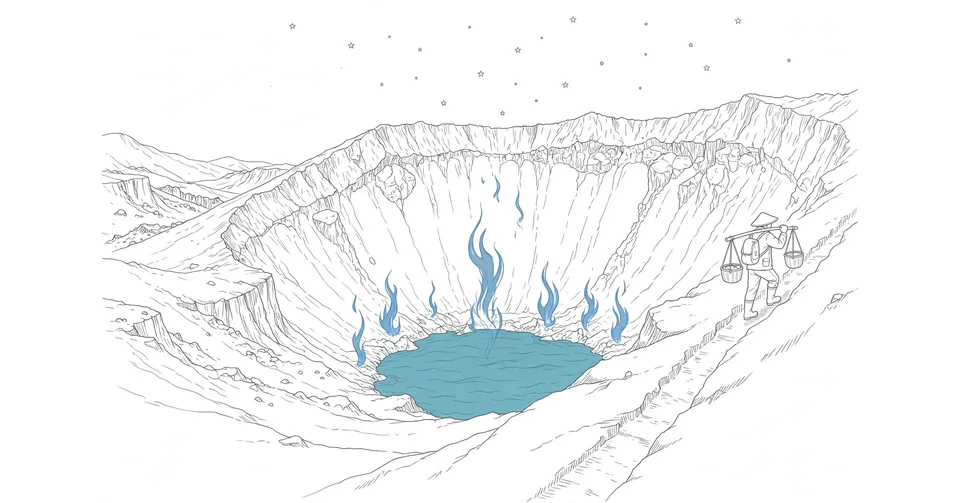
Seeing the Ijen blue fire takes effort, and that is part of its appeal. The site opens at 2 a.m., the Ijen blue fire is only visible in total darkness, and the window closes with the first light, usually between 4 and 5 a.m. After that the sun does the thing it always does, and the Ijen blue fire becomes invisible until the next night. A sight that demands a midnight alarm filters out the casual visitor, and the people who make it tend to remember it for the rest of their lives.
What the Ijen blue fire actually is
The Ijen blue fire is not lava, and it is not a trick of the light. Deep inside the volcano, sulfur-rich gas escapes from vents in the crater floor at temperatures around 600 degrees Celsius. When that gas meets the oxygen in the air, the Ijen blue fire ignites. The flame burns blue because of the sulfur itself, the same chemistry that colours the flame of a struck match blue at its base, only here the Ijen blue fire burns on the floor of a volcano, in sheets and jets that can reach several metres high.
The gas comes from the same source as the sulfur that miners have been digging out of the crater for decades. Ceramic pipes are run into a vent to condense the vapour, and as the sulfur cools it solidifies into bright yellow rock. The pipes glow faintly in the dark, and the Ijen blue fire dances around them. On a still night the fire looks almost calm, a slow blue shimmer across the crater floor. When the wind moves, the flames lean and stretch and flare, and the whole scene feels less like geology and more like something alive.
The Ijen blue fire is visible only in darkness, which is why the climb starts in the middle of the night. They are there during the day too, burning just as steadily, but daylight washes them out completely. That is the quiet joke of the Ijen blue fire. It never stops, and you can only see it when you cannot see anything else.
The phenomenon stayed almost unknown outside East Java until the early 2010s, when photographs of the Ijen blue fire began to circulate and the crater went from a working mine to a destination. The miners were there long before the tourists, and they are still there, which is the part of the story that deserves as much attention as the Ijen blue fire.
The miners who carry the mountain on their shoulders
Long before the first hiker arrives at the trailhead, the sulfur miners of Ijen are already at work. They break the solidified sulfur out of the crater with iron bars, load it into two bamboo baskets hung from a shoulder pole, and carry it up out of the crater and down the mountain to a weighing station. The loads weigh between 70 and 90 kilograms. The climb out of the crater rises about 300 metres on gradients of 45 to 60 degrees, and then there is a walk of about three kilometres down the outside of the mountain. Most miners make the trip twice a day.
It is hard, dangerous work, and it has been going on since the 1960s. The miners work without the protective equipment that a visitor would consider essential, breathing air thick with sulfur dioxide, and they are paid per trip, roughly 50,000 to 100,000 rupiah for each load. Some supplement their income by selling small sulfur carvings, little yellow turtles and ashtrays moulded from the same rock they carry, to the tourists who pass them on the trail.
Visitors meet the miners on the path, often in the dark, and the etiquette is simple. Step aside, let them pass, and do not block the trail for a photograph. These men are at work, and the trail is their workplace. A photo is fine if it does not slow them down. Buying a small carving is a small, direct way to put money in a miner's pocket, and it costs less than a coffee back home.
There is a trolley taxi on the mountain, a converted barrow with a seat, worked by two men, one pulling and one braking. It costs between 800,000 and 1,200,000 rupiah for the ride up and back, and it is mostly used by visitors who cannot manage the climb on foot. The miners, meanwhile, keep walking.
The night hike, hour by hour
The standard Ijen trip starts in Banyuwangi, about 35 to 40 kilometres from the trailhead at Paltuding, a drive of roughly an hour and a half. Most visitors leave their hotel around midnight and reach the base camp at about 1 a.m. The site opens at 2 a.m., and the climb begins in darkness, headlamps on, gas masks in hand.
The trail is about three kilometres long and climbs roughly 600 vertical metres to the crater rim at 2,386 metres. It is a steady, well-worn path, steep in places but not technical, and most reasonably fit hikers reach the rim in 60 to 90 minutes. The reward at the top is not the view. It is the dark, and the smell of sulfur, and the knowledge that the fire is burning somewhere below.
From the rim, visitors who want to see the Ijen blue fire up close descend into the crater itself, a drop of about 150 to 300 metres down a rocky path. This descent is the part that depends on the day. It is governed by gas readings rather than by a fixed schedule, and on days when the sulfur dioxide is too strong, the crater floor is closed. That is worth knowing before you book, because no operator can guarantee the Ijen blue fire, and a tour that promises it as a certainty is selling something it cannot control. Ask your guide or operator directly about the position on your date, and treat the descent as a bonus rather than a promise.
At the bottom, the Ijen blue fire is close enough to feel warm. The gas mask, which felt unnecessary at the trailhead, earns its place here. The air is sharp and the eyes water, and most people stay for 20 or 30 minutes before the gas pushes them back up to the rim. Then comes the part no photograph can quite capture. As the sky lightens, the Ijen blue fire fades, and the crater lake appears below, turquoise and vast, a kilometre of acid water glowing in the dawn. On a clear morning you can see across the strait to Bali.
Sunrise at the rim is the second act of the trip, and it is the gentler one. People sit on the rocks, eat the snacks they carried up, and watch the light change the colour of the lake from grey to green to a blue-green that looks retouched. The descent back to Paltuding takes about an hour, and most visitors are back in Banyuwangi by late morning, in time for a very late breakfast and a very early nap.
The lake that looks beautiful and is anything but safe
The turquoise lake in the crater of Ijen is the largest body of highly acidic water on Earth. It is about 722 metres across and around 200 metres deep, and its pH has been measured near 0.5 at the shore and as low as 0.13 toward the middle. For comparison, lemon juice sits at a pH of about 2. The lake is beautiful precisely because of the chemistry that makes it deadly, and it is one of the great examples of a place where looking is the whole of the experience.
Do not touch the water, and do not let the colour fool you into thinking it is a swimming spot. The acidity comes from sulfuric and hydrochloric acids dissolved in the water, fed by the same volcanic system that produces the blue flames. The lake has no outlet that a swimmer could use, and no one swims in it. The viewing point on the rim is the right distance, close enough to see the colour change with the light, far enough to stay safe.
The lake is also the reason the volcano is watched so closely. Ijen is an active volcano, monitored daily by volcanologists, and access is closed if seismic readings turn abnormal. It has not erupted in more than 20 years, and the daily monitoring is the reason visitors are allowed in at all. That monitoring is part of the ticket price, in a sense, and part of the reason the rules are worth following.
How to visit: tickets, health checks and the rules
Visiting Ijen takes a little more planning than most Indonesian hikes, and the planning starts before you leave home. Since 2023, entry has required an advance online reservation through the East Java conservation agency's booking system, at tiket.bbksdajatim.org, and walk-up entry is no longer guaranteed. The park enforces a daily visitor limit of 2,000 people, and weekends and dry-season nights sell out. Book first, then book your hotel.
The entrance fee for international visitors is around 100,000 rupiah on weekdays and 150,000 rupiah on weekends, though fees are reviewed periodically, so confirm the current rate when you book. A mandatory health check is also required on site before the climb, and since January 2024 every visitor must present a medical certificate confirming no history of heart or respiratory problems. The check itself costs around 25,000 rupiah at clinics near the trailhead. It is a small formality, and it is also the park's way of making sure nobody with asthma discovers the sulfur the hard way, halfway down into the crater.
| Item | Typical cost | Notes |
|---|---|---|
| Entrance, international visitor | 100,000 rupiah weekday, 150,000 rupiah weekend | Book online in advance |
| Health certificate | Around 25,000 rupiah | Required since January 2024 |
| Local guide, Banyuwangi departure | 400,000 to 900,000 rupiah | Usually includes transport, mask and headlamp |
| Tour from Bali | 1,500,000 to 2,500,000 rupiah | Includes ferry, 20 to 24 hours door to door |
| Trolley taxi, up and back | 800,000 to 1,200,000 rupiah | Two men, one pulling and one braking |
The dry season, from April to October, is the best window for the Ijen blue fire. Skies are clearer, the trail is drier, and the Ijen blue fire is easier to see. The site is closed on the first Friday of every month for conservation work, so check the calendar before you fix your dates. Bring a gas mask, or make sure your guide provides one, and bring a headlamp with a red light mode if you have one. The red light preserves your night vision and is kinder to everyone else on the trail.
A local guide is not legally required for the hike, but it is strongly recommended, especially for the crater descent. Guides know the gas conditions, the route, and the miners, and a good one will tell you honestly whether the descent is open that night. Tours from Banyuwangi typically cost 400,000 to 900,000 rupiah including transport, mask and headlamp, while all-inclusive tours from Bali run 1,500,000 to 2,500,000 rupiah and take 20 to 24 hours door to door, including the ferry across the Bali Strait.
What Ijen teaches you about travel
There is a version of travel that is entirely about the photograph, and Ijen resists it. The Ijen blue fire cannot be photographed well by a phone in the dark, the gas makes your eyes water, and the best part of the night, the quiet on the rim before dawn, does not show up in a picture at all. What Ijen rewards is the willingness to be uncomfortable for a few hours, to walk in the dark, to breathe bad air, and to stand still while the Ijen blue fire burns in front of you. That is a different kind of souvenir, and it lasts longer than a photo.
The mountain also asks for a little humility. The miners carry 90 kilograms out of the same crater that tourists descend into for fun, and they do it twice a day, every day, for a fraction of what a visitor spends on a tour. Remembering that while you stand at the rim, mask on, camera ready, is part of the visit. The Ijen blue fire is a natural wonder, and it is also a workplace, and treating it as both is the right way to see it.
If you climb one volcano in Indonesia, make it this one. Mount Bromo is easier and more famous, and Mount Rinjani is higher and harder, and both are worth the trip. But neither of them burns blue. Ijen does, and it does so every night, whether anyone is watching or not. The fire does not perform. It simply burns, and the privilege is in being there to see it.
For the practical details, including current hours and fees, the visitor guide at kawahijen.org is the most direct source, and the 2026 hiking guide at TravelProGuides covers the booking system and the route in detail. Check both before you go, because the rules, the prices and the gas conditions change, and the mountain does not send updates. Book the ticket, bring the mask, set the alarm for midnight, and go and see the Ijen blue fire while the night is still dark enough to show it.
More in Food & Travel
- Tanah Lot and the Temple That Rises From the Sea
- Lombok, the Island Next Door to Bali That Keeps Its Own Pace
- Ubud and the Valley Where Bali Slows Down
- Durian, the King of Fruits That Divides Southeast Asia
- Banda Islands and the Nutmeg That Changed the World
- Martabak and the Pancake Indonesia Eats Two Ways
Latest posts
- Sendai Tanabata Turns Three August Days Into Japan's Grandest Star Festival
- Tanzaku Carries Japan's Wishes on a Strip of Paper
- The Ainu People, Japan's Indigenous North
- Indonesian Coffee and the Islands Behind Every Cup
- Mount Rinjani, the Volcano Trek That Tests Every Hiker
- Koi-Koi Is the Card Game Where Knowing When to Stop Wins
- Yogyakarta and the City Where Java Keeps Its Soul
- Reog Ponorogo and the Giant Lion Mask That Dancers Carry With Their Teeth
- Doraemon, the Blue Robot Cat Japan Still Cannot Live Without
- Shirakawa-go, the Village of Praying Hands
- Hanafuda Turns Twelve Months of Flowers Into a Card Game
- Nintendo, the Playing Card Maker That Became a Gaming Giant
- Tana Toraja and the Funerals That Last for Days
- Tempeh and the Fermented Bean Cake Indonesia Gave the World
- Gado-Gado, the Peanut Sauce Salad That Feeds All of Indonesia