Mount Bromo, Indonesia's Volcano You Can Walk Into
· 9 min read
Mount Bromo is an active volcano in East Java that you can stand on, not just look at. This is how the sunrise, the sea of sand, and the Tengger people who hold it sacred all fit together.
Mount Bromo is not a mountain you admire from a distance. It is a volcano you walk into, across a grey desert of sand, up about 250 steps, until you are standing on the rim of a crater with smoke rising at your feet. For a few hours on a cold morning in East Java, the ground under you feels alive, and that is the whole point of going.
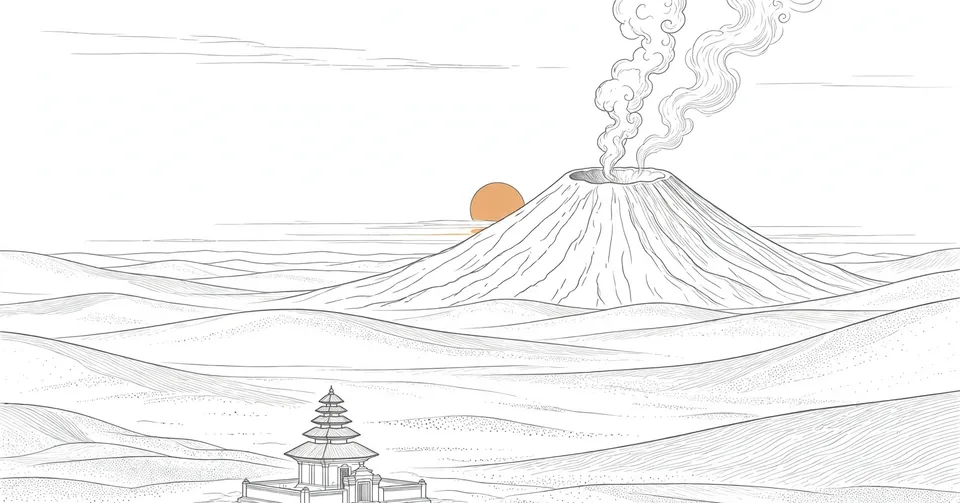
Most famous volcanoes keep visitors behind fences and far away. Mount Bromo does the opposite. The classic visit starts before dawn at a viewpoint, continues across a volcanic plain in a jeep, and ends with you looking straight down into an active crater. It is one of the easiest great volcano walks in the world, and also one of the strangest landscapes in Indonesia: a desert, a smoking cone, and green hills, all in one view.
What Mount Bromo is
Mount Bromo is an active volcano in East Java, inside Bromo Tengger Semeru National Park. It stands about 2,329 metres high in the Tengger highlands, in a vast old caldera left behind by an even larger volcano. Its neighbours are part of the view too: Mount Batok, a steep green cone that has not erupted in living memory, and Mount Semeru, the tallest mountain in Java at 3,676 metres, which often sends up its own plume of smoke on the horizon.
The name comes from Brahma, the Hindu god of creation. That is no accident. The Tengger people who live around Mount Bromo are Hindu, and the volcano is sacred to them. For centuries they have treated the crater not as a danger to avoid but as a holy place to respect, and that attitude shapes everything about a visit here. You do not conquer Mount Bromo. You are allowed to come close.
Mount Bromo is still active, and it smokes on most days. The crater floor is a wide bowl of grey and yellow rock, and the smell of sulfur hangs in the air at the rim. Eruptions have closed the area in the past, and the park can restrict access when activity rises, so the first thing a wise visitor does is check the current status before setting out. On a normal day, though, the rim is open, and hundreds of people climb it every morning.
The sunrise at Penanjakan
The day starts very early. Jeeps leave the village of Cemoro Lawang at around 3 in the morning, in the dark, and climb to the Penanjakan viewpoint at about 2,770 metres. Bring a jacket. The temperature at dawn can fall to single digits, and the wind at the viewpoint has nothing to stop it.
Then the light comes, slowly. First the sky turns grey, then the shapes appear: the sea of sand below, the cone of Mount Bromo, the green slopes of Batok beside it, and Semeru far behind, catching the first sun. When the sun finally clears the horizon, the whole caldera turns gold, and for a few minutes nobody at the viewpoint says much. It is the kind of sunrise that makes the 3 a.m. alarm feel like a good decision.
Penanjakan gets crowded, and that is the honest truth about it. On a busy morning the viewpoint is full of people with tripods and phones, and the quiet lasts only until the sun is up. If crowds bother you, there are lower viewpoints along the same road where the view is nearly as good and the space is easier. But even at its busiest, the sunrise at Penanjakan is worth the crowd, because the landscape is so large that it absorbs everyone in it.
Crossing the sea of sand
After sunrise, the jeeps drive down into the caldera and across the Segara Wedi, the sea of sand. It is a wide plain of grey volcanic ash and sand, almost flat, with nothing growing on it except a few hardy shrubs near the edges. The jeep leaves a trail of dust behind it, and for a few minutes you are crossing a desert that sits inside a volcano.
At the foot of Mount Bromo, the jeeps stop. From here you can walk, or hire a horse for part of the way, and then climb the steps to the crater rim. There are about 250 of them, steep and uneven, and the altitude makes them feel harder than they look. Take them slowly. The view from the top is the reward: the crater opening below, smoke curling up from the vents, and the yellow sulfur stains on the rock.
Stay behind the fences and the marked paths at the rim. The edge is not a place to test your balance, and the ground near a live crater deserves respect. The best photos are taken from the safe side of the fence anyway, where the smoke, the crater, and the sea of sand all fit into one frame.
The Tengger people and Yadnya Kasada
The people who live around Mount Bromo are the Tenggerese, and their story is part of what makes the volcano special. They are Hindus in a mostly Muslim country, and their traditions go back to the Majapahit kingdom, the great Javanese empire that fell in the early 1500s. According to their own history, their ancestors fled into these highlands when Majapahit collapsed, and they have kept their faith and customs here ever since.
Once a year they hold the Yadnya Kasada festival at Mount Bromo. Families climb to the crater rim carrying offerings of food, flowers, fruit, and sometimes livestock, and throw them into the crater as a gift to the gods. The festival comes from an old legend: a couple who could not have children prayed to the gods, were granted many, and promised their youngest son in return. When the time came, the son threw himself into the crater so the village would be spared, and the offerings remember that sacrifice.
The festival draws thousands of people, and it is the most crowded time to visit. If you come for Kasada, expect a crowd, a ceremony, and a mountain that feels more like a temple than a tourist site. If you come on an ordinary day, the Tengger presence is quieter but still there: in the village temples, in the farmers working the highland fields, and in the guides and jeep drivers who know every turn of the road.
When to go and what to bring
The best season for Mount Bromo is the dry season, roughly April to October, when clear mornings are most likely. In the wet season the sunrise is a gamble, and the road to Penanjakan can be foggy. That said, the mountain is beautiful in any month, and a cloudy morning can still clear by the time you reach the crater.
A typical Bromo morning runs on a simple schedule.
| Time | What happens |
|---|---|
| 3:00 a.m. | Jeeps leave Cemoro Lawang for Penanjakan |
| 4:30 a.m. | Arrive at the viewpoint and wait for first light |
| 5:00 a.m. | Sunrise over the caldera |
| 6:00 a.m. | Drive down and cross the sea of sand |
| 7:00 a.m. | Climb the steps to the crater rim |
| 8:30 a.m. | Back at the jeep, usually in time for breakfast |
Pack for two different climates in one morning. At the viewpoint you need a warm jacket, long trousers, and closed shoes. By the time you are walking on the sand, the sun is strong, so bring sunscreen, water, and a hat. A mask or a scarf helps at the crater rim, where the wind can carry sulfur and fine ash into your face. Cash is useful too, since the jeep hire, the horse ride, and the park entrance are usually paid on the spot.
How to get there
The nearest city is Probolinggo, on the north coast of East Java. From there it is about an hour by road to Cemoro Lawang, the small village at the edge of the crater, where most visitors spend the night. The road climbs steeply, and the temperature drops as you go up, so by the time you arrive the air already feels different from the coast.
Most visitors arrange a jeep tour from Probolinggo, or from Malang, the larger city to the south. The tour usually includes the sunrise viewpoint, the sea of sand, and the crater climb, and it ends before midday. If you prefer to go on your own, you can stay in Cemoro Lawang and hire a jeep at the village, but book the night before, because the jeeps leave early and the good drivers are taken first.
Cemoro Lawang itself is worth an evening. It is a small village of guesthouses and food stalls sitting on the rim of the caldera, and the view from the village edge at sunset is almost as good as the sunrise. Sit outside with a hot drink, watch the light change over the sand, and you will understand why people come back to Mount Bromo more than once.
Mount Bromo is not the biggest volcano in Indonesia. Tambora, the volcano whose eruption changed the world, was far larger, and its story is a reminder of what these mountains can do. But Bromo offers something Tambora cannot: you can stand on it, in the morning, and watch the earth breathe. Borobudur, the great temple a few hours to the west, shows what people built in this landscape. Mount Bromo shows what the landscape built first, and why the people who live beside it still bring it offerings.
Go slowly, dress warmly, and give the mountain the respect it asks for. The sunrise will do the rest.
More in Food & Travel
- Numazu Deep Sea Aquarium and the Creatures of Suruga Bay
- Numazu Himono and the Art of Dried Fish
- Numazu Port and the Freshest Seafood in Shizuoka
- Bullet Climbing Mount Fuji, the Overnight Ascent Japan Is Trying to Stop
- Climbing Mount Semeru, Java's Highest Volcano
- Tamago Sando and Japan's Konbini Egg Sandwich
Latest posts
- Love Live Sunshine and How Anime Changed Numazu
- Numazu Imperial Villa and Japan's Seaside Imperial Retreat
- Disaster Vending Machines in Japan That Give Their Drinks Away
- The E33G Remote Worker Visa and How to Legally Work from Bali
- Wabi-Sabi and the Japanese Beauty of Imperfect Things
- Women Only Train Cars in Japan and the Problem They Answer
- Maneki Neko and Japan's Beckoning Lucky Cat
- The Baduy People and Life Without Modern Technology
- The Salaryman and Japan's Loyal Office Culture
- Onsen Tattoo Rules in Japan and How They Are Slowly Changing
- Key Money in Japan and Why Renting Costs Four Months Up Front
- Sento, Japan's Everyday Public Bathhouse
- The Fuji Five Lakes and the Best Views of Mount Fuji
- The Obon Festival, Japan's Week for Honouring Ancestors
- Visiting the Ghibli Museum and Ghibli Park in Japan