Yogyakarta and the City Where Java Keeps Its Soul
· 12 min read
Yogyakarta is the one Indonesian city where a sultan still rules, a palace still sets the rhythm of daily life, and a 6 kilometre line drawn in 1755 still shapes the streets. This is why Yogyakarta rewards slow travel.
Most Indonesian cities ask you to keep moving. Yogyakarta asks you to slow down. It is the one city in the country where a sultan still lives in his palace, still governs the province, and still sets the rhythm of daily life. The streets, the food, the music, and even the layout of the city all follow a logic drawn up in 1755, and that logic is still visible if you know where to look.
Yogyakarta is not the biggest city in Indonesia, and it is not trying to be. What it offers instead is density of meaning. A morning can hold a palace visit, a bowl of jackfruit stew that has simmered overnight, a batik workshop, and a walk down a street that has sold the same goods for generations. Few places in Southeast Asia pack that much living culture into such a walkable centre.
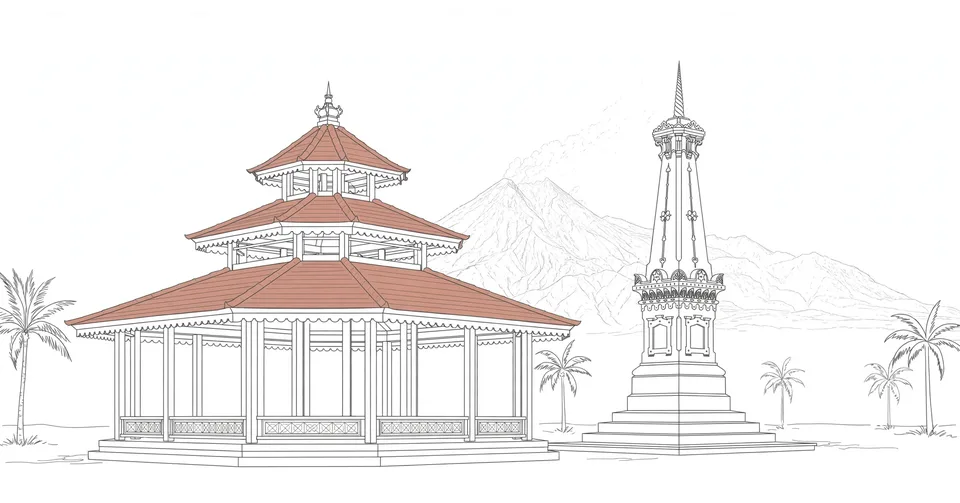
That is the honest answer to the question every traveller asks before going: is Yogyakarta worth the trip from Jakarta or Bali? Yes, and not only for the temples on its doorstep. The city itself is the attraction. Borobudur and Prambanan are extraordinary, but they are day trips. Yogyakarta is the place you come back to at night, and it is the place that stays with you.
Yogyakarta Was Built on a Straight Line
Yogyakarta begins with a line. In 1755, after the Treaty of Giyanti split the old Mataram kingdom, Sultan Hamengkubuwono I founded a new capital and laid it out along a straight north-south axis about six kilometres long. The line runs from Mount Merapi, the volcano to the north, to the Indian Ocean in the south, with the Kraton, the royal palace, sitting at its exact centre. In Javanese cosmology the capital was a miniature of the universe, and the axis embodied ideas about the human life cycle, harmony between people and nature, and the relationship between ruler and ruled.
For centuries this was local knowledge, taught in schools and walked in processions. Then, on 18 September 2023, UNESCO inscribed the Cosmological Axis of Yogyakarta and its Historic Landmarks as a World Heritage Site, recognising the axis as an exceptional testimony to Javanese civilisation. The listing covers the Kraton complex and the landmarks along the line, from Panggung Krapyak in the south to the Tugu Yogyakarta monument in the north. Indonesia now counts ten World Heritage Sites, six of them cultural, and the Yogyakarta axis is the most recent addition.
What makes the listing unusual is that the site is not a ruin. The axis is a working piece of 18th century urban planning that people still use every day. Sections of it close to traffic for ceremonial processions on palace occasions, and the Kraton remains a lived-in royal residence rather than a museum piece. Yogyakarta rewards travellers who walk the axis slowly, because the city reveals itself in order: the monument at the north end, the palace at the centre, and the ceremonial square at the south.
A Palace That Still Rules
The Kraton Ngayogyakarta Hadiningrat was built in 1755 and 1756, one of the first acts of the new sultanate. It is a walled complex of pavilions, courtyards, and museums, and it still houses the sultan and his court. Visitors can walk through the public pavilions in the morning, watch gamelan rehearsals, and see the royal carriages and batik collections in the museum halls. The ticket for international visitors is modest, and the palace keeps limited hours, roughly 8 in the morning to 2 in the afternoon, Tuesday through Sunday, so an early start pays off.
The part that surprises first-time visitors is the politics. Sultan Hamengkubuwono X holds two roles at once. He is the traditional head of the sultanate and the governor of the Yogyakarta Special Region, the only governorship in Indonesia passed down hereditarily rather than through election. No other Indonesian province works this way. The arrangement is written into national law, and it gives Yogyakarta a political identity unlike anywhere else in the country. When people in Yogyakarta talk about the sultan, they are talking about both their king and their governor, and the distinction barely matters in daily conversation.
That dual role shapes the city in practical ways. The palace sponsors cultural events, the sultan's birthday brings processions along the axis, and the region's identity is tied to the court in a way that feels personal rather than ceremonial. My own view is that this is what separates Yogyakarta from other heritage cities. Elsewhere, the past is preserved behind glass. In Yogyakarta, the past still signs documents.
Malioboro and the Art of the Stroll
From the Kraton, the axis runs north through the Alun-Alun and up Jalan Malioboro, the city's most famous street. Malioboro is a kilometre of shops, street vendors, batik stalls, and food carts, and it is best experienced on foot in the late afternoon, when the heat softens and the street fills with families. The name is often linked to the Duke of Marlborough, a reminder of the British interlude in Java two centuries ago, though the street has long since become thoroughly Javanese.
The street is also the most practical base for a first visit. Hotels cluster around it, the train station sits at its northern end, and the becak drivers and andong horse carts waiting at the kerb will take you anywhere in the old city for a negotiated fare. Agree the price before you get in, as you would anywhere in Indonesia, and the ride becomes part of the experience rather than a negotiation.
Malioboro rewards the patient. The batik sold here ranges from printed cloth made in factories to hand-drawn pieces that took months to finish, and the price tells you which is which. The food carts sell wedang ronde, a warm ginger drink with glutinous rice balls, and angkringan stalls serve rice, skewers, and sweet tea for a few thousand rupiah. It is street food at its most democratic, and it is where Yogyakarta's students, workers, and visitors eat side by side.
The Temples at the Doorstep
No honest account of Yogyakarta can skip the two temples that made it famous, even though both sit outside the city itself. Borobudur, the world's largest Buddhist temple, lies about 40 kilometres northwest, roughly an hour's drive, and Prambanan, Indonesia's largest Hindu temple complex, sits about 17 kilometres to the east. Both are UNESCO World Heritage Sites, and both are covered in detail in their own articles on this site, including Borobudur, the World's Largest Buddhist Temple and the story of Prambanan.
What matters for a Yogyakarta trip is how the temples fit into the day. Borobudur at sunrise remains the classic experience, with the stupas emerging from the mist over the Menoreh hills, though the climb to the upper terraces is now managed with limited numbers and timed entry. Prambanan is best in the late afternoon, when the low sun turns the stone gold, and on dry-season evenings the Ramayana Ballet performs on the open-air stage with the temple as a backdrop. The ballet retells the same epic that the temple's reliefs carve in stone, and watching it after walking the complex makes the carvings read like a storyboard.
The scale of temple tourism here is easy to underestimate. Prambanan Jazz, the annual music festival held inside the temple grounds, drew a record 85,000 visitors over three days in July 2026, its largest crowd in twelve years. The temples are not quiet ruins. They are stages, and Yogyakarta is the city that hosts the audience.
The Food That Defines Yogyakarta
Yogyakarta's signature dish is gudeg, young jackfruit stewed for hours in coconut milk and palm sugar until it turns dark brown and sweet. It is served with rice, chicken, egg, and krecek, a spicy stew of cow skin crackers, and it is the dish every visitor is told to try first. The best gudeg sellers open early and sell out by midday, which tells you everything about how seriously the city takes breakfast.
Beyond gudeg, the city has a second icon in bakpia, the small mung bean pastry that travellers buy by the box as a souvenir. The original filling is green mung bean, but bakeries now sell chocolate, cheese, and black sesame versions, and the shops along the road to the airport do a brisk trade in all of them. Then there is sate klathak, skewered goat meat grilled over charcoal and seasoned only with salt, a speciality of the Jejeran area south of the city that deliberately skips the peanut sauce other satay depends on.
Yogyakarta's food scene is not about fine dining. It is about the warung that has cooked the same dish for forty years, the angkringan that opens at dusk, and the market stall that sells exactly one thing. The city rewards eaters who follow the queues rather than the guidebooks, and the queues here are usually right.
Batik, Wayang, and the Arts That Never Left
Yogyakarta is one of the two great centres of Javanese batik, alongside Solo, and the craft is woven into the city's identity. The palace has its own batik traditions, with certain patterns reserved for the royal family, and workshops across the city still draw wax by hand with a canting tool. Visitors can try a short workshop and leave with a piece of cloth they made themselves, which is a better souvenir than anything in a gift shop. The story of the craft itself is told in Batik, Indonesia's Wearable Art.
The same living tradition runs through the performing arts. Wayang kulit, the shadow puppet theatre, is still performed in Yogyakarta, with the dalang narrating, singing, and voicing every character behind a backlit screen while a gamelan orchestra plays through the night. The form is introduced in Wayang, Indonesia's Shadow Puppet Theatre, and the gamelan that accompanies it is the sound of Java itself, bronze keys and gongs tuned to scales that predate Western music theory in the archipelago by centuries.
Yogyakarta also carries a quieter artistic reputation. It is home to Gadjah Mada University, founded in 1949, one of Indonesia's oldest and largest universities, and its student population gives the city a creative energy that shows up in galleries, cafes, and street art. The city has long been a magnet for painters, and the art scene here is less commercial than Jakarta's and more experimental than Bali's. That mix of court tradition and student restlessness is, to my mind, the real character of the place. Yogyakarta does not choose between old and new. It keeps both in the same room.
Getting There and Getting Around
Yogyakarta is easier to reach than most travellers expect. The Jakarta to Yogyakarta train is the busiest intercity route pair in Indonesia, carrying 1,164,448 passengers in the first ten months of 2026 alone, according to the state railway company KAI. The journey from Gambir station takes around six to eight hours depending on the service, and the Argo trains are comfortable enough that the ride becomes part of the trip. Flights land at Yogyakarta International Airport in Kulon Progo, about 45 kilometres west of the city, with a rail link into town.
Inside the city, the old centre is walkable, and the Trans Jogja bus network covers the wider area for a flat fare. Ride-hailing apps work well, and rental cars with drivers are cheap by international standards for day trips to the temples, the beaches of Gunungkidul to the south, or the slopes of Mount Merapi to the north. The southern beaches, with their white sand and cliff views, are a different Yogyakarta entirely, and they make a good second day after the temples.
The practical question is how long to stay. Two full days cover the Kraton, Malioboro, and one temple comfortably. Three days allow a second temple, a batik workshop, and a slow morning. A week lets you add the beaches, the Merapi lava tour, and the villages that make batik and pottery by hand. Yogyakarta rewards the extra day more than most cities its size, because its pleasures are cumulative rather than spectacular. The first day gives you the sights. The third day gives you the rhythm.
When to Go
The dry season, roughly May to October, is the most comfortable time to visit, with cooler mornings and reliable sunsets at the temples. The wet season brings afternoon rain and greener rice fields, and hotel prices soften. The city fills up during school holidays, the Eid homecoming period, and the Prambanan Jazz weekend, so book ahead if your dates fall in those windows. Foreign arrivals to the Yogyakarta region remain modest by Bali standards, with about 12,000 foreign visits recorded in September 2026, which means the city never feels overwhelmed the way the island's resort towns can.
If there is a single piece of advice worth keeping, it is this: do not treat Yogyakarta as a stopover. Travellers often slot it between Jakarta and Bali as a one-night temple break, and they leave having seen the stones but not the city. The axis, the palace, the food, and the arts all need unhurried time, and the city repays it. Yogyakarta is the place where Java keeps its soul, and souls are not understood in a hurry.
The best time to walk the axis is at dawn, when the street sweepers are out, the mosque loudspeakers fade, and the Tugu monument stands in silhouette against a sky the colour of weak tea. Stand there, look south along the straight line the sultan drew in 1755, and you will see a city that still believes a street can mean something. That is a rare thing, and it is worth travelling for.
More in Food & Travel
- Mount Rinjani, the Volcano Trek That Tests Every Hiker
- Shirakawa-go, the Village of Praying Hands
- Tempeh and the Fermented Bean Cake Indonesia Gave the World
- Gado-Gado, the Peanut Sauce Salad That Feeds All of Indonesia
- Bakso and the Meatball Soup Indonesia Eats Everywhere
- Sapporo Snow Festival and the Ice City That Rises Every February
Latest posts
- Koi-Koi Is the Card Game Where Knowing When to Stop Wins
- Reog Ponorogo and the Giant Lion Mask That Dancers Carry With Their Teeth
- Doraemon, the Blue Robot Cat Japan Still Cannot Live Without
- Hanafuda Turns Twelve Months of Flowers Into a Card Game
- Nintendo, the Playing Card Maker That Became a Gaming Giant
- Tana Toraja and the Funerals That Last for Days
- The Washlet Made the Japanese Bathroom the Warmest Room in the House
- Kecak Dance and the Hundred Voices That Tell the Ramayana
- Rangda Is the Witch Queen Bali Never Lets Win
- The Japanese School Uniform and the Story Behind the Sailor Suit
- Aikido and the Martial Art That Refuses to Fight Back
- Satay and the Smoke That Carries Indonesia to the World
- Barong Is the Lion Bali Calls Out When the Village Needs Protection
- Tumpeng Is the Rice Cone Java Serves When It Wants to Say Thanks
- Onsen Etiquette and the Unwritten Rules of Japan's Hot Springs