Tanzaku Carries Japan's Wishes on a Strip of Paper
· 16 min read
A tanzaku is a long, narrow strip of paper that has carried Japanese poems, wishes, and card games for centuries, and its small size is exactly what gives it power.
A tanzaku is a strip of paper about as long as a forearm and as wide as two fingers, and it has carried some of the most careful words in Japan for more than seven hundred years. Poets wrote waka on it, children wrote wishes on it, and card players still chase it across a table. The object never changed much, because it never needed to. A narrow strip leaves no room for rambling, so whatever is written on it has to matter.
That is the whole secret of the tanzaku. It is not a notebook, not a letter, and not a poster. It is one short thought, written by hand, in a space too small to hide in. When a tanzaku hangs from a bamboo branch in summer, or when one sits framed on a wall, the paper is doing the same job it has always done. It holds a few words still, long enough for someone else to read them slowly.
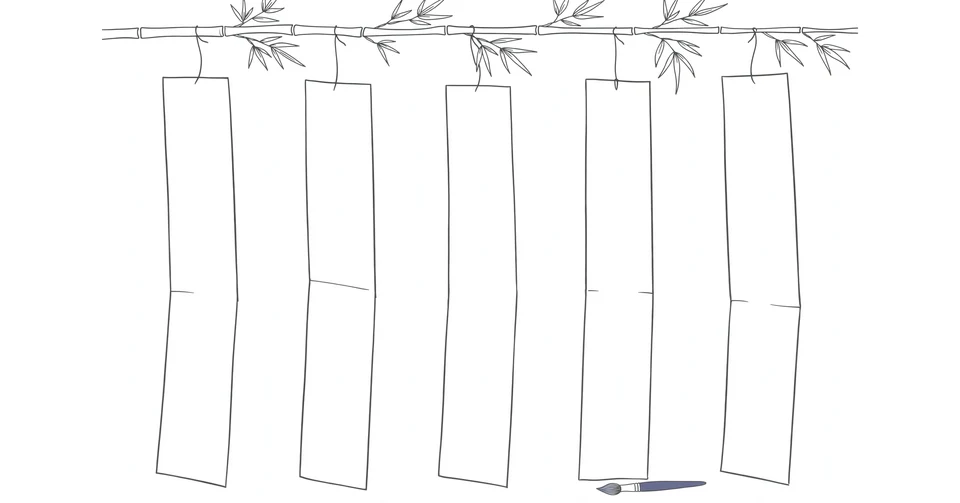
The word itself means short book, which sounds odd for a strip of paper until you think about what a book used to be. A tanzaku is a book reduced to a single page, a single idea, and nothing else. Over the centuries it has taken three different jobs, as a poem sheet, as a wish hung on bamboo, and as a playing card, and each job reveals a different side of the same small object. To understand the tanzaku is to understand how Japan treats words, as things worth writing carefully, displaying proudly, and sometimes even playing with.
What a tanzaku is, and why it stays narrow
A tanzaku is a long, narrow strip of paper, usually about 35 centimetres long and about 6 centimetres wide, a size that has stayed roughly steady across the centuries. It can be plain white or decorated, and the decoration is often restrained, a wash of colour at the top or bottom, a cloud pattern, or flecks of gold and silver leaf. The point of the strip is not the paper itself. The point is the writing, and the narrow shape forces the writer to choose. There is no space for a draft, no margin for a second thought, and no room to explain yourself twice.
The name tanzaku began to be used during the Kamakura period, and the first document known to mention the word dates to 1313, in the diary of Emperor Hanazono. By then the strip was already being used as a simplified form of kaishi, the folded paper used for prose and poetry at gatherings, and it was sometimes used as the stake in a poetry contest, which tells you how seriously people took it. A tanzaku was not scrap paper. It was a formal surface, good enough to carry a poem and good enough to bet on.
The oldest surviving examples come from 1344, a set of 120 sheets known as the Hoshakkyo Yobon Shihai Tanzaku, and the sheets share such a consistent format that scholars take it as evidence the conventions for writing waka on a tanzaku were already settled by the middle of the 14th century. That is a remarkable thing to realise. The way a poet lays out a poem on this strip today follows rules that were already fixed nearly seven hundred years ago, and the strip itself has barely changed since. Most objects that old have become museum pieces. The tanzaku is still in use, in classrooms, at festivals, and in living rooms, because its job never went away.
Part of the appeal is the discipline it imposes. A blank page invites you to fill it. A tanzaku invites you to stop. You write one poem, or one wish, or one line that you are willing to stand behind, and then the paper is full. There is a quiet honesty in that. A person who writes on a tanzaku has to decide what they actually mean, and the paper will not let them pretend otherwise.
The poem strip: waka on a narrow stage
The oldest job of the tanzaku is the poem strip, and it is the job that shaped everything else. A waka is a poem of 31 syllables in a 5-7-5-7-7 pattern, and on a tanzaku it is written in two lines, with the upper phrase on the first line and the lower phrase on the second. The title sits above the poem, and there are further rules about where the first character should fall and when the brush should be reloaded with ink, at the first, third, and fifth phrases. It sounds fussy, and in a way it is, but the fuss is the point. The rules turn writing into a small ceremony, and the ceremony turns a few syllables into something worth keeping.
In the 14th century, during the Nanboku-cho period when two rival imperial courts were fighting for legitimacy, the four great waka poets known as the Waka Shitenno, Kenko, Joben, Keiun, and Ton'a, used plain white tanzaku with no decoration at all. That detail matters, because the period was one of war and division, and the poets still wrote. Their plain strips suggest that the poem was enough, and that decoration was a luxury the moment did not need. Later, during the Muromachi period, the strips became highly decorated, with cloud patterns overlaid with cut pieces of gold and silver, and the decoration itself became part of the art. A tanzaku could be beautiful before a single character was brushed onto it, and the poet had to write well enough to deserve the paper.
There is something touching about the way these poem strips were treated. They were exchanged, displayed, and kept, and a single poem on a single strip could be a gift, a greeting, or a quiet declaration. A waka is short, but it is not small. It carries a season, a feeling, and an observation in 31 syllables, and the strip gives it a physical form that matches its scale. A poem that fits on a strip of paper can be held in one hand, and that is part of its charm. It is not a performance for a crowd. It is a small thing, made carefully, for one reader at a time.
The tanzaku also became a place where calligraphy itself was the art. A poet who was also a fine calligrapher, like the 19th century poet and artist Otagaki Rengetsu, wrote waka on decorated slips in clear, confident brushwork, and those slips are now collected as works of art in their own right. The words matter, and so does the hand that wrote them. A tanzaku records both at once, the thought and the gesture, and that is why old ones are still worth looking at centuries later. You are not only reading a poem. You are watching a hand move.
I think there is a lesson in the poem strip that has nothing to do with poetry. A small, fixed space makes you a better writer, because it takes away your excuses. You cannot pad a tanzaku, you cannot bury a weak idea in a long paragraph, and you cannot hide behind decoration, even when the decoration is gold leaf. The strip asks a simple question, and it asks it every time. What is the one thing you want to say, and can you say it well enough to fit here? That is a question worth asking about far more than poems.
The wish strip: a tanzaku on bamboo
The most familiar job of the tanzaku today is the wish strip, and it is the one most people outside Japan have seen, even if they did not know its name. At Tanabata, people write wishes, sometimes in the form of poetry, on small pieces of paper and hang them on bamboo. The bamboo branches fill up with colour, the strips flutter in the summer air, and the whole tree becomes a public record of private hopes. You can read more about the festival itself, and the two star-crossed lovers at its heart, in Tanabata Festival and the Star-Crossed Lovers Behind the Bamboo Wishes, but the strip deserves its own story, because the festival is one night and the strip is the part that people keep.
The custom of hanging a tanzaku on bamboo is generally believed to have started in the Edo period. Tanabata itself is far older, introduced to Japan by Empress Koken in 755 from the Chinese festival of Qixi, and by the early Edo period it had spread from the imperial court to the general public. In those days girls wished for better sewing and craftsmanship, and boys wished for better handwriting, writing their wishes on strips of paper, and the custom was to make the ink from dew left on taro leaves. It is a lovely detail, and it shows how seriously the wish was taken. Even the ink had to be gathered with care.
The schools of Edo Japan, the terakoya, played a large part in spreading the practice. Teachers would have their male students hang a tanzaku on Tanabata to display their calligraphy and aspire to further improvement, so the wish strip was also a piece of homework, hung in public for everyone to judge. That may sound harsh, but it is also generous. A child who writes a wish in their best handwriting is practising two things at once, honesty and craft, and the bamboo branch is a kinder audience than a red pen. The practice spread nationwide in the late Edo period, and after the Second World War it became a national custom, taught in schools across the country. Today, writing a wish on a tanzaku and hanging it on bamboo is something most Japanese people experience in childhood, and that shared memory is part of why the custom endures.
The traditional date of Tanabata is the seventh day of the seventh lunar month, and the first festivities begin on 7 July of the Gregorian calendar, though the date varies by region and some festivals are held in August. At the Sendai Tanabata Festival, held from 6 to 8 August, the tanzaku is one of seven traditional decorations, and it stands for handwritten wishes for a good future. The other decorations have their own meanings, paper cranes for long life, a paper kimono, a purse for good business, a net for good fishing, a trash bag for cleanliness, and streamers for improved weaving skills, but the tanzaku is the only one that carries words. The rest are symbols. The strip is a sentence.
The wish strip has also travelled far beyond the festival. In 2008, when the G8 summit in Toyako coincided with Tanabata, Prime Minister Yasuo Fukuda invited the visiting leaders to write a wish on a tanzaku and hang it on a bamboo tree, and the Ministry of Foreign Affairs set out coloured strips and a bamboo tree in Roppongi for the public to do the same. It was a small gesture, and it was widely reported, because it caught something true about the object. A tanzaku is a wish that you have to write yourself, in your own hand, and then hang up where other people can see it. That takes a little courage. A wish kept in your head costs nothing. A wish written on a strip and hung on a tree is a promise, even if it is only a promise to yourself.
There is also a song that many Japanese children learn, and its lyrics name the five colour paper strips directly, the five colour tanzaku that the singer has written. The song is simple, and it is sung the way nursery songs are sung, without thinking too hard about it, but it carries the same idea as the festival itself. The stars are watching from above, and the strips are the message. Whether or not you believe the stars are listening, the act of writing the wish down changes something. It turns a vague hope into a sentence, and a sentence is something you can return to, remember, and measure yourself against.
The card strip: tanzaku in hanafuda
The third job of the tanzaku is the one most people would never guess, and it is the one that gave this article its starting point. In the card game hanafuda, the tanzaku is a rank of card, worth 5 points, and it sits between the bright cards worth 20 and the animal cards worth 10 on one side, and the plain chaff cards worth 1 on the other. The hanafuda article on this site puts it plainly: "Ten are Ribbon cards, thin paper strips called tanzaku, worth 5 points, some plain, some blue, some carrying short lines of old poetry." That sentence is a small portrait of the whole deck, and it is also a reminder that the strip never really left Japanese life. It simply changed shape, from a sheet of paper into a picture of one.
A hanafuda deck holds 48 cards, divided into twelve suits, one for each month of the year, and each suit has four cards sharing a flower or plant. Every suit has one tanzaku card, so there are twelve in a deck, and they are not all alike. Some carry short lines of old poetry, some are plain, and some are blue, and the differences matter in the game. The poetry strips belong to January, February, and March, the months of pine, plum blossom, and cherry blossom, and the blue strips belong to June, the month of the peony. A player who knows the deck can glance at a tanzaku and know the month, the value, and the combination it might complete, all from a strip of painted paper a few centimetres tall.
The history of the deck explains why poetry ended up on playing cards at all. Playing cards reached Japan with the Portuguese in the middle of the 16th century, and after Japan closed itself off from the Western world in 1633, foreign cards were banned. Gambling with cards stayed popular anyway, and each time a design became too popular the government banned it, which prompted the creation of a new design. Cards were banned again in 1791, during the Kansei era, but uta-garuta, the poetry cards based on the Hyakunin Isshu anthology, were officially permitted because they were considered educational. So the makers of the new flower cards put old poems on some of them, disguising a gambling deck as an educational one, and the remnants of that disguise can still be seen in the tanzaku cards today. The poetry on the cards is not decoration. It is a loophole, preserved for more than two centuries.
That story is worth pausing over, because it says something about how culture survives. The tanzaku card exists because someone found a clever way to keep playing a banned game, and the cleverness became the tradition. The cards were eventually tolerated, and in 1889 Fusajiro Yamauchi founded Nintendo for the purpose of producing and selling hand crafted hanafuda, a company that still makes the cards today. If you want the full story of the deck, Hanafuda Turns Twelve Months of Flowers Into a Card Game tells it in detail, from the Portuguese cards to the modern game of koi-koi, where the tanzaku combinations are worth chasing and the decision to stop or continue is the whole drama.
In koi-koi, the tanzaku cards are the middle of the deck, not the brightest and not the cheapest, and that is fitting. A bright card is a spectacle, a crane or a curtain or a full moon, and a chaff card is almost nothing, but a tanzaku is a working card, the one you build combinations with. Collecting five poetry strips or five blue strips is a real achievement, and it takes patience, because the strips are scattered across the months. The game rewards the player who notices the small cards, and that is a good description of the strip itself. It is never the loudest thing in the room, but it is often the thing that decides the outcome.
Why a small strip of paper still matters
Three jobs, one object, and the same lesson in each of them. The poem strip teaches that a few words, chosen carefully, can outlast the person who wrote them. The wish strip teaches that writing a hope down makes it real enough to hang on a tree and show to other people. The card strip teaches that a small thing, repeated across a deck and a game, can carry the whole structure. In every case, the tanzaku works because it is small. It does not ask for much space, much time, or much material, and in return it asks for something rarer, which is attention.
That is why the strip has survived for seven centuries without changing its shape. Japan has no shortage of beautiful objects, and most of them are larger, grander, and more expensive than a strip of paper. But the tanzaku does a job that grand objects cannot do. It gives an ordinary person a formal surface for one honest thought, and it does so without ceremony, without cost, and without asking for permission. A child can write on one, a poet can write on one, and a world leader can write on one, and the paper treats them all the same. The strip does not care who you are. It only cares what you write.
There is also a quieter reason the tanzaku endures, and it is the reason I keep coming back to it. We live in a time when words are cheap, when anyone can publish a thousand of them before breakfast and none of them have to mean anything. A tanzaku is the opposite of that. It is a small, physical limit, and limits are good for words. When you have only a strip to work with, you write the thing you actually mean, and you write it as well as you can, because there is no room for anything else. That discipline is not old fashioned. It is the one thing our age of endless text needs most, and it comes in the humblest possible form, a strip of paper about as long as a forearm and as wide as two fingers.
So the next time you see a tanzaku hanging from bamboo, or a poem strip in a frame, or a ribbon card laid down in a game, take a moment to read it properly. Someone chose those words, and chose them carefully, and the strip is still holding them, patiently, until a reader comes along. A small piece of paper should not be able to carry that much weight, and yet it does, summer after summer, poem after poem, game after game. That is the whole story of the tanzaku, and it fits, as it should, on a very small surface.
More in Culture & Society
- The Ainu People, Japan's Indigenous North
- Koi-Koi Is the Card Game Where Knowing When to Stop Wins
- Reog Ponorogo and the Giant Lion Mask That Dancers Carry With Their Teeth
- Hanafuda Turns Twelve Months of Flowers Into a Card Game
- Tana Toraja and the Funerals That Last for Days
- Rangda Is the Witch Queen Bali Never Lets Win
Latest posts
- Martabak and the Pancake Indonesia Eats Two Ways
- Indonesian Coffee and the Islands Behind Every Cup
- Mount Rinjani, the Volcano Trek That Tests Every Hiker
- Yogyakarta and the City Where Java Keeps Its Soul
- Doraemon, the Blue Robot Cat Japan Still Cannot Live Without
- Shirakawa-go, the Village of Praying Hands
- Nintendo, the Playing Card Maker That Became a Gaming Giant
- Tempeh and the Fermented Bean Cake Indonesia Gave the World
- Gado-Gado, the Peanut Sauce Salad That Feeds All of Indonesia
- The Washlet Made the Japanese Bathroom the Warmest Room in the House
- Bakso and the Meatball Soup Indonesia Eats Everywhere
- Kecak Dance and the Hundred Voices That Tell the Ramayana
- Sapporo Snow Festival and the Ice City That Rises Every February
- The Japanese School Uniform and the Story Behind the Sailor Suit
- Aikido and the Martial Art That Refuses to Fight Back