Doraemon, the Blue Robot Cat Japan Still Cannot Live Without
· 10 min read
Doraemon has been Japan's most beloved robot cat since 1969, and the blue cat from the 22nd century still shapes how the world sees Japanese pop culture.
Ask a child in Japan to name a robot and the answer arrives before you finish the question. Doraemon, the round blue cat from the 22nd century, has been part of everyday life in Japan since 1969, and he shows no sign of leaving. He is on stationery, on lunch boxes, on the side of buses, and in the memories of at least three generations who grew up watching him pull impossible gadgets out of his belly pocket.
What makes Doraemon remarkable is not that he is famous. Plenty of characters are famous. What makes him remarkable is that he has stayed loved for more than fifty years without ever changing his basic job: helping one lazy schoolboy get through one ordinary day at a time.
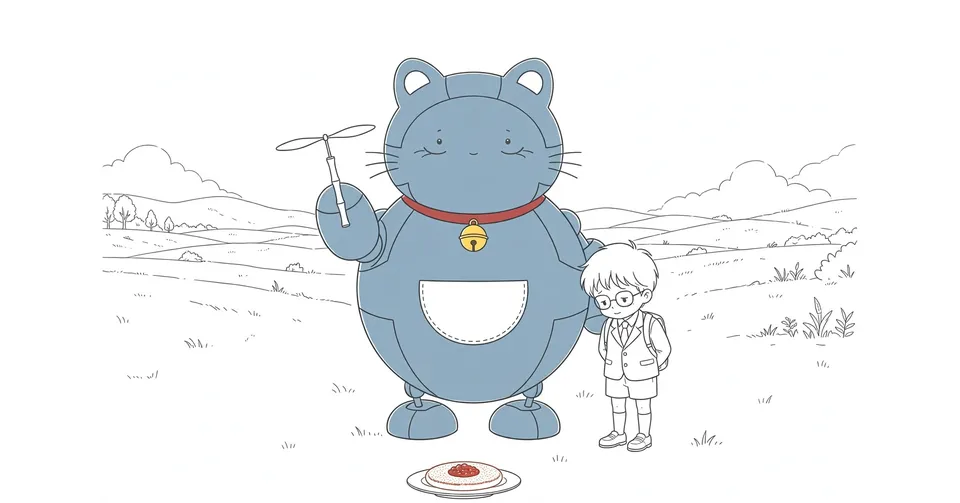
The premise is simple enough for a five year old to explain. Nobita Nobi is a schoolboy who is bad at almost everything: school, sports, and staying out of trouble. His great-great-grandson Sewashi, living in the 22nd century, sends a robot cat back in time to help him, because the family believes Nobita's failures are the reason their descendants are poor. That robot cat is Doraemon, and he arrives with a pocket full of tools from the future.
Doraemon Began in Six Magazines at Once
Doraemon first appeared in December 1969, published at the same time in six different children's magazines from Shogakukan. The creator was Fujiko F. Fujio, the pen name of Hiroshi Fujimoto, who had created the character together with his childhood friend Motoo Abiko under their shared pen name Fujiko Fujio. The two men split their partnership in 1987, and Fujimoto continued the series alone until his death in 1996.
The manga ran from 1969 to 1996 and produced 1,344 stories, collected into 45 tankobon volumes published between 1974 and 1996. As of 2024, the manga has sold more than 300 million copies worldwide, which puts Doraemon among the best selling manga series of all time. That is roughly the population of Indonesia, each holding one copy.
The early years were not an instant triumph. The series built its audience slowly through children's magazines, and the launch of CoroCoro Comic in 1977, a magazine created partly to showcase the character, gave it a permanent home. By the end of the 1970s, it was no longer just a comic. It was becoming a fixture of Japanese childhood.
The Ears, the Bell, and the 129.3 Joke
Doraemon's design is a list of jokes that every fan in Japan can recite. He was manufactured on 3 September 2112 at the Matsushiba Robot Factory, and he is 129.3 centimetres tall and weighs 129.3 kilograms. His head, chest, and waist all measure 129.3 centimetres. He can run at 129.3 kilometres per hour when he is scared, and jump 129.3 centimetres when he is threatened. The number comes from the average height of a Japanese elementary school student when the character was created, and the creators simply refused to let it go.
He was not always blue, and he was not always earless. He was originally yellow and had ears, until a robot mouse chewed them off while he was looking after a baby. The accident left him bald and blue after he drank the wrong potion in his misery, and it left him with a lasting fear of mice. That is why the most advanced robot in the story screams at the sight of a mouse, and why strangers keep mistaking him for a raccoon dog, which makes him furious every single time.
His name comes from "dora-neko", a Japanese word for a stray cat, plus "-emon", an old fashioned ending for a male name. His favourite food is dorayaki, the red bean pancake, and he can be bribed, comforted, or distracted with one. The red collar with its yellow bell, the white face, and the round belly pocket complete a design so simple that a child can draw it from memory. That simplicity is part of the point. He looks like a toy, and that is exactly how he entered millions of homes.
The Pocket That Holds a Thousand Wishes
Every story runs on the same engine. Nobita has a problem, usually one he caused himself, and he reaches into his fourth dimensional pocket and pulls out a gadget from the future. The Take-copter, a small bamboo propeller that sits on the head and lets the wearer fly. The Anywhere Door, a pink door that opens onto any place the user is thinking of. The Time Machine, kept in Nobita's desk drawer. Hundreds of gadgets have appeared across the manga and the anime, and each one is a small thought experiment about what a child would do with a superpower.
The genius of the formula is that the gadget almost never solves the problem cleanly. Nobita uses the tool to cheat on a test, spy on a crush, or get revenge on Gian, the neighbourhood bully, and the plan collapses in a way that teaches him something without ever lecturing the reader. The gadget is the hook, but the story is always about Nobita's choices. Children get the adventure, and adults get the quiet moral underneath it. Nobody has to be told which is which.
That balance is why parents in Japan trust the blue cat in a way they do not trust most cartoons. The stories are gentle, the violence is cartoonish, and the worst thing Nobita usually does is lie about his homework. The show has aired in a family time slot for decades, and it is one of the few programmes grandparents, parents, and children can honestly say they all watched as children.
Three Anime Series and a Film Every Year
The character reached television three times. The first anime, in 1973, lasted only six months and was not popular. The second, produced by Shin-Ei Animation for TV Asahi, began on 2 April 1979 and ran for 1,787 episodes until 25 March 2005. It was this version, with Nobuyo Oyama voicing him, that made the character a national institution. A new series began on 15 April 2005, with Wasabi Mizuta taking over the voice, and it is still running today.
The films are a tradition of their own. A feature film has been released almost every year since 1980, usually in the spring school holidays, and the films take the characters on bigger adventures than the television episodes allow: to dinosaur worlds, to the bottom of the sea, to the moon, and into the past. The 2014 film Stand by Me Doraemon, the first in 3D computer animation, became one of the highest grossing Japanese films of its year and introduced the character to a new generation of parents who had grown up with the 1979 series.
Outside Japan, he travelled further than almost any Japanese character except Pikachu. The anime was licensed for an English language release by Disney in North America in 2014, and the manga and the show have been broadcast across Asia for decades, from India to Indonesia to Vietnam. In many countries, children know Doraemon before they know anything else about Japan. He is, for millions of people, the first Japanese friend they ever had.
Doraemon as Japan's Cartoon Ambassador
In March 2008, Japan's Foreign Ministry appointed him as the nation's first anime ambassador, a formal recognition that a cartoon cat had become a tool of diplomacy. The appointment was not a joke, even if it sounded like one. He was chosen because he was already known in countries where Japanese diplomats wanted to be liked, and because a character who helps a child with his homework is a friendlier face for a country than any official slogan.
The honours around the character tell the same story. The series won the first Shogakukan Manga Award for children's manga in 1982 and the first Osamu Tezuka Culture Award in 1997. The Fujiko F. Fujio Museum opened in Kawasaki on 3 September 2011, in the city where the manga was created, and visitors still book timed entry tickets in advance because it sells out. In 2012, fans marked one hundred years to go until Doraemon's fictional birthday in 2112 with exhibitions in Hong Kong and Japan, celebrating a birthday that has not happened yet for a cat that was never born.
That is the strange position Doraemon occupies. He is a fictional character with an official birth certificate, a hometown, and a museum. He has a birthday that people celebrate, and a death, that of his creator in 1996, that people still mourn. Few characters anywhere in the world are treated with that kind of seriousness, and fewer still earn it.
Why the Blue Cat Still Matters
There is an easy, cynical way to look at Doraemon: a merchandising machine that has been running for five decades, kept alive by nostalgia and toy sales. There is truth in that, as there is with any character this successful. But it misses why the machine keeps running. Doraemon endures because the stories are built on something that does not age. A child who is not good enough, a friend who shows up anyway, and a tool that promises an easy way out but never quite delivers one.
I find the most moving part of Doraemon is not the gadgets at all. It is that Nobita never really improves, and Doraemon never leaves. Week after week, year after year, the robot cat watches the same boy make the same mistakes, and he stays. That is a better picture of friendship than most stories for adults manage, and it is probably why adults keep coming back to a show they first watched when they were eight years old.
Japanese pop culture has produced bigger spectacles than Doraemon, and louder ones. The manga world that produced Doraemon also produced epics of pirates, ninjas, and giant robots, and the anime boom that followed owes a debt to the same generation of creators. Studio Ghibli gave the world films of extraordinary beauty, and the manga industry grew into one of Japan's largest cultural exports. But none of those works did what Doraemon did, which was to move into the daily life of a country and stay there, quietly, for more than half a century.
The anime that grew up around him changed the world, and the gadgets he carries still show up in real inventions, from video calls to translation earbuds. Engineers in Japan have spent decades trying to build the tools Doraemon carries in his pocket, and the fact that they keep trying says something about the power of a children's comic to set the agenda for the future. Fujiko F. Fujio did not just draw a funny cat. He drew a list of wishes, and the world has been working through that list ever since. You can read more about the creators in this profile of Fujiko Fujio.
Doraemon will turn 57 years old as a character in 2026, if a fictional cat can be said to have an age, and his fictional birthday is still 86 years away. Children who have never seen a black and white television will meet him the same way their grandparents did: a blue cat, a lazy boy, a pocket full of impossible tools, and a problem that only honesty can fix. That is a formula no gadget can improve, and Japan knows it. That is why the blue robot cat is still here, and why he is not going anywhere.
More in Music & Entertainment
- Kecak Dance and the Hundred Voices That Tell the Ramayana
- Taiko Drums and the Thunder That Shook Japanese Festivals
- Hello Kitty and the Cat Who Conquered the World
- Japanese Kabuki and the Theatre That Paints Its Actors
- Chihayafuru Made a Card Game Feel Like a Sport
- Japanese Anime and How a Niche Hobby Conquered the World
Latest posts
- Shirakawa-go, the Village of Praying Hands
- Hanafuda Turns Twelve Months of Flowers Into a Card Game
- Nintendo, the Playing Card Maker That Became a Gaming Giant
- Tana Toraja and the Funerals That Last for Days
- Tempeh and the Fermented Bean Cake Indonesia Gave the World
- Gado-Gado, the Peanut Sauce Salad That Feeds All of Indonesia
- The Washlet Made the Japanese Bathroom the Warmest Room in the House
- Bakso and the Meatball Soup Indonesia Eats Everywhere
- Sapporo Snow Festival and the Ice City That Rises Every February
- Rangda Is the Witch Queen Bali Never Lets Win
- The Japanese School Uniform and the Story Behind the Sailor Suit
- Aikido and the Martial Art That Refuses to Fight Back
- Satay and the Smoke That Carries Indonesia to the World
- Barong Is the Lion Bali Calls Out When the Village Needs Protection
- Tumpeng Is the Rice Cone Java Serves When It Wants to Say Thanks