Gado-Gado, the Peanut Sauce Salad That Feeds All of Indonesia
· 10 min read
Gado-gado is Indonesia's peanut sauce salad of blanched vegetables, egg, tofu, tempeh and lontong, and one of the country's five national dishes.
Gado-gado is Indonesia's peanut sauce salad, and it is also one of the most democratic dishes in the country. Blanched vegetables, a hard-boiled egg, fried tofu and tempeh, and slices of lontong rice cake arrive under a warm, thick peanut sauce, with krupuk crackers on the side. In 2018 it was named one of Indonesia's five national dishes, alongside soto, sate, nasi goreng and rendang, which tells you how seriously the country takes a plate of vegetables in sauce. The full background of the dish, from its Betawi roots to its regional versions, is well documented on Wikipedia.
The name gives away the method. In Betawi, the language of Jakarta, gado means to eat something without rice, and gado-gado means mix-mix. Everything on the plate is mixed together in the sauce before it reaches you, and no two vendors mix it quite the same way. That looseness is the point. Gado-gado is less a fixed recipe than a format, and the format has fed Jakarta for generations.
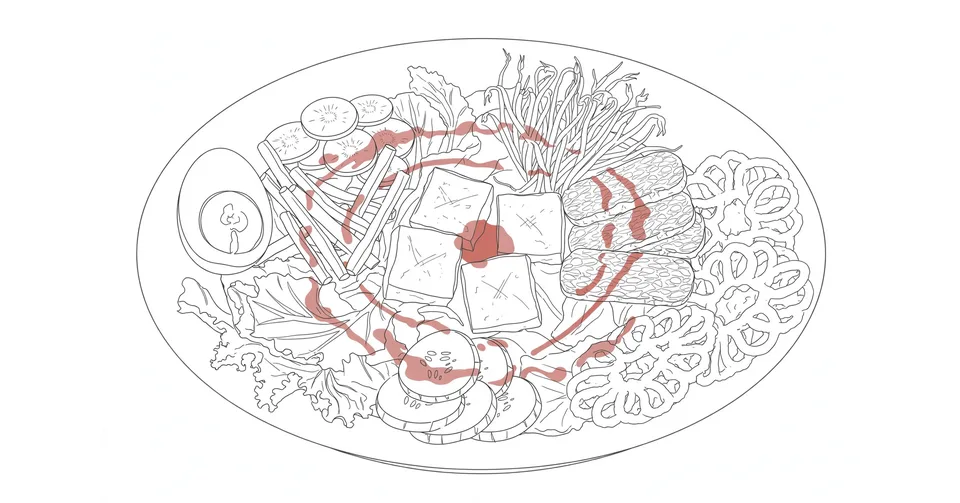
The first time I watched a vendor make gado-gado, I understood why Indonesians defend it so fiercely. She worked from a low cart with a stack of small bowls, a pestle and a stone mortar, and she built each plate to order. Vegetables went in, sauce went over, and the whole thing was tossed once, quickly, so the sauce coated everything without turning it to mush. It took about three minutes, and it cost less than a cup of coffee in most Jakarta cafes. Dishes that are this cheap and this good rarely stay local, and gado-gado has not.
What goes on the plate
A standard plate of gado-gado starts with vegetables. Cabbage, long beans, bean sprouts, spinach, chayote and potato are the usual cast, blanched just long enough to soften them while keeping some bite. A hard-boiled egg adds richness, fried tofu and tempeh add protein, and lontong, compressed rice cake wrapped in banana leaf, adds weight. The plate is finished with krupuk, deep-fried crackers, and a sprinkle of fried shallots.
Nothing on that list is expensive, and nothing is hard to find in a Jakarta market. That is why gado-gado spread so far. A vendor needs a pot of hot water, a mortar, and a basket of vegetables, and the dish scales from a street cart to a hotel restaurant without changing its character. At a five-star resort in Bali, the same dish appears on menus at Rp150,000 to Rp350,000. At a Jakarta warung, it remains one of the cheapest full meals in the city, and the warung version is usually the better one.
The vegetables change with the season and the region. In West Java the plate leans on raw vegetables and a sharper sauce, while the Betawi version from Jakarta uses lontong and a thinner, wetter sauce. Some vendors add corn or bitter gourd. Others leave out the egg. The sauce stays constant, and the sauce is what makes gado-gado what it is.
Bumbu kacang, the sauce that decides everything
Bumbu kacang, the peanut sauce, is the heart of gado-gado. The classic version starts with fried peanuts ground with garlic, chillies, palm sugar, salt and tamarind, then thinned with warm water until it pours but still coats. Some versions add a piece of fried terasi, shrimp paste, or kencur, aromatic ginger, for depth. Lime juice goes in at the end, to lift the whole thing.
The flavour balances four directions at once. Palm sugar brings sweetness, tamarind and lime bring sourness, salt and terasi bring savouriness, and chilli brings heat. A good vendor adjusts the balance to order, more chilli if you ask for pedas, more palm sugar if you like it sweet. The sauce is made fresh through the day, and a vendor who runs out of sauce closes early, because without it there is no dish. A traditional gado-gado recipe shows the same balance in measured form, with the sauce ground in a cobek mortar before the tamarind is added to reach the right consistency.
The same sauce shows up across Indonesian cooking. It coats satay, it dresses ketoprak, and it turns up in asinan and pecel. Learning to taste bumbu kacang is learning to taste Indonesia, because the sauce carries the same sweet, sour, salty and spicy balance that runs through the whole cuisine. If you have tried nasi goreng, you have already met kecap manis, the sweet soy sauce that often joins the peanut sauce in the mortar.
A dish with several birth stories
Nobody can say exactly when gado-gado was invented, and the dish has several birth stories instead of one. The most widely repeated links it to the Betawi people of Jakarta, where it grew from a home dish into a street staple. Another theory traces it to Sundanese cooking in West Java, where peanut sauce vegetable dishes are older and more common. A third story points to Tugu village, settled by Portuguese descendants in the early 1700s, and a fourth credits Chinese traders in Batavia who adapted the Javanese pecel to their own taste.
The honest answer is that all of these stories can be partly true. Jakarta has always been a port city where Javanese, Chinese, Arab and European food traditions mixed, and gado-gado looks exactly like the dish such a city would produce. It takes the Javanese habit of eating vegetables with peanut sauce, adds Chinese tofu and tempeh, and serves it with the practicality of a port town that needed food fast and cheap. The dish does not need a single inventor, because the city itself invented it.
That mixed origin is also why gado-gado travelled so well. It is vegetarian by default, filling without meat, and adjustable to almost any budget. A plate can be a light snack or a full meal depending on how much lontong and egg goes in. In a country where most people eat rice at every meal, a dish whose name means eating without rice is a quiet rebellion, and a popular one.
The cousins of gado-gado
Gado-gado belongs to a family of peanut sauce vegetable dishes across Java, and the cousins are worth knowing because menus often list them side by side. They share the same sauce and the same spirit, but each one has its own rules.
| Dish | Region | What makes it different |
|---|---|---|
| Pecel | East and Central Java | Vegetables with a pre-made peanut sauce, often spicier and served with rempeyek crackers |
| Lotek | West Java, Sundanese | Sauce ground to order with kencur, usually with lontong and a stronger herbal note |
| Karedok | West Java | Raw vegetables, never blanched, pounded fresh with the sauce |
| Ketoprak | Jakarta | Lontong, tofu, bean sprouts and rice vermicelli with peanut sauce and kecap manis |
| Gado-gado Surabaya | East Java | Also called siram, meaning pour, because the sauce is poured over at the moment of ordering |
The family resemblance is the point, and the differences are small enough that a first-time eater can be forgiven for mixing them up. If the vegetables are raw and crunchy, you are probably eating karedok. If there are rice noodles in the bowl, it is likely ketoprak. If the sauce arrives already made and the plate comes with rempeyek, it is probably pecel. And if everything is blanched, mixed and served with lontong and krupuk, you have found gado-gado.
The world has started to notice the whole family. In TasteAtlas's 2026 ranking of the world's top 100 salads, East Java pecel placed 7th, ketoprak placed 18th, and gado-gado placed 30th. Three Indonesian peanut sauce dishes in one global salad list is not an accident. It is a sign that the rest of the world is catching up to what Jakarta has known for a century.
Where to eat gado-gado
The best gado-gado is usually the closest one. In Jakarta, vendors sell it from carts, from warung stalls, and from small restaurants that have served the same neighbourhood for decades. Gado-gado Boplo, from the Boplo area of Jakarta, is famous for using cashew nuts instead of peanuts in its sauce, and it has queues to prove it. In Surabaya, the siram version has its own loyal following. In Bali, warung versions lean on local vegetables and a slightly sweeter sauce.
Ordering is simple. Ask for pedas if you want it spicy, and say so clearly, because the default chilli level in Jakarta is higher than most visitors expect. Ask for extra lontong if you are hungry, or skip it if you want a lighter plate. Eat it soon after it arrives, while the vegetables are still warm and the krupuk is still crisp, because the sauce softens everything it touches and the crackers go soggy within minutes.
For travellers, gado-gado is also one of the safest introductions to Indonesian food. Everything is cooked except the garnish, the ingredients are visible on the plate, and the spice level is yours to control. It is the dish I would hand to a friend who has never eaten Indonesian food and wants to understand it in one bite. If that friend then wants the heavier classics, rendang is waiting, and it has held the top spot on CNN's World's 50 Best Foods list for years. Gado-gado never needed that kind of ranking to matter, but it is good to see the world catching up.
Why gado-gado still matters
Indonesian food is often introduced to the world through its loudest dishes, the slow-cooked rendang, the smoky satay, the fried rice that CNN ranked second in the world. Gado-gado is quieter than all of them, and that is exactly why it matters. It is the dish Indonesians actually eat on an ordinary Tuesday, made from ordinary vegetables, sold for ordinary money, and it has carried that role for a hundred years without needing a festival or a ranking to justify itself.
What I like most about gado-gado is that it refuses to be precious. It does not need rare ingredients or a famous chef. It needs a good sauce, fresh vegetables, and a vendor who cares about the balance. That is a small thing to ask, and it is why the dish survives every food trend that passes through Jakarta. Trends come and go, but a plate of vegetables in peanut sauce, eaten standing at a cart while the city moves past, is not a trend. It is lunch, and it is very good lunch. The next time you are in Jakarta, skip the hotel menu, find the nearest cart, and let the vendor decide the spice. You will understand the whole country a little better by the last bite.
More in Food & Travel
- Bakso and the Meatball Soup Indonesia Eats Everywhere
- Sapporo Snow Festival and the Ice City That Rises Every February
- Satay and the Smoke That Carries Indonesia to the World
- Tumpeng Is the Rice Cone Java Serves When It Wants to Say Thanks
- Japan's Winter Illuminations Turn Dark Nights Into Light
- Lake Toba and the Supervolcano That Made the World's Largest Volcanic Lake
Latest posts
- The Washlet Made the Japanese Bathroom the Warmest Room in the House
- Kecak Dance and the Hundred Voices That Tell the Ramayana
- Rangda Is the Witch Queen Bali Never Lets Win
- The Japanese School Uniform and the Story Behind the Sailor Suit
- Aikido and the Martial Art That Refuses to Fight Back
- Barong Is the Lion Bali Calls Out When the Village Needs Protection
- Onsen Etiquette and the Unwritten Rules of Japan's Hot Springs
- Setsubun, the Bean Throwing Festival That Chases Winter Away
- Karate, the Empty Hand That Became Japan's Most Exported Martial Art
- Kemari Is the Ball Game Japan Played Without Trying to Win
- Chagama Is the Kettle That Never Leaves the Tea Room
- Judo, the Gentle Way Japan Gave the World
- Raja Ampat and the Coral Kingdom at the Edge of Indonesia
- Tokyo Skytree and How Japan Built the World's Tallest Tower
- Matsumoto Temari Turns Mountain Cocoons Into Wishes You Can Hold